Page 1
WELCOME
Page 2
FARMER TO FARMER EXTENSION (F2F)
Speaker
Sipai Salman A.
(Rg. No: 04-2661-2015)
Page 3
Farmer Led Extension/Farmer to Farmer Extension
• F2F extension is defined here as “the provision of training by farmers to
farmers, often through the creation of a structure of farmer promoters
and farmer trainers” (Scarborough et al., 1997).
• We use ‘farmer-trainer’ as a generic term, even though we recognize
that different names (e.g. lead farmer, farmer-promoter, community
knowledge worker) may imply different roles.
• F2F extension programs date back at least to the 1950s .Currently such
programs are widespread.
Page 4
Criteria used for selection of lead farmers
 Farming expertise/hard working/can be a role model
 Literacy : able to read and write
 Residence in the community
 Able to communicate
 Good behavior, trustworthy, acceptable to community
 Reachable/available
 Trainable/teachable
 Good track record (has not defaulted on loans in past, no criminal record)
 Innovative
Page 5
Philosophy and principles
 Farmers and local institutions (e.g. producer organisations or village leaders)
should play a key role in selecting farmer-trainers and monitoring and
evaluating them. This helps make the programmes more accountable to the
community or groups that they serve.
 Farmer-trainers are ‘of the community’; they communicate in local languages
and are more sensitive to local cultures, mannerisms, farming practices, and
farmers’ needs.
 Farmer-trainers should be selected on the basis of their skills and interest in
sharing information, not just on their farming expertise.
Page 6
 Farmer-trainers need strong linkages with and support from development
agents (whether government, non-government organisation (NGO), or
private), the people who train and backstop them. Farmer-trainers generally
serve as a complement to existing extension systems, rather than being a
substitute for them.
 Facilitating organisations and local institutions need to be proactive in
ensuring that women as well as men become farmer-trainers.
 Simple and appropriate reference materials should be made available to the
farmer-trainers.
Page 7
Farmer Field School
What are Farmer Field Schools?
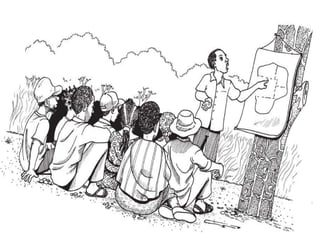
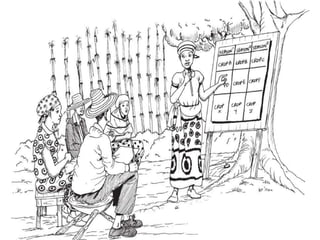
• Farmer Field Schools (FFS) consist of groups of farmers who get together to study a
particular topic.
• The topics covered vary from conservation agriculture, organic agriculture, animal
husbandry, and soil husbandry, to income generating activities such as handicrafts.
• FFS provide opportunities for learning by doing. It teaches basic agricultural and
management skills that make farmers experts in their own farms.
• FFS is a forum where farmers and trainers debate observations, experiences and
present new information from outside the community.
Page 8
Thus,
• FFS creates awareness, supports learning, transfer
technology and assist rural communities in problem
solving.
Page 9
Historical Background of FFS
• First wave of FFS in 1989 in the rice fields of Indonesia
• 200 FFS’s in four districts of Yogyakarta
• Indonesian National IPM programme
• Funded by Govt. of Indonesia, USAID
• Technical support by FAO-UN
• 1800 FFS’s for rice by 1990 as part of upscaling of GoIN IPM
in 6 provinces
• By 1991, pilot FFS’s for rotation crops and spreading to other
countries in Asia
Page 10
• From 1991 to 1994, with support from the FAO
Inter-country IPM Programme, rice IPM-FFSs
reached to Bangladesh, Cambodia, China, India,
Philippines, Sri Lanka and Vietnam.
Page 11
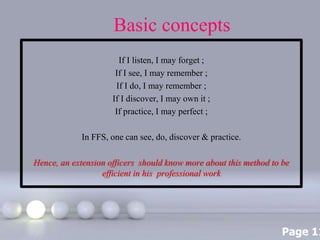
Basic concepts
If I listen, I may forget ;
If I see, I may remember ;
If I do, I may remember ;
If I discover, I may own it ;
If practice, I may perfect ;
In FFS, one can see, do, discover & practice.
Hence, an extension officers should know more about this method to be
efficient in his professional work
Page 12
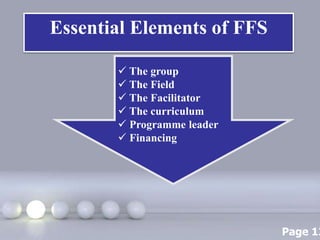
Essential Elements of FFS
 The group
 The Field
 The Facilitator
 The curriculum
 Programme leader
 Financing
Page 13
Page 14
Page 15
• The goal of FFS is mobilization, sensitization and
empowerment of rural farming communities
• In small groups (20 – 30 people) they identify their production
gaps, test for themselves best on – farm options and practices
which are adaptable and sustainable to their farming situation
Goal/Objective of FFS
Page 16
 All learning is field based & it is primary venue for learning
 FFS is group learning constantly over the experimentation period
 FFS learning promotes healthy decisions & quality decisions
 Farmers conduct their own field studies with comparisons or treatments
 Learning continue until a full crop season
Special features of FFS
Page 17
 Facilitates Farmer-to-Farmer communication
 Field staff serve as facilitators
 Farmer Field Schools is a unique way to educate farmers
 It is an effective platform for sharing of experiences and collectively solving
agriculture related problems.
 Since 1989 more than two million farmers across Asia have participated in this
type of learning.
Page 18
• “Farm schools are established in the fields of such innovative
farmers or farmer achievers who are actually enhancing
productivity and profitability in their farms through
scientific and sustainable agriculture”.
FARM SCHOOL
Page 19
FARM SCHOOL IS A…
• Farm School is powerful instrument for participatory research and
knowledge management.
• It is an alternative extension tool and facilitate farmer-to-farmer
learning.
• It also reduces the widening gap between scientific know-how and
farmers practices.
• This would facilitate development of farming situation / system specific
packages.
• The host achiever farmer is designated as Farmer Scientist / Farmer
Professor in the respective crops / enterprises considering his area of
expertise
Page 20

Farmer to farmer extension

  • 1.
  • 2.
    Page 2 FARMER TOFARMER EXTENSION (F2F) Speaker Sipai Salman A. (Rg. No: 04-2661-2015)
  • 3.
    Page 3 Farmer LedExtension/Farmer to Farmer Extension • F2F extension is defined here as “the provision of training by farmers to farmers, often through the creation of a structure of farmer promoters and farmer trainers” (Scarborough et al., 1997). • We use ‘farmer-trainer’ as a generic term, even though we recognize that different names (e.g. lead farmer, farmer-promoter, community knowledge worker) may imply different roles. • F2F extension programs date back at least to the 1950s .Currently such programs are widespread.
  • 4.
    Page 4 Criteria usedfor selection of lead farmers  Farming expertise/hard working/can be a role model  Literacy : able to read and write  Residence in the community  Able to communicate  Good behavior, trustworthy, acceptable to community  Reachable/available  Trainable/teachable  Good track record (has not defaulted on loans in past, no criminal record)  Innovative
  • 5.
    Page 5 Philosophy andprinciples  Farmers and local institutions (e.g. producer organisations or village leaders) should play a key role in selecting farmer-trainers and monitoring and evaluating them. This helps make the programmes more accountable to the community or groups that they serve.  Farmer-trainers are ‘of the community’; they communicate in local languages and are more sensitive to local cultures, mannerisms, farming practices, and farmers’ needs.  Farmer-trainers should be selected on the basis of their skills and interest in sharing information, not just on their farming expertise.
  • 6.
    Page 6  Farmer-trainersneed strong linkages with and support from development agents (whether government, non-government organisation (NGO), or private), the people who train and backstop them. Farmer-trainers generally serve as a complement to existing extension systems, rather than being a substitute for them.  Facilitating organisations and local institutions need to be proactive in ensuring that women as well as men become farmer-trainers.  Simple and appropriate reference materials should be made available to the farmer-trainers.
  • 7.
    Page 7 Farmer FieldSchool What are Farmer Field Schools? • Farmer Field Schools (FFS) consist of groups of farmers who get together to study a particular topic. • The topics covered vary from conservation agriculture, organic agriculture, animal husbandry, and soil husbandry, to income generating activities such as handicrafts. • FFS provide opportunities for learning by doing. It teaches basic agricultural and management skills that make farmers experts in their own farms. • FFS is a forum where farmers and trainers debate observations, experiences and present new information from outside the community.
  • 8.
    Page 8 Thus, • FFScreates awareness, supports learning, transfer technology and assist rural communities in problem solving.
  • 9.
    Page 9 Historical Backgroundof FFS • First wave of FFS in 1989 in the rice fields of Indonesia • 200 FFS’s in four districts of Yogyakarta • Indonesian National IPM programme • Funded by Govt. of Indonesia, USAID • Technical support by FAO-UN • 1800 FFS’s for rice by 1990 as part of upscaling of GoIN IPM in 6 provinces • By 1991, pilot FFS’s for rotation crops and spreading to other countries in Asia
  • 10.
    Page 10 • From1991 to 1994, with support from the FAO Inter-country IPM Programme, rice IPM-FFSs reached to Bangladesh, Cambodia, China, India, Philippines, Sri Lanka and Vietnam.
  • 11.
    Page 11 Basic concepts IfI listen, I may forget ; If I see, I may remember ; If I do, I may remember ; If I discover, I may own it ; If practice, I may perfect ; In FFS, one can see, do, discover & practice. Hence, an extension officers should know more about this method to be efficient in his professional work
  • 12.
    Page 12 Essential Elementsof FFS  The group  The Field  The Facilitator  The curriculum  Programme leader  Financing
  • 13.
  • 14.
  • 15.
    Page 15 • Thegoal of FFS is mobilization, sensitization and empowerment of rural farming communities • In small groups (20 – 30 people) they identify their production gaps, test for themselves best on – farm options and practices which are adaptable and sustainable to their farming situation Goal/Objective of FFS
  • 16.
    Page 16  Alllearning is field based & it is primary venue for learning  FFS is group learning constantly over the experimentation period  FFS learning promotes healthy decisions & quality decisions  Farmers conduct their own field studies with comparisons or treatments  Learning continue until a full crop season Special features of FFS
  • 17.
    Page 17  FacilitatesFarmer-to-Farmer communication  Field staff serve as facilitators  Farmer Field Schools is a unique way to educate farmers  It is an effective platform for sharing of experiences and collectively solving agriculture related problems.  Since 1989 more than two million farmers across Asia have participated in this type of learning.
  • 18.
    Page 18 • “Farmschools are established in the fields of such innovative farmers or farmer achievers who are actually enhancing productivity and profitability in their farms through scientific and sustainable agriculture”. FARM SCHOOL
  • 19.
    Page 19 FARM SCHOOLIS A… • Farm School is powerful instrument for participatory research and knowledge management. • It is an alternative extension tool and facilitate farmer-to-farmer learning. • It also reduces the widening gap between scientific know-how and farmers practices. • This would facilitate development of farming situation / system specific packages. • The host achiever farmer is designated as Farmer Scientist / Farmer Professor in the respective crops / enterprises considering his area of expertise
  • 20.