Commonwealth Educational
Media Centre for Asia


Radio for Learning
Sanjaya Mishra
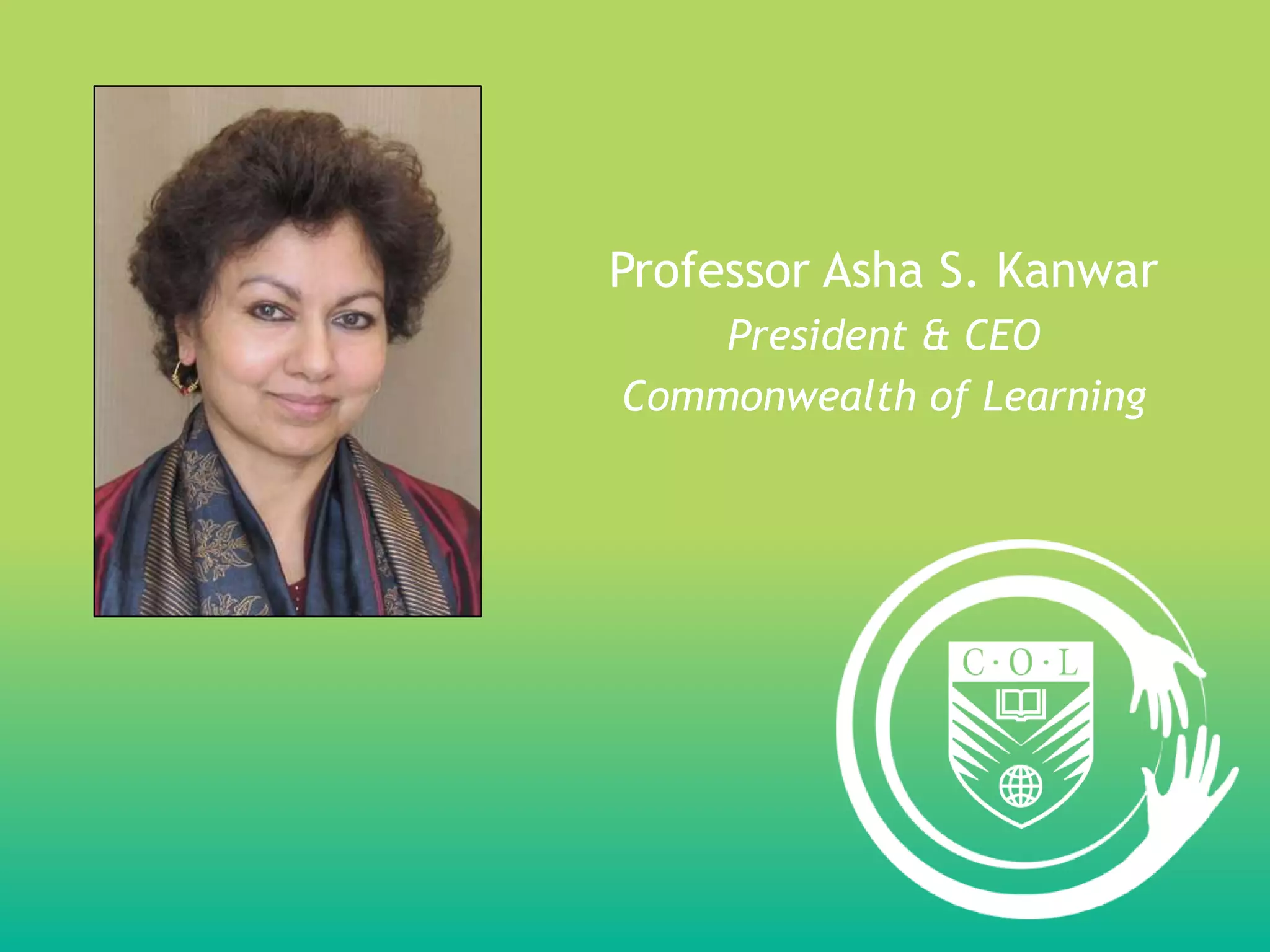
Professor Asha S. Kanwar
    President & CEO
Commonwealth of Learning
Structure

    COL and Radio
    Indian Situation
    Lessons Learnt
    CEMCA and Community Radio
COL AND RADIO
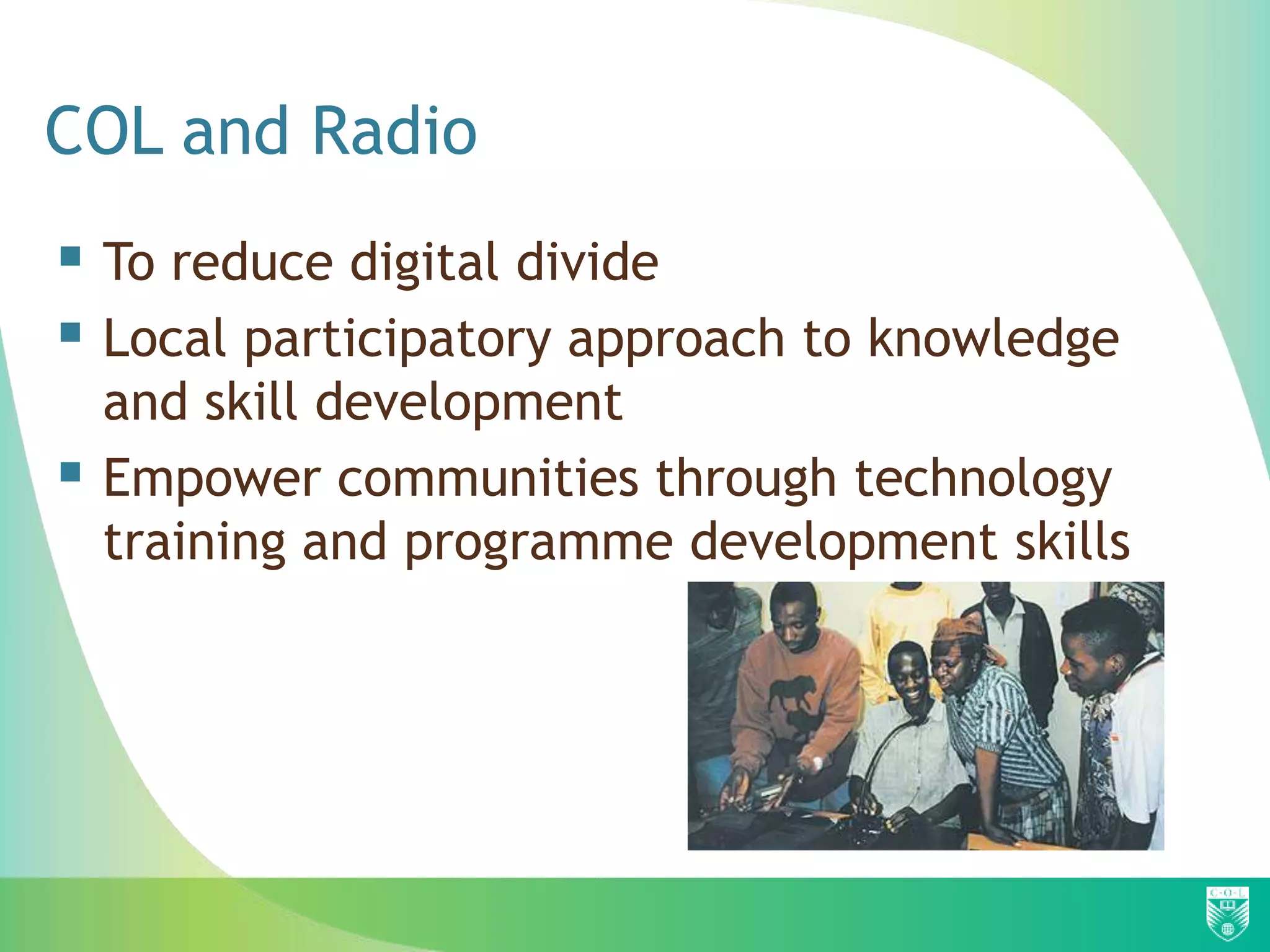
COL and Radio
 To reduce digital divide
 Local participatory approach to knowledge
    and skill development
   Empower communities through technology
    training and programme development skills
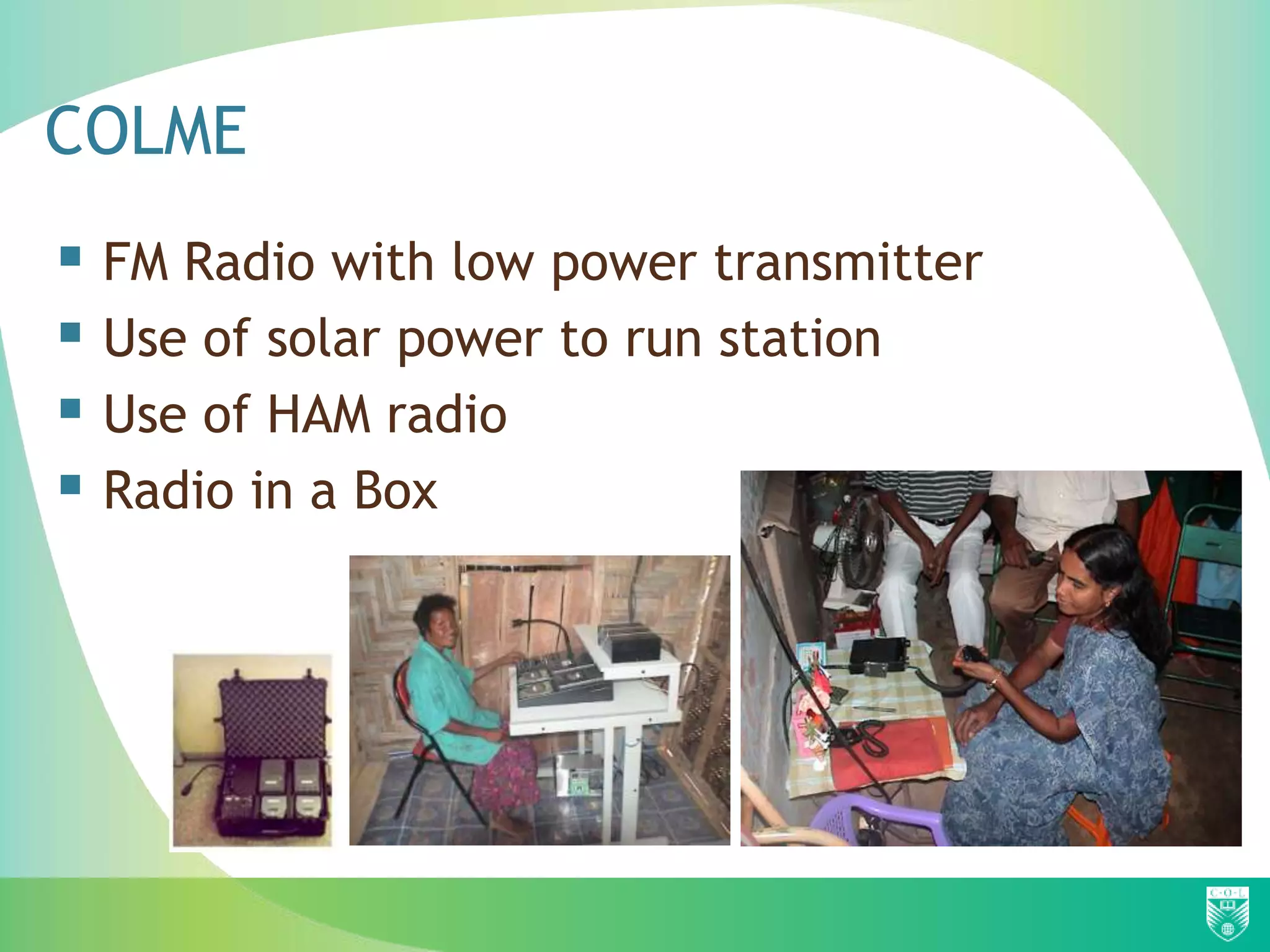
COLME
 FM Radio with low power transmitter
 Use of solar power to run station
 Use of HAM radio
 Radio in a Box
Radio: for whom, for what and how?
 UGANDA
  – Used solar powered FM station reaching 1 million
    Luo speakers; Daily programmes concerning
    health, gender, agriculture; Health-based
    information that has led to the HIV/AIDS
    prevention in the community.
 PAPUA NEW GUINEA
  – FM radio used by Govt. to reach primary and
    secondary students in remote locality
Radio: for whom, for what and how?
 SOUTH AFRICA
  – Secondary school FM radio station that reaches
    the town of Manguzi in Kwazulu Natal (estimated
    population of 200,000)
 SRI LANKA
  – Portable FM radio station utilised in primary and
    secondary schools in Southern Sri Lanka.
  – Two hundred students trained in the value of
    radio and community development by SLBC.
INDIAN SITUATION
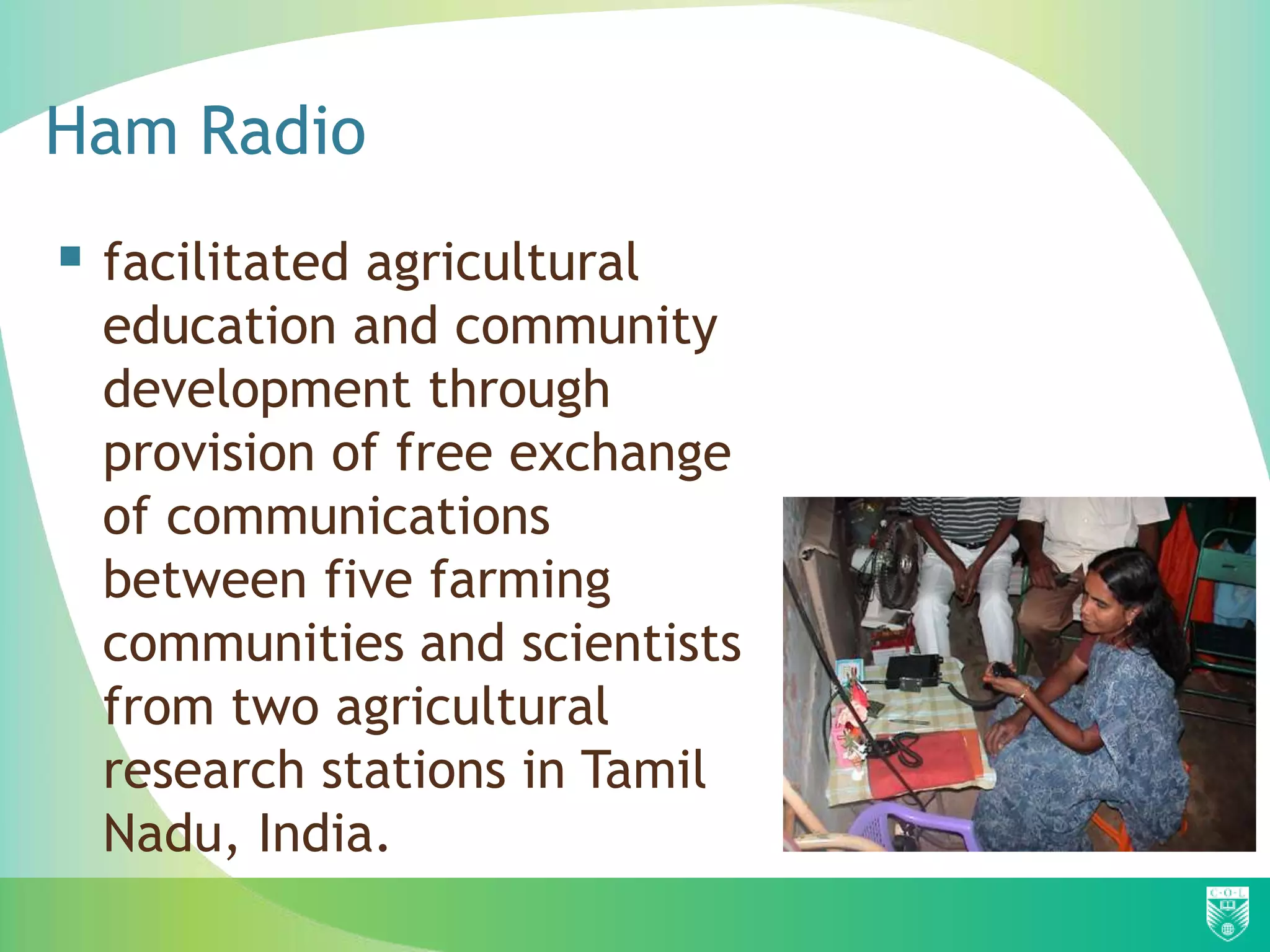
Ham Radio
 facilitated agricultural
  education and community
  development through
  provision of free exchange
  of communications
  between five farming
  communities and scientists
  from two agricultural
  research stations in Tamil
  Nadu, India.
Community Radio Movement
 1995 Supreme Court: airwaves constitute
    public property and must be utilized for
    advancing public good
   2003 MIB Guidelines
   2006 MIB Guidelines (Revised)
   141 CR station (as of 15/11/2012); 187 GOPA
    signed
   IGNOU Gyan Vani FM stations
LESSONS LEARNT
What Research Shows
 Majority of studies report that achievement
    of the target group increased as a result of
    radio programme
   Learners are interested in radio programmes,
    if the timing is suitable
   Radio programmes in story and drama
    formats are received well, though talks and
    quiz-based programmes are also useful
   Students also appreciate interactivity in radio
    through phone-in                 Source: Mishra, 2005
Lessons Learnt: Pedagogy
 Radio to be an integral part of the curriculum
 Broadcast time suitable for the target group
 Use innovative formats; but also use story
    and drama
   Use radio for more factual information
   Use radio vision, for subjects that require
    illustrations
Lessons Learnt: Technology
 Radio station systems require easy plug in and out leads
    so that soldering of wires is avoided
   Dual microphone systems for discussion groups are
    important for community radio systems
   Solar systems are effective only if the proper
    maintenance scheme is completed
   Issues to do with lightening strikes are a constant threat
    to station transmitters and proper training and
    maintenance must be in effect.
   A maintenance scheme should be drawn up and ensured
    that the technician carries it out and reports to the
    radio station manager
Lessons Learnt: Policy and Practice
 Enabling policy environment important
 Understanding sustainability issues as well as
    not-for-profit
   Community engagement both in management
    and programming
   Ethical practice and Self-regulatory
    mechanism
   Quality improvement needed
CEMCA AND COMMUNITY
       RADIO
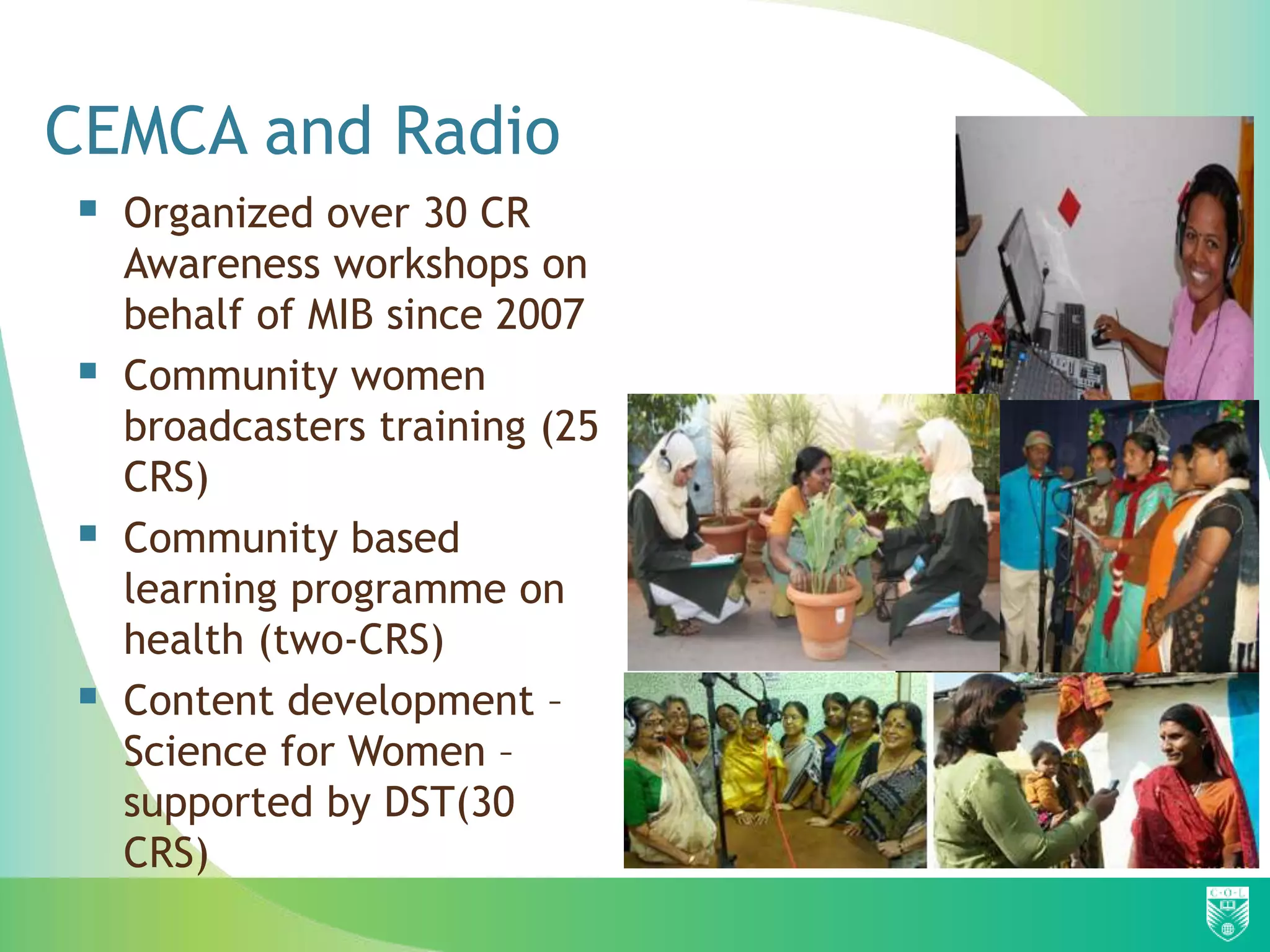
CEMCA and Radio
 Organized over 30 CR
    Awareness workshops on
    behalf of MIB since 2007
   Community women
    broadcasters training (25
    CRS)
   Community based
    learning programme on
    health (two-CRS)
   Content development –
    Science for Women –
    supported by DST(30
    CRS)
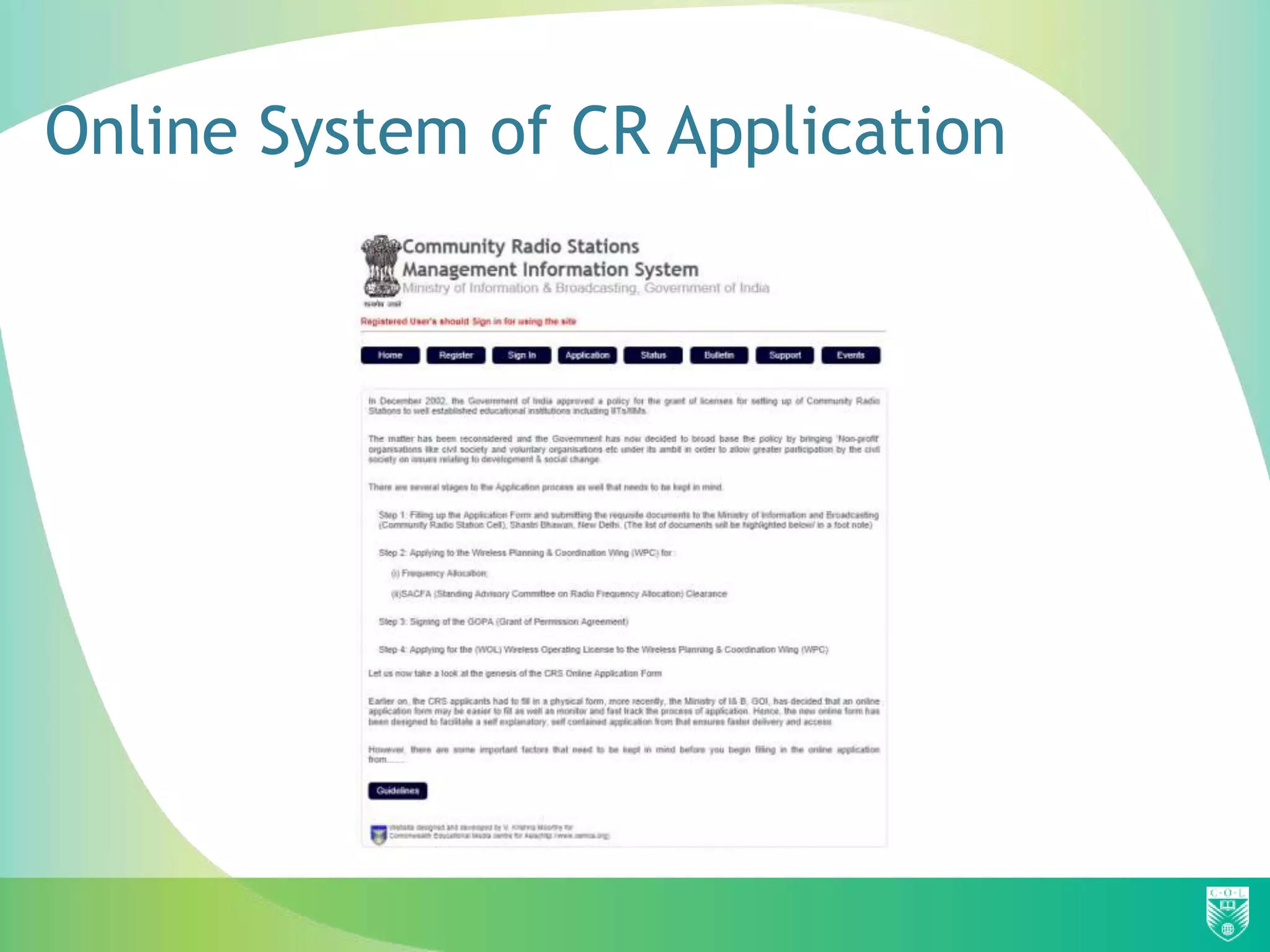
Online System of CR Application
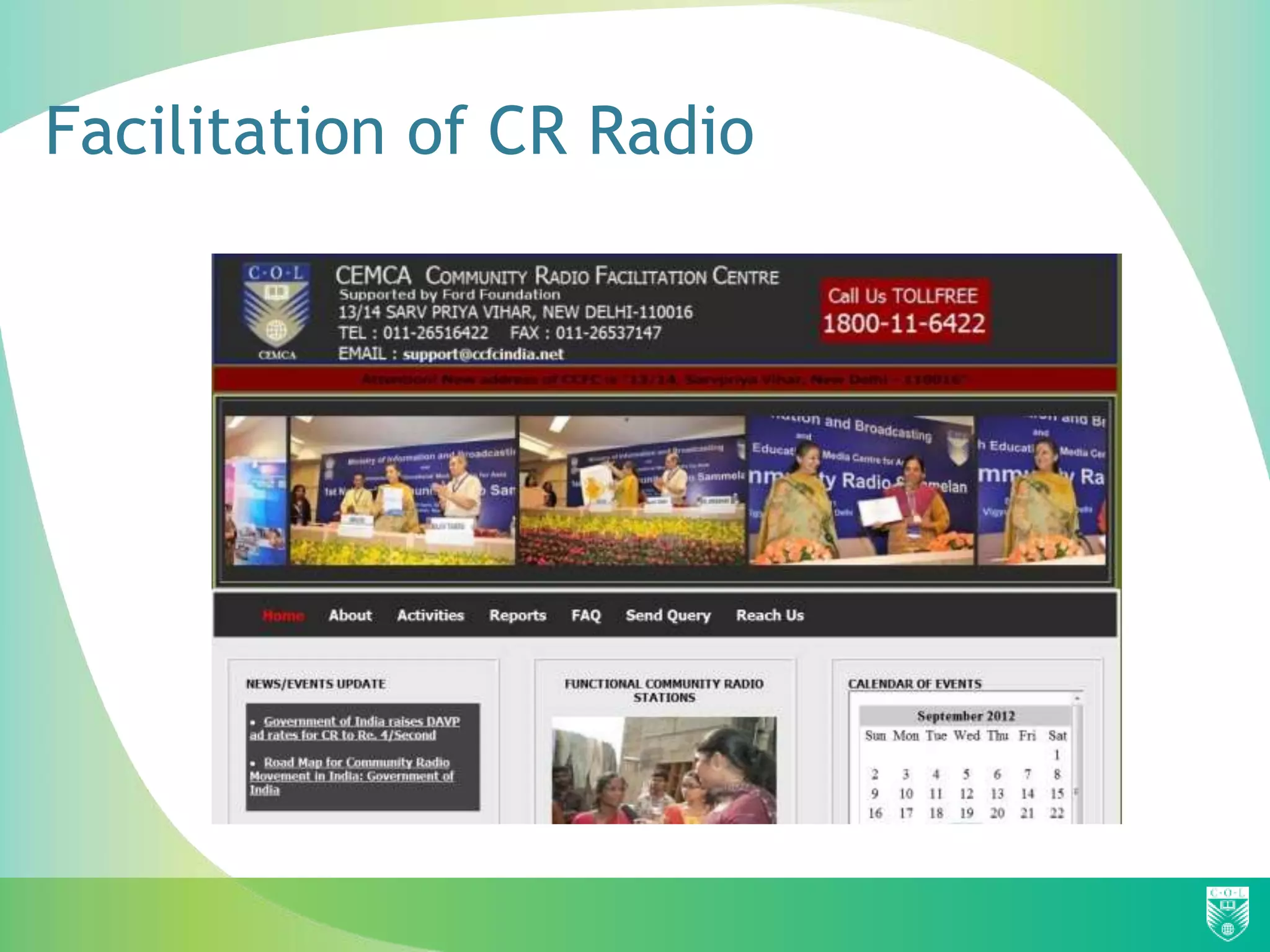
Facilitation of CR Radio
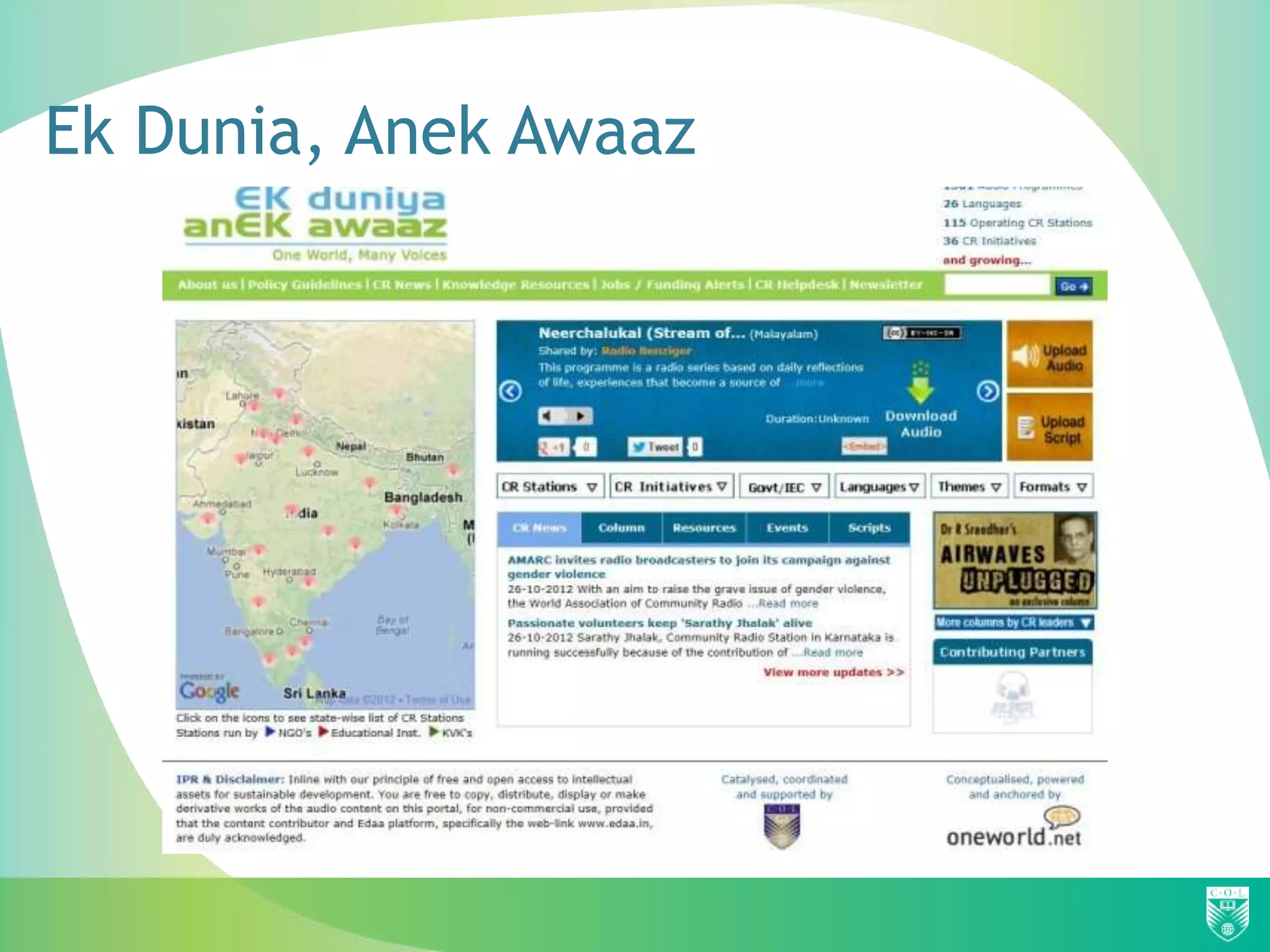
Ek Dunia, Anek Awaaz
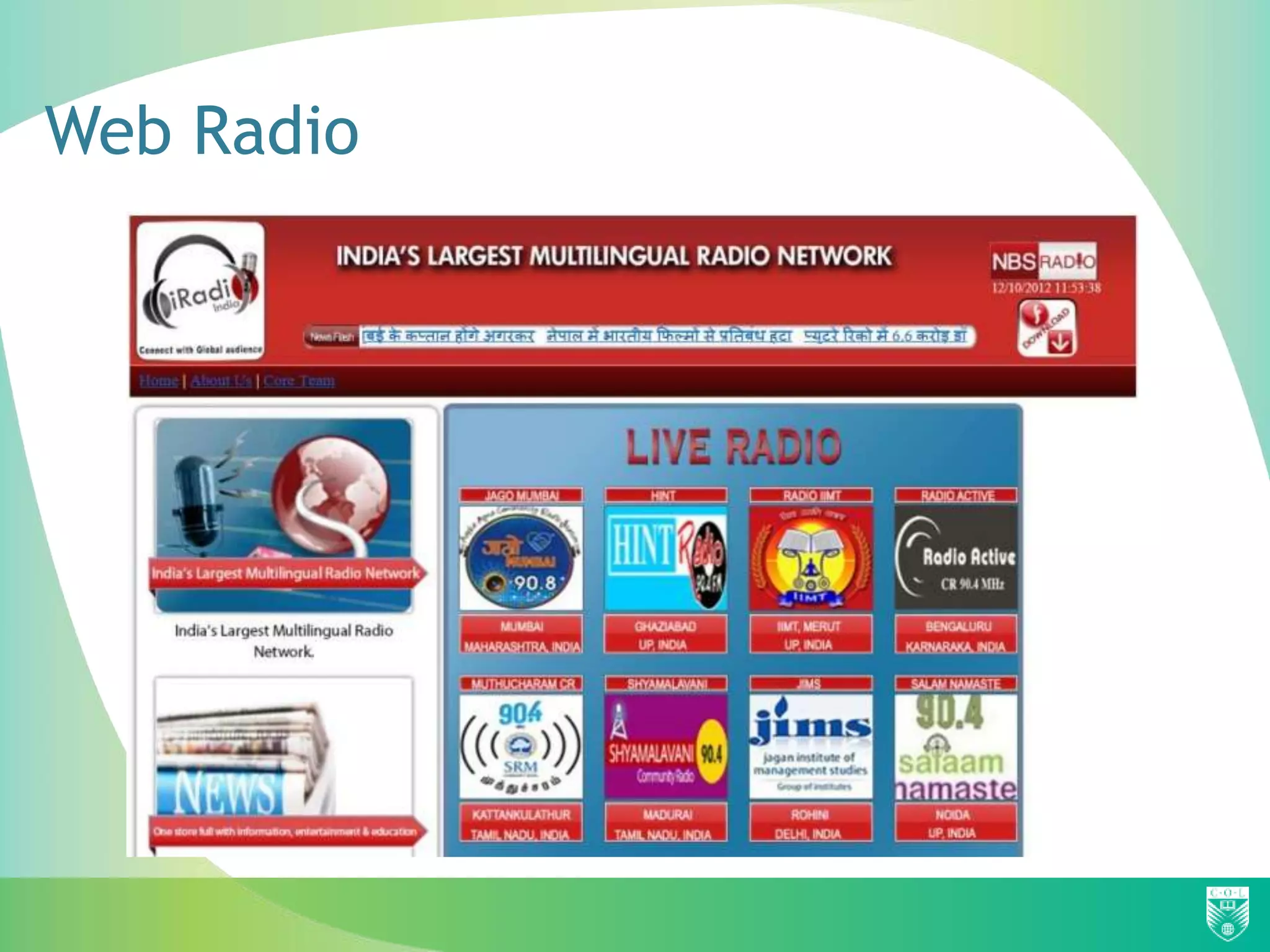
Web Radio
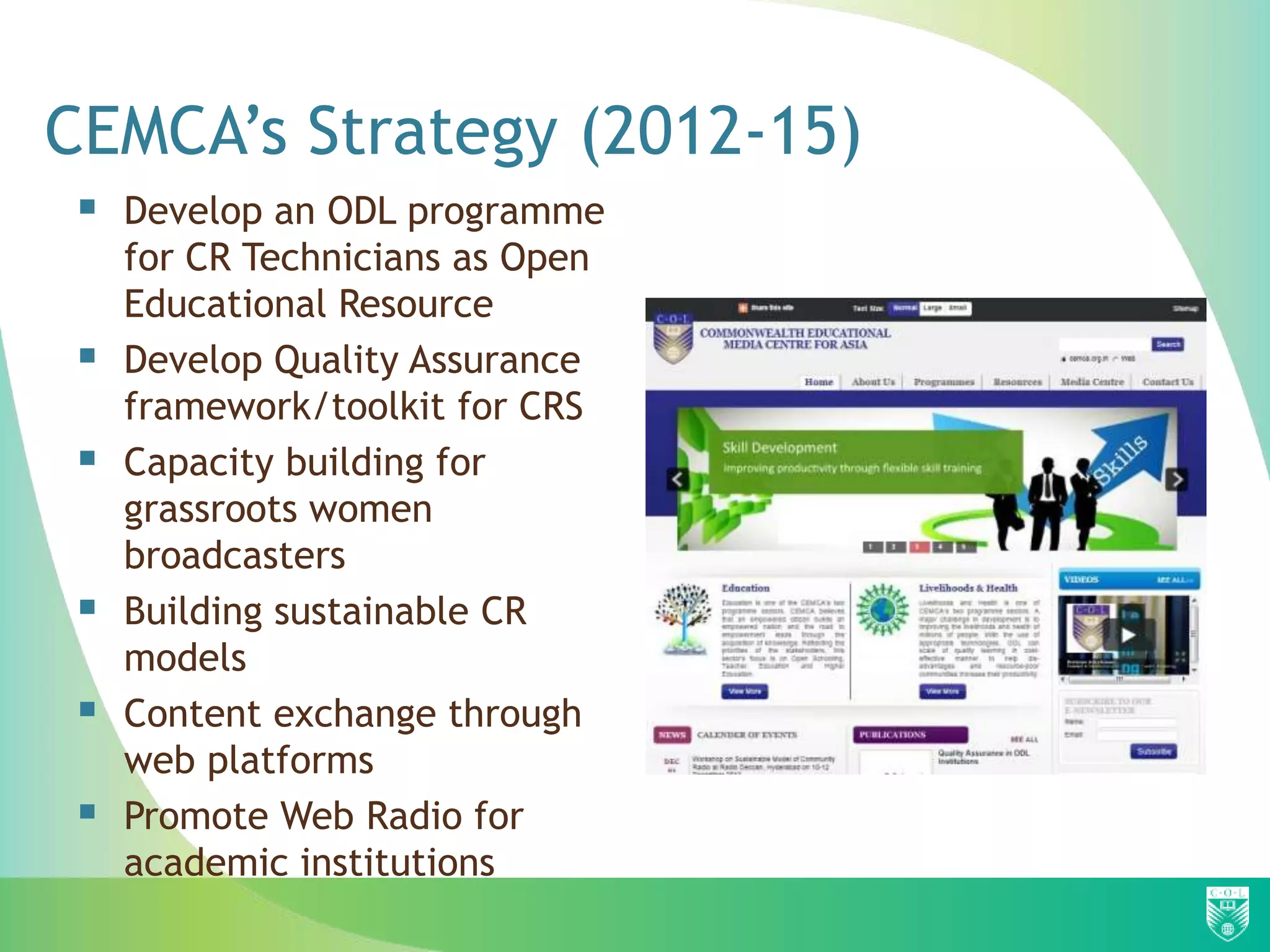
CEMCA’s Strategy (2012-15)
    Develop an ODL programme
     for CR Technicians as Open
     Educational Resource
    Develop Quality Assurance
     framework/toolkit for CRS
    Capacity building for
     grassroots women
     broadcasters
    Building sustainable CR
     models
    Content exchange through
     web platforms
    Promote Web Radio for
     academic institutions
Thank You

Radio for Learning

  • 1.
    Commonwealth Educational Media Centrefor Asia Radio for Learning Sanjaya Mishra
  • 2.
    Professor Asha S.Kanwar President & CEO Commonwealth of Learning
  • 3.
    Structure  COL and Radio  Indian Situation  Lessons Learnt  CEMCA and Community Radio
  • 4.
  • 5.
    COL and Radio To reduce digital divide  Local participatory approach to knowledge and skill development  Empower communities through technology training and programme development skills
  • 6.
    COLME  FM Radiowith low power transmitter  Use of solar power to run station  Use of HAM radio  Radio in a Box
  • 7.
    Radio: for whom,for what and how?  UGANDA – Used solar powered FM station reaching 1 million Luo speakers; Daily programmes concerning health, gender, agriculture; Health-based information that has led to the HIV/AIDS prevention in the community.  PAPUA NEW GUINEA – FM radio used by Govt. to reach primary and secondary students in remote locality
  • 8.
    Radio: for whom,for what and how?  SOUTH AFRICA – Secondary school FM radio station that reaches the town of Manguzi in Kwazulu Natal (estimated population of 200,000)  SRI LANKA – Portable FM radio station utilised in primary and secondary schools in Southern Sri Lanka. – Two hundred students trained in the value of radio and community development by SLBC.
  • 9.
  • 10.
    Ham Radio  facilitatedagricultural education and community development through provision of free exchange of communications between five farming communities and scientists from two agricultural research stations in Tamil Nadu, India.
  • 11.
    Community Radio Movement 1995 Supreme Court: airwaves constitute public property and must be utilized for advancing public good  2003 MIB Guidelines  2006 MIB Guidelines (Revised)  141 CR station (as of 15/11/2012); 187 GOPA signed  IGNOU Gyan Vani FM stations
  • 12.
  • 13.
    What Research Shows Majority of studies report that achievement of the target group increased as a result of radio programme  Learners are interested in radio programmes, if the timing is suitable  Radio programmes in story and drama formats are received well, though talks and quiz-based programmes are also useful  Students also appreciate interactivity in radio through phone-in Source: Mishra, 2005
  • 14.
    Lessons Learnt: Pedagogy Radio to be an integral part of the curriculum  Broadcast time suitable for the target group  Use innovative formats; but also use story and drama  Use radio for more factual information  Use radio vision, for subjects that require illustrations
  • 15.
    Lessons Learnt: Technology Radio station systems require easy plug in and out leads so that soldering of wires is avoided  Dual microphone systems for discussion groups are important for community radio systems  Solar systems are effective only if the proper maintenance scheme is completed  Issues to do with lightening strikes are a constant threat to station transmitters and proper training and maintenance must be in effect.  A maintenance scheme should be drawn up and ensured that the technician carries it out and reports to the radio station manager
  • 16.
    Lessons Learnt: Policyand Practice  Enabling policy environment important  Understanding sustainability issues as well as not-for-profit  Community engagement both in management and programming  Ethical practice and Self-regulatory mechanism  Quality improvement needed
  • 17.
  • 18.
    CEMCA and Radio Organized over 30 CR Awareness workshops on behalf of MIB since 2007  Community women broadcasters training (25 CRS)  Community based learning programme on health (two-CRS)  Content development – Science for Women – supported by DST(30 CRS)
  • 19.
    Online System ofCR Application
  • 20.
  • 21.
  • 22.
  • 23.
    CEMCA’s Strategy (2012-15)  Develop an ODL programme for CR Technicians as Open Educational Resource  Develop Quality Assurance framework/toolkit for CRS  Capacity building for grassroots women broadcasters  Building sustainable CR models  Content exchange through web platforms  Promote Web Radio for academic institutions
  • 24.