SSD (SSD (Solid State Drive)Solid State Drive)
GUIDED BY :
Mr. ASHWANI KR. PANDEY
B.TECH, M.TECH
Associate Professor
DEPARTMENT OF ELECTRONICS AND COMMUNICATIONS
PRESENTED BY :
SAURABH KUMAR
ContentsContents•HistoryHistory
•Solid State DrivesSolid State Drives
•NAND Flash MemoryNAND Flash Memory
•SSD ElementsSSD Elements
1. SSD Controller1. SSD Controller
2. SSD Flash2. SSD Flash
3. SSD Interfaces3. SSD Interfaces
•SSD StorageSSD Storage
SchemeScheme
• SSD ArchitectureSSD Architecture
• SSD Around usSSD Around us
• Inter x25 SSD- anInter x25 SSD- an
ExampleExample
• Benefits of SSDBenefits of SSD
• SSD vs. HDDSSD vs. HDD
• ApplicationApplication
HistoryHistory
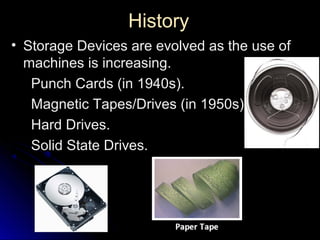
• Storage Devices are evolved as the use of
machines is increasing.
Punch Cards (in 1940s).
Magnetic Tapes/Drives (in 1950s).
Hard Drives.
Solid State Drives.
Solid State Drive(SSD)Solid State Drive(SSD)
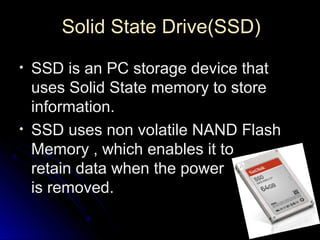
• SSD is an PC storage device thatSSD is an PC storage device that
uses Solid State memory to storeuses Solid State memory to store
information.information.
• SSD uses non volatile NAND FlashSSD uses non volatile NAND Flash
Memory , which enables it toMemory , which enables it to
retain data when the powerretain data when the power
is removed.is removed.
NAND Flash MemoryNAND Flash Memory
• NAND Flash Memory is the keyNAND Flash Memory is the key
component of SSD.component of SSD.
• It is a specific type of EEPROM chip.It is a specific type of EEPROM chip.
• It has a grid of columns and rows with aIt has a grid of columns and rows with a
cell that has two transistors at eachcell that has two transistors at each
intersection as Control gate and Floatingintersection as Control gate and Floating
gate transistor.gate transistor.
• The principle of operation is based onThe principle of operation is based on
MOSFETs.MOSFETs.
Types of NAND FlashTypes of NAND Flash
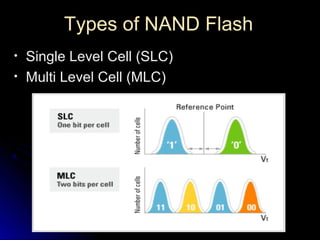
• Single Level Cell (SLC)Single Level Cell (SLC)
• Multi Level Cell (MLC)Multi Level Cell (MLC)
SLC vs. MLCSLC vs. MLC
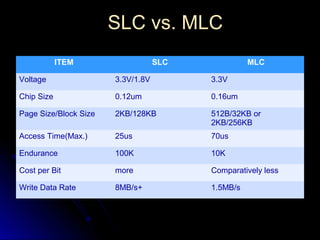
ITEM SLC MLC
Voltage 3.3V/1.8V 3.3V
Chip Size 0.12um 0.16um
Page Size/Block Size 2KB/128KB 512B/32KB or
2KB/256KB
Access Time(Max.) 25us 70us
Endurance 100K 10K
Cost per Bit more Comparatively less
Write Data Rate 8MB/s+ 1.5MB/s
SSD ElementsSSD Elements
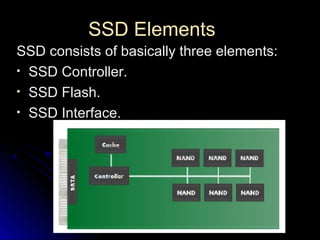
SSD consists of basically three elements:SSD consists of basically three elements:
• SSD Controller.SSD Controller.
• SSD Flash.SSD Flash.
• SSD Interface.SSD Interface.
SSD ControllerSSD Controller
• Flash controller includes the electronicsFlash controller includes the electronics
that bridge the Flash memory componentsthat bridge the Flash memory components
to the SSD input/output interfaces.to the SSD input/output interfaces.
• The controller is an embedded processorThe controller is an embedded processor
that executes firmware-level software.that executes firmware-level software.
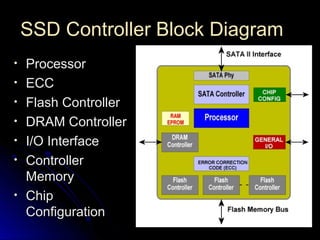
SSD Controller Block DiagramSSD Controller Block Diagram
• ProcessorProcessor
• ECCECC
• Flash ControllerFlash Controller
• DRAM ControllerDRAM Controller
• I/O InterfaceI/O Interface
• ControllerController
MemoryMemory
• ChipChip
ConfigurationConfiguration
SSD FlashSSD Flash
• Solid State Flash memory is available usingSolid State Flash memory is available using
NAND technology.NAND technology.
• NAND Flash components come in densitiesNAND Flash components come in densities
from 1Gb (gigabit) to 64Gb per chip.from 1Gb (gigabit) to 64Gb per chip.
• NAND Flash components have structuresNAND Flash components have structures
called pages and blocks.called pages and blocks.
• There is an Error Correction Code (ECC)There is an Error Correction Code (ECC)
associated with each sector.associated with each sector.
• NAND Flash has a limited rewrite enduranceNAND Flash has a limited rewrite endurance
of about 1,000,000 times per block.of about 1,000,000 times per block.
SSD InterfaceSSD Interface
• Interface is used to connect the SSD with theInterface is used to connect the SSD with the
computer.computer.
• Also, since SDDs are generally used inAlso, since SDDs are generally used in
conjunction with magnetic disk drives, aconjunction with magnetic disk drives, a
common mass storage bus interface is usedcommon mass storage bus interface is used
in most cases.in most cases.
• SSD are available with a variety of systemSSD are available with a variety of system
interfaces based primarily on theinterfaces based primarily on the
performance requirements:performance requirements:
Serial ATASerial ATA
Serial attached SCSISerial attached SCSI
Fiber ChannelFiber Channel
USBUSB
SSD Storage SchemeSSD Storage Scheme
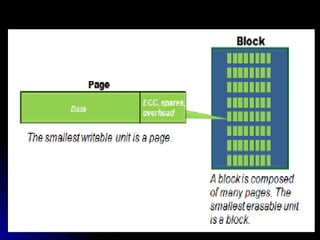
• Groups of NAND flash cells are organizedGroups of NAND flash cells are organized
into pages and these pages are organizedinto pages and these pages are organized
into blocks.into blocks.
• Read and write operations can beRead and write operations can be
performed on pages, but erase operationsperformed on pages, but erase operations
can only be performed at the block level.can only be performed at the block level.
• This means that when rewriting a page,This means that when rewriting a page,
the entire block must be erased first.the entire block must be erased first.
• The SSD controller manages this processThe SSD controller manages this process..
SSD Around UsSSD Around Us
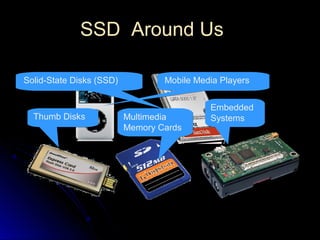
Mobile Media PlayersMobile Media PlayersSolid-State Disks (SSD)Solid-State Disks (SSD)
Thumb DisksThumb Disks Multimedia
Memory Cards
Multimedia
Memory Cards
Embedded
Systems
Embedded
Systems
Intel x25 SSD- An ExampleIntel x25 SSD- An Example
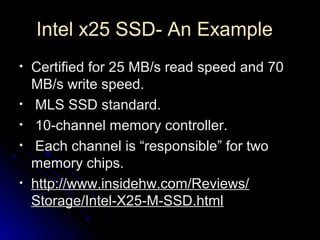
• Certified for 25 MB/s read speed and 70Certified for 25 MB/s read speed and 70
MB/s write speed.MB/s write speed.
• MLS SSD standard.MLS SSD standard.
• 10-channel memory controller.10-channel memory controller.
• Each channel is “responsible” for twoEach channel is “responsible” for two
memory chips.memory chips.
• http://www.insidehw.com/Reviews/http://www.insidehw.com/Reviews/
Storage/Intel-X25-M-SSD.htmlStorage/Intel-X25-M-SSD.html
SSD vs. HDDSSD vs. HDD
SSDSSD ApplicationsApplications
• ServersServers
• Desktop computersDesktop computers
• LaptopsLaptops
• Ultra booksUltra books
• HD CamcordersHD Camcorders
• Smart TVSmart TV
• CCTV Digital Video Recorder (DVR)CCTV Digital Video Recorder (DVR)
• Set-Top BoxesSet-Top Boxes
• Gaming ConsolesGaming Consoles
Advantages

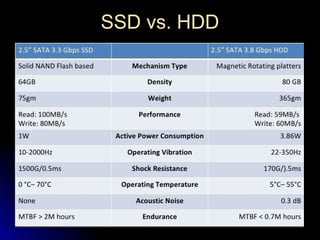
High performance – significantly faster than aHigh performance – significantly faster than a
standard HDDstandard HDD

Higher reliability – no moving parts, can withstandHigher reliability – no moving parts, can withstand
1500Gs operating shock1500Gs operating shock

Lower power – Lesser power consumption ,coolerLower power – Lesser power consumption ,cooler
operationoperation

Silent operation – ideal for post productionSilent operation – ideal for post production
environmentsenvironments

Lighter weight – perfect for portable devicesLighter weight – perfect for portable devices

Wider operating Temp. - 0c – 70cWider operating Temp. - 0c – 70c
Disadvantages
•
They are more expensive than traditionalThey are more expensive than traditional
hard driveshard drives
•
They currently offer less storage space thanThey currently offer less storage space than
traditional hard drives.traditional hard drives.
•
Slower Write Speed on low-endSlower Write Speed on low-end
Models(MLC based types)Models(MLC based types)
Conclusion
• Faster Data AccessFaster Data Access
• Less Power UsageLess Power Usage
• Higher ReliabilityHigher Reliability
• Latest high-end laptops and ultra books nowLatest high-end laptops and ultra books now
comes with SSDcomes with SSD
• In coming years SSD Will Replace Hard DiskIn coming years SSD Will Replace Hard Disk
DrivesDrives
ReferencesReferences
•http://en.wikipedia.org/wiki/Solid_state_driveshttp://en.wikipedia.org/wiki/Solid_state_drives
•http://www.storagereview.com/ssd_reference_http://www.storagereview.com/ssd_reference_
guideguide
•http://electronics.howstuffworks.com/flash-http://electronics.howstuffworks.com/flash-
memory.htmmemory.htm
•http://i.dell.com/sites/content/business/solutiohttp://i.dell.com/sites/content/business/solutio
ns/whitepapers/en/Documents/wp-2009-ns/whitepapers/en/Documents/wp-2009-
SSD.pdfSSD.pdf
Thank You.

SSD PPT BY SAURABH

  • 1.
    SSD (SSD (SolidState Drive)Solid State Drive) GUIDED BY : Mr. ASHWANI KR. PANDEY B.TECH, M.TECH Associate Professor DEPARTMENT OF ELECTRONICS AND COMMUNICATIONS PRESENTED BY : SAURABH KUMAR
  • 2.
    ContentsContents•HistoryHistory •Solid State DrivesSolidState Drives •NAND Flash MemoryNAND Flash Memory •SSD ElementsSSD Elements 1. SSD Controller1. SSD Controller 2. SSD Flash2. SSD Flash 3. SSD Interfaces3. SSD Interfaces •SSD StorageSSD Storage SchemeScheme • SSD ArchitectureSSD Architecture • SSD Around usSSD Around us • Inter x25 SSD- anInter x25 SSD- an ExampleExample • Benefits of SSDBenefits of SSD • SSD vs. HDDSSD vs. HDD • ApplicationApplication
  • 3.
    HistoryHistory • Storage Devicesare evolved as the use of machines is increasing. Punch Cards (in 1940s). Magnetic Tapes/Drives (in 1950s). Hard Drives. Solid State Drives.
  • 4.
    Solid State Drive(SSD)SolidState Drive(SSD) • SSD is an PC storage device thatSSD is an PC storage device that uses Solid State memory to storeuses Solid State memory to store information.information. • SSD uses non volatile NAND FlashSSD uses non volatile NAND Flash Memory , which enables it toMemory , which enables it to retain data when the powerretain data when the power is removed.is removed.
  • 5.
    NAND Flash MemoryNANDFlash Memory • NAND Flash Memory is the keyNAND Flash Memory is the key component of SSD.component of SSD. • It is a specific type of EEPROM chip.It is a specific type of EEPROM chip. • It has a grid of columns and rows with aIt has a grid of columns and rows with a cell that has two transistors at eachcell that has two transistors at each intersection as Control gate and Floatingintersection as Control gate and Floating gate transistor.gate transistor. • The principle of operation is based onThe principle of operation is based on MOSFETs.MOSFETs.
  • 6.
    Types of NANDFlashTypes of NAND Flash • Single Level Cell (SLC)Single Level Cell (SLC) • Multi Level Cell (MLC)Multi Level Cell (MLC)
  • 7.
    SLC vs. MLCSLCvs. MLC ITEM SLC MLC Voltage 3.3V/1.8V 3.3V Chip Size 0.12um 0.16um Page Size/Block Size 2KB/128KB 512B/32KB or 2KB/256KB Access Time(Max.) 25us 70us Endurance 100K 10K Cost per Bit more Comparatively less Write Data Rate 8MB/s+ 1.5MB/s
  • 8.
    SSD ElementsSSD Elements SSDconsists of basically three elements:SSD consists of basically three elements: • SSD Controller.SSD Controller. • SSD Flash.SSD Flash. • SSD Interface.SSD Interface.
  • 9.
    SSD ControllerSSD Controller •Flash controller includes the electronicsFlash controller includes the electronics that bridge the Flash memory componentsthat bridge the Flash memory components to the SSD input/output interfaces.to the SSD input/output interfaces. • The controller is an embedded processorThe controller is an embedded processor that executes firmware-level software.that executes firmware-level software.
  • 10.
    SSD Controller BlockDiagramSSD Controller Block Diagram • ProcessorProcessor • ECCECC • Flash ControllerFlash Controller • DRAM ControllerDRAM Controller • I/O InterfaceI/O Interface • ControllerController MemoryMemory • ChipChip ConfigurationConfiguration
  • 11.
    SSD FlashSSD Flash •Solid State Flash memory is available usingSolid State Flash memory is available using NAND technology.NAND technology. • NAND Flash components come in densitiesNAND Flash components come in densities from 1Gb (gigabit) to 64Gb per chip.from 1Gb (gigabit) to 64Gb per chip. • NAND Flash components have structuresNAND Flash components have structures called pages and blocks.called pages and blocks. • There is an Error Correction Code (ECC)There is an Error Correction Code (ECC) associated with each sector.associated with each sector. • NAND Flash has a limited rewrite enduranceNAND Flash has a limited rewrite endurance of about 1,000,000 times per block.of about 1,000,000 times per block.
  • 12.
    SSD InterfaceSSD Interface •Interface is used to connect the SSD with theInterface is used to connect the SSD with the computer.computer. • Also, since SDDs are generally used inAlso, since SDDs are generally used in conjunction with magnetic disk drives, aconjunction with magnetic disk drives, a common mass storage bus interface is usedcommon mass storage bus interface is used in most cases.in most cases. • SSD are available with a variety of systemSSD are available with a variety of system interfaces based primarily on theinterfaces based primarily on the performance requirements:performance requirements: Serial ATASerial ATA Serial attached SCSISerial attached SCSI Fiber ChannelFiber Channel USBUSB
  • 13.
    SSD Storage SchemeSSDStorage Scheme • Groups of NAND flash cells are organizedGroups of NAND flash cells are organized into pages and these pages are organizedinto pages and these pages are organized into blocks.into blocks. • Read and write operations can beRead and write operations can be performed on pages, but erase operationsperformed on pages, but erase operations can only be performed at the block level.can only be performed at the block level. • This means that when rewriting a page,This means that when rewriting a page, the entire block must be erased first.the entire block must be erased first. • The SSD controller manages this processThe SSD controller manages this process..
  • 15.
    SSD Around UsSSDAround Us Mobile Media PlayersMobile Media PlayersSolid-State Disks (SSD)Solid-State Disks (SSD) Thumb DisksThumb Disks Multimedia Memory Cards Multimedia Memory Cards Embedded Systems Embedded Systems
  • 16.
    Intel x25 SSD-An ExampleIntel x25 SSD- An Example • Certified for 25 MB/s read speed and 70Certified for 25 MB/s read speed and 70 MB/s write speed.MB/s write speed. • MLS SSD standard.MLS SSD standard. • 10-channel memory controller.10-channel memory controller. • Each channel is “responsible” for twoEach channel is “responsible” for two memory chips.memory chips. • http://www.insidehw.com/Reviews/http://www.insidehw.com/Reviews/ Storage/Intel-X25-M-SSD.htmlStorage/Intel-X25-M-SSD.html
  • 17.
  • 19.
    SSDSSD ApplicationsApplications • ServersServers •Desktop computersDesktop computers • LaptopsLaptops • Ultra booksUltra books • HD CamcordersHD Camcorders • Smart TVSmart TV • CCTV Digital Video Recorder (DVR)CCTV Digital Video Recorder (DVR) • Set-Top BoxesSet-Top Boxes • Gaming ConsolesGaming Consoles
  • 20.
    Advantages  High performance –significantly faster than aHigh performance – significantly faster than a standard HDDstandard HDD  Higher reliability – no moving parts, can withstandHigher reliability – no moving parts, can withstand 1500Gs operating shock1500Gs operating shock  Lower power – Lesser power consumption ,coolerLower power – Lesser power consumption ,cooler operationoperation  Silent operation – ideal for post productionSilent operation – ideal for post production environmentsenvironments  Lighter weight – perfect for portable devicesLighter weight – perfect for portable devices  Wider operating Temp. - 0c – 70cWider operating Temp. - 0c – 70c
  • 21.
    Disadvantages • They are moreexpensive than traditionalThey are more expensive than traditional hard driveshard drives • They currently offer less storage space thanThey currently offer less storage space than traditional hard drives.traditional hard drives. • Slower Write Speed on low-endSlower Write Speed on low-end Models(MLC based types)Models(MLC based types)
  • 22.
    Conclusion • Faster DataAccessFaster Data Access • Less Power UsageLess Power Usage • Higher ReliabilityHigher Reliability • Latest high-end laptops and ultra books nowLatest high-end laptops and ultra books now comes with SSDcomes with SSD • In coming years SSD Will Replace Hard DiskIn coming years SSD Will Replace Hard Disk DrivesDrives
  • 23.
  • 24.

Editor's Notes

  • #8 Two main types of NAND flash have been used: single-level cell (SLC) and multi-level cell (MLC) flash. SLC flash stores one bit per cell, or memory location, within the NAND flash. MLC stores two bits per cell. SLC flash has higher read/write performance and greater write endurance, but MLC carries a lower cost per gigabyte because it offers approximately double the storage capacity in a similar amount of silicon. MLC flash is also made in higher volumes due to its application in consumer electronics and other devices, adding to its cost effectiveness. While SLC flash is common in enterprise server applications, virtually all SSDs used in client PCs and handheld devices today use MLC flash because of its cost advantage over SLC.
  • #11 Processor - 16 or 32 bit embedded microcontroller, programmed in C in most cases, and compiled to run on the target CPU engine Error Correction (ECC) - A hardware function that appends redundancy bits with each byte stored in order to provide data error detection and correction upon readout.  Flash Controller - Contains the addressing, data bus, and control for managing one or more Flash components. A typical SSD controller will manage up to 512GB of Flash.  DRAM Controller - Contains the addressing, data bus, and control for managing one or more DRAM components. A typical SSD controller can manage up to 256MB of DRAM. I/O interface (i.e.: SATA) - Contains the native electrical interface per a particular open system standard such as SATA, USB, or SAS. The interface is controlled by the controller firmware driver.  Basic addressing and handshaking is done in hardware. Controller Memory - Comprised of programmed memory (ROM) and scratchpad/buffer RAM tightly coupled to the processor. This memory is used by the controller for program execution and for storing scratchpad values. In some cost constrained applications the RAM acts as the sole data buffer for the SSD. Chip Configuration - Establishes setting for types and speeds of memory parts used, clock inputs, diagnostic I/O, and LED status outputs. General I/O - General purpose programmable pins available to the application.  
  • #13 Serial Advanced Technology Attachment Interface   Description Details Standards SATA Serial ATA    A serial implementation of the Parallel ATA interface (also called the IDE) used on floppy drives and early magnetic disk drives. A point-to-point system that utilizes a 7-conductor cable with two differential [Tx/Rx] pairs to each drive. A separate 15-pin power connector is used.   Data throughput potential is 150, 300, or 600 Mbytes/s, based on the version used. The max unshielded cable length is 1 meter, 2 meters if shielded, or up to 8 meters using the xSATA version.  Serial ATA Revision 3.0, 5/2009 T13 committee --------------------------------------------------------------------------- FC Fibre Channel A multiple rate serial  Gbit, Multiprotocol interface.   Fibre Channel was developed as a modern serial interface for Storage Area Networks (SAN) where an array of drives in the same cabinet, room, or facility where shared by a set of servers. A bidirectional interface that supports SCSI, IP, ATM, HIPPI, and/or IEEE802.2 over copper or fiber optic cables. Rates from 1 to 10 Gbits/s based on version used.   Twister pair: 33 meters Coax: 75 meters Fiber Optic: 10 kilometers   In addition, FC can be configured in an arbitrated loop containing up to 127 devices, Point to Point,  or in a switched fabric.   SSD drives using Fibre channel support the twisted pair electrical interface and most use the 40-pin SCA-2 connector. This connector contains 4 twisted pairs for the base FC signals as well as various configuration, power, and ground pins. Maximum length 1 meter.   SSD drives utilize the Fibre Channel Protocol FCP-SCSI protocol command set. (SCSI - Small Computer System Interface). T10 committee ----------------------------------------------------------------------------------- SAS Serial Attached SCSI A 3 or 6-Gbit rate serial implementation of the 8/16/32-bit wide parallel Small Computer Systems Interface (SCSI) A point-to-point full duplex system. It utilizes a 4 two differential [Tx/Rx] pairs to each drive. A separate 15-pin power connector is used when combined with SATA, or can be integrated into a single connector. There are various connectors utilized.   Data throughput potential is 3 or 6 Gbits/s with 12 Gbits/s planned for 2012 release.    The max cable length is 10 meters.  Serial Attached SCSI - 2.0 {SAS-2.0), 11/2007 T10 committee -------------------------------------------------------------------------------------------- USB Universal Serial Bus A simple serial bus with integrated power.   Base data rate is 12 Mbits/s. Later versions support up to 480 Mbits/sec. A 4-pin bidirectional serial bus using a hub and spoke topology in order to connect up to 128 devices under the control of one master controller.   The current USD 2.0 standard allows operation 5 meters per cable but supports a string of cables with intermediate hubs to achieve a 30 meter maximum cable length.   SSD thumb drives and many form factor drives provide a USD interface as a secondary access channel. This is possible since the controller chip used in many form factor SSD drives only needs to use a few pins to integrate this interface into the drive design. USB 2.0 Specification USB.org
  • #18 SSD vs. HDD 2.5” SATA 3.8Gbps SSD 2.5” SATA 3.8Gbps Solid NAND Flash HDD based Mechanism type Magnetic rotating platters 64GB Density 80GB 73g Weight 365g Read: 100MB/s Write: 80 MB/s Performance Read: 59MB/s Write: 60MB/s 1W Active Power Consumption 3.86W 1,500G/.5ms shock resistance 170G/.5ms 20G (10~2000Hz) Operating Vibration 0.5G (22~350Hz) 1500G for 0.5ms Shock Resistance 170G for 0.5ms 0 °C– 70°C Operating temperature 5°C– 55°C None Acoustic Noise 0.3 dB MTBF > 2M hours Endurance MTBF < 0.7M hours Source: http://www.samsung.com
  • #20 SSD vs. HDD 2.5” SATA 3.8Gbps SSD 2.5” SATA 3.8Gbps Solid NAND Flash HDD based Mechanism type Magnetic rotating platters 64GB Density 80GB 73g Weight 365g Read: 100MB/s Write: 80 MB/s Performance Read: 59MB/s Write: 60MB/s 1W Active Power Consumption 3.86W 1,500G/.5ms shock resistance 170G/.5ms 20G (10~2000Hz) Operating Vibration 0.5G (22~350Hz) 1500G for 0.5ms Shock Resistance 170G for 0.5ms 0 °C– 70°C Operating temperature 5°C– 55°C None Acoustic Noise 0.3 dB MTBF > 2M hours Endurance MTBF < 0.7M hours Source: http://www.samsung.com
  • #21 SSD vs. HDD 2.5” SATA 3.8Gbps SSD 2.5” SATA 3.8Gbps Solid NAND Flash HDD based Mechanism type Magnetic rotating platters 64GB Density 80GB 73g Weight 365g Read: 100MB/s Write: 80 MB/s Performance Read: 59MB/s Write: 60MB/s 1W Active Power Consumption 3.86W 1,500G/.5ms shock resistance 170G/.5ms 20G (10~2000Hz) Operating Vibration 0.5G (22~350Hz) 1500G for 0.5ms Shock Resistance 170G for 0.5ms 0 °C– 70°C Operating temperature 5°C– 55°C None Acoustic Noise 0.3 dB MTBF > 2M hours Endurance MTBF < 0.7M hours Source: http://www.samsung.com
  • #22 SSD vs. HDD 2.5” SATA 3.8Gbps SSD 2.5” SATA 3.8Gbps Solid NAND Flash HDD based Mechanism type Magnetic rotating platters 64GB Density 80GB 73g Weight 365g Read: 100MB/s Write: 80 MB/s Performance Read: 59MB/s Write: 60MB/s 1W Active Power Consumption 3.86W 1,500G/.5ms shock resistance 170G/.5ms 20G (10~2000Hz) Operating Vibration 0.5G (22~350Hz) 1500G for 0.5ms Shock Resistance 170G for 0.5ms 0 °C– 70°C Operating temperature 5°C– 55°C None Acoustic Noise 0.3 dB MTBF > 2M hours Endurance MTBF < 0.7M hours Source: http://www.samsung.com