AMD PROCESSORS
Presented by,
Md. Ali Haider.
Roll-150123, Section-A.
Dpt. of ICT.
AMD PROCESSOR
Presented By-
MD.ALI HAIDER.
ROLL-150123.
Dept. Of ICT.
Bangladesh University Of Professionals
INTRODUCTION
 Advanced Micro Devices (AMD) is the world's second
largest manufacturer x86 architecture processors.
 World’s fastest Quadcore CPU invented by AMD.
 AMD solutions allow you to interact with technology in
your way.
 4 out of first 5 supercomputers of the world Today , use
AMD technology.
INTRODUCTION
 AMD PIONEERED the accelerated processing unit
(APU) with HSA.
 Any CPU running at lowest possible temp (-235 C) is
invented by AMD.
 One of the largest suppliers of graphics processing
units.
 AMD is the only significant rival to Intel in the CPU
market for (x86 based) personal computers.
History of AMD Processor
 First generation AMD processors like AM2900 were
created in 1975.
Design of this technology is founded on the principles of
slice technology.
The purpose of the slice technology is to make them
compatible.
 Next family of microprocessors is x86 Architecture.
 AMD's first in-house x86 processor was the K5, which was
launched in 1996.
Quiz- 01
The First in house x86 processor of AMD –
•K4
•K5
•A4
•A6
History of AMD Processor
 In 1999 AMD introduced World’s first Seventh
generation processor named Athlon.
 The Duron was a lower-cost and limited version of the
Athlon .
 The K8 was a major revision of the K7 architecture
 The most notable features being the addition of a 64-
bit extension to the x86 instruction set.
History of AMD Processor
 The AMD K8 processor was the first to implement
the x86-64 architecture.
 Quad-core Third Generation processor named
Opteron .
 Opteron was the first processor to run the AMD86
instruction set.
 This processor was aim to compete in the market
with Intel Xeon.
 After K8 came K10 In September 2007 named
Sempron.
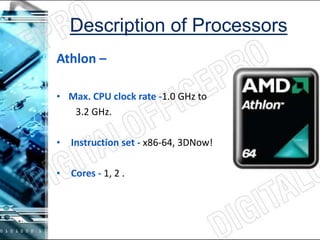
Athlon –
• Max. CPU clock rate -1.0 GHz to
3.2 GHz.
• Instruction set - x86-64, 3DNow!
• Cores - 1, 2 .
Pros and cons -
• Has the best gaming processors these days as they have
a larger cache .
• Available in 32-bit or 64-bit.
• Features CPU speed throttling technology
branded Cool'n'Quiet.
• Limited to DDR memory .
• Gets heated up more quickly and need more power to
drive it.
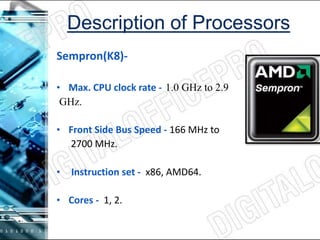
Sempron(K8)-
• Max. CPU clock rate --1.0 GHz to 2.9
GHz.
• Front Side Bus Speed - 166 MHz to
2700 MHz.
• Instruction set - x86, AMD64.
• Cores - 1, 2.
Pros and cons -
• Basic Productivity.
• E-mail, and Web Browsing.
• Also have integrated virus protection into their cores.
• Built in Power saving technology.
• Associated with very limited media applications.
• Uses crystal® technology, if it works for long time the
crystals start to burn .
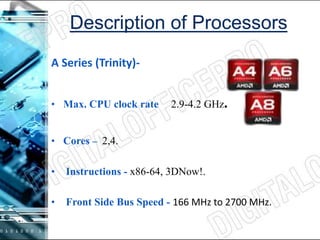
A Series (Trinity)-
• Max. CPU clock rate – 2.9-4.2 GHz.
• Cores – 2,4.
• Instructions - x86-64, 3DNow!.
• Front Side Bus Speed - 166 MHz to 2700 MHz.
Description of Processors
Pros and cons -
• Basic All-Around Use/Productivity.
• Casual Gaming.
• Advanced 3D Graphics.
• DirectX 11 Capable Graphics.
• Run lower in DDR2 RAM than other contemporary
processors .
• Less stable.
Why should one have AMD processor -
• AMD chips use less energy and are cheaper than
other chips.
• AMD has adopted Enhanced Virus Protection (EVP).
• It is a processor-level virus blocker.
• AMD has the best gaming processors these days as
they have a larger cache.
Summery
Why should one have AMD processor -
• AMD has the most useful Dual Core.
• AMD's have better onboard graphics than any other
CPUs in its range.
• 3D now! Can support a wide range of graphics rich
programs.
Summery
And Why Not!!!!
• AMD is limited to DDR memory .
• AMD is less stable.
• Limited Media applications.
• Older processors can overheat quickly.
Conclusion
• Delivering higher performance with similar power
consumption at a lower price therefore seems to be
AMD score competence.
• Its platforms were offering significant advantages,
delivering high performance and power efficiency
• AMD was also strongly understanding that end-users
buying behavior .
• AMD’s VISION Technology therefore provides improved
performance and battery life, consequently offering
higher quality and higher quantity.
THANK YOU !
?

AMD Processor

  • 1.
    AMD PROCESSORS Presented by, Md.Ali Haider. Roll-150123, Section-A. Dpt. of ICT. AMD PROCESSOR
  • 2.
    Presented By- MD.ALI HAIDER. ROLL-150123. Dept.Of ICT. Bangladesh University Of Professionals
  • 3.
    INTRODUCTION  Advanced MicroDevices (AMD) is the world's second largest manufacturer x86 architecture processors.  World’s fastest Quadcore CPU invented by AMD.  AMD solutions allow you to interact with technology in your way.  4 out of first 5 supercomputers of the world Today , use AMD technology.
  • 4.
    INTRODUCTION  AMD PIONEEREDthe accelerated processing unit (APU) with HSA.  Any CPU running at lowest possible temp (-235 C) is invented by AMD.  One of the largest suppliers of graphics processing units.  AMD is the only significant rival to Intel in the CPU market for (x86 based) personal computers.
  • 5.
    History of AMDProcessor  First generation AMD processors like AM2900 were created in 1975. Design of this technology is founded on the principles of slice technology. The purpose of the slice technology is to make them compatible.  Next family of microprocessors is x86 Architecture.  AMD's first in-house x86 processor was the K5, which was launched in 1996.
  • 6.
    Quiz- 01 The Firstin house x86 processor of AMD – •K4 •K5 •A4 •A6
  • 7.
    History of AMDProcessor  In 1999 AMD introduced World’s first Seventh generation processor named Athlon.  The Duron was a lower-cost and limited version of the Athlon .  The K8 was a major revision of the K7 architecture  The most notable features being the addition of a 64- bit extension to the x86 instruction set.
  • 8.
    History of AMDProcessor  The AMD K8 processor was the first to implement the x86-64 architecture.  Quad-core Third Generation processor named Opteron .  Opteron was the first processor to run the AMD86 instruction set.  This processor was aim to compete in the market with Intel Xeon.  After K8 came K10 In September 2007 named Sempron.
  • 9.
    Athlon – • Max.CPU clock rate -1.0 GHz to 3.2 GHz. • Instruction set - x86-64, 3DNow! • Cores - 1, 2 .
  • 10.
    Pros and cons- • Has the best gaming processors these days as they have a larger cache . • Available in 32-bit or 64-bit. • Features CPU speed throttling technology branded Cool'n'Quiet. • Limited to DDR memory . • Gets heated up more quickly and need more power to drive it.
  • 11.
    Sempron(K8)- • Max. CPUclock rate --1.0 GHz to 2.9 GHz. • Front Side Bus Speed - 166 MHz to 2700 MHz. • Instruction set - x86, AMD64. • Cores - 1, 2.
  • 12.
    Pros and cons- • Basic Productivity. • E-mail, and Web Browsing. • Also have integrated virus protection into their cores. • Built in Power saving technology. • Associated with very limited media applications. • Uses crystal® technology, if it works for long time the crystals start to burn .
  • 13.
    A Series (Trinity)- •Max. CPU clock rate – 2.9-4.2 GHz. • Cores – 2,4. • Instructions - x86-64, 3DNow!. • Front Side Bus Speed - 166 MHz to 2700 MHz.
  • 14.
    Description of Processors Prosand cons - • Basic All-Around Use/Productivity. • Casual Gaming. • Advanced 3D Graphics. • DirectX 11 Capable Graphics. • Run lower in DDR2 RAM than other contemporary processors . • Less stable.
  • 15.
    Why should onehave AMD processor - • AMD chips use less energy and are cheaper than other chips. • AMD has adopted Enhanced Virus Protection (EVP). • It is a processor-level virus blocker. • AMD has the best gaming processors these days as they have a larger cache.
  • 16.
    Summery Why should onehave AMD processor - • AMD has the most useful Dual Core. • AMD's have better onboard graphics than any other CPUs in its range. • 3D now! Can support a wide range of graphics rich programs.
  • 17.
    Summery And Why Not!!!! •AMD is limited to DDR memory . • AMD is less stable. • Limited Media applications. • Older processors can overheat quickly.
  • 18.
    Conclusion • Delivering higherperformance with similar power consumption at a lower price therefore seems to be AMD score competence. • Its platforms were offering significant advantages, delivering high performance and power efficiency • AMD was also strongly understanding that end-users buying behavior . • AMD’s VISION Technology therefore provides improved performance and battery life, consequently offering higher quality and higher quantity.
  • 19.
  • 20.