Presentation on
HUMANOID ROBOTS
PRESENTED By,
SAURABH KUMAR
EC-3rd
Year
Motivation
What is a Humanoid ?
Why Develop Humanoids?
Beginning of humanoid robots
How do they work?
Bipedal Locomotion
Advantages
Disadvantages
Applications
Outline
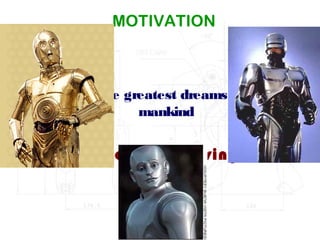
MOTIVATION
One of the greatest dreams of the
mankind
Being a creator, giving life
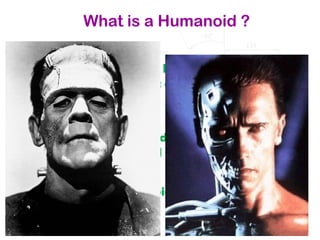
What is a Humanoid ?
Humanoid refers to any being whose body
structure resembles that of a human: head, torso,
legs, arms, hands.
But it is also a robot made to resemble a human
both in appearance and behaviour.
They are called humanoids because they
resemble humans.
Why Develop Humanoids?
The reasons are:
They can work in human
environment without a need to
adapt themselves or to change
the environment.
Our environment and our tools
are adapted for us
Why adapt all to robots?!
It is easier for a human being to
interact with a human-like being.
Beginning of humanoid robots
The word robot appeared first in 1920, in the play
‘Rossum's Universal Robots’,written by the Czech
writer Karel Capek.
The beginning of the development of humanoid
robotics started first in the world, in 1969 in the
Mihajlo Pupin Institute under the guidance of
Prof. Vukobratovic .
How do they work?
They have sensors and
actuators which do the actual work of
motion.
Sensors detect changes in environment like
motion, heating, change in direction and
actuators are the motors responsible for
movement. These human robots have a motion
which is close to that of humans.
The actuators
used are mainly rotary actuators in order to get
the human-like motions.
Sensors can be classified according to the physical process
with which they work.
Proprioceptive sensors sense the position, the orientation and
the speed of the humanoid's body and joints.
Arrays of tactels can be used to provide data on what has
been touched.
Vision sensors work most similarly to the eyes of human
beings. Most humanoid robots use CCD cameras as vision
sensors.
Sound sensors allow humanoid robots to hear speech and
environmental sounds, and perform as the ears of the human
being. Microphones are usually used for this task.
Humanoid Evolution (cont’d)
Nowadays, humanoid robot researchers are
focusing on legged robots rather than wheeled.
They are also focusing on bipedalism.
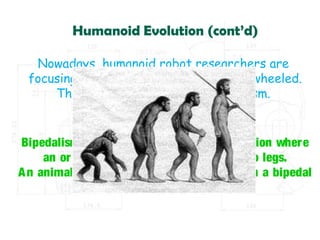
What is bipedalism?
Bipedalism is a form of terrestrial locomotion where
an organism moves by means of its two legs.
An animal or machine that usually moves in a bipedal
manner is known as a biped.
WHY LEGS FOR HUMANOIDS?
Potentially less weight.
Better handling on rough terrains.
Do less damage to terrains.
More energy efficient.
Use of isolated footholds that optimize support.
WHY BIPEDS?
Why 2 legs? 4 or 6 legs give more stability,
don’t they?
A biped robot body can be made shorter along
the walking direction and can turn around in
small areas.
Light weight.
More efficient due to less no. of actuators
needed.
Everything around us is built to be comfortable
for use by human form.
ADVANTAGES
The first main advantage that Humanoid Robots bring to
the table is that they can do things that people can do
and even things that people are unable to do.
They do not make mistakes and can do a task again and
again without getting tired.
Humanoid Robots can be used to teach children or read
to them. Even more specifically Humanoid Robots can
help children with autism immensely!
DISADVANTAGES
There are also some disadvantages that are
produced by Humanoid Robots.
One main disadvantage that results from
Humanoid Robots will be that many people are
going to lose their jobs.
Another disadvantage would be that this
implementation of robots into people’s
lives will cause a shift in their social ability and
willingness, in other words, people are going
to become more introverted.
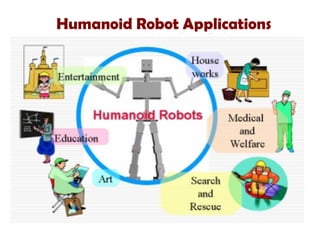
Humanoid Robot Applications
CONCLUSION
In regards to Humanoid Robots the winners will generally be the
people involved in the overall project of Humanoid Robots.
Winners will also be the autistic children that the Humanoid
Robots can help. As for losers in this situation the dominating
category would have to be the people that are going to lose their
jobs because they are being replaced by robots.
Overall Humanoid Robots are an amazing emerging technology
that is going to continue to progress to a place that no one could
dream about in the future.
REFERENCE
1. http://www.wikipedia.org
2. http://www.yuvaengineers.com
3.http://www.technologyreview.com
17
Thank
You

Why humanoid robots by saurabh

  • 1.
    Presentation on HUMANOID ROBOTS PRESENTEDBy, SAURABH KUMAR EC-3rd Year
  • 2.
    Motivation What is aHumanoid ? Why Develop Humanoids? Beginning of humanoid robots How do they work? Bipedal Locomotion Advantages Disadvantages Applications Outline
  • 3.
    MOTIVATION One of thegreatest dreams of the mankind Being a creator, giving life
  • 4.
    What is aHumanoid ? Humanoid refers to any being whose body structure resembles that of a human: head, torso, legs, arms, hands. But it is also a robot made to resemble a human both in appearance and behaviour. They are called humanoids because they resemble humans.
  • 5.
    Why Develop Humanoids? Thereasons are: They can work in human environment without a need to adapt themselves or to change the environment. Our environment and our tools are adapted for us Why adapt all to robots?! It is easier for a human being to interact with a human-like being.
  • 6.
    Beginning of humanoidrobots The word robot appeared first in 1920, in the play ‘Rossum's Universal Robots’,written by the Czech writer Karel Capek. The beginning of the development of humanoid robotics started first in the world, in 1969 in the Mihajlo Pupin Institute under the guidance of Prof. Vukobratovic .
  • 7.
    How do theywork? They have sensors and actuators which do the actual work of motion. Sensors detect changes in environment like motion, heating, change in direction and actuators are the motors responsible for movement. These human robots have a motion which is close to that of humans. The actuators used are mainly rotary actuators in order to get the human-like motions.
  • 8.
    Sensors can beclassified according to the physical process with which they work. Proprioceptive sensors sense the position, the orientation and the speed of the humanoid's body and joints. Arrays of tactels can be used to provide data on what has been touched. Vision sensors work most similarly to the eyes of human beings. Most humanoid robots use CCD cameras as vision sensors. Sound sensors allow humanoid robots to hear speech and environmental sounds, and perform as the ears of the human being. Microphones are usually used for this task.
  • 9.
    Humanoid Evolution (cont’d) Nowadays,humanoid robot researchers are focusing on legged robots rather than wheeled. They are also focusing on bipedalism. What is bipedalism? Bipedalism is a form of terrestrial locomotion where an organism moves by means of its two legs. An animal or machine that usually moves in a bipedal manner is known as a biped.
  • 10.
    WHY LEGS FORHUMANOIDS? Potentially less weight. Better handling on rough terrains. Do less damage to terrains. More energy efficient. Use of isolated footholds that optimize support.
  • 11.
    WHY BIPEDS? Why 2legs? 4 or 6 legs give more stability, don’t they? A biped robot body can be made shorter along the walking direction and can turn around in small areas. Light weight. More efficient due to less no. of actuators needed. Everything around us is built to be comfortable for use by human form.
  • 12.
    ADVANTAGES The first mainadvantage that Humanoid Robots bring to the table is that they can do things that people can do and even things that people are unable to do. They do not make mistakes and can do a task again and again without getting tired. Humanoid Robots can be used to teach children or read to them. Even more specifically Humanoid Robots can help children with autism immensely!
  • 13.
    DISADVANTAGES There are alsosome disadvantages that are produced by Humanoid Robots. One main disadvantage that results from Humanoid Robots will be that many people are going to lose their jobs. Another disadvantage would be that this implementation of robots into people’s lives will cause a shift in their social ability and willingness, in other words, people are going to become more introverted.
  • 14.
  • 15.
    CONCLUSION In regards toHumanoid Robots the winners will generally be the people involved in the overall project of Humanoid Robots. Winners will also be the autistic children that the Humanoid Robots can help. As for losers in this situation the dominating category would have to be the people that are going to lose their jobs because they are being replaced by robots. Overall Humanoid Robots are an amazing emerging technology that is going to continue to progress to a place that no one could dream about in the future.
  • 16.
  • 17.