SQL and Business Intelligence
Understanding and Establishing
Business Value
Bridging the gap between business and technology
Agenda
1. Introduction
2. What this session is not
3. Understanding Business Value
4. Purpose of a Business Case
5. Business Case components
6. Data Business Challenges and the Future
7. Digital Transformation
About Me
• Varied background and career
• 12 years US Naval Service (Chief Petty Officer)
• BS Allied Health
• MA Counseling
• 7 years Probation / corrections
• Started working in technology in the Navy and through my
corrections career
• 12 Years CIO experience in mid market / mid size company
• Broad and deep technical background
• Multiple IT and technology certifications across multiple
technology areas and stacks
• Much more BS
• 10 years as a Business Solutions consultant
3
What this session is NOT
• How to
• Deep technical dive
• Technical demo
• SQL technical capabilities
• What’s New etc.
• Sales pitch
4
What this session IS
• Business focused
• Business problem focused
• Business driver focused
• Business pain and requirement focused
• Objective is to help IT / technology folks effectively bridge the gap
between business and technology!
5
Questions
• How many of you are IT team, staff or leadership?
• How many of you are business?
• How many are more of a hybrid?
Questions
• Who has worked to budget for a SQL implementation?
• How many of your organizations have a specific business case model
that you use?
• For what business solutions are you using SQL?
• What is the value of a business case?
Establishing Business Value
Establishing Business Value - Terms
• Business Drivers
• Business Problem
• Business Case
• Business Value
• Business Benefits
Business Drivers
• Whether managers plan to implement new-business processes or
specify new technology, a proposed change in operations often
involves a financial investment, forcing managers to make an effective
business case that justifies the change. To make the case, managers
must understand business drivers the change must support.
• Simply put, it is critical to show the way the proposed change will
better align the organization with its mission. It must show the way this
proposed project’s measurable benefits will outweigh potential risks.
Managers should consider the primary business drivers. One major
global facilities organization identified its top five business drivers as:
Business Drivers
• elevate the level of consistency and quality of services across the entire
portfolio and automate standardized business processes by using
enabling technology
• shift time spent on labor-intensive activities to higher value-add
activities
• achieve data transparency to allow visibility and timely access to data
at all levels of the organization
• leverage technology as a resource to scale for increasing client
demands, while reducing the cost of providing those services
• support professional staff by freeing up their time for core activities,
aid in career growth, and make the collective institutional knowledge
available for the entire organization.
Business Problem
Well-defined problems lead to breakthrough solutions. When developing new
products, processes, or even businesses, most companies aren’t sufficiently
rigorous in defining the problems they’re attempting to solve and articulating
why those issues are important. Without that rigor, organizations miss
opportunities, waste resources, and end up pursuing innovation initiatives that
aren’t aligned with their strategies. How many times have you seen a project go
down one path only to realize in hindsight that it should have gone down
another? How many times have you seen an innovation program deliver a
seemingly breakthrough result only to find that it can’t be implemented or it
addresses the wrong problem? Many organizations need to become better at
asking the right questions so that they tackle the right problems.
Harvard Business Review
Business Benefits
A business benefit can be defined as an outcome of an action or
decision that contributes towards meeting one or
more business objectives.
What is a Business Case
• A business case captures the reasoning for initiating a project or
task. It is often presented in a well-structured written document, but
may also sometimes come in the form of a short verbal argument
or presentation.
• The logic of the business case is that, whenever resources such as
money or effort are consumed, they should be in support of a
specific business need
Why Use a Business Case
You’ve got a great idea for a new product that will
increase revenue or a new system that will cut the
company’s costs. But how can you be sure that it’s a
worthwhile investment? Any time you propose a capital
expenditure, you can be sure senior leaders will want
to know what the return on investment (ROI) is. There
are a variety of methods you can use to calculate ROI
— net present value, payback, breakeven — and
internal rate of return, or IRR.
Why use a Business Case?
• SQL Server like every business technology is an investment
• Before making an investment you should always know your
expected return
• Business Case Formulas (will not go into these in detail):
• Net Present Value (NPV)
• Return on Investment (ROI)
• Rate of Return (ROR)
• Internal Rate of Return (IRR)
• Cost Benefit Analysis
Why use a Business Case
• Focus requirements/scope on capabilities that will
deliver Value
• Useful for managing scope change
• Beginning of the Organization Change Management
Process – Ensure Users will use the system
• Level of Precision
• Depends on Maturity of the Plan
• Organization Culture – what is your culture?
• Make and document assumptions
Business Case Components
• Basic Components
• Costs,
• Benefits,
• Risk,
• Time
• People tend to focus on Costs
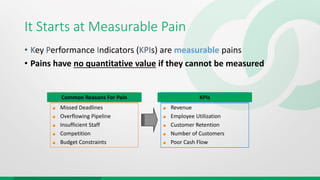
It Starts at Measurable Pain
• Key Performance Indicators (KPIs) are measurable pains
• Pains have no quantitative value if they cannot be measured
Missed Deadlines
Overflowing Pipeline
Insufficient Staff
Competition
Budget Constraints
Revenue
Employee Utilization
Customer Retention
Number of Customers
Poor Cash Flow
KPIsCommon Reasons For Pain
Cost Analysis: Best Practices
• Group costs into buckets
• For example, desktop and server solutions usually
have different cost buckets
• The key to effective costing is identifying the time spent on each activity - Work Breakdown Structure
• Recognize costs that should not be included in analysis
• Costs that would be incurred anyway
• e.g.., normal hardware refresh
• Costs not directly related to the project
• e.g., additional system changes
• Costs already incurred (sunk costs)
• e.g., operating system upgrades already completed
• Be sure to include all components
• Always perform “what-if” analysis
• Like benefits, get buy-in to defend numbers before presenting business value study
Business Process Value Modeling
• Study one process at a time – Survey to understand best opportunities
• Prerequisite: Work directly with the end user
• Physically map business process metrics to get buy-in
for process change
• Business managers are the source for pains and benefit equation variables
• Pain/KPI discussion drives business value versus productivity
• Keep equations simple
• Estimate process change metrics and then present them for approval if you can’t
get the numbers you need
• Get buy-in to defend numbers before presenting
How are you using SQL Server?
The business doesn’t care about SQL. They care about the capabilities
and the benefits to the business that SQL provides.
• Integration services
• Master data management
• High availability
• Data integrity
• Reporting and analytics
• KPIs and metrics
SQL Business Scenarios
• Enterprise reporting
• KPIs and metrics
• Financial reporting
• End user reports
• Sales reporting
• Point of sale analysis
• Production metrics
• Customer satisfaction
• Customer engagement
• Marketing metrics
The Business Challenges
Data - Then
• Easy to forget how far we have come
• The first computers most of us worked with had memory measured in
Kilobytes, and had no hard drives
• Most data captured was from accounting software, and didn’t add up even to
gigabytes
• Green bar reports and VisiCalc were state of the art…
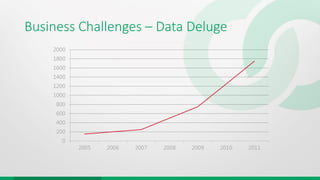
Business Challenges – Data Deluge
Data - Now
• New challenges have arisen
• Data is captured across most systems in an enterprise,
producing Petabytes of new raw data annually
• Integration across multiple source systems, is expected
• Access is expected to be instantaneous
• Data reliability and quality are critical
• Big data leading to huge influxes of data
• IOT is transforming the data landscape
• And many more…
The Business Priority
• Consolidate information from data
spread across the enterprise
• Manage data governance and quality
based on business knowledge
• Make faster, better business
decisions based on trusted data
“Exploiting business
data and information is
a nearly universal
priority for
organizations.”
– Gartner
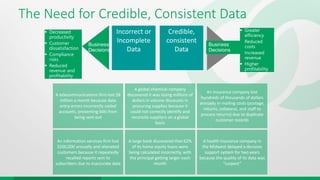
The Need for Credible, Consistent Data
A telecommunications firm lost $8
million a month because data
entry errors incorrectly coded
accounts, preventing bills from
being sent out
A global chemical company
discovered it was losing millions of
dollars in volume discounts in
procuring supplies because it
could not correctly identify and
reconcile suppliers on a global
basis
An insurance company lost
hundreds of thousands of dollars
annually in mailing costs (postage,
returns, collateral, and staff to
process returns) due to duplicate
customer records
An information services firm lost
$500,000 annually and alienated
customers because it repeatedly
recalled reports sent to
subscribers due to inaccurate data
A large bank discovered that 62%
of its home equity loans were
being calculated incorrectly, with
the principal getting larger each
month
A health insurance company in
the Midwest delayed a decision
support system for two years
because the quality of its data was
“suspect”








Business
Decisions
Incorrect or
Incomplete
Data
Credible,
consistent
Data
Business
Decisions
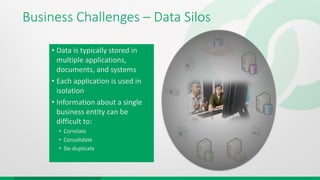
Business Challenges – Data Silos
• Data is typically stored in
multiple applications,
documents, and systems
• Each application is used in
isolation
• Information about a single
business entity can be
difficult to:
• Correlate
• Consolidate
• De-duplicate
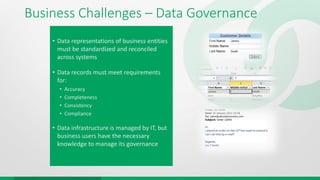
Business Challenges – Data Governance
• Data representations of business entities
must be standardized and reconciled
across systems
• Data records must meet requirements
for:
• Accuracy
• Completeness
• Consistency
• Compliance
• Data infrastructure is managed by IT, but
business users have the necessary
knowledge to manage its governance
Contributing factors
• Relentless advancements in technology
• Storage density
• Memory capacity
• Processing speed
• Improved 55% per year from 1986 - 2000
• Every decreasing costs per unit for CPU capacity, memory
and storage
• Ever increasing application of data capture for all kinds of
business and industrial proceses
Contributing Factors
• For every increase in CPU, Memory and storage capacity,
software vendors will introduce features to consume it.
• Some useful, some inane…
• And some insanely Great!
• Analysis Services
• SharePoint
• Excel/PowerPivot
What is next?
• Even larger data volumes
• Need to incorporate unstructured and external sources of data
• Geo-sensitive applications and analysis
• Integrate with cloud storage and services –
• “Mash-up” applications
• Self-Service BI
• Power BI
• “Agile” BI
• IOT
• Machine Learning
• Streaming Analytics
What to expect?
• Greater need than ever for data quality
• Data has to be trusted to be used effectively
• End-user capabilities cannot be ignored
• X64 platforms, dual quad-core CPU’s, Gigabytes of Memory,
and no-where to go…
• Greater need for access to data
• More Alerts/event trigger notifications
• Open sources of data being standardized
• ODATA standard, REST, ATOM data feeds
• Greater reliance on Network performance
• Cloud, cloud and more cloud
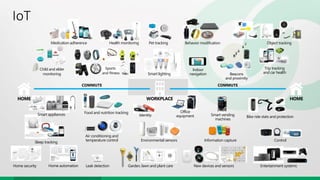
IoT
Sleep tracking
COMMUTE COMMUTE
Home security Home automation Leak detection
Smart appliances
Indoor
navigation
Health monitoring
Smart lighting
Pet tracking
Information capture
Trip tracking
and car health
Control
Child and elder
monitoring
Sports
and fitness
Air conditioning and
temperature control Environmental sensors
Behavior modification
Garden, lawn and plant care
Food and nutrition tracking
Beacons
and proximity
New devices and sensors
Object tracking
Identity Smart vending
machines
Medication adherence
Bike ride stats and protection
Entertainment systems
Office
equipment
HOME HOMEWORKPLACE
How do we get there from here?
• Provide a secure, stable platform for Information
delivery
• Ensure data integrity and quality across all operational
and reporting systems
• Empower analysts to produce out-of the box
• Enable business users to create compelling and useful
ad hoc reports
• Leverage the cloud
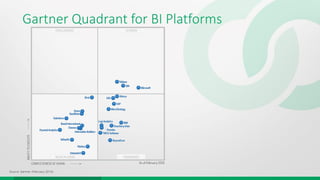
Gartner Quadrant for BI Platforms
• Microsoft's cloud-based delivery model and low per-user pricing offers a low TCO — one of the top three reasons
why customers selected it, in addition to ease of use for business users and the availability of skilled resources.
While Microsoft has long offered low per-user pricing, customers are advised to consider the TCO, which includes
hardware costs, development and support costs. Previously, Microsoft had a high cost of ownership in its on-
premises deployment model (despite low licensing costs), because of the complexity of implementing multiple
servers. The new Power BI addresses this issue with both a streamlined workflow for content authors and because
the hardware and server architecture is in the Microsoft Azure cloud.
• Microsoft ranks in the top quartile for achievement of business benefits, with high scores in its use for monetizing
data, improving customer service and increasing revenue, as well as delivering better insights to more users. As
customers move to business-user-led deployments, an emphasis on the achievement of business benefits at a
lower cost has driven much of the net new BI and analytics buying — in lieu of centrally provisioned, IT-authored
reporting platforms.
• Microsoft was ranked in the top quartile of Magic Quadrant vendors for user enablement (only Tableau ranked
slightly higher), with high scores for online tutorials, community support, conferences and documentation. The high
enablement scores also contributed to Microsoft's ranking in the top quartile for product success.
• Microsoft has continued to expand the number and variety of data sources it supports natively and has also
improved its partner network to build out connectors and content that includes prebuilt reports and dashboards.
For example, Microsoft now has prebuilt connectors (and content) to Facebook, Salesforce, Dynamics CRM, Google
Analytics, Zendesk and Marketo, to name a few.
Questions?
Bridging the gap between business and technology
Contact Me
mbowers@mailctp.com
618-972-2152
https://www.linkedin.com/in/matthew-bowers-ab8a932
https://www.facebook.com/matthew.w.bowers.1
@mbowersmailctp

SQL Saturday STL 2016 Presentation

  • 1.
    SQL and BusinessIntelligence Understanding and Establishing Business Value Bridging the gap between business and technology
  • 2.
    Agenda 1. Introduction 2. Whatthis session is not 3. Understanding Business Value 4. Purpose of a Business Case 5. Business Case components 6. Data Business Challenges and the Future 7. Digital Transformation
  • 3.
    About Me • Variedbackground and career • 12 years US Naval Service (Chief Petty Officer) • BS Allied Health • MA Counseling • 7 years Probation / corrections • Started working in technology in the Navy and through my corrections career • 12 Years CIO experience in mid market / mid size company • Broad and deep technical background • Multiple IT and technology certifications across multiple technology areas and stacks • Much more BS • 10 years as a Business Solutions consultant 3
  • 4.
    What this sessionis NOT • How to • Deep technical dive • Technical demo • SQL technical capabilities • What’s New etc. • Sales pitch 4
  • 5.
    What this sessionIS • Business focused • Business problem focused • Business driver focused • Business pain and requirement focused • Objective is to help IT / technology folks effectively bridge the gap between business and technology! 5
  • 6.
    Questions • How manyof you are IT team, staff or leadership? • How many of you are business? • How many are more of a hybrid?
  • 7.
    Questions • Who hasworked to budget for a SQL implementation? • How many of your organizations have a specific business case model that you use? • For what business solutions are you using SQL? • What is the value of a business case?
  • 8.
  • 9.
    Establishing Business Value- Terms • Business Drivers • Business Problem • Business Case • Business Value • Business Benefits
  • 10.
    Business Drivers • Whethermanagers plan to implement new-business processes or specify new technology, a proposed change in operations often involves a financial investment, forcing managers to make an effective business case that justifies the change. To make the case, managers must understand business drivers the change must support. • Simply put, it is critical to show the way the proposed change will better align the organization with its mission. It must show the way this proposed project’s measurable benefits will outweigh potential risks. Managers should consider the primary business drivers. One major global facilities organization identified its top five business drivers as:
  • 11.
    Business Drivers • elevatethe level of consistency and quality of services across the entire portfolio and automate standardized business processes by using enabling technology • shift time spent on labor-intensive activities to higher value-add activities • achieve data transparency to allow visibility and timely access to data at all levels of the organization • leverage technology as a resource to scale for increasing client demands, while reducing the cost of providing those services • support professional staff by freeing up their time for core activities, aid in career growth, and make the collective institutional knowledge available for the entire organization.
  • 12.
    Business Problem Well-defined problemslead to breakthrough solutions. When developing new products, processes, or even businesses, most companies aren’t sufficiently rigorous in defining the problems they’re attempting to solve and articulating why those issues are important. Without that rigor, organizations miss opportunities, waste resources, and end up pursuing innovation initiatives that aren’t aligned with their strategies. How many times have you seen a project go down one path only to realize in hindsight that it should have gone down another? How many times have you seen an innovation program deliver a seemingly breakthrough result only to find that it can’t be implemented or it addresses the wrong problem? Many organizations need to become better at asking the right questions so that they tackle the right problems. Harvard Business Review
  • 13.
    Business Benefits A businessbenefit can be defined as an outcome of an action or decision that contributes towards meeting one or more business objectives.
  • 14.
    What is aBusiness Case • A business case captures the reasoning for initiating a project or task. It is often presented in a well-structured written document, but may also sometimes come in the form of a short verbal argument or presentation. • The logic of the business case is that, whenever resources such as money or effort are consumed, they should be in support of a specific business need
  • 15.
    Why Use aBusiness Case You’ve got a great idea for a new product that will increase revenue or a new system that will cut the company’s costs. But how can you be sure that it’s a worthwhile investment? Any time you propose a capital expenditure, you can be sure senior leaders will want to know what the return on investment (ROI) is. There are a variety of methods you can use to calculate ROI — net present value, payback, breakeven — and internal rate of return, or IRR.
  • 16.
    Why use aBusiness Case? • SQL Server like every business technology is an investment • Before making an investment you should always know your expected return • Business Case Formulas (will not go into these in detail): • Net Present Value (NPV) • Return on Investment (ROI) • Rate of Return (ROR) • Internal Rate of Return (IRR) • Cost Benefit Analysis
  • 17.
    Why use aBusiness Case • Focus requirements/scope on capabilities that will deliver Value • Useful for managing scope change • Beginning of the Organization Change Management Process – Ensure Users will use the system • Level of Precision • Depends on Maturity of the Plan • Organization Culture – what is your culture? • Make and document assumptions
  • 18.
    Business Case Components •Basic Components • Costs, • Benefits, • Risk, • Time • People tend to focus on Costs
  • 19.
    It Starts atMeasurable Pain • Key Performance Indicators (KPIs) are measurable pains • Pains have no quantitative value if they cannot be measured Missed Deadlines Overflowing Pipeline Insufficient Staff Competition Budget Constraints Revenue Employee Utilization Customer Retention Number of Customers Poor Cash Flow KPIsCommon Reasons For Pain
  • 20.
    Cost Analysis: BestPractices • Group costs into buckets • For example, desktop and server solutions usually have different cost buckets • The key to effective costing is identifying the time spent on each activity - Work Breakdown Structure • Recognize costs that should not be included in analysis • Costs that would be incurred anyway • e.g.., normal hardware refresh • Costs not directly related to the project • e.g., additional system changes • Costs already incurred (sunk costs) • e.g., operating system upgrades already completed • Be sure to include all components • Always perform “what-if” analysis • Like benefits, get buy-in to defend numbers before presenting business value study
  • 21.
    Business Process ValueModeling • Study one process at a time – Survey to understand best opportunities • Prerequisite: Work directly with the end user • Physically map business process metrics to get buy-in for process change • Business managers are the source for pains and benefit equation variables • Pain/KPI discussion drives business value versus productivity • Keep equations simple • Estimate process change metrics and then present them for approval if you can’t get the numbers you need • Get buy-in to defend numbers before presenting
  • 22.
    How are youusing SQL Server? The business doesn’t care about SQL. They care about the capabilities and the benefits to the business that SQL provides. • Integration services • Master data management • High availability • Data integrity • Reporting and analytics • KPIs and metrics
  • 23.
    SQL Business Scenarios •Enterprise reporting • KPIs and metrics • Financial reporting • End user reports • Sales reporting • Point of sale analysis • Production metrics • Customer satisfaction • Customer engagement • Marketing metrics
  • 24.
  • 25.
    Data - Then •Easy to forget how far we have come • The first computers most of us worked with had memory measured in Kilobytes, and had no hard drives • Most data captured was from accounting software, and didn’t add up even to gigabytes • Green bar reports and VisiCalc were state of the art…
  • 26.
  • 27.
    Data - Now •New challenges have arisen • Data is captured across most systems in an enterprise, producing Petabytes of new raw data annually • Integration across multiple source systems, is expected • Access is expected to be instantaneous • Data reliability and quality are critical • Big data leading to huge influxes of data • IOT is transforming the data landscape • And many more…
  • 28.
    The Business Priority •Consolidate information from data spread across the enterprise • Manage data governance and quality based on business knowledge • Make faster, better business decisions based on trusted data “Exploiting business data and information is a nearly universal priority for organizations.” – Gartner
  • 29.
    The Need forCredible, Consistent Data A telecommunications firm lost $8 million a month because data entry errors incorrectly coded accounts, preventing bills from being sent out A global chemical company discovered it was losing millions of dollars in volume discounts in procuring supplies because it could not correctly identify and reconcile suppliers on a global basis An insurance company lost hundreds of thousands of dollars annually in mailing costs (postage, returns, collateral, and staff to process returns) due to duplicate customer records An information services firm lost $500,000 annually and alienated customers because it repeatedly recalled reports sent to subscribers due to inaccurate data A large bank discovered that 62% of its home equity loans were being calculated incorrectly, with the principal getting larger each month A health insurance company in the Midwest delayed a decision support system for two years because the quality of its data was “suspect”         Business Decisions Incorrect or Incomplete Data Credible, consistent Data Business Decisions
  • 30.
    Business Challenges –Data Silos • Data is typically stored in multiple applications, documents, and systems • Each application is used in isolation • Information about a single business entity can be difficult to: • Correlate • Consolidate • De-duplicate
  • 31.
    Business Challenges –Data Governance • Data representations of business entities must be standardized and reconciled across systems • Data records must meet requirements for: • Accuracy • Completeness • Consistency • Compliance • Data infrastructure is managed by IT, but business users have the necessary knowledge to manage its governance
  • 32.
    Contributing factors • Relentlessadvancements in technology • Storage density • Memory capacity • Processing speed • Improved 55% per year from 1986 - 2000 • Every decreasing costs per unit for CPU capacity, memory and storage • Ever increasing application of data capture for all kinds of business and industrial proceses
  • 33.
    Contributing Factors • Forevery increase in CPU, Memory and storage capacity, software vendors will introduce features to consume it. • Some useful, some inane… • And some insanely Great! • Analysis Services • SharePoint • Excel/PowerPivot
  • 34.
    What is next? •Even larger data volumes • Need to incorporate unstructured and external sources of data • Geo-sensitive applications and analysis • Integrate with cloud storage and services – • “Mash-up” applications • Self-Service BI • Power BI • “Agile” BI • IOT • Machine Learning • Streaming Analytics
  • 35.
    What to expect? •Greater need than ever for data quality • Data has to be trusted to be used effectively • End-user capabilities cannot be ignored • X64 platforms, dual quad-core CPU’s, Gigabytes of Memory, and no-where to go… • Greater need for access to data • More Alerts/event trigger notifications • Open sources of data being standardized • ODATA standard, REST, ATOM data feeds • Greater reliance on Network performance • Cloud, cloud and more cloud
  • 36.
    IoT Sleep tracking COMMUTE COMMUTE Homesecurity Home automation Leak detection Smart appliances Indoor navigation Health monitoring Smart lighting Pet tracking Information capture Trip tracking and car health Control Child and elder monitoring Sports and fitness Air conditioning and temperature control Environmental sensors Behavior modification Garden, lawn and plant care Food and nutrition tracking Beacons and proximity New devices and sensors Object tracking Identity Smart vending machines Medication adherence Bike ride stats and protection Entertainment systems Office equipment HOME HOMEWORKPLACE
  • 37.
    How do weget there from here? • Provide a secure, stable platform for Information delivery • Ensure data integrity and quality across all operational and reporting systems • Empower analysts to produce out-of the box • Enable business users to create compelling and useful ad hoc reports • Leverage the cloud
  • 38.
  • 39.
    Gartner Quadrant forBI Platforms • Microsoft's cloud-based delivery model and low per-user pricing offers a low TCO — one of the top three reasons why customers selected it, in addition to ease of use for business users and the availability of skilled resources. While Microsoft has long offered low per-user pricing, customers are advised to consider the TCO, which includes hardware costs, development and support costs. Previously, Microsoft had a high cost of ownership in its on- premises deployment model (despite low licensing costs), because of the complexity of implementing multiple servers. The new Power BI addresses this issue with both a streamlined workflow for content authors and because the hardware and server architecture is in the Microsoft Azure cloud. • Microsoft ranks in the top quartile for achievement of business benefits, with high scores in its use for monetizing data, improving customer service and increasing revenue, as well as delivering better insights to more users. As customers move to business-user-led deployments, an emphasis on the achievement of business benefits at a lower cost has driven much of the net new BI and analytics buying — in lieu of centrally provisioned, IT-authored reporting platforms. • Microsoft was ranked in the top quartile of Magic Quadrant vendors for user enablement (only Tableau ranked slightly higher), with high scores for online tutorials, community support, conferences and documentation. The high enablement scores also contributed to Microsoft's ranking in the top quartile for product success. • Microsoft has continued to expand the number and variety of data sources it supports natively and has also improved its partner network to build out connectors and content that includes prebuilt reports and dashboards. For example, Microsoft now has prebuilt connectors (and content) to Facebook, Salesforce, Dynamics CRM, Google Analytics, Zendesk and Marketo, to name a few.
  • 40.
    Questions? Bridging the gapbetween business and technology
  • 41.