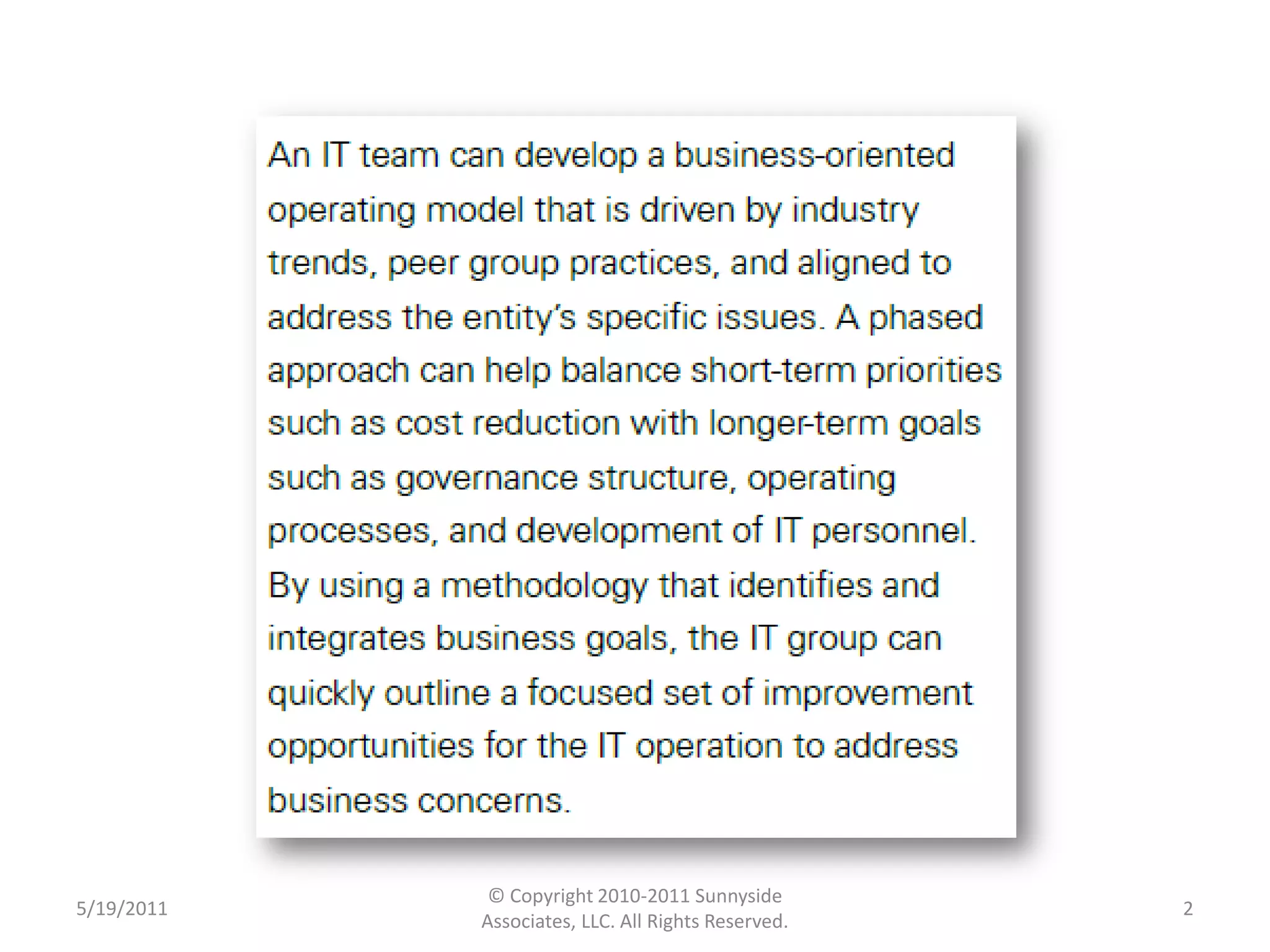
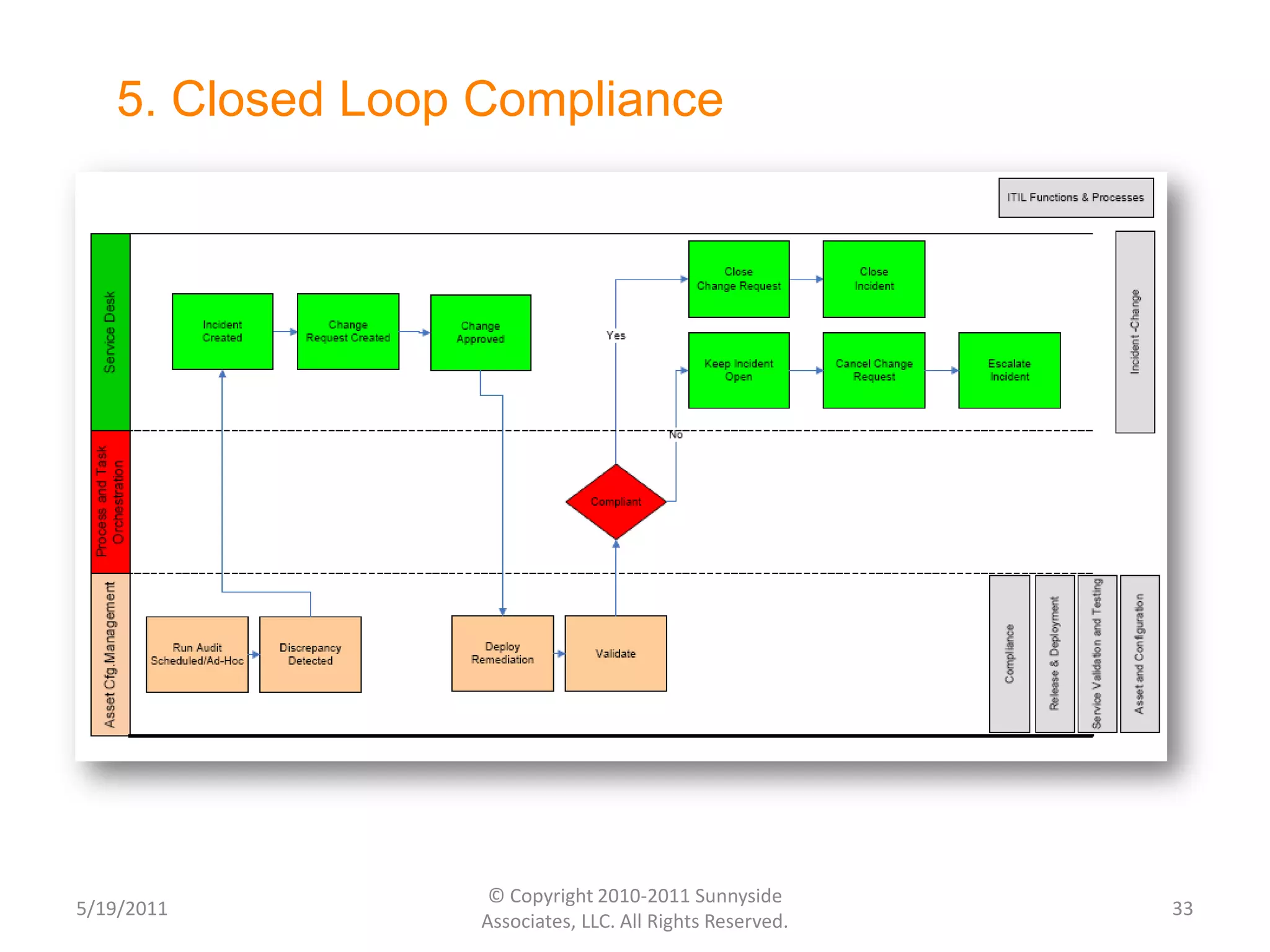
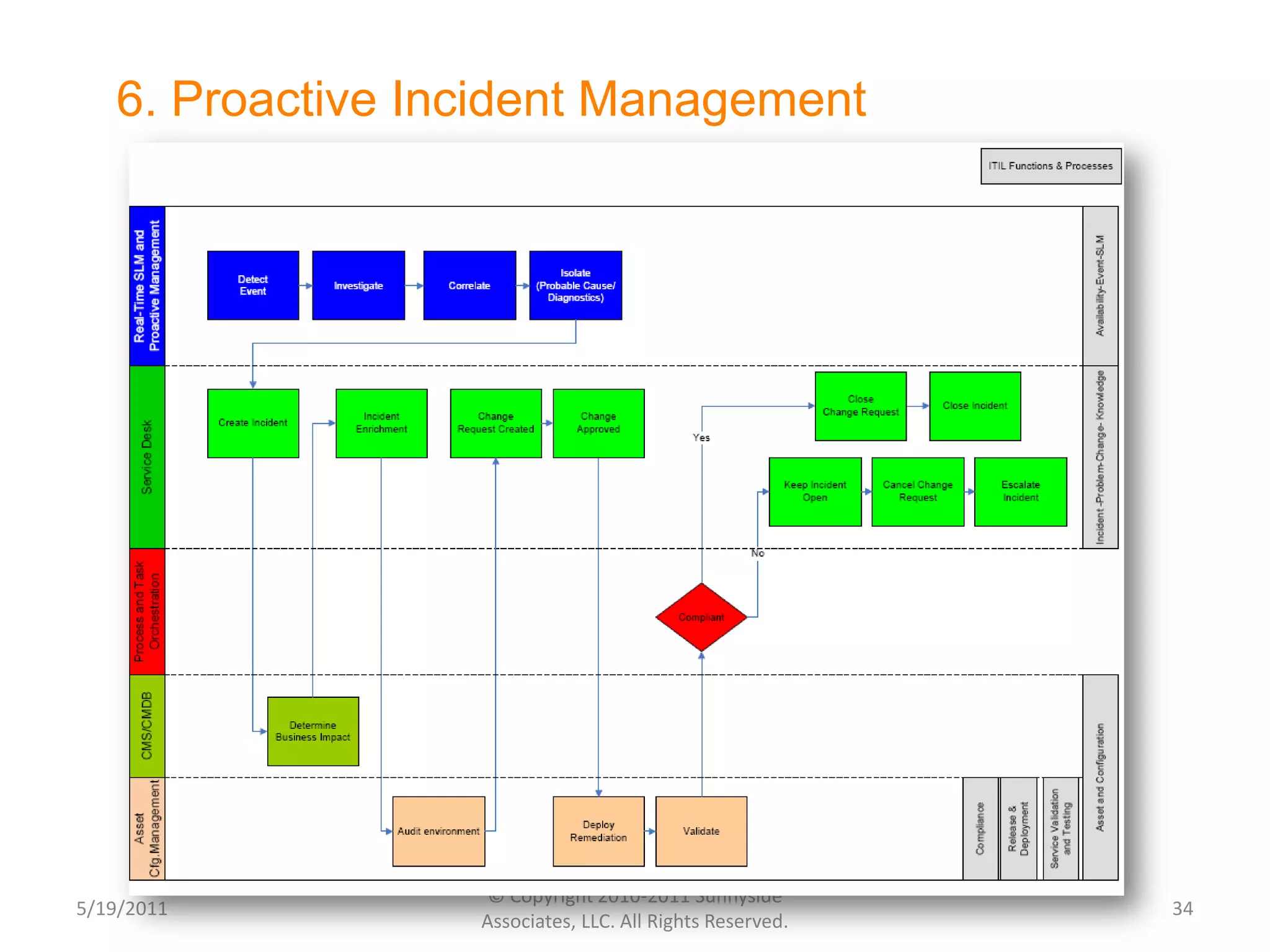
The document outlines an operating model design for managed IT services. It includes discussions of key elements like processes, governance, sourcing, services, and measurement. The agenda covers assumptions, operating model scope, value proposition, design approach, a high-level process model mapped to ITIL processes, how the model can be used for business planning, candidate operational flows, and next steps. The goal is to design an efficient operating model that improves customer experience, revenue, and organizational maturity through best practices like ITIL.
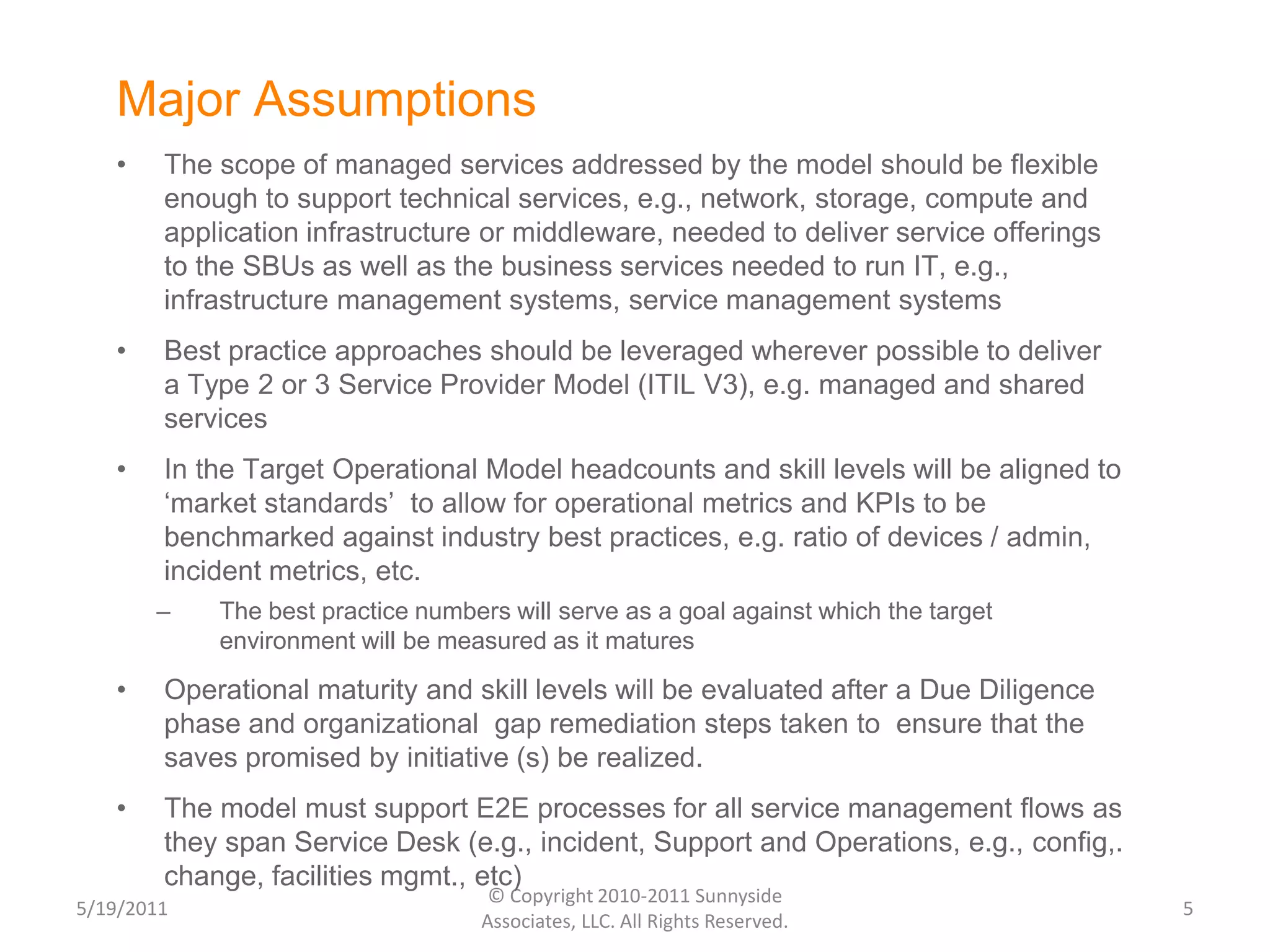
Major AssumptionsThe scopeof managed services addressed by the model should be flexible enough to support technical services, e.g., network, storage, compute and application infrastructure or middleware, needed to deliver service offerings to the SBUs as well as the business services needed to run IT, e.g., infrastructure management systems, service management systemsBest practice approaches should be leveraged wherever possible to deliver a Type 2 or 3 Service Provider Model (ITIL V3), e.g. managed and shared servicesIn the Target Operational Model headcounts and skill levels will be aligned to ‘market standards’ to allow for operational metrics and KPIs to be benchmarked against industry best practices, e.g. ratio of devices / admin, incident metrics, etc. The best practice numbers will serve as a goal against which the target environment will be measured as it maturesOperational maturity and skill levels will be evaluated after a Due Diligence phase and organizational gap remediation steps taken to ensure that the saves promised by initiative (s) be realized.The model must support E2E processes for all service management flows as they span Service Desk (e.g., incident, Support and Operations, e.g., config,. change, facilities mgmt., etc)
6.
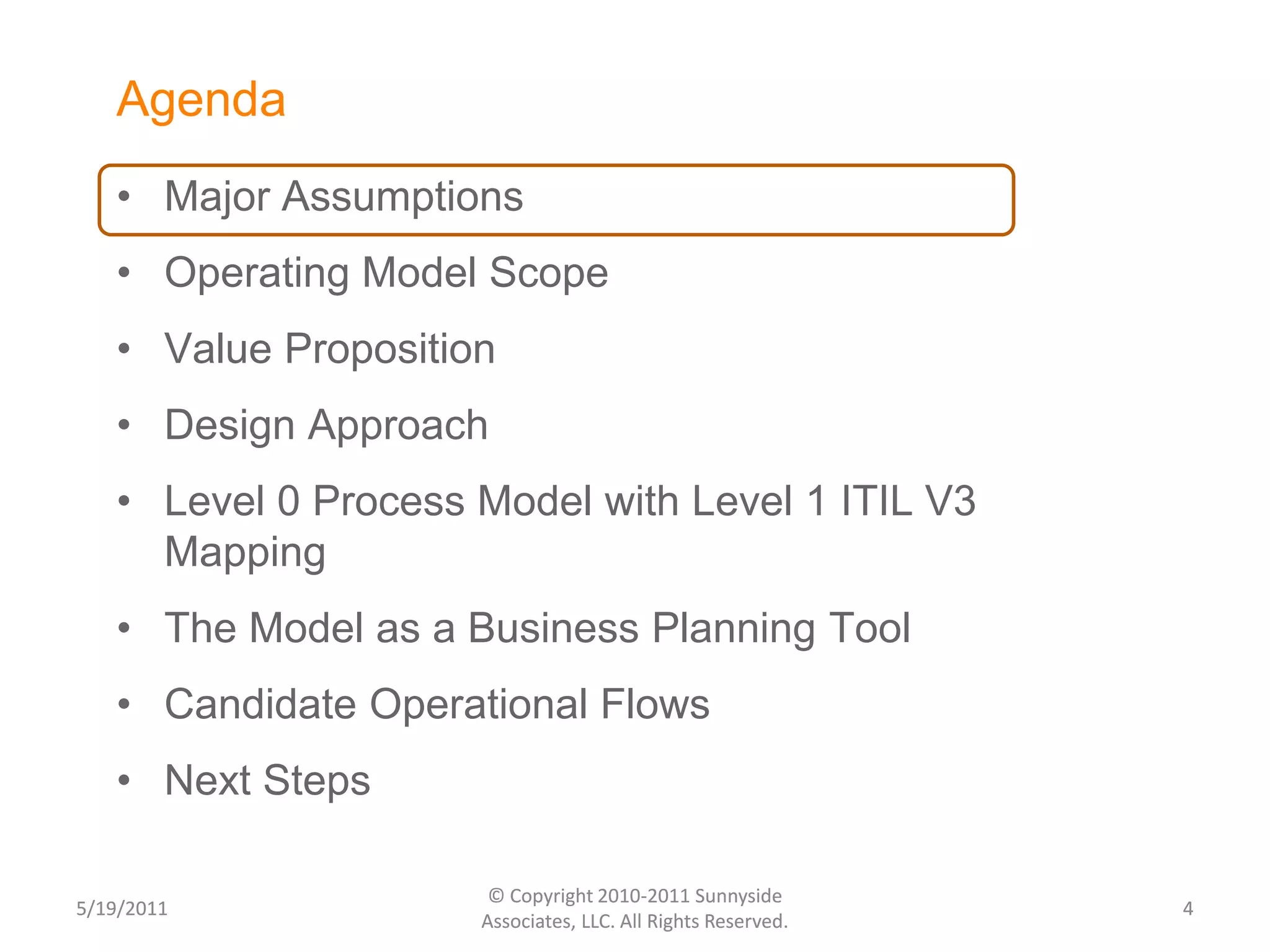
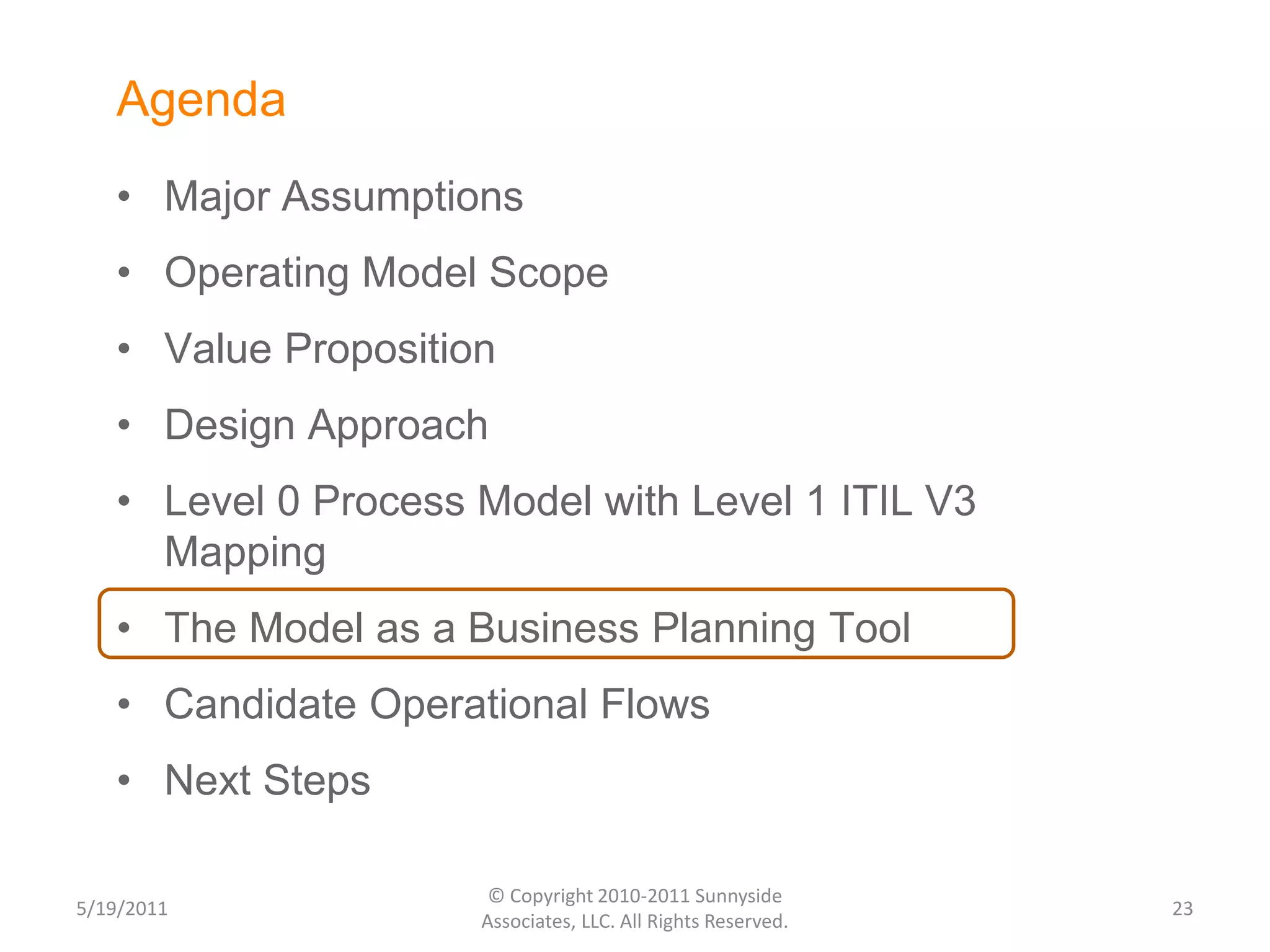
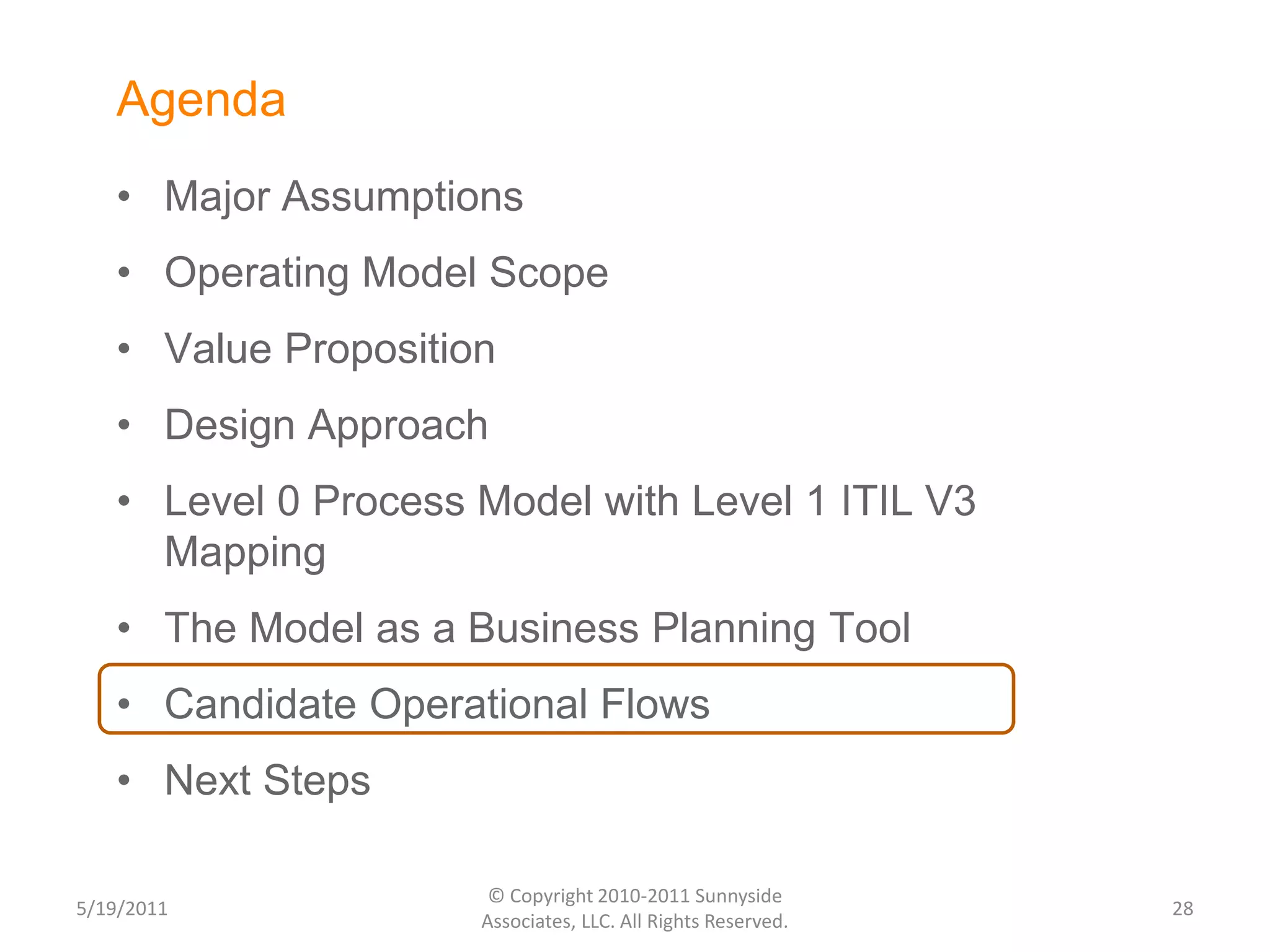
AgendaMajor AssumptionsOperating ModelScopeValue PropositionDesign ApproachLevel 0 Process Model with Level 1 ITIL V3 MappingThe Model as a Business Planning ToolCandidate Operational FlowsNext Steps
23.
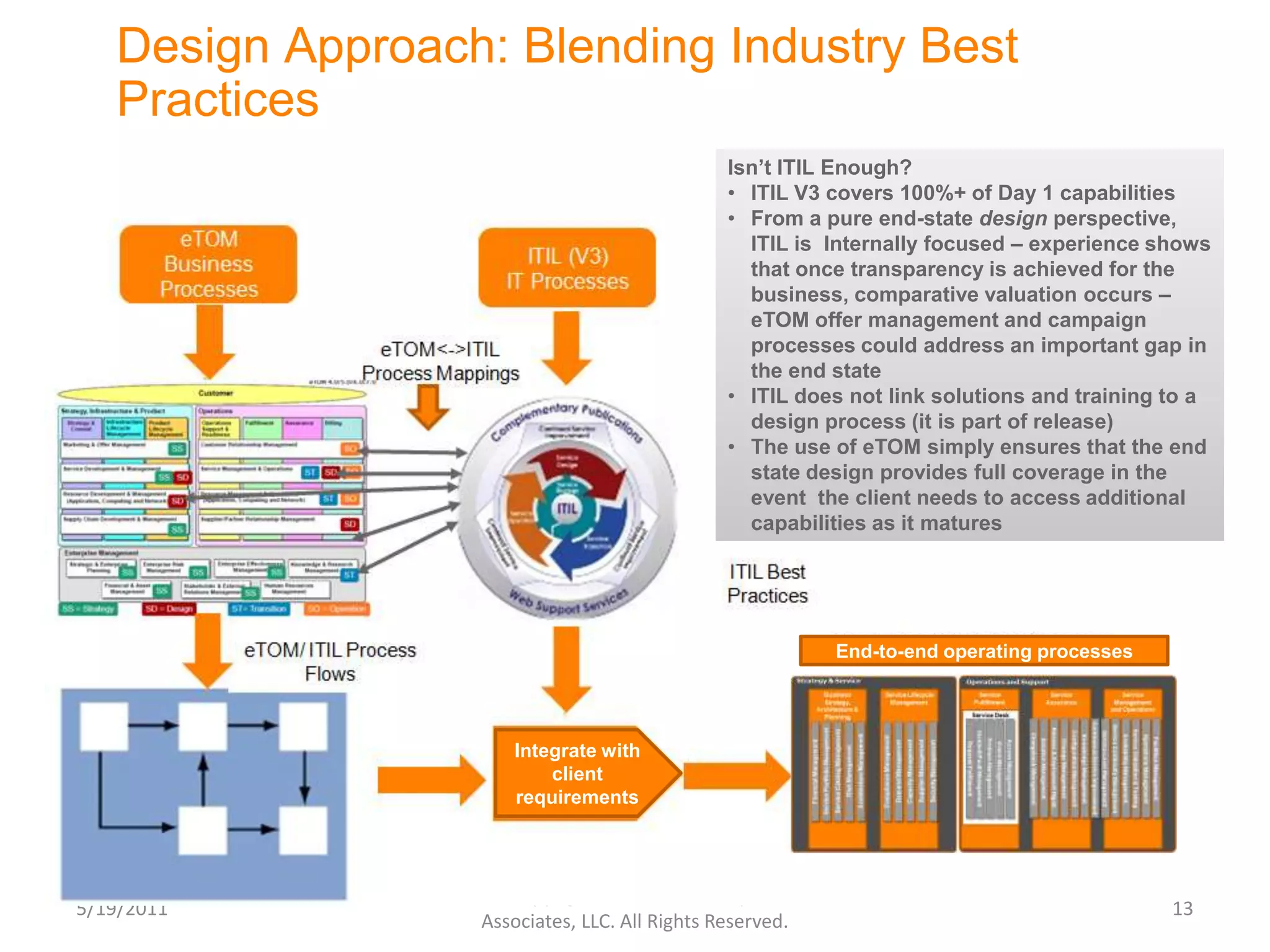
Design Approach: BlendingIndustry Best PracticesIsn’t ITIL Enough?ITIL V3 covers 100%+ of Day 1 capabilities
24.
From a pureend-state design perspective, ITIL is Internally focused – experience shows that once transparency is achieved for the business, comparative valuation occurs – eTOM offer management and campaign processes could address an important gap in the end state
25.
ITIL does notlink solutions and training to a design process (it is part of release)
26.
The use ofeTOM simply ensures that the end state design provides full coverage in the event the client needs to access additional capabilities as it maturesEnd-to-end operating processesIntegrate with client requirements
27.
AgendaMajor AssumptionsOperating ModelScopeValue PropositionDesign ApproachLevel 0 Process Model with Level 1 ITIL V3 MappingThe Model as a Business Planning ToolCandidate Operational FlowsNext Steps
28.
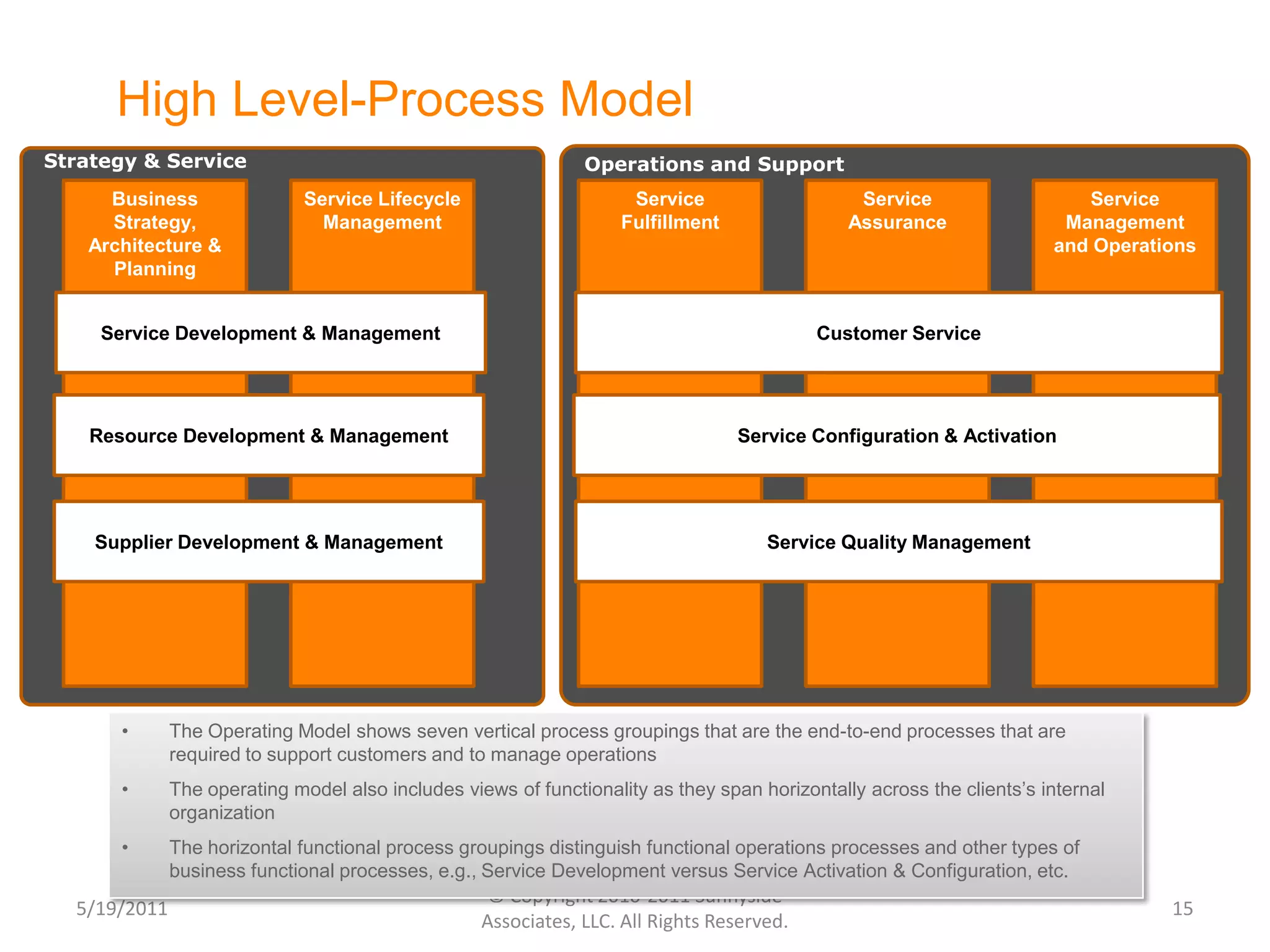
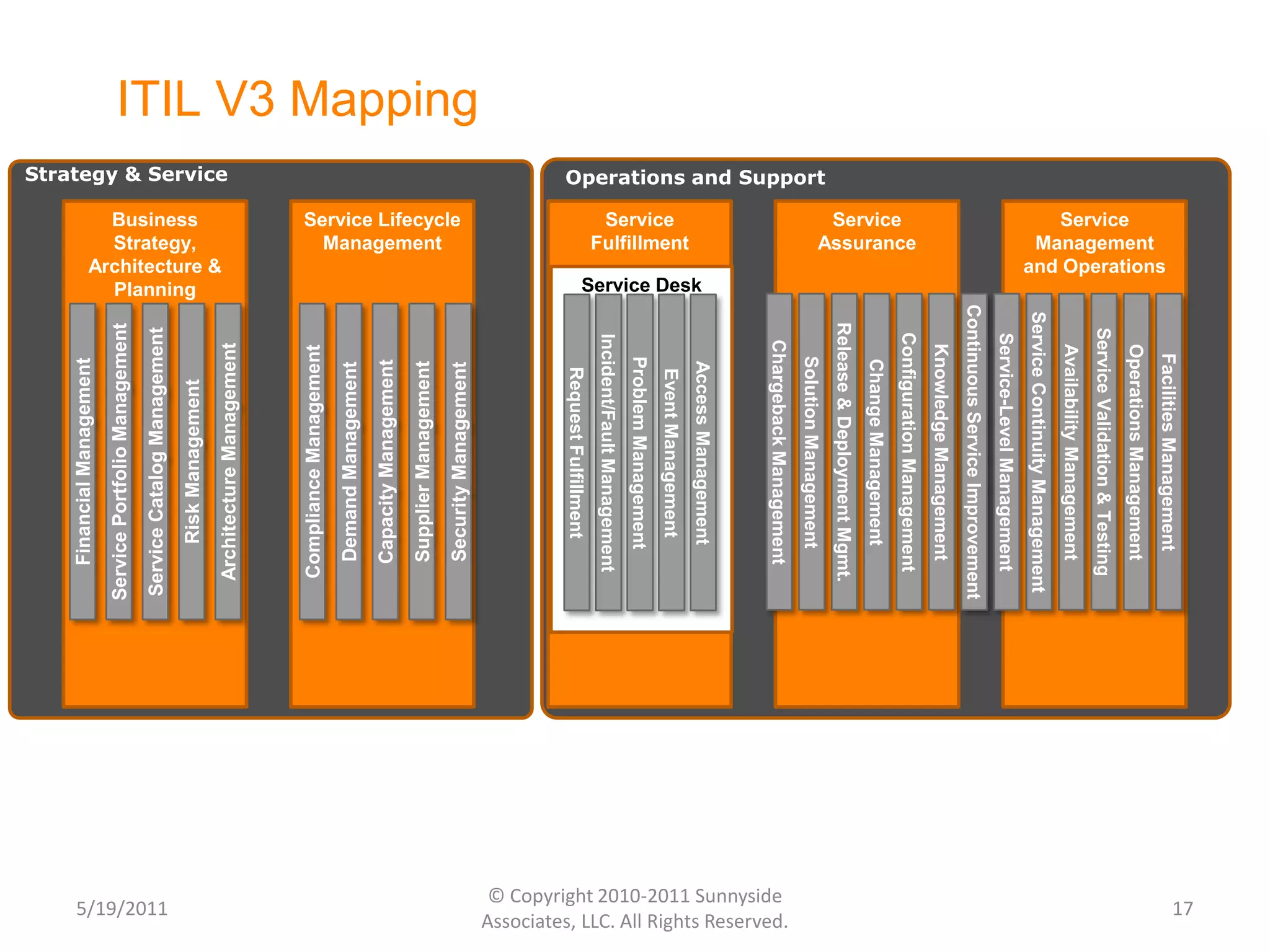
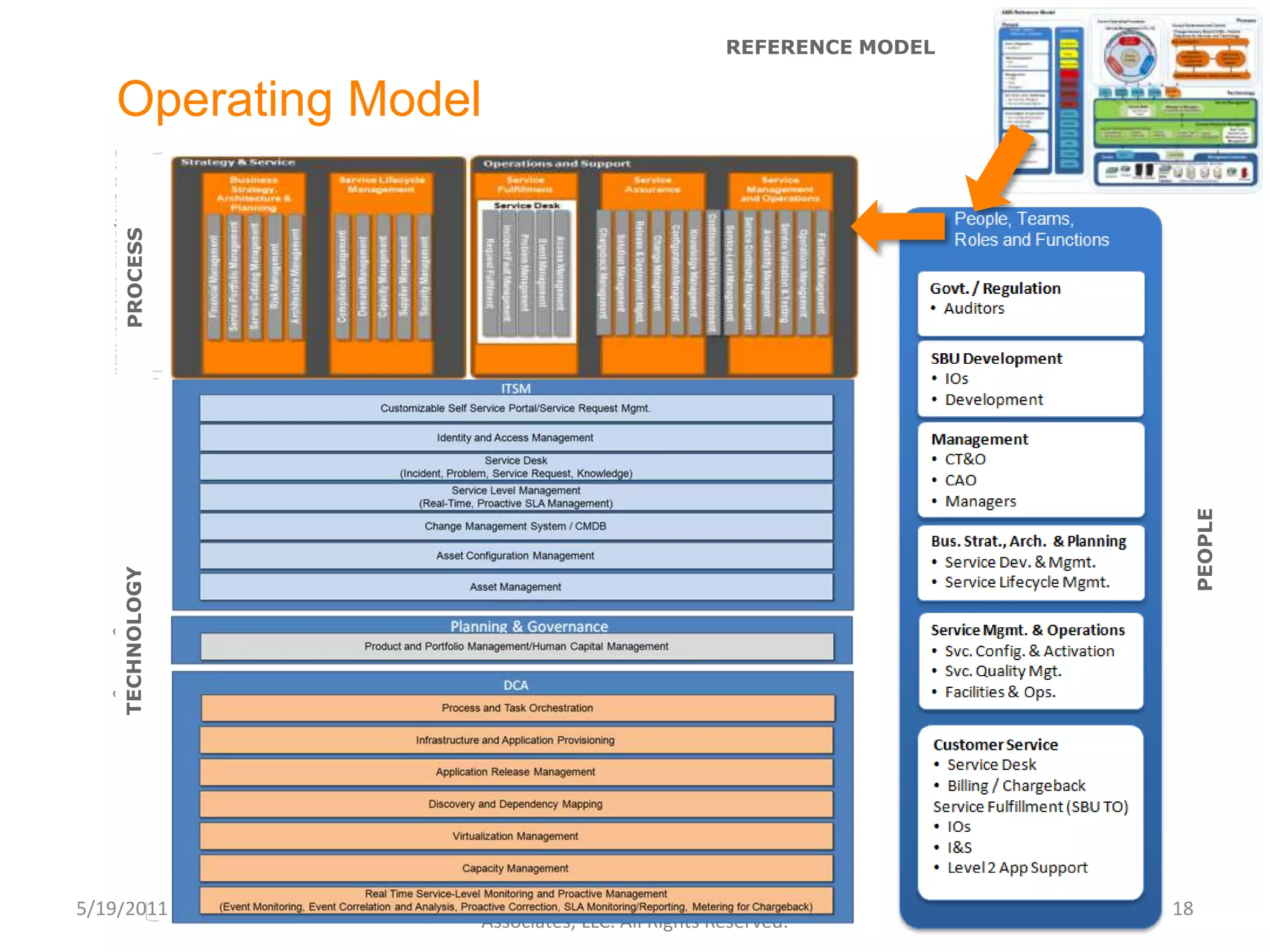
Strategy & ServiceOperations and SupportHigh Level-Process ModelService Lifecycle ManagementBusiness Strategy, Architecture & PlanningService Management and OperationsService FulfillmentService AssuranceCustomer ServiceService Development & ManagementService Configuration & ActivationResource Development & ManagementService Quality ManagementSupplier Development & ManagementThe Operating Model shows seven vertical process groupings that are the end-to-end processes that are required to support customers and to manage operations
29.
The operating modelalso includes views of functionality as they span horizontally across the clients’s internal organization
30.
The horizontal functionalprocess groupings distinguish functional operations processes and other types of business functional processes, e.g., Service Development versus Service Activation & Configuration, etc.Operating Model E2E ProcessesBuilt on industry best practice business and IT process modelsAddresses all of end-to-end processes needed to deliver Managed Services to customers - Includes Strategy and Service: “Enabling” processes of Business Strategy, Architecture & Planning, includingService Lifecycle Management and Service Development & ManagementOperations and Support: “Lights on,” or core operations processes of Customer Service, Service Management and Operations, including Operations Support, Billing/Chargeback, Service Desk, Service Development and ManagementService Configuration & Activation, Service Quality Management, Facilities and Operations
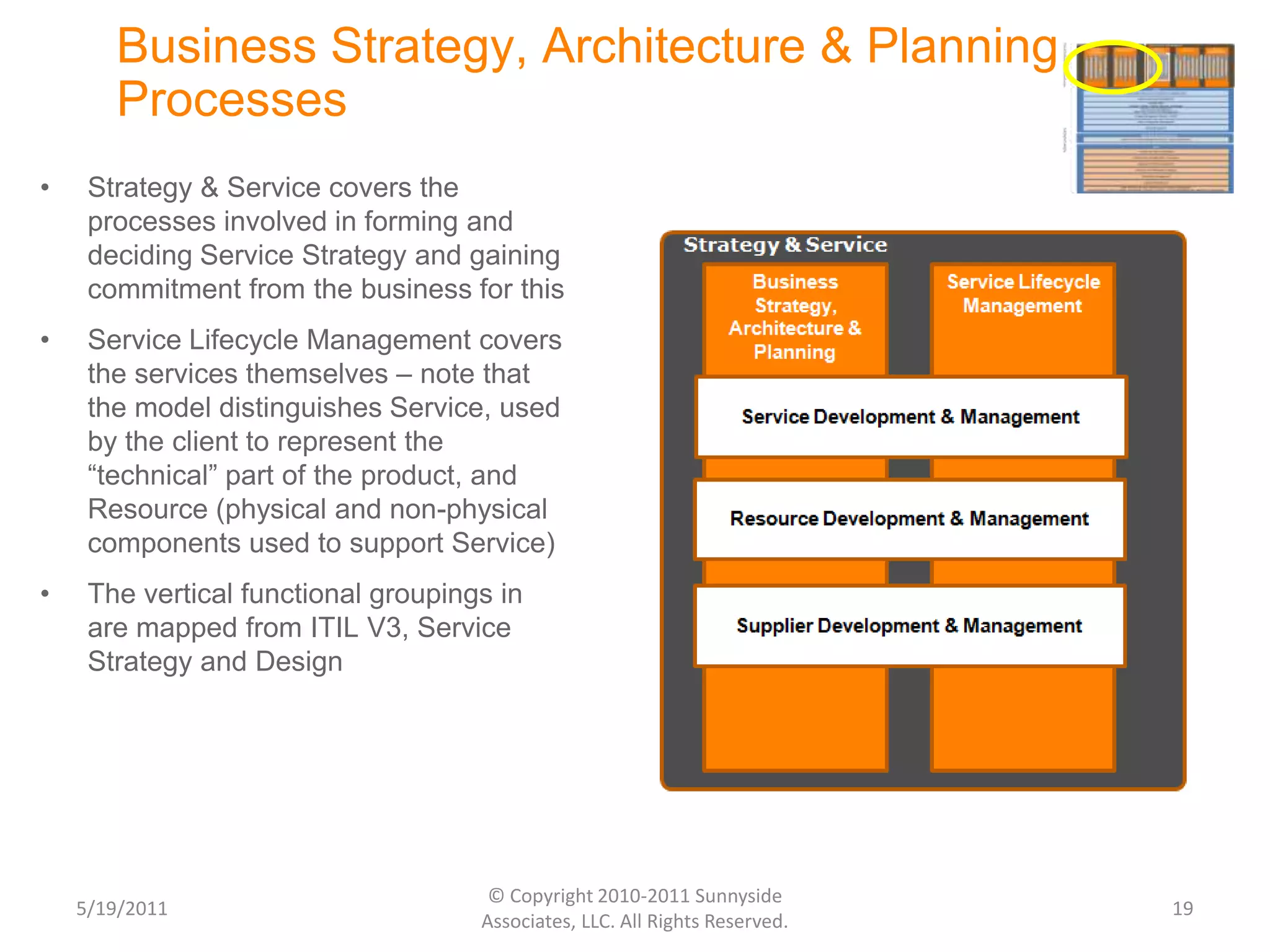
Strategy & Servicecovers the processes involved in forming and deciding Service Strategy and gaining commitment from the business for thisService Lifecycle Management covers the services themselves – note that the model distinguishes Service, used by the client to represent the “technical” part of the product, and Resource (physical and non-physical components used to support Service)The vertical functional groupings in are mapped from ITIL V3, Service Strategy and DesignBusiness Strategy, Architecture & Planning Processes
34.
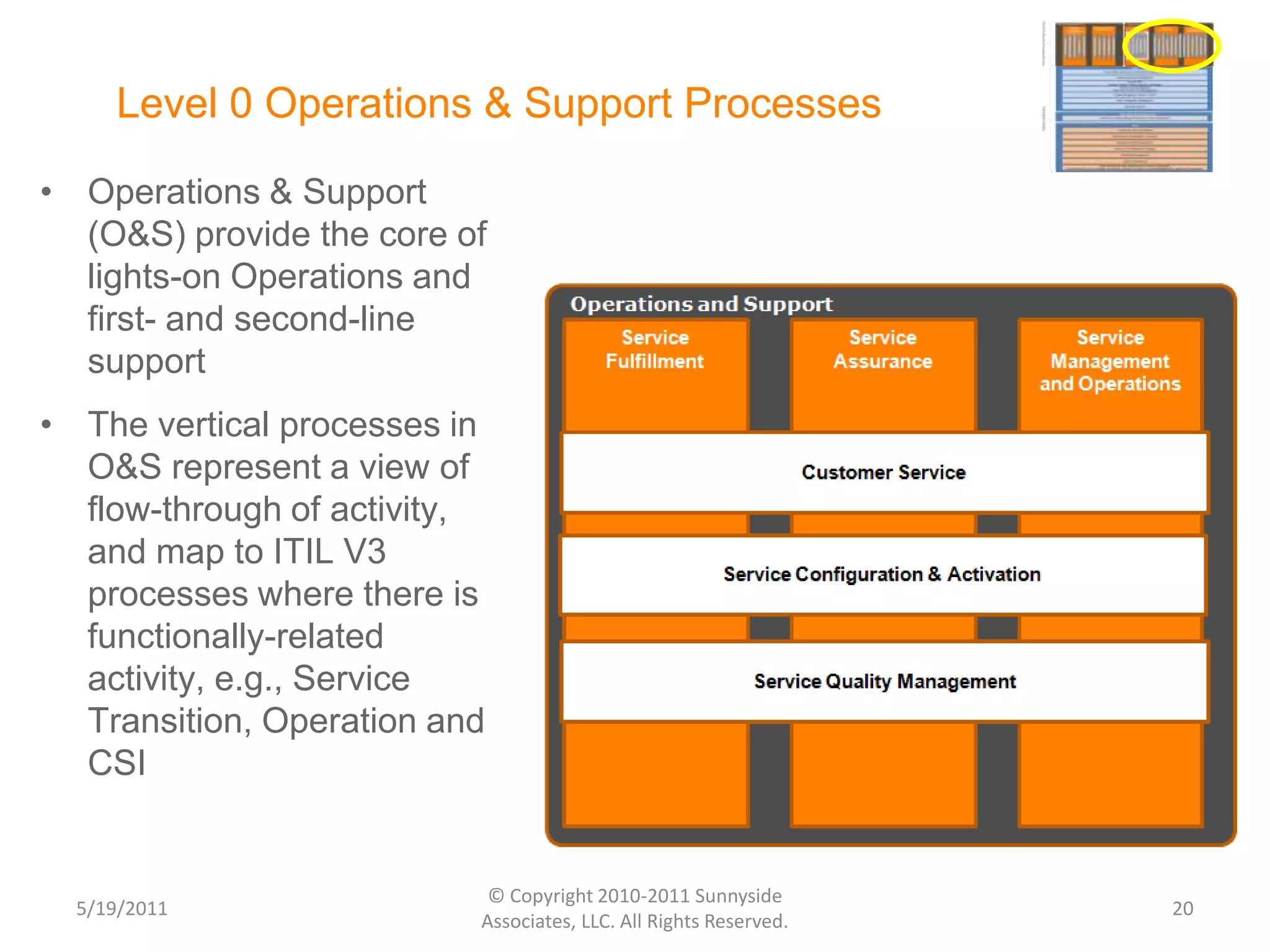
Level 0 Operations& Support ProcessesOperations & Support (O&S) provide the core of lights-on Operations and first- and second-line supportThe vertical processes in O&S represent a view of flow-through of activity, and map to ITIL V3 processes where there is functionally-related activity, e.g., Service Transition, Operation and CSI
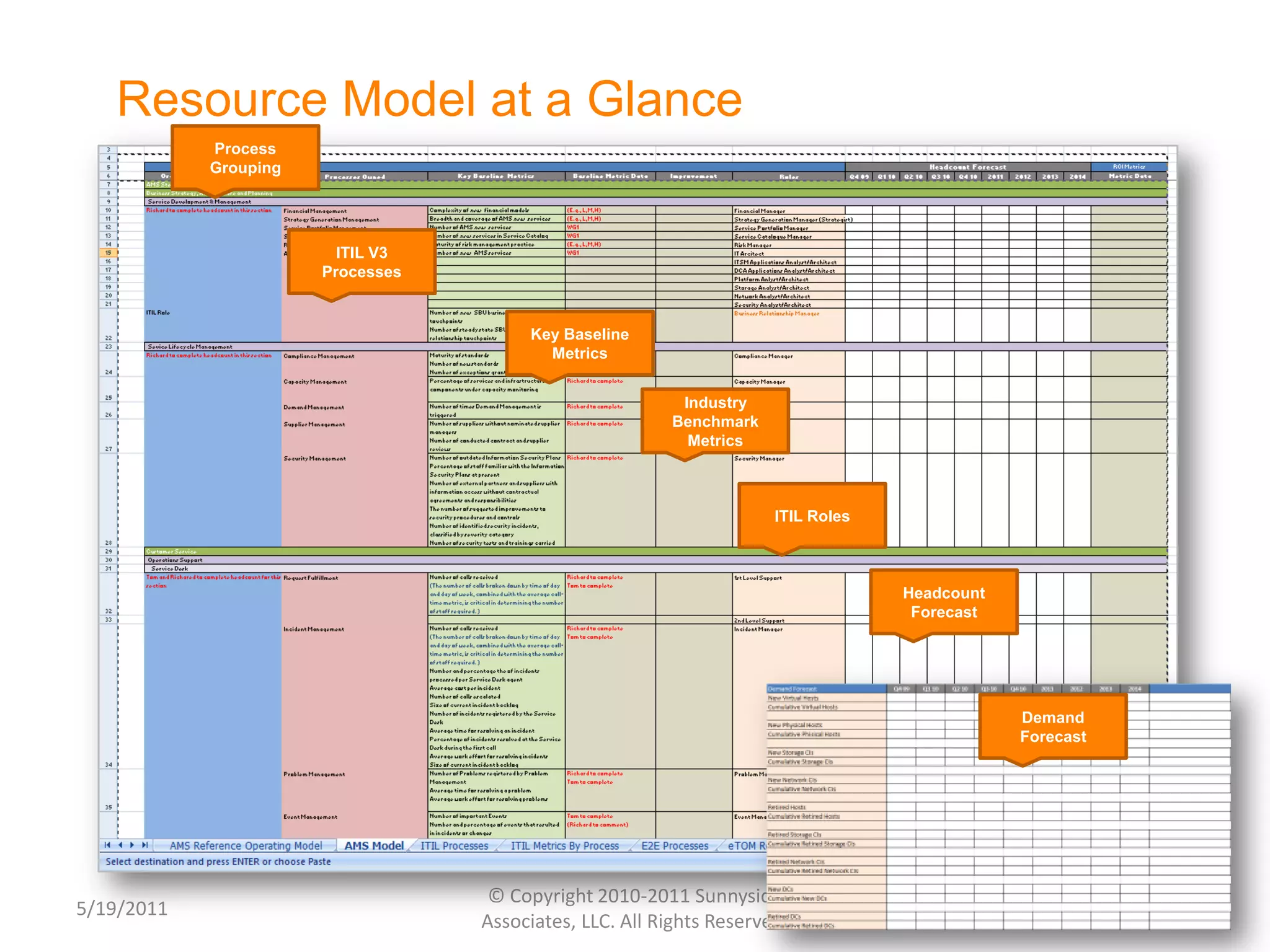
Resource Model ata GlanceProcess GroupingITIL V3 ProcessesKey Baseline MetricsIndustry Benchmark MetricsITIL RolesHeadcount ForecastDemandForecast
37.
AgendaMajor AssumptionsOperating ModelScopeValue PropositionDesign ApproachLevel 0 Process Model with Level 1 ITIL V3 MappingThe Model as a Business Planning ToolCandidate Operational FlowsNext Steps
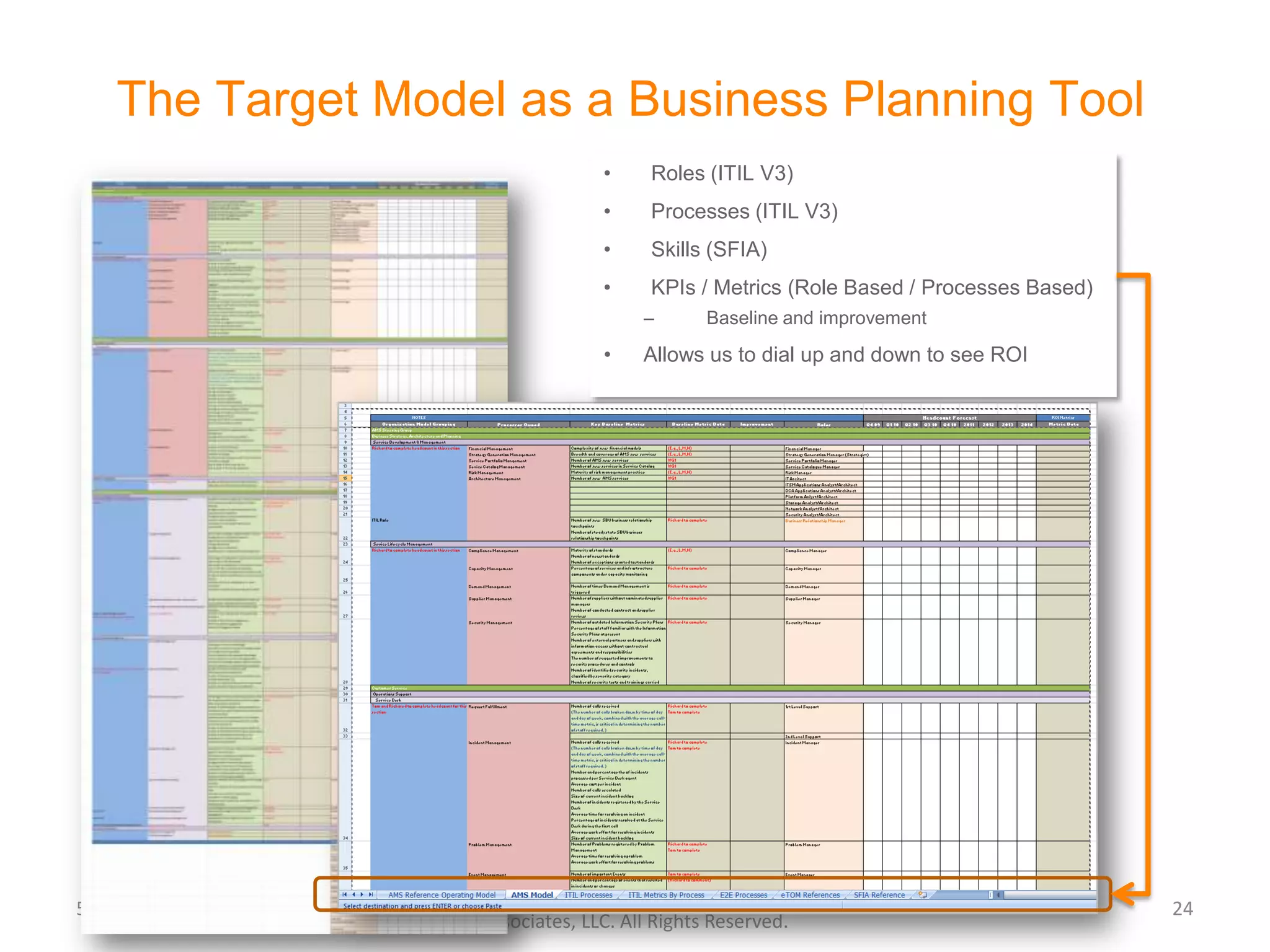
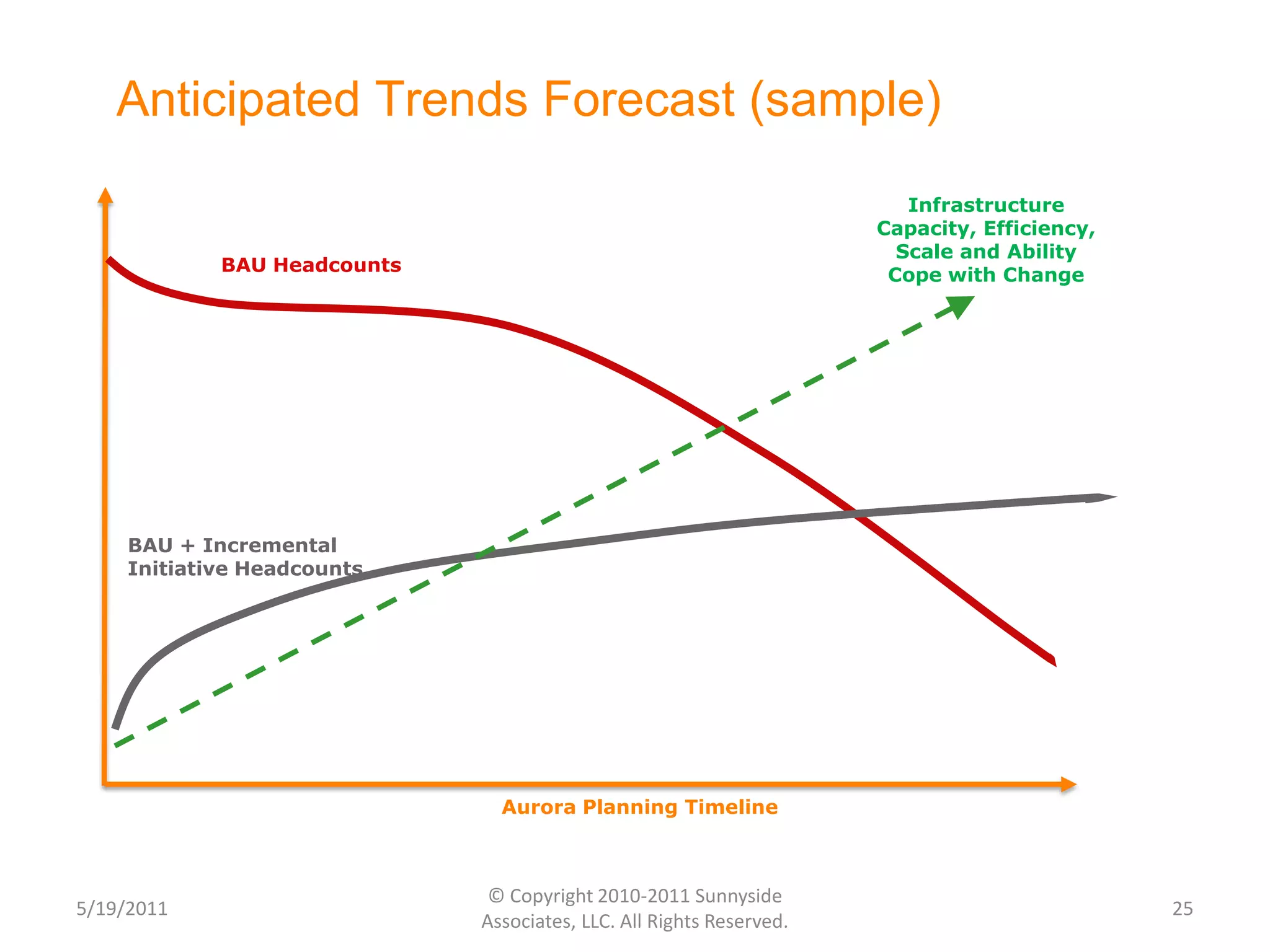
Allows us todial up and down to see ROIAnticipated Trends Forecast (sample)Infrastructure Capacity, Efficiency, Scale and Ability Cope with ChangeBAU HeadcountsBAU + Incremental Initiative HeadcountsAurora Planning Timeline
44.
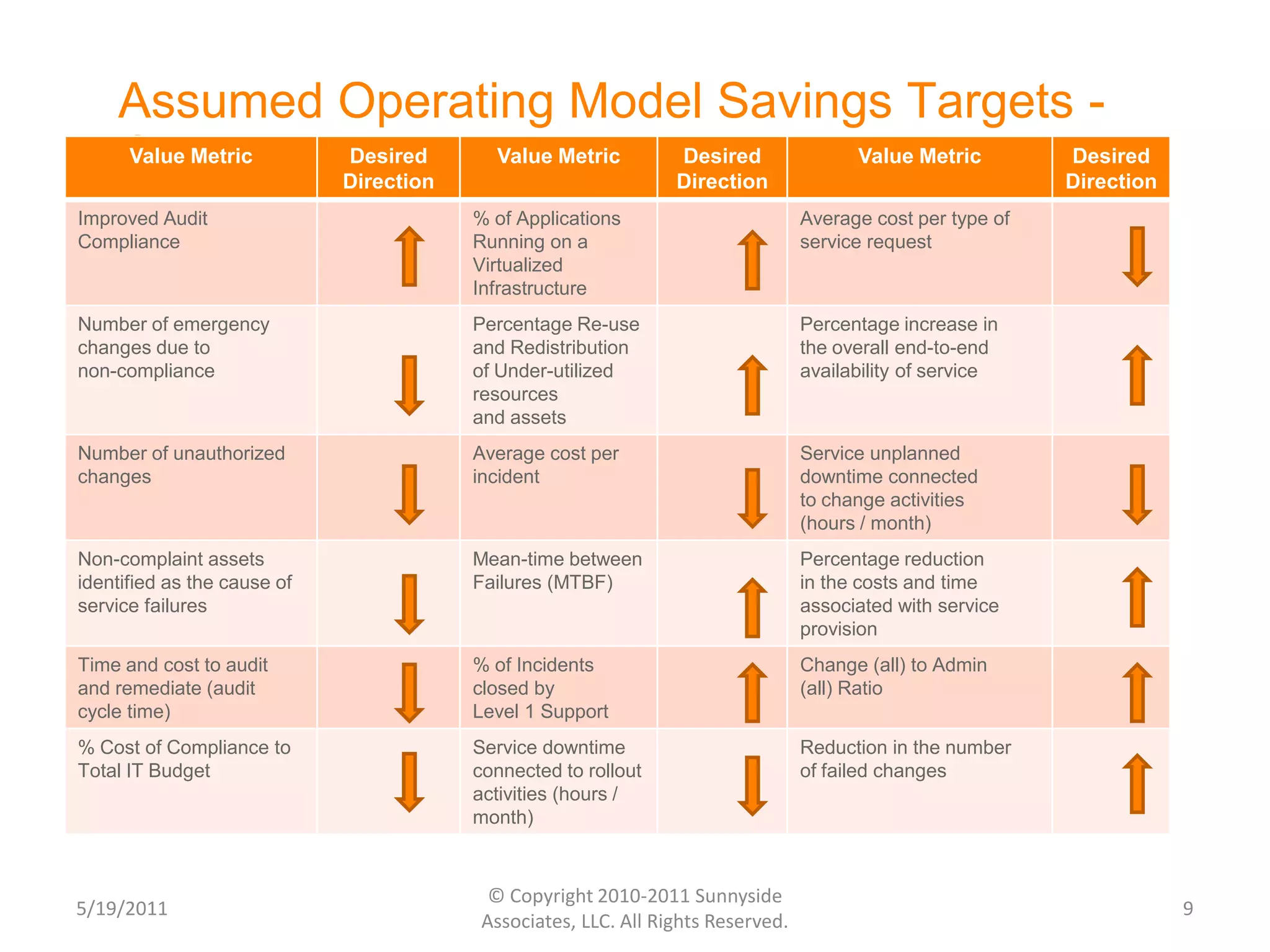
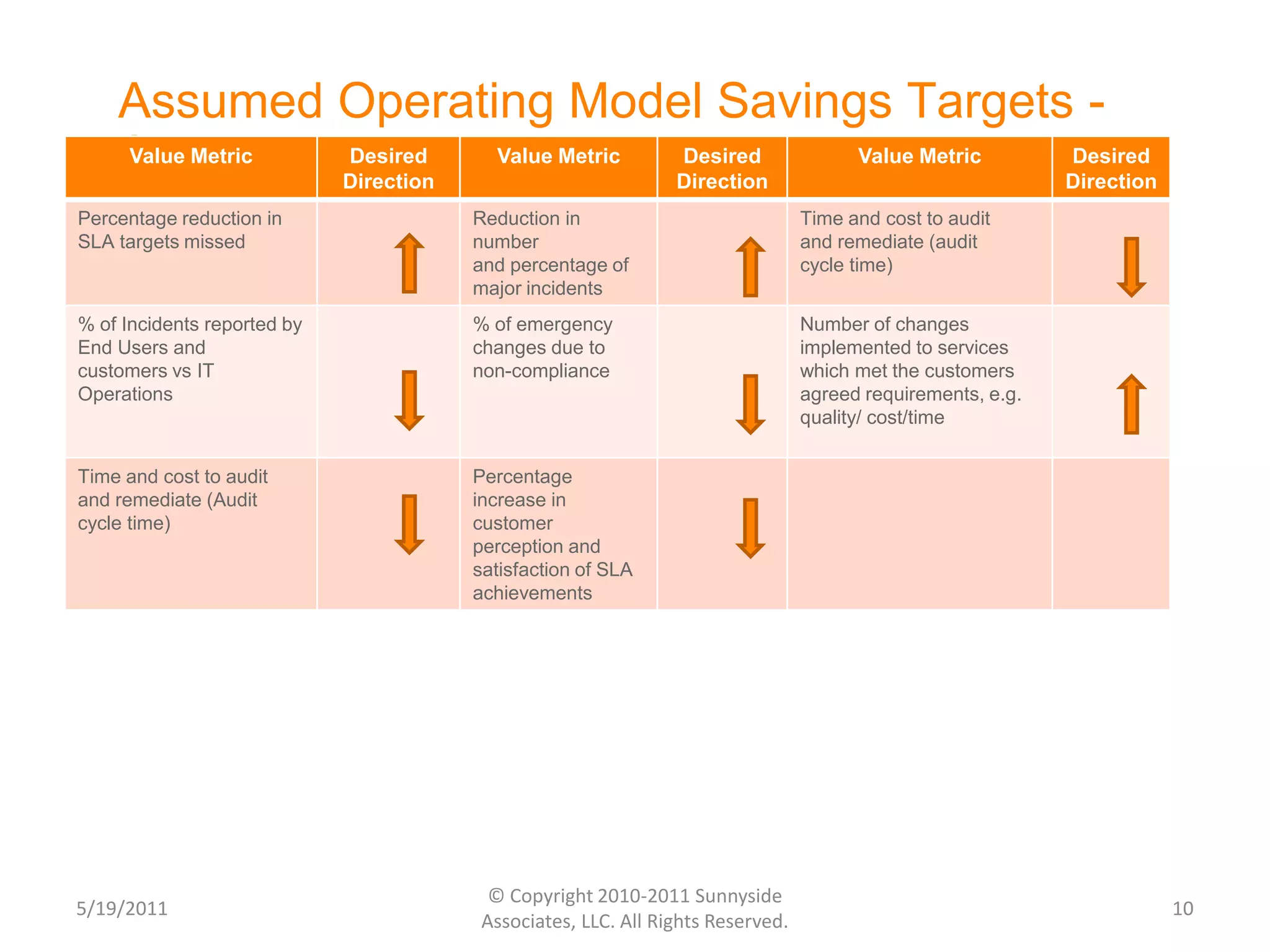
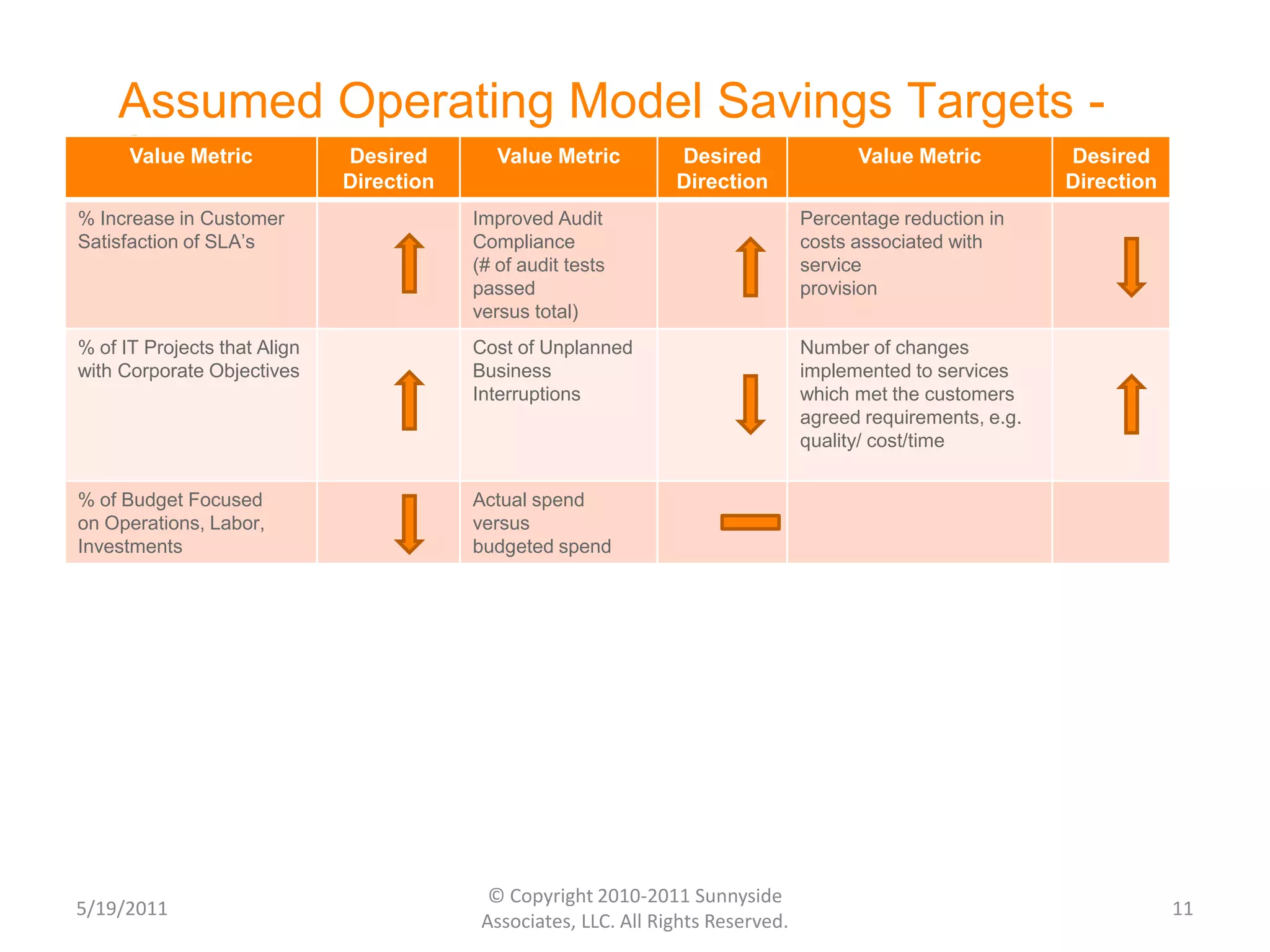
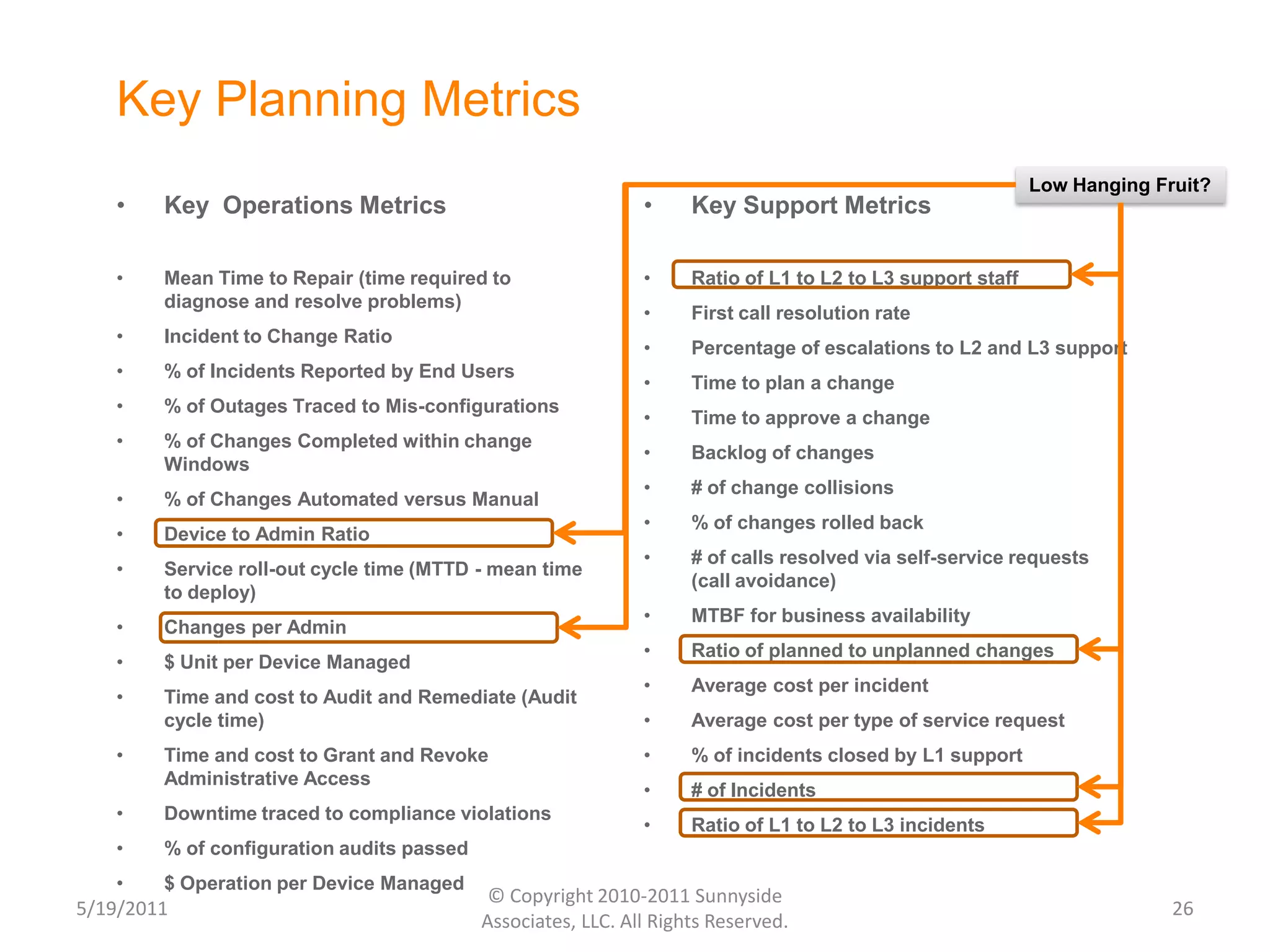
Key Planning MetricsLowHanging Fruit?Key Operations MetricsMean Time to Repair (time required to diagnose and resolve problems)Incident to Change Ratio% of Incidents Reported by End Users% of Outages Traced to Mis-configurations% of Changes Completed within change Windows% of Changes Automated versus ManualDevice to Admin RatioService roll-out cycle time (MTTD - mean time to deploy)Changes per Admin$ Unit per Device ManagedTime and cost to Audit and Remediate (Audit cycle time)Time and cost to Grant and Revoke Administrative AccessDowntime traced to compliance violations% of configuration audits passed$ Operation per Device ManagedKey Support Metrics
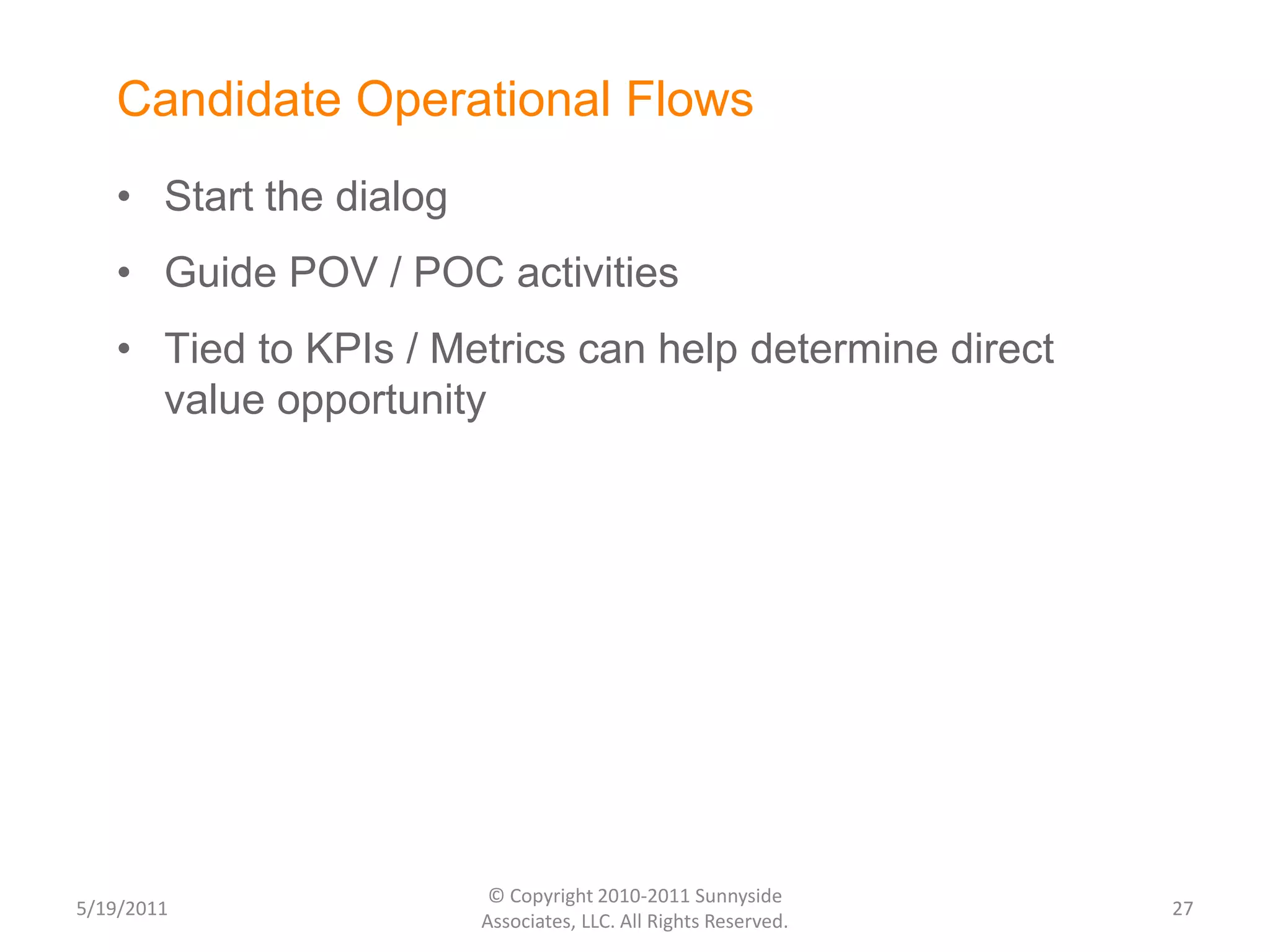
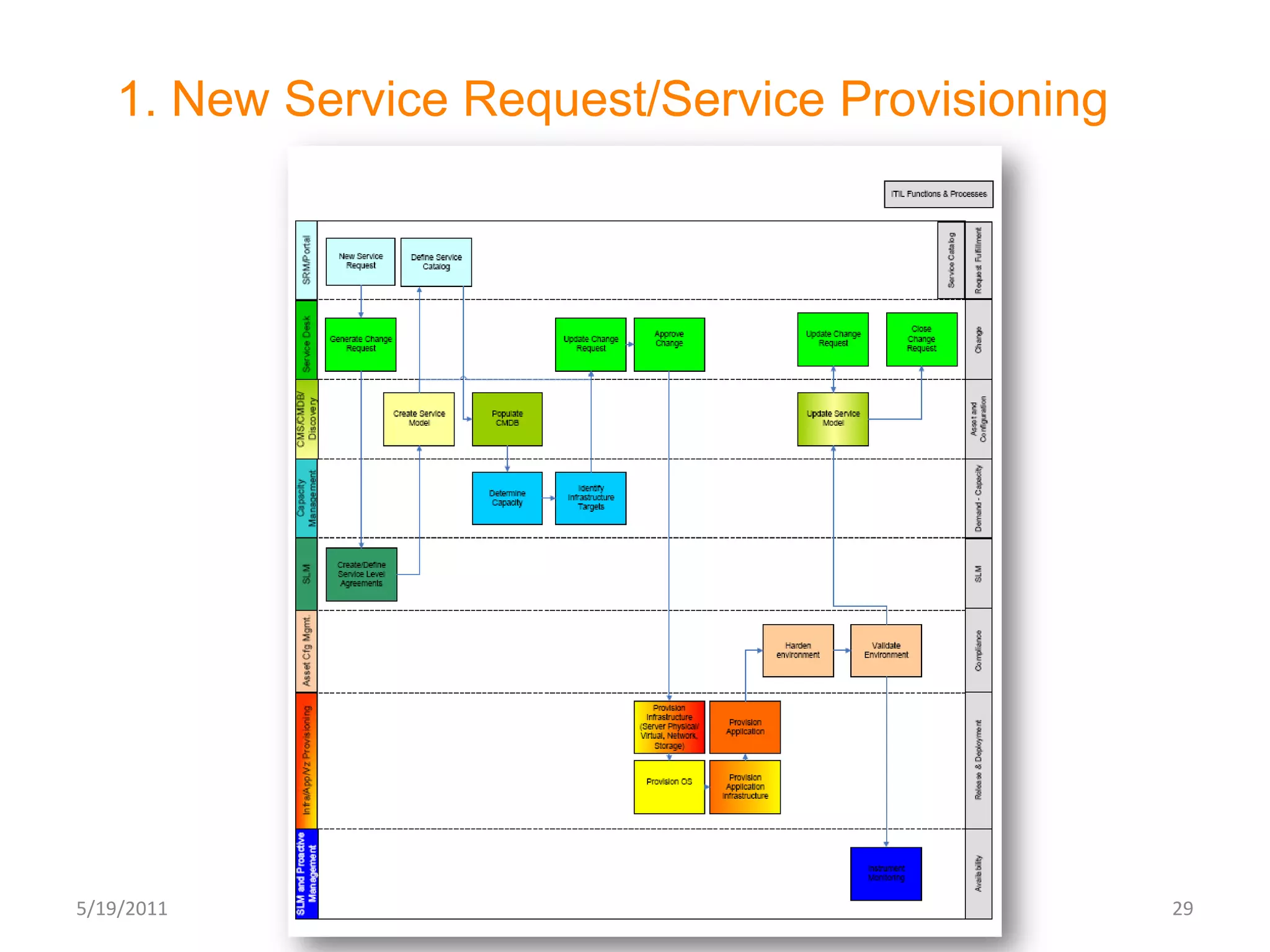
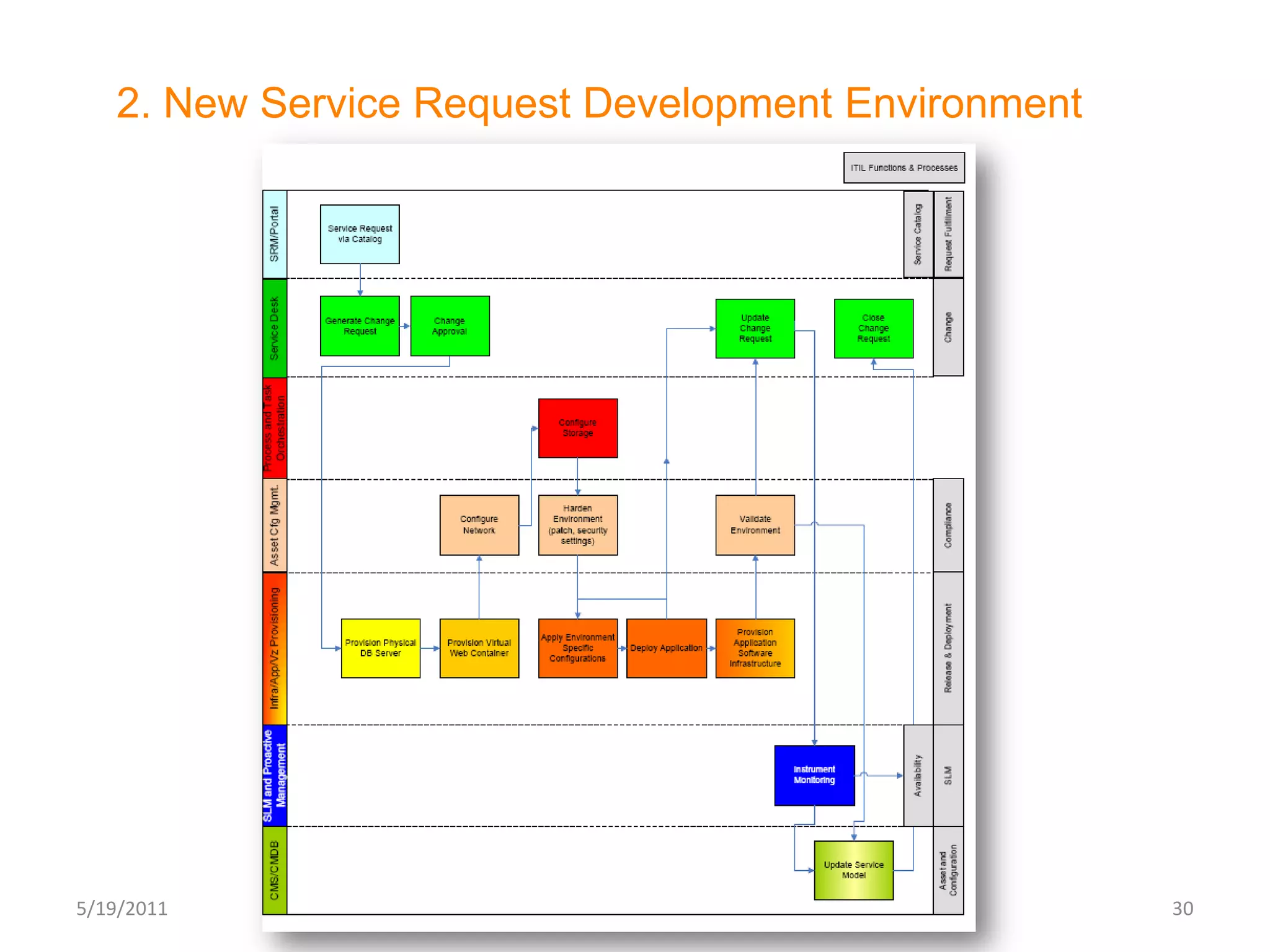
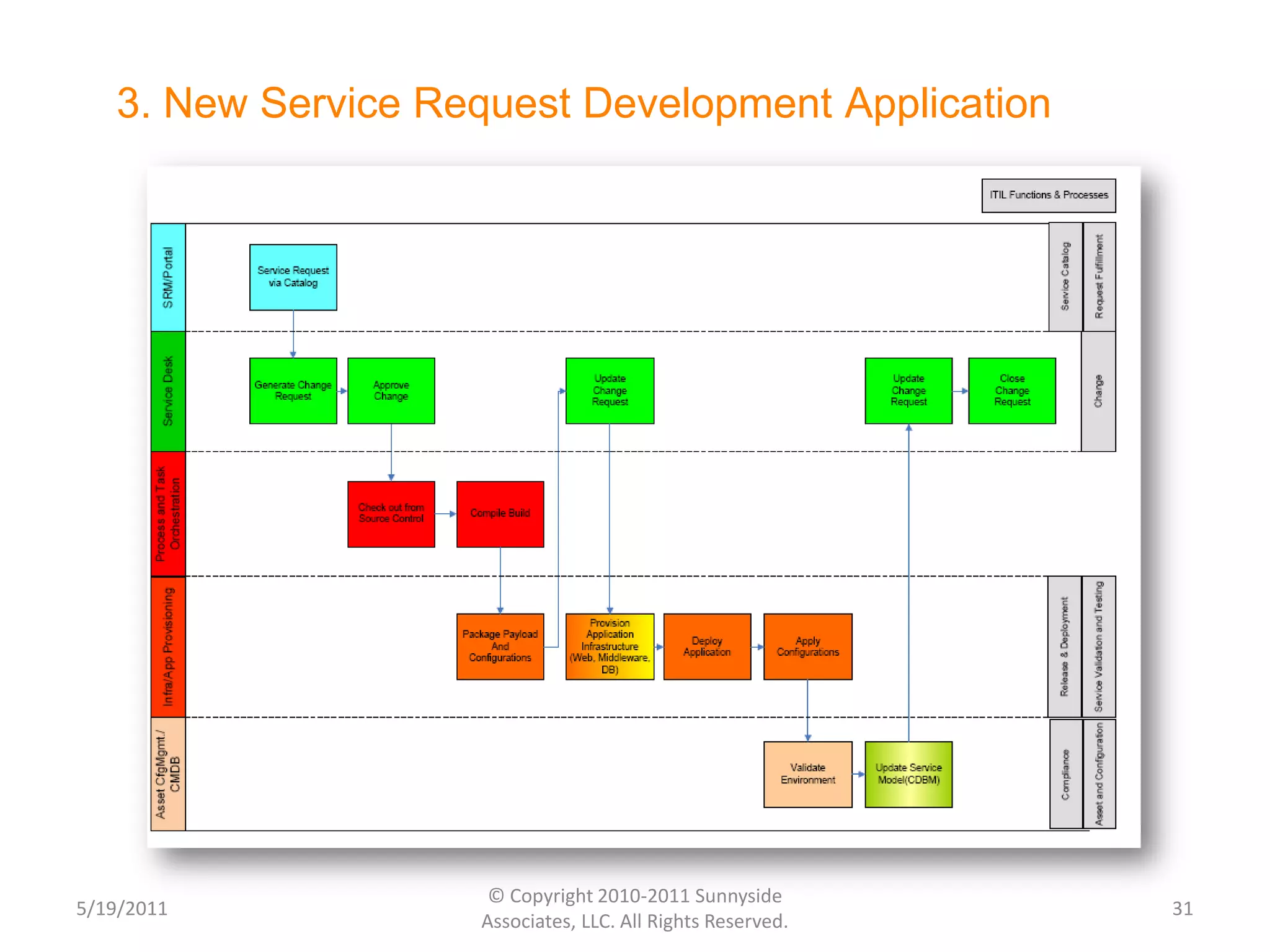
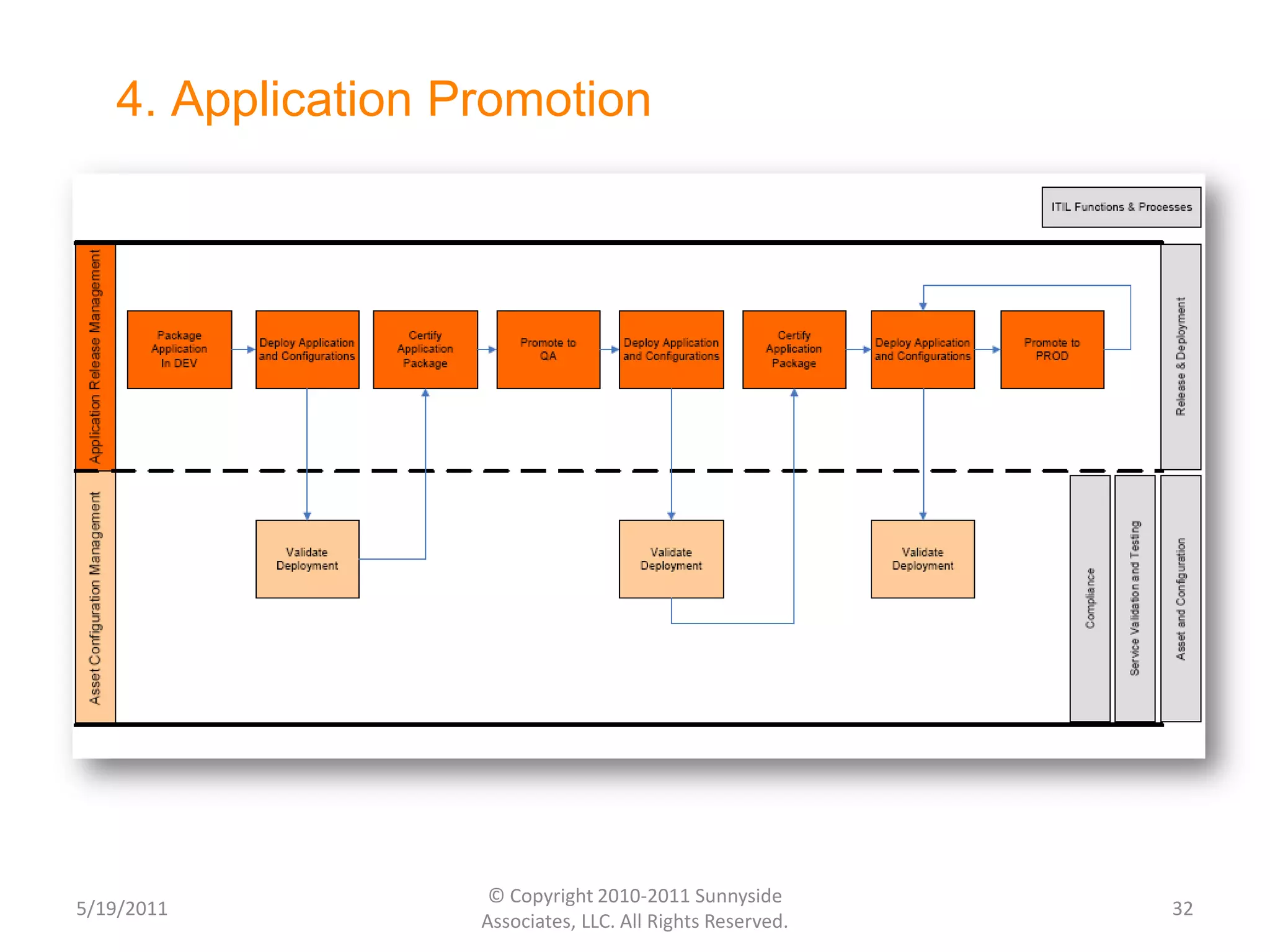
Ratio of L1to L2 to L3 incidentsCandidate Operational FlowsStart the dialogGuide POV / POC activitiesTied to KPIs / Metrics can help determine direct value opportunity
61.
AgendaMajor AssumptionsOperating ModelScopeValue PropositionDesign ApproachLevel 0 Process Model with Level 1 ITIL V3 MappingThe Model as a Business Planning ToolCandidate Operational FlowsNext Steps
69.
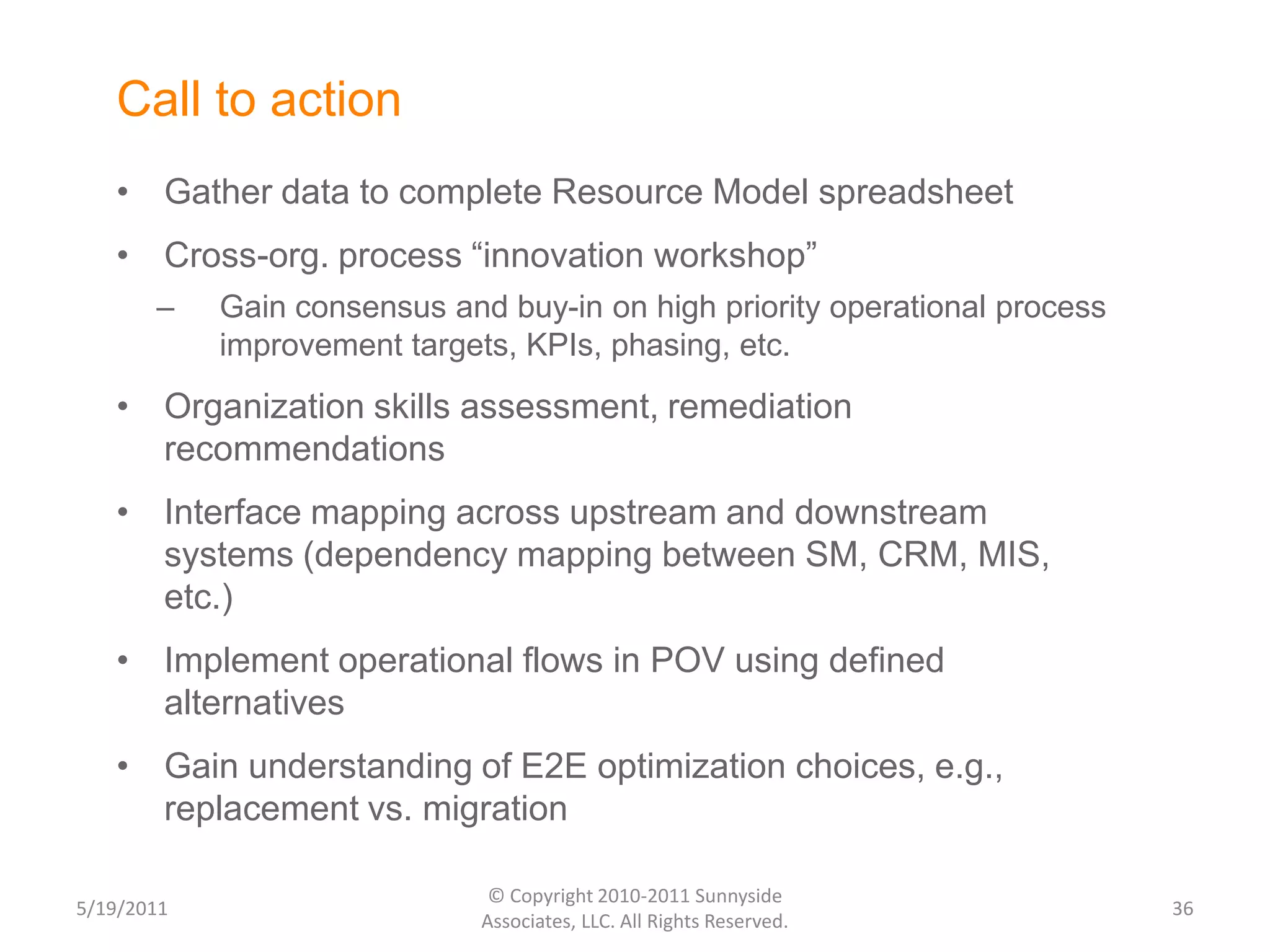
Call to actionGatherdata to complete Resource Model spreadsheetCross-org. process “innovation workshop”Gain consensus and buy-in on high priority operational process improvement targets, KPIs, phasing, etc.Organization skills assessment, remediation recommendationsInterface mapping across upstream and downstream systems (dependency mapping between SM, CRM, MIS, etc.)Implement operational flows in POV using defined alternativesGain understanding of E2E optimization choices, e.g., replacement vs. migration
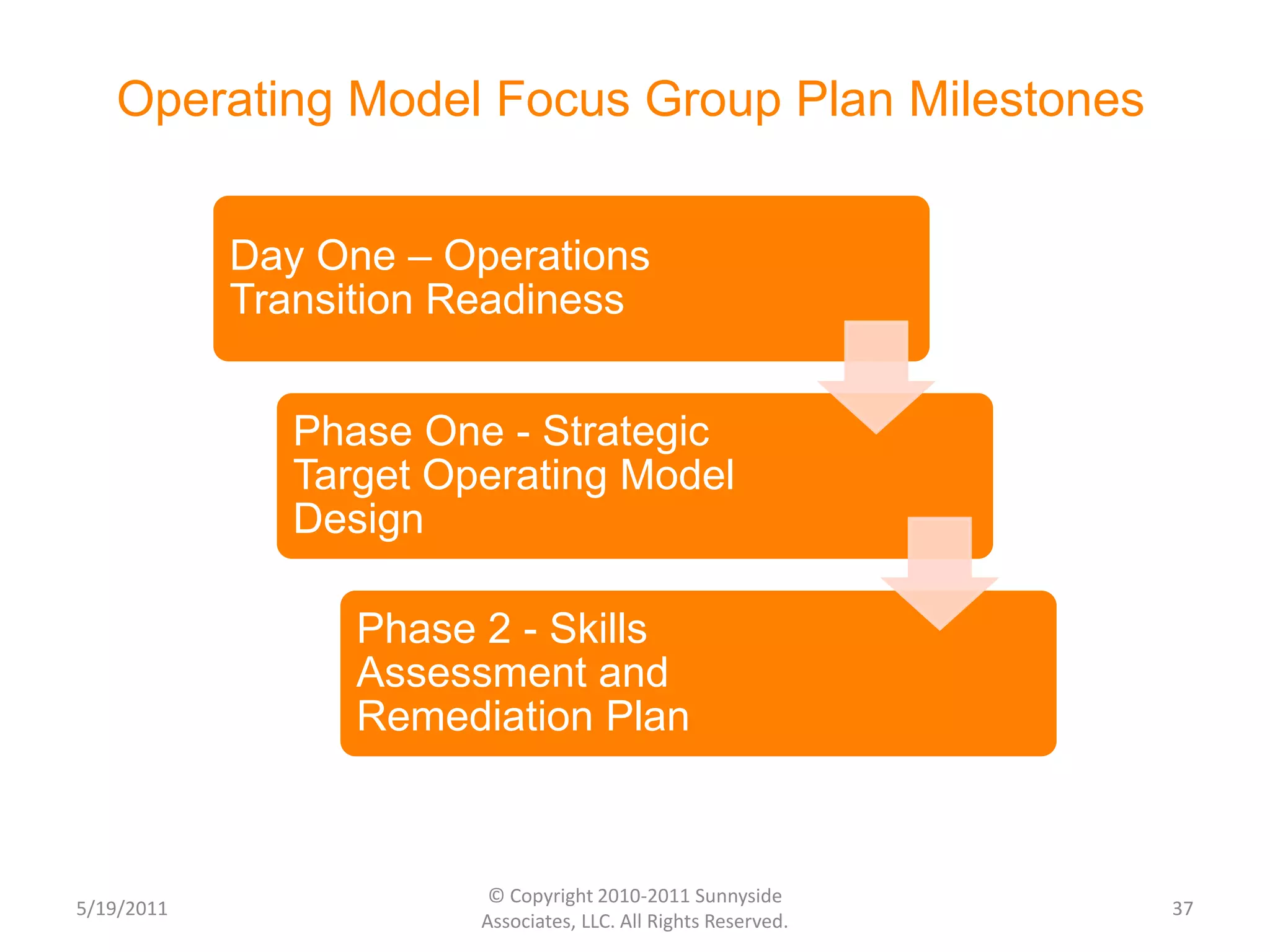
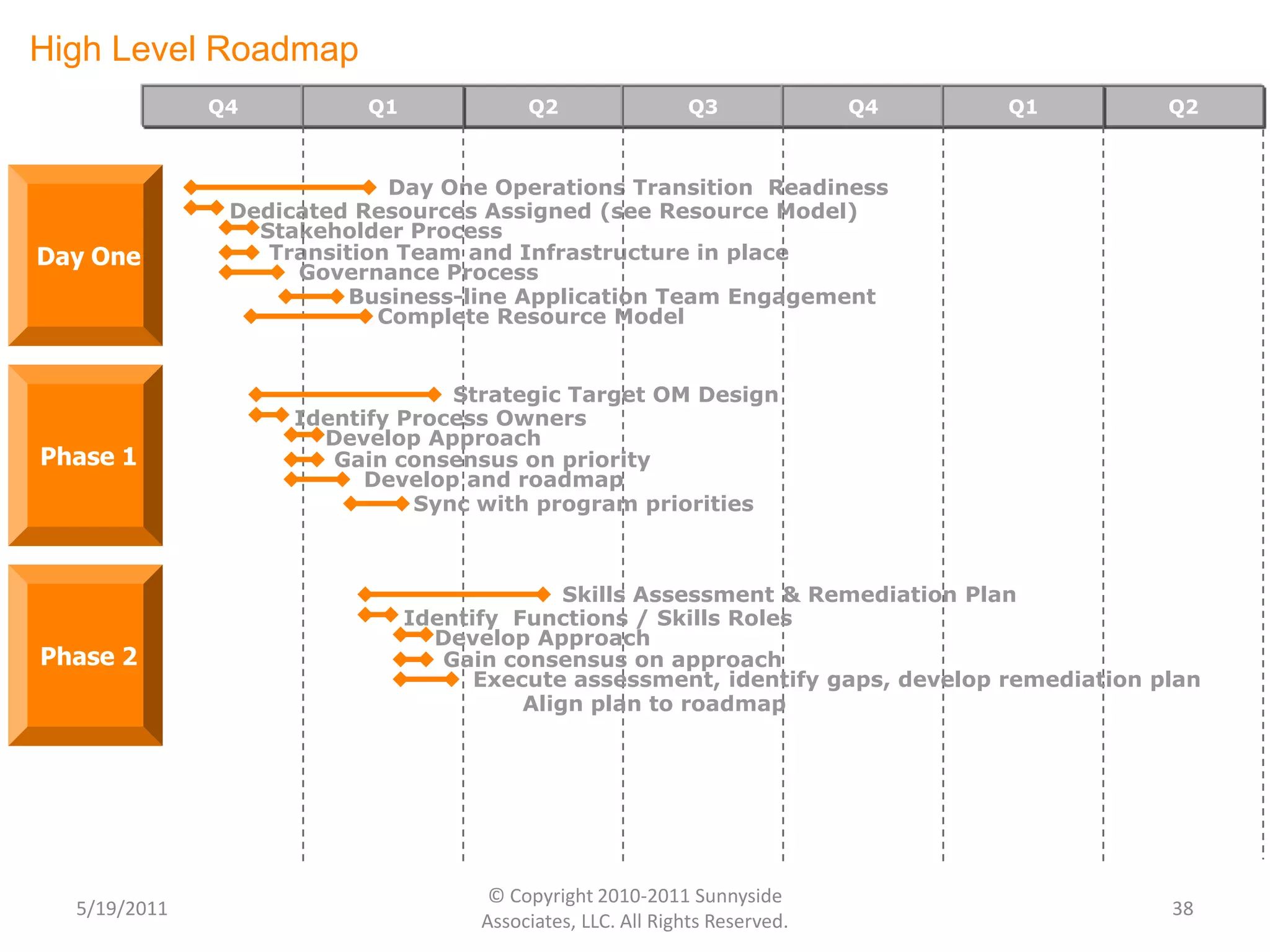
High Level RoadmapQ4Q2Q1Q3Q4Q2Q1Day OneDay One Operations Transition ReadinessDedicated Resources Assigned (see Resource Model)Stakeholder Process Transition Team and Infrastructure in placeGovernance ProcessBusiness-line Application Team EngagementComplete Resource ModelPhase 1Strategic Target OM DesignIdentify Process OwnersDevelop ApproachGain consensus on priorityDevelop and roadmapSync with program prioritiesPhase 2Skills Assessment & Remediation PlanIdentify Functions / Skills RolesDevelop ApproachGain consensus on approachExecute assessment, identify gaps, develop remediation planAlign plan to roadmap
72.
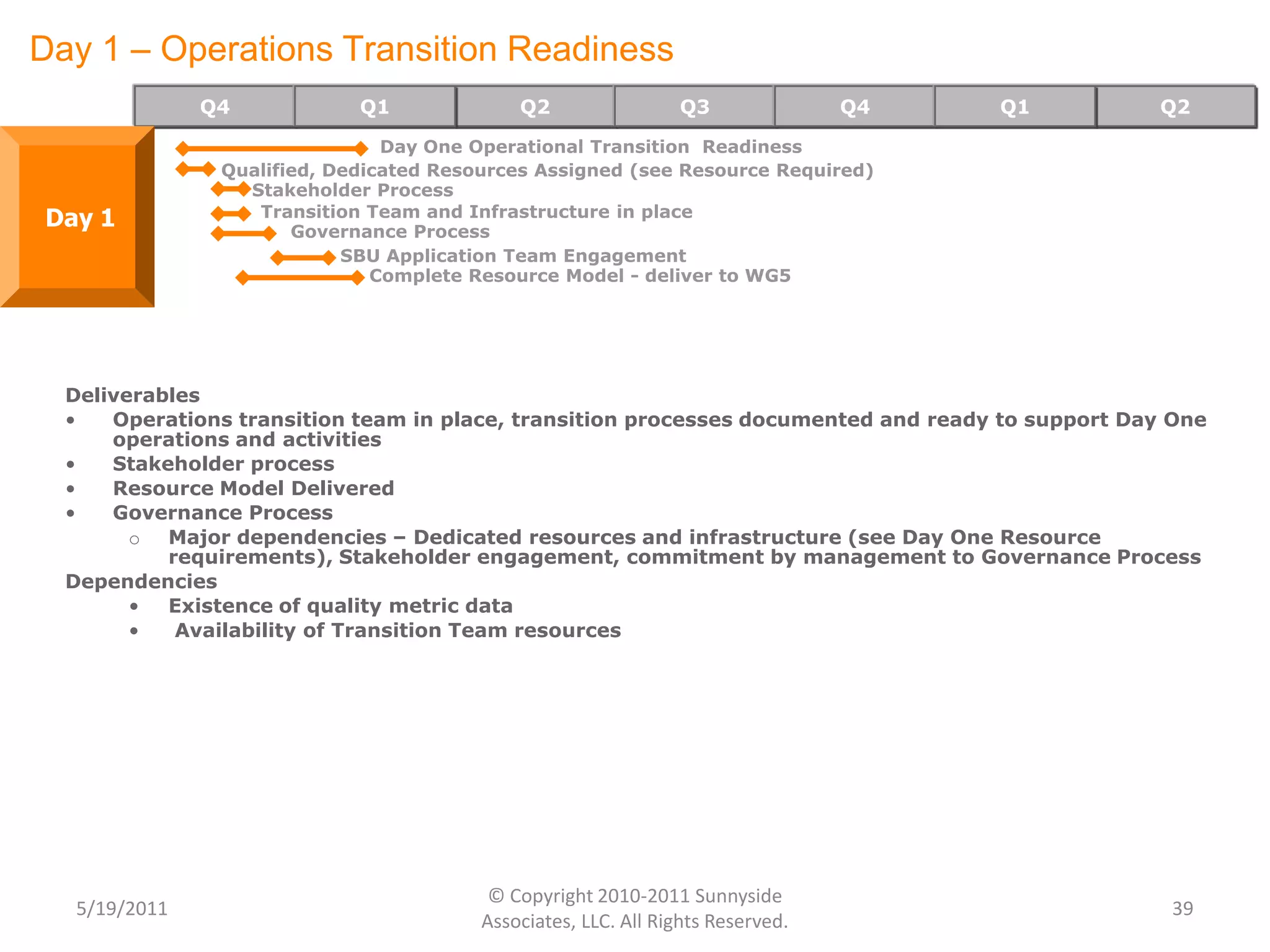
Day 1 –Operations Transition ReadinessQ4Q2Q1Q3Q4Q2Q1Day 1Day One Operational Transition ReadinessQualified, Dedicated Resources Assigned (see Resource Required)Stakeholder Process Transition Team and Infrastructure in placeGovernance ProcessSBU Application Team EngagementComplete Resource Model - deliver to WG5DeliverablesOperations transition team in place, transition processes documented and ready to support Day One operations and activities
Major dependencies –Dedicated resources and infrastructure (see Day One Resource requirements), Stakeholder engagement, commitment by management to Governance ProcessDependenciesExistence of quality metric data
77.
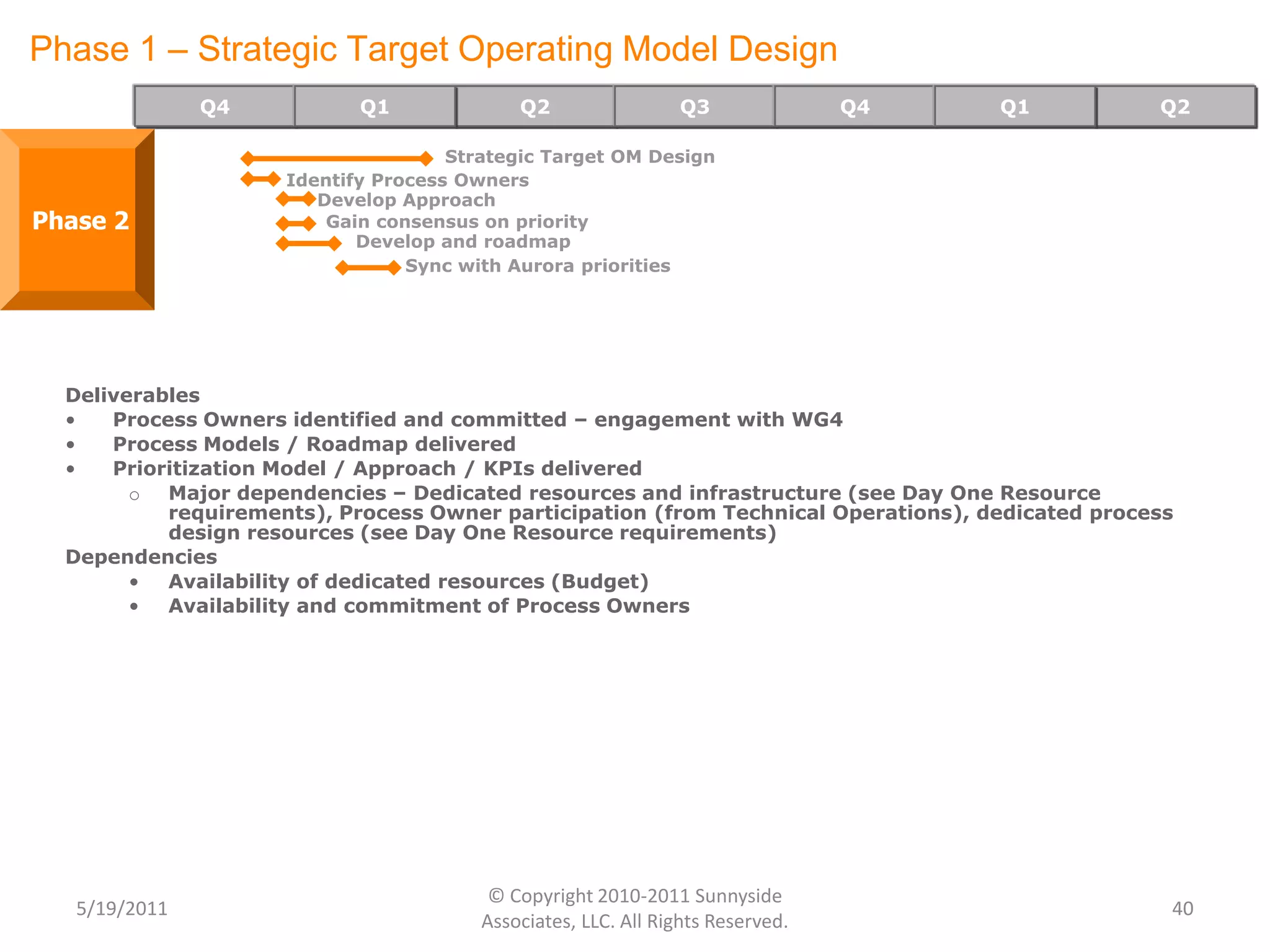
Availability ofTransition Team resources Phase 1 – Strategic Target Operating Model Design Q4Q2Q1Q3Q4Q2Q1Phase 2Strategic Target OM DesignIdentify Process OwnersDevelop ApproachGain consensus on priorityDevelop and roadmapSync with Aurora prioritiesDeliverablesProcess Owners identified and committed – engagement with WG4
Major dependencies –Dedicated resources and infrastructure (see Day One Resource requirements), Process Owner participation (from Technical Operations), dedicated process design resources (see Day One Resource requirements)DependenciesAvailability of dedicated resources (Budget)
81.
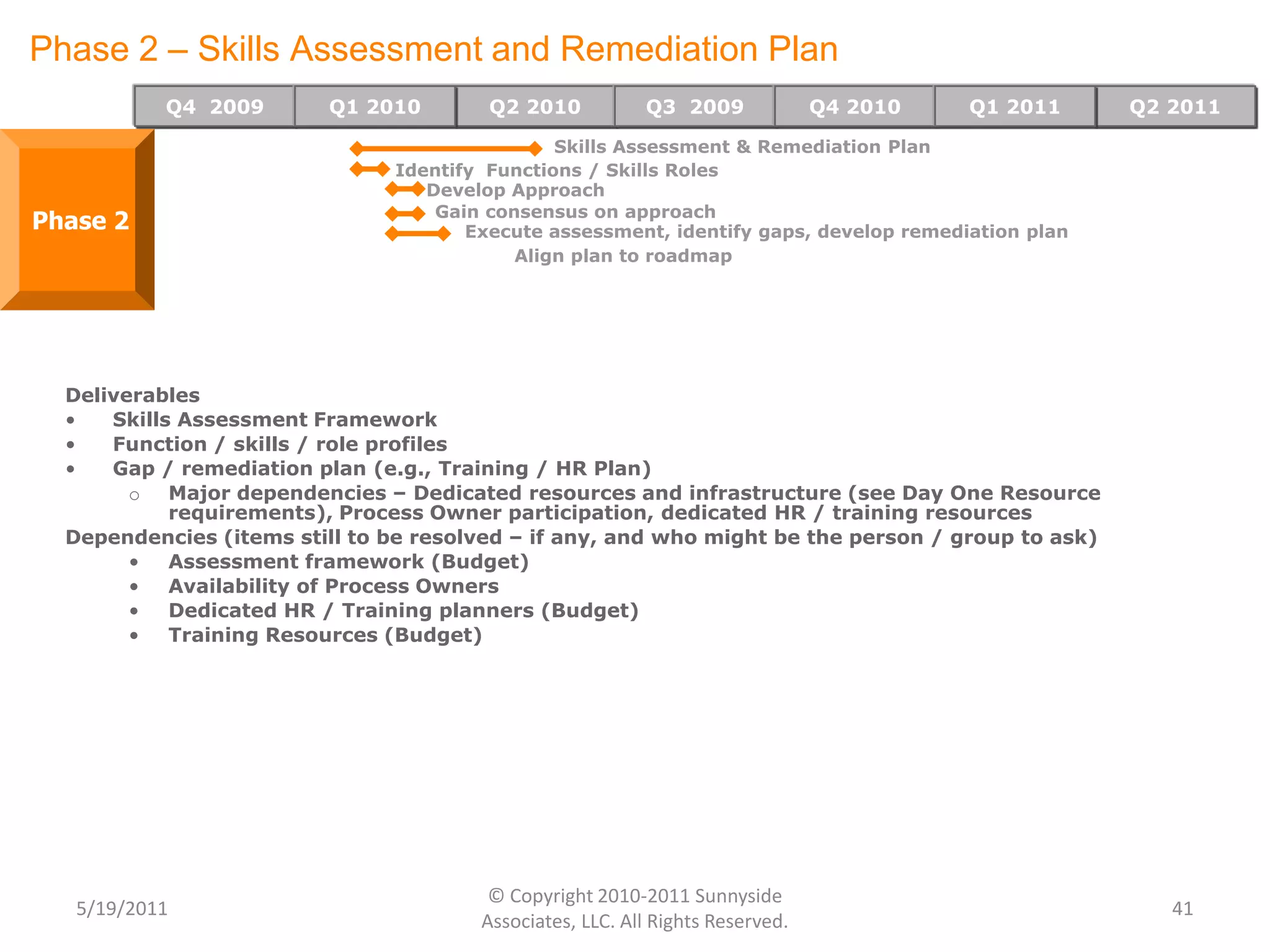
Availability and commitmentof Process OwnersPhase 2 – Skills Assessment and Remediation PlanQ4 2009Q2 2010Q1 2010Q3 2009Q4 2010Q2 2011Q1 2011Phase 2Skills Assessment & Remediation Plan Identify Functions / Skills RolesDevelop ApproachGain consensus on approachExecute assessment, identify gaps, develop remediation planAlign plan to roadmap DeliverablesSkills Assessment Framework
Major dependencies –Dedicated resources and infrastructure (see Day One Resource requirements), Process Owner participation, dedicated HR / training resourcesDependencies (items still to be resolved – if any, and who might be the person / group to ask)Assessment framework (Budget)