IT STRATEGY
Your Company
IT STRATEGY
This presentation outlines the
steps required to produce a
Technology enabled Business
Strategy which will support
your business goals to further
Your Company’s successes into
the future in this Digital age.
Your Company
Logo
Background information
Summary
Current Environment & Assumptions
Risks & Considerations
Conclusion
IT STRATEGY
Content
IT STRATEGY
Who am I?
• Creagh Warren
• +61 419 396 772
• creagh.warren@icloud.com
• DOB: 6th July, 1972
• Dip Eng (Elec), B.App.Sc (Comp), MBA
• Strategic Business & Technology Leader
• Over 25 years of international
experience and a reputation as a highly
valued strategic partner
• Worked with organisations including:
AXA, Citibank, Deutsche Bank, KPMG,
University of Cambridge, IT Global (UK)
and Starbucks
Personal
information
IT STRATEGY
Who are we?
Who are we
We make X and Y. With these products, our community of
customers achieve amazing things. We are based in Berlin
with offices located all around the globe and our company is
run by its founders – Burt and Ernie – who established Your
Company in 1999.
What do we produce/offer?
We produce and distribute production and performance
applications as well as a collection of related tools and
sample libraries.
Our customers purchase, download and authorise our
products from our Website.
We also have a very strong global presence in educational
institutions and universities and launched a Certification
Program in 2005 to licence certified trainers.
IT STRATEGY
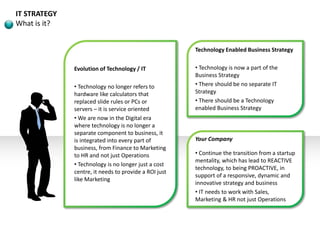
What is it?
Evolution of Technology / IT
• Technology no longer refers to
hardware like calculators that
replaced slide rules or PCs or
servers – it is service oriented
• We are now in the Digital era
where technology is no longer a
separate component to business, it
is integrated into every part of
business, from Finance to Marketing
to HR and not just Operations
• Technology is no longer just a cost
centre, it needs to provide a ROI just
like Marketing
Technology Enabled Business Strategy
• Technology is now a part of the
Business Strategy
• There should be no separate IT
Strategy
• There should be a Technology
enabled Business Strategy
Your Company
• Continue the transition from a startup
mentality, which has lead to REACTIVE
technology, to being PROACTIVE, in
support of a responsive, dynamic and
innovative strategy and business
• IT needs to work with Sales,
Marketing & HR not just Operations
IT STRATEGY
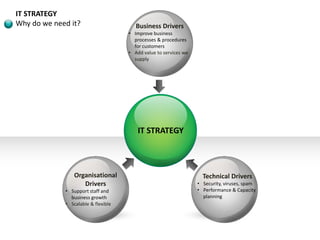
Business Drivers
• Improve business
processes & procedures
for customers
• Add value to services we
supply
IT STRATEGY
Why do we need it?
Organisational
Drivers
• Support staff and
business growth
• Scalable & flexible
Technical Drivers
• Security, viruses, spam
• Performance & Capacity
planning
IT STRATEGY
How do we do it?
Objectives
• Define Business goals and objectives
• Identify competitors and their strategies
• Understanding our current business and technology environment
• Understand technology available today and emerging technology
• Develop solutions to take us where we want to go
• Identify business Risks that are both created by and can be solved by technology
• Support traditional business growth methods of increased customers, profit
margins, purchase frequency and customer retention
IT STRATEGY
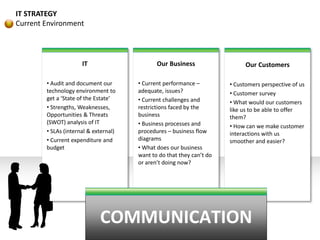
Current Environment
IT
• Audit and document our
technology environment to
get a ‘State of the Estate’
• Strengths, Weaknesses,
Opportunities & Threats
(SWOT) analysis of IT
• SLAs (internal & external)
• Current expenditure and
budget
Our Business
• Current performance –
adequate, issues?
• Current challenges and
restrictions faced by the
business
• Business processes and
procedures – business flow
diagrams
• What does our business
want to do that they can’t do
or aren’t doing now?
Our Customers
• Customers perspective of us
• Customer survey
• What would our customers
like us to be able to offer
them?
• How can we make customer
interactions with us
smoother and easier?
COMMUNICATION
IT STRATEGY
Assumptions
Assumptions
Based on information currently at hand we know:
• Some staff administer their computers themselves
• We have inconsistency in applications providing the same solutions
• We have custom/bespoke software with only a subset of business processes
supported with market solutions e.g. CRM
• Some infrastructure hosted internally, some hosted externally
IT STRATEGY
Risks
Risks
Based on our assumptions, potential risks are:
• BYOD – licensing/legal, support, security, shadow IT (uncontrolled expenditure),
inconsistent/aged hardware/software
• Bespoke software – support, knowledge loss with attrition of staff, incompatible
formats of documents and information, inconsistent public image
• Externally hosted infrastructure/services (Cloud) – SLAs, support, response
times, knowledge, security
• Responsiveness, flexibility, scalability, capacity to meet business demands
IT STRATEGY
Considerations
Considerations
Based on the identified risks, some considerations might be:
• Disaster Recovery Plan leading to a Business Continuity Plan (DRP/BCP)
• Standard Operating Environment (SOE)
• Rolling refresh program for hardware/software linked to financial depreciation
of assets
• Upgraded ITSM framework and system to analyse IT SLAs, introduce Change
Management, reduce support requirements, identify issues and manage assets
• Implementation of an Enterprise Response Planning (ERP) system to integrate
and streamline business processes from financials to CRM to e-commerce to
logistics and asset management
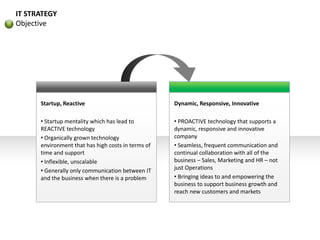
Startup, Reactive
• Startup mentality which has lead to
REACTIVE technology
• Organically grown technology
environment that has high costs in terms of
time and support
• Inflexible, unscalable
• Generally only communication between IT
and the business when there is a problem
Dynamic, Responsive, Innovative
• PROACTIVE technology that supports a
dynamic, responsive and innovative
company
• Seamless, frequent communication and
continual collaboration with all of the
business – Sales, Marketing and HR – not
just Operations
• Bringing ideas to and empowering the
business to support business growth and
reach new customers and markets
IT STRATEGY
Objective
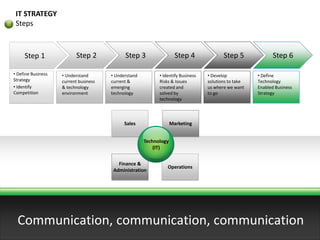
Step 1 Step 2 Step 3 Step 4 Step 5 Step 6
• Define Business
Strategy
• Identify
Competition
• Understand
current business
& technology
environment
• Understand
current &
emerging
technology
• Identify Business
Risks & Issues
created and
solved by
technology
• Develop
solutions to take
us where we want
to go
• Define
Technology
Enabled Business
Strategy
IT STRATEGY
Steps
Communication, communication, communication
Technology
(IT)
Sales Marketing
Operations
Finance &
Administration
IT STRATEGY
Conclusion
In conclusion we need to:
• Define and understand the current Business Strategy
• Understand our current environment
• Understand current and emerging technology
• Establish communications between IT and both the
business and our customers
• Recognise that there is no such thing as an IT
Strategy – we want to create a Technology enabled
Business Strategy that defines Business Objectives
and incorporates all areas of the business including
Finance, Sales, Marketing, HR and Operations

IT strategy presentation by global leading CIO, Creagh Warren

  • 1.
    IT STRATEGY Your Company ITSTRATEGY This presentation outlines the steps required to produce a Technology enabled Business Strategy which will support your business goals to further Your Company’s successes into the future in this Digital age. Your Company Logo
  • 2.
    Background information Summary Current Environment& Assumptions Risks & Considerations Conclusion IT STRATEGY Content
  • 3.
    IT STRATEGY Who amI? • Creagh Warren • +61 419 396 772 • creagh.warren@icloud.com • DOB: 6th July, 1972 • Dip Eng (Elec), B.App.Sc (Comp), MBA • Strategic Business & Technology Leader • Over 25 years of international experience and a reputation as a highly valued strategic partner • Worked with organisations including: AXA, Citibank, Deutsche Bank, KPMG, University of Cambridge, IT Global (UK) and Starbucks Personal information
  • 4.
    IT STRATEGY Who arewe? Who are we We make X and Y. With these products, our community of customers achieve amazing things. We are based in Berlin with offices located all around the globe and our company is run by its founders – Burt and Ernie – who established Your Company in 1999. What do we produce/offer? We produce and distribute production and performance applications as well as a collection of related tools and sample libraries. Our customers purchase, download and authorise our products from our Website. We also have a very strong global presence in educational institutions and universities and launched a Certification Program in 2005 to licence certified trainers.
  • 5.
    IT STRATEGY What isit? Evolution of Technology / IT • Technology no longer refers to hardware like calculators that replaced slide rules or PCs or servers – it is service oriented • We are now in the Digital era where technology is no longer a separate component to business, it is integrated into every part of business, from Finance to Marketing to HR and not just Operations • Technology is no longer just a cost centre, it needs to provide a ROI just like Marketing Technology Enabled Business Strategy • Technology is now a part of the Business Strategy • There should be no separate IT Strategy • There should be a Technology enabled Business Strategy Your Company • Continue the transition from a startup mentality, which has lead to REACTIVE technology, to being PROACTIVE, in support of a responsive, dynamic and innovative strategy and business • IT needs to work with Sales, Marketing & HR not just Operations
  • 6.
    IT STRATEGY Business Drivers •Improve business processes & procedures for customers • Add value to services we supply IT STRATEGY Why do we need it? Organisational Drivers • Support staff and business growth • Scalable & flexible Technical Drivers • Security, viruses, spam • Performance & Capacity planning
  • 7.
    IT STRATEGY How dowe do it? Objectives • Define Business goals and objectives • Identify competitors and their strategies • Understanding our current business and technology environment • Understand technology available today and emerging technology • Develop solutions to take us where we want to go • Identify business Risks that are both created by and can be solved by technology • Support traditional business growth methods of increased customers, profit margins, purchase frequency and customer retention
  • 8.
    IT STRATEGY Current Environment IT •Audit and document our technology environment to get a ‘State of the Estate’ • Strengths, Weaknesses, Opportunities & Threats (SWOT) analysis of IT • SLAs (internal & external) • Current expenditure and budget Our Business • Current performance – adequate, issues? • Current challenges and restrictions faced by the business • Business processes and procedures – business flow diagrams • What does our business want to do that they can’t do or aren’t doing now? Our Customers • Customers perspective of us • Customer survey • What would our customers like us to be able to offer them? • How can we make customer interactions with us smoother and easier? COMMUNICATION
  • 9.
    IT STRATEGY Assumptions Assumptions Based oninformation currently at hand we know: • Some staff administer their computers themselves • We have inconsistency in applications providing the same solutions • We have custom/bespoke software with only a subset of business processes supported with market solutions e.g. CRM • Some infrastructure hosted internally, some hosted externally
  • 10.
    IT STRATEGY Risks Risks Based onour assumptions, potential risks are: • BYOD – licensing/legal, support, security, shadow IT (uncontrolled expenditure), inconsistent/aged hardware/software • Bespoke software – support, knowledge loss with attrition of staff, incompatible formats of documents and information, inconsistent public image • Externally hosted infrastructure/services (Cloud) – SLAs, support, response times, knowledge, security • Responsiveness, flexibility, scalability, capacity to meet business demands
  • 11.
    IT STRATEGY Considerations Considerations Based onthe identified risks, some considerations might be: • Disaster Recovery Plan leading to a Business Continuity Plan (DRP/BCP) • Standard Operating Environment (SOE) • Rolling refresh program for hardware/software linked to financial depreciation of assets • Upgraded ITSM framework and system to analyse IT SLAs, introduce Change Management, reduce support requirements, identify issues and manage assets • Implementation of an Enterprise Response Planning (ERP) system to integrate and streamline business processes from financials to CRM to e-commerce to logistics and asset management
  • 12.
    Startup, Reactive • Startupmentality which has lead to REACTIVE technology • Organically grown technology environment that has high costs in terms of time and support • Inflexible, unscalable • Generally only communication between IT and the business when there is a problem Dynamic, Responsive, Innovative • PROACTIVE technology that supports a dynamic, responsive and innovative company • Seamless, frequent communication and continual collaboration with all of the business – Sales, Marketing and HR – not just Operations • Bringing ideas to and empowering the business to support business growth and reach new customers and markets IT STRATEGY Objective
  • 13.
    Step 1 Step2 Step 3 Step 4 Step 5 Step 6 • Define Business Strategy • Identify Competition • Understand current business & technology environment • Understand current & emerging technology • Identify Business Risks & Issues created and solved by technology • Develop solutions to take us where we want to go • Define Technology Enabled Business Strategy IT STRATEGY Steps Communication, communication, communication Technology (IT) Sales Marketing Operations Finance & Administration
  • 14.
    IT STRATEGY Conclusion In conclusionwe need to: • Define and understand the current Business Strategy • Understand our current environment • Understand current and emerging technology • Establish communications between IT and both the business and our customers • Recognise that there is no such thing as an IT Strategy – we want to create a Technology enabled Business Strategy that defines Business Objectives and incorporates all areas of the business including Finance, Sales, Marketing, HR and Operations

Editor's Notes

  • #3 Content   Background information Summary Personal resources and goals The product or service The market Sale and marketing plan Management & organisation Development of the business Budgets Financial requirements Appendices