Copyright © 2018 ScottMadden, Inc. All rights reserved. Report _2018
Technology for HR Shared Services
A Discussion of Key Concepts in Shared Services
Technology
August 2011
Copyright © 2018 by ScottMadden, Inc. All rights reserved.
Agenda
■ About ScottMadden
■ Overview of HR Technology
■ Design, Evaluation, and Selection of Technology
■ Lessons Learned
1
About ScottMadden
Copyright © 2018 by ScottMadden, Inc. All rights reserved.
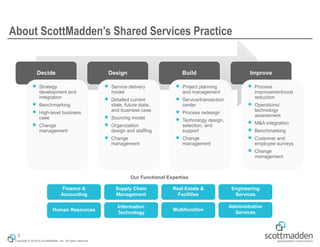
About ScottMadden’s Shared Services Practice
3
Decide Design Build Improve
■ Strategy
development and
integration
■ Benchmarking
■ High-level business
case
■ Change
management
■ Service delivery
model
■ Detailed current
state, future state,
and business case
■ Sourcing model
■ Organization
design and staffing
■ Change
management
■ Project planning
and management
■ Service/transaction
center
■ Process redesign
■ Technology design,
selection, and
support
■ Change
management
■ Process
improvement/cost
reduction
■ Operations/
technology
assessment
■ M&A integration
■ Benchmarking
■ Customer and
employee surveys
■ Change
management
Finance &
Accounting
Human Resources
Supply Chain
Management
Information
Technology
Real Estate &
Facilities
Multifunction
Engineering
Services
Administrative
Services
Our Functional Expertise
Overview of HR Technology
Copyright © 2018 by ScottMadden, Inc. All rights reserved.
Overview of HR Technology
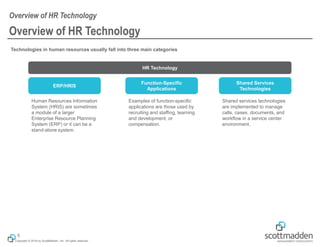
Technologies in human resources usually fall into three main categories
Overview of HR Technology
5
Human Resources Information
System (HRIS) are sometimes
a module of a larger
Enterprise Resource Planning
System (ERP) or it can be a
stand-alone system.
Examples of function-specific
applications are those used by
recruiting and staffing, learning
and development, or
compensation.
Shared services technologies
are implemented to manage
calls, cases, documents, and
workflow in a service center
environment.
Shared Services
Technologies
Function-Specific
Applications
ERP/HRIS
HR Technology
Copyright © 2018 by ScottMadden, Inc. All rights reserved.
Overview of HR Technology (Cont’d)
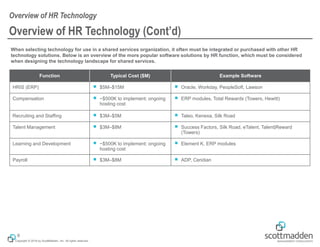
When selecting technology for use in a shared services organization, it often must be integrated or purchased with other HR
technology solutions. Below is an overview of the more popular software solutions by HR function, which must be considered
when designing the technology landscape for shared services.
Overview of HR Technology
6
Function Typical Cost ($M) Example Software
HRIS (ERP) ■ $5M–$15M ■ Oracle, Workday, PeopleSoft, Lawson
Compensation ■ ~$500K to implement; ongoing
hosting cost
■ ERP modules, Total Rewards (Towers, Hewitt)
Recruiting and Staffing ■ $3M–$5M ■ Taleo, Kenexa, Silk Road
Talent Management ■ $3M–$8M ■ Success Factors, Silk Road, eTalent, Talent|Reward
(Towers)
Learning and Development ■ ~$500K to implement; ongoing
hosting cost
■ Element K, ERP modules
Payroll ■ $3M–$8M ■ ADP, Ceridian
Copyright © 2018 by ScottMadden, Inc. All rights reserved.
Overview of HR Technology (Cont’d)
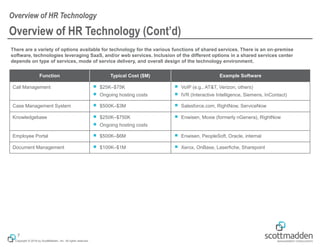
There are a variety of options available for technology for the various functions of shared services. There is an on-premise
software, technologies leveraging SaaS, and/or web services. Inclusion of the different options in a shared services center
depends on type of services, mode of service delivery, and overall design of the technology environment.
Overview of HR Technology
7
Function Typical Cost ($M) Example Software
Call Management ■ $25K–$75K
■ Ongoing hosting costs
■ VoIP (e.g., AT&T, Verizon, others)
■ IVR (Interactive Intelligence, Siemens, InContact)
Case Management System ■ $500K–$3M ■ Salesforce.com, RightNow, ServiceNow
Knowledgebase ■ $250K–$750K
■ Ongoing hosting costs
■ Enwisen, Moxie (formerly nGenera), RightNow
Employee Portal ■ $500K–$6M ■ Enwisen, PeopleSoft, Oracle, internal
Document Management ■ $100K–$1M ■ Xerox, OnBase, Laserfiche, Sharepoint
Copyright © 2018 by ScottMadden, Inc. All rights reserved.
■ Automatic Call Distributor (ACD) – handles queue management
■ 800#/Interactive Voice Response System (IVR) – provides customers with access to information via the telephone; provides menu
options
■ Computer Telephony Integration – “screen pops;” recognizes caller’s phone number and pulls up relevant information for call reps
while they are answering the phone
■ Case Management – provides caller history/information
■ Knowledgebase – provides searchable information for call reps
■ Document Management – manages electronic receipt/filing/retrieval of documents
■ Employee/Manager Self-Service Application and Workflow Technology – provides web front-end and back-end processing to
enable customers to view/interact with back-end data via a PC, kiosk, etc.
■ Web Content Management Software (portals) – serves to pull distributed data from a variety of sources into a standard web
presentation
■ Web Chat – allows customers to interact real time with a customer service rep over the web
■ Voice over IP – enables call reps and customers to speak directly over the internet (bypassing telecomm costs) while customers
navigate the website
■ Wireless PDA – ports back office and web-based information to wireless personal digital assistants
■ Core HRIS/Payroll Systems – database-based systems used for core HR reporting and payroll functions
Service Center Technologies
Overview of HR Technology
8
Copyright © 2018 by ScottMadden, Inc. All rights reserved.
Service Center Technologies (Cont’d)
Overview of HR Technology
9
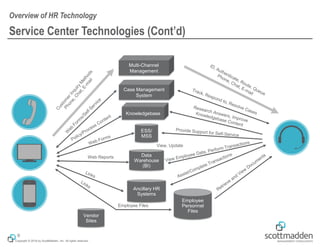
Employee Files
Data
Warehouse
(BI)
Knowledgebase
Case Management
System
ESS/
MSS
Employee
Personnel
Files
View, Update
Ancillary HR
Systems
Vendor
Sites
Web Reports
Multi-Channel
Management
Copyright © 2018 by ScottMadden, Inc. All rights reserved.
Service Center Technologies (Cont’d)
Overview of HR Technology
10
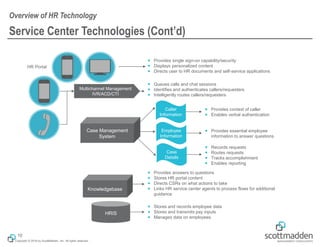
HRIS
■ Queues calls and chat sessions
■ Identifies and authenticates callers/requesters
■ Intelligently routes callers/requesters
■ Provides context of caller
■ Enables verbal authentication
■ Provides essential employee
information to answer questions
■ Provides answers to questions
■ Stores HR portal content
■ Directs CSRs on what actions to take
■ Links HR service center agents to process flows for additional
guidance
■ Stores and records employee data
■ Stores and transmits pay inputs
■ Manages data on employees
Caller
Information
Employee
Information
Case
Details
Multichannel Management
IVR/ACD/CTI
■ Records requests
■ Routes requests
■ Tracks accomplishment
■ Enables reporting
Knowledgebase
Case Management
System
■ Provides single sign-on capability/security
■ Displays personalized content
■ Directs user to HR documents and self-service applications
HR Portal
Copyright © 2018 by ScottMadden, Inc. All rights reserved.
Trends in HR Technology
These trends are frequent topics in design discussions and human resources information forums:
1. Expanding Tier 0
■ Expanding self-service options to employees and managers. This can be accomplished through integration of an employee portal and
other linked smart forms with the knowledgebase and case management system
2. Interactive chat, messaging, and personal devices
■ Understanding the employee population and their service requests should influence the choice to include these interactive options for
customer support
3. Business intelligence
■ Adding a business intelligence module to an application to enable reporting and data analytics is frequently an option offered by
vendors. Some modules are more effective than others, and it is prudent to assess how the module can integrate with other existing
reporting tools and business processes
4. Virtual teams and flexible work arrangements
■ Utilizing virtual teams to deliver service across various regions is effective for global companies
■ Offering flexible work arrangements is attractive to employees searching for a position with work-life balance and for the growing
workforce of Gen Y; however, these arrangements present different challenges in management and operations
5. Cloud technology and software as a service (SaaS)
■ Evaluating solutions that offer benefits in ease of access and decreased maintenance costs is now a compelling option
■ Ensuring that the SaaS options fit with the overall strategies of IT and security and that the ROI is robust is critical to the decision
process
Overview of HR Technology
11
Design, Evaluation, and Selection of Technology
Copyright © 2018 by ScottMadden, Inc. All rights reserved.
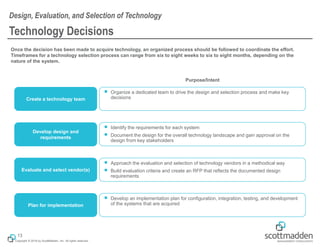
■ Organize a dedicated team to drive the design and selection process and make key
decisions
Technology Decisions
Once the decision has been made to acquire technology, an organized process should be followed to coordinate the effort.
Timeframes for a technology selection process can range from six to eight weeks to six to eight months, depending on the
nature of the system.
Design, Evaluation, and Selection of Technology
13
Purpose/Intent
Create a technology team
Develop design and
requirements
Evaluate and select vendor(s)
Plan for implementation
■ Identify the requirements for each system
■ Document the design for the overall technology landscape and gain approval on the
design from key stakeholders
■ Approach the evaluation and selection of technology vendors in a methodical way
■ Build evaluation criteria and create an RFP that reflects the documented design
requirements
■ Develop an implementation plan for configuration, integration, testing, and development
of the systems that are acquired
Copyright © 2018 by ScottMadden, Inc. All rights reserved.
Technology Team
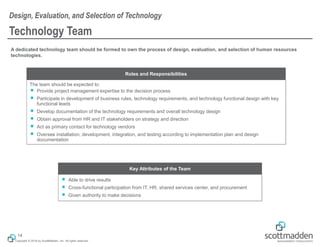
A dedicated technology team should be formed to own the process of design, evaluation, and selection of human resources
technologies.
Design, Evaluation, and Selection of Technology
14
The team should be expected to:
■ Provide project management expertise to the decision process
■ Participate in development of business rules, technology requirements, and technology functional design with key
functional leads
■ Develop documentation of the technology requirements and overall technology design
■ Obtain approval from HR and IT stakeholders on strategy and direction
■ Act as primary contact for technology vendors
■ Oversee installation, development, integration, and testing according to implementation plan and design
documentation
Roles and Responsibilities
■ Able to drive results
■ Cross-functional participation from IT, HR, shared services center, and procurement
■ Given authority to make decisions
Key Attributes of the Team
Copyright © 2018 by ScottMadden, Inc. All rights reserved.
Requirements
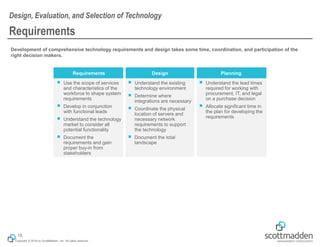
Development of comprehensive technology requirements and design takes some time, coordination, and participation of the
right decision makers.
Design, Evaluation, and Selection of Technology
15
Requirements Design Planning
■ Use the scope of services
and characteristics of the
workforce to shape system
requirements
■ Develop in conjunction
with functional leads
■ Understand the technology
market to consider all
potential functionality
■ Document the
requirements and gain
proper buy-in from
stakeholders
■ Understand the existing
technology environment
■ Determine where
integrations are necessary
■ Coordinate the physical
location of servers and
necessary network
requirements to support
the technology
■ Document the total
landscape
■ Understand the lead times
required for working with
procurement, IT, and legal
on a purchase decision
■ Allocate significant time in
the plan for developing the
requirements
Copyright © 2018 by ScottMadden, Inc. All rights reserved.
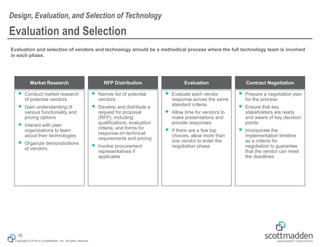
Evaluation and Selection
Evaluation and selection of vendors and technology should be a methodical process where the full technology team is involved
in each phase.
Design, Evaluation, and Selection of Technology
16
■ Prepare a negotiation plan
for the process
■ Ensure that key
stakeholders are ready
and aware of key decision
points
■ Incorporate the
implementation timeline
as a criteria for
negotiation to guarantee
that the vendor can meet
the deadlines
Contract Negotiation
■ Conduct market research
of potential vendors
■ Gain understanding of
various functionality and
pricing options
■ Interact with peer
organizations to learn
about their technologies
■ Organize demonstrations
of vendors
Market Research
■ Narrow list of potential
vendors
■ Develop and distribute a
request for proposal
(RFP), including
qualifications, evaluation
criteria, and forms for
response on technical
requirements and pricing
■ Involve procurement
representatives if
applicable
RFP Distribution
■ Evaluate each vendor
response across the same
standard criteria
■ Allow time for vendors to
make presentations and
provide responses
■ If there are a few top
choices, allow more than
one vendor to enter the
negotiation phase
Evaluation
Copyright © 2018 by ScottMadden, Inc. All rights reserved.
Evaluation and Selection (Cont’d)
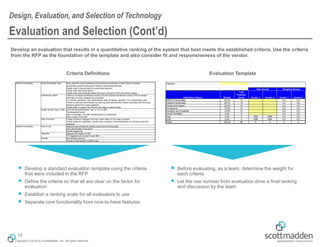
Develop an evaluation that results in a quantitative ranking of the system that best meets the established criteria. Use the criteria
from the RFP as the foundation of the template and also consider fit and responsiveness of the vendor.
Design, Evaluation, and Selection of Technology
17
Criteria Definitions Evaluation Template
■ Develop a standard evaluation template using the criteria
that were included in the RFP
■ Define the criteria so that all are clear on the factor for
evaluation
■ Establish a ranking scale for all evaluators to use
■ Separate core functionality from nice-to-have features
■ Before evaluating, as a team, determine the weight for
each criteria
■ Let the raw number from evaluation drive a final ranking
and discussion by the team
Evaluator:
Evaluation Criteria Weight
Total
Potential
Score Vendor 1 Vendor 2 Vendor 1 Vendor 2
IVR/CTI Functionality 30.0% 10 0.0 0.0
General Functionality 20.0% 10 0.0 0.0
Service and Support 20.0% 10 0.0 0.0
Architecture 15.0% 10 0.0 0.0
Flexibility and Scalability 10.0% 10 0.0 0.0
Vendor Suitability 5.0% 10 0.0 0.0
Cost 0.0% 0 DNR DNR 0.0 0.0
Trust 0.0% 0 DNR DNR 0.0 0.0
Totals 100.0% 60 0 0 0 0
Raw Scores Weighted Scores
Query data from Lawson database using employee identification number collect via handset
Dynamically present routing options based on queried data elements
Transfer calls to queues based on queried data elements
Prompt caller with routing options
Transfer calls inside Advocate health Care and to third party POTS and toll-free numbers
Collect an employee identification number (EID) and personal identification number (PIN) via handset
Send data to Lawson database for comparison
For matches, generate a "yes" authentication value; for failures, generate a "no" authentication value
Present an alternate authentication by matching three data elements entered via handset with three data
elements queried from Lawson database
Provide ability to request new PIN and enter digits at option of caller
Send EID and authentication "yes" or "no" to CMS
Pop designated screen
Effect a message in the CMS indicating failure to authenticate
Effect a query in the CMS
Provide a dynamic message of the day to alert callers to call center conditions
Provide expansion capabilities, including voice recognition and authentication and voiceing of data from
databases
Graphical user interface for creating scripts and call routing logic
Easy administration of accounts
Remote programing
Integrate with Alcatel 8.0 PBX
CTI integration with Alcatel 8.0 and CMS
Administration security
Security of data queried to perform logic
IVR/CTI Functionality
Other Functions
Ease of Use
Integration
Security
General Functionality
Route and Transfer Calls
Authenticate Callers
Provide Screen Pops in CMS
Copyright © 2018 by ScottMadden, Inc. All rights reserved.
Implementation Plan
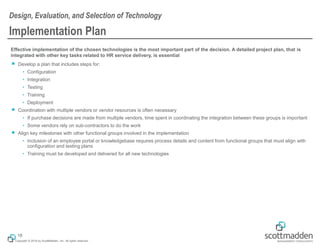
Effective implementation of the chosen technologies is the most important part of the decision. A detailed project plan, that is
integrated with other key tasks related to HR service delivery, is essential
■ Develop a plan that includes steps for:
• Configuration
• Integration
• Testing
• Training
• Deployment
■ Coordination with multiple vendors or vendor resources is often necessary
• If purchase decisions are made from multiple vendors, time spent in coordinating the integration between these groups is important
• Some vendors rely on sub-contractors to do the work
■ Align key milestones with other functional groups involved in the implementation
• Inclusion of an employee portal or knowledgebase requires process details and content from functional groups that must align with
configuration and testing plans
• Training must be developed and delivered for all new technologies
Design, Evaluation, and Selection of Technology
18
Lessons Learned
Copyright © 2018 by ScottMadden, Inc. All rights reserved.
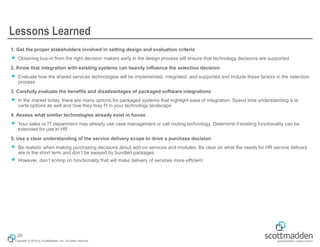
Lessons Learned
1. Get the proper stakeholders involved in setting design and evaluation criteria
■ Obtaining buy-in from the right decision makers early in the design process will ensure that technology decisions are supported
2. Know that integration with existing systems can heavily influence the selection decision
■ Evaluate how the shared services technologies will be implemented, integrated, and supported and include these factors in the selection
process
3. Carefully evaluate the benefits and disadvantages of packaged software integrations
■ In the market today, there are many options for packaged systems that highlight ease of integration. Spend time understanding á la
carte options as well and how they may fit in your technology landscape
4. Assess what similar technologies already exist in house
■ Your sales or IT department may already use case management or call routing technology. Determine if existing functionality can be
extended for use in HR
5. Use a clear understanding of the service delivery scope to drive a purchase decision
■ Be realistic when making purchasing decisions about add-on services and modules. Be clear on what the needs for HR service delivery
are in the short term and don’t be swayed by bundled packages
■ However, don’t scrimp on functionality that will make delivery of services more efficient
20

Technology for HR Shared Services

  • 1.
    Copyright © 2018ScottMadden, Inc. All rights reserved. Report _2018 Technology for HR Shared Services A Discussion of Key Concepts in Shared Services Technology August 2011
  • 2.
    Copyright © 2018by ScottMadden, Inc. All rights reserved. Agenda ■ About ScottMadden ■ Overview of HR Technology ■ Design, Evaluation, and Selection of Technology ■ Lessons Learned 1
  • 3.
  • 4.
    Copyright © 2018by ScottMadden, Inc. All rights reserved. About ScottMadden’s Shared Services Practice 3 Decide Design Build Improve ■ Strategy development and integration ■ Benchmarking ■ High-level business case ■ Change management ■ Service delivery model ■ Detailed current state, future state, and business case ■ Sourcing model ■ Organization design and staffing ■ Change management ■ Project planning and management ■ Service/transaction center ■ Process redesign ■ Technology design, selection, and support ■ Change management ■ Process improvement/cost reduction ■ Operations/ technology assessment ■ M&A integration ■ Benchmarking ■ Customer and employee surveys ■ Change management Finance & Accounting Human Resources Supply Chain Management Information Technology Real Estate & Facilities Multifunction Engineering Services Administrative Services Our Functional Expertise
  • 5.
    Overview of HRTechnology
  • 6.
    Copyright © 2018by ScottMadden, Inc. All rights reserved. Overview of HR Technology Technologies in human resources usually fall into three main categories Overview of HR Technology 5 Human Resources Information System (HRIS) are sometimes a module of a larger Enterprise Resource Planning System (ERP) or it can be a stand-alone system. Examples of function-specific applications are those used by recruiting and staffing, learning and development, or compensation. Shared services technologies are implemented to manage calls, cases, documents, and workflow in a service center environment. Shared Services Technologies Function-Specific Applications ERP/HRIS HR Technology
  • 7.
    Copyright © 2018by ScottMadden, Inc. All rights reserved. Overview of HR Technology (Cont’d) When selecting technology for use in a shared services organization, it often must be integrated or purchased with other HR technology solutions. Below is an overview of the more popular software solutions by HR function, which must be considered when designing the technology landscape for shared services. Overview of HR Technology 6 Function Typical Cost ($M) Example Software HRIS (ERP) ■ $5M–$15M ■ Oracle, Workday, PeopleSoft, Lawson Compensation ■ ~$500K to implement; ongoing hosting cost ■ ERP modules, Total Rewards (Towers, Hewitt) Recruiting and Staffing ■ $3M–$5M ■ Taleo, Kenexa, Silk Road Talent Management ■ $3M–$8M ■ Success Factors, Silk Road, eTalent, Talent|Reward (Towers) Learning and Development ■ ~$500K to implement; ongoing hosting cost ■ Element K, ERP modules Payroll ■ $3M–$8M ■ ADP, Ceridian
  • 8.
    Copyright © 2018by ScottMadden, Inc. All rights reserved. Overview of HR Technology (Cont’d) There are a variety of options available for technology for the various functions of shared services. There is an on-premise software, technologies leveraging SaaS, and/or web services. Inclusion of the different options in a shared services center depends on type of services, mode of service delivery, and overall design of the technology environment. Overview of HR Technology 7 Function Typical Cost ($M) Example Software Call Management ■ $25K–$75K ■ Ongoing hosting costs ■ VoIP (e.g., AT&T, Verizon, others) ■ IVR (Interactive Intelligence, Siemens, InContact) Case Management System ■ $500K–$3M ■ Salesforce.com, RightNow, ServiceNow Knowledgebase ■ $250K–$750K ■ Ongoing hosting costs ■ Enwisen, Moxie (formerly nGenera), RightNow Employee Portal ■ $500K–$6M ■ Enwisen, PeopleSoft, Oracle, internal Document Management ■ $100K–$1M ■ Xerox, OnBase, Laserfiche, Sharepoint
  • 9.
    Copyright © 2018by ScottMadden, Inc. All rights reserved. ■ Automatic Call Distributor (ACD) – handles queue management ■ 800#/Interactive Voice Response System (IVR) – provides customers with access to information via the telephone; provides menu options ■ Computer Telephony Integration – “screen pops;” recognizes caller’s phone number and pulls up relevant information for call reps while they are answering the phone ■ Case Management – provides caller history/information ■ Knowledgebase – provides searchable information for call reps ■ Document Management – manages electronic receipt/filing/retrieval of documents ■ Employee/Manager Self-Service Application and Workflow Technology – provides web front-end and back-end processing to enable customers to view/interact with back-end data via a PC, kiosk, etc. ■ Web Content Management Software (portals) – serves to pull distributed data from a variety of sources into a standard web presentation ■ Web Chat – allows customers to interact real time with a customer service rep over the web ■ Voice over IP – enables call reps and customers to speak directly over the internet (bypassing telecomm costs) while customers navigate the website ■ Wireless PDA – ports back office and web-based information to wireless personal digital assistants ■ Core HRIS/Payroll Systems – database-based systems used for core HR reporting and payroll functions Service Center Technologies Overview of HR Technology 8
  • 10.
    Copyright © 2018by ScottMadden, Inc. All rights reserved. Service Center Technologies (Cont’d) Overview of HR Technology 9 Employee Files Data Warehouse (BI) Knowledgebase Case Management System ESS/ MSS Employee Personnel Files View, Update Ancillary HR Systems Vendor Sites Web Reports Multi-Channel Management
  • 11.
    Copyright © 2018by ScottMadden, Inc. All rights reserved. Service Center Technologies (Cont’d) Overview of HR Technology 10 HRIS ■ Queues calls and chat sessions ■ Identifies and authenticates callers/requesters ■ Intelligently routes callers/requesters ■ Provides context of caller ■ Enables verbal authentication ■ Provides essential employee information to answer questions ■ Provides answers to questions ■ Stores HR portal content ■ Directs CSRs on what actions to take ■ Links HR service center agents to process flows for additional guidance ■ Stores and records employee data ■ Stores and transmits pay inputs ■ Manages data on employees Caller Information Employee Information Case Details Multichannel Management IVR/ACD/CTI ■ Records requests ■ Routes requests ■ Tracks accomplishment ■ Enables reporting Knowledgebase Case Management System ■ Provides single sign-on capability/security ■ Displays personalized content ■ Directs user to HR documents and self-service applications HR Portal
  • 12.
    Copyright © 2018by ScottMadden, Inc. All rights reserved. Trends in HR Technology These trends are frequent topics in design discussions and human resources information forums: 1. Expanding Tier 0 ■ Expanding self-service options to employees and managers. This can be accomplished through integration of an employee portal and other linked smart forms with the knowledgebase and case management system 2. Interactive chat, messaging, and personal devices ■ Understanding the employee population and their service requests should influence the choice to include these interactive options for customer support 3. Business intelligence ■ Adding a business intelligence module to an application to enable reporting and data analytics is frequently an option offered by vendors. Some modules are more effective than others, and it is prudent to assess how the module can integrate with other existing reporting tools and business processes 4. Virtual teams and flexible work arrangements ■ Utilizing virtual teams to deliver service across various regions is effective for global companies ■ Offering flexible work arrangements is attractive to employees searching for a position with work-life balance and for the growing workforce of Gen Y; however, these arrangements present different challenges in management and operations 5. Cloud technology and software as a service (SaaS) ■ Evaluating solutions that offer benefits in ease of access and decreased maintenance costs is now a compelling option ■ Ensuring that the SaaS options fit with the overall strategies of IT and security and that the ROI is robust is critical to the decision process Overview of HR Technology 11
  • 13.
    Design, Evaluation, andSelection of Technology
  • 14.
    Copyright © 2018by ScottMadden, Inc. All rights reserved. ■ Organize a dedicated team to drive the design and selection process and make key decisions Technology Decisions Once the decision has been made to acquire technology, an organized process should be followed to coordinate the effort. Timeframes for a technology selection process can range from six to eight weeks to six to eight months, depending on the nature of the system. Design, Evaluation, and Selection of Technology 13 Purpose/Intent Create a technology team Develop design and requirements Evaluate and select vendor(s) Plan for implementation ■ Identify the requirements for each system ■ Document the design for the overall technology landscape and gain approval on the design from key stakeholders ■ Approach the evaluation and selection of technology vendors in a methodical way ■ Build evaluation criteria and create an RFP that reflects the documented design requirements ■ Develop an implementation plan for configuration, integration, testing, and development of the systems that are acquired
  • 15.
    Copyright © 2018by ScottMadden, Inc. All rights reserved. Technology Team A dedicated technology team should be formed to own the process of design, evaluation, and selection of human resources technologies. Design, Evaluation, and Selection of Technology 14 The team should be expected to: ■ Provide project management expertise to the decision process ■ Participate in development of business rules, technology requirements, and technology functional design with key functional leads ■ Develop documentation of the technology requirements and overall technology design ■ Obtain approval from HR and IT stakeholders on strategy and direction ■ Act as primary contact for technology vendors ■ Oversee installation, development, integration, and testing according to implementation plan and design documentation Roles and Responsibilities ■ Able to drive results ■ Cross-functional participation from IT, HR, shared services center, and procurement ■ Given authority to make decisions Key Attributes of the Team
  • 16.
    Copyright © 2018by ScottMadden, Inc. All rights reserved. Requirements Development of comprehensive technology requirements and design takes some time, coordination, and participation of the right decision makers. Design, Evaluation, and Selection of Technology 15 Requirements Design Planning ■ Use the scope of services and characteristics of the workforce to shape system requirements ■ Develop in conjunction with functional leads ■ Understand the technology market to consider all potential functionality ■ Document the requirements and gain proper buy-in from stakeholders ■ Understand the existing technology environment ■ Determine where integrations are necessary ■ Coordinate the physical location of servers and necessary network requirements to support the technology ■ Document the total landscape ■ Understand the lead times required for working with procurement, IT, and legal on a purchase decision ■ Allocate significant time in the plan for developing the requirements
  • 17.
    Copyright © 2018by ScottMadden, Inc. All rights reserved. Evaluation and Selection Evaluation and selection of vendors and technology should be a methodical process where the full technology team is involved in each phase. Design, Evaluation, and Selection of Technology 16 ■ Prepare a negotiation plan for the process ■ Ensure that key stakeholders are ready and aware of key decision points ■ Incorporate the implementation timeline as a criteria for negotiation to guarantee that the vendor can meet the deadlines Contract Negotiation ■ Conduct market research of potential vendors ■ Gain understanding of various functionality and pricing options ■ Interact with peer organizations to learn about their technologies ■ Organize demonstrations of vendors Market Research ■ Narrow list of potential vendors ■ Develop and distribute a request for proposal (RFP), including qualifications, evaluation criteria, and forms for response on technical requirements and pricing ■ Involve procurement representatives if applicable RFP Distribution ■ Evaluate each vendor response across the same standard criteria ■ Allow time for vendors to make presentations and provide responses ■ If there are a few top choices, allow more than one vendor to enter the negotiation phase Evaluation
  • 18.
    Copyright © 2018by ScottMadden, Inc. All rights reserved. Evaluation and Selection (Cont’d) Develop an evaluation that results in a quantitative ranking of the system that best meets the established criteria. Use the criteria from the RFP as the foundation of the template and also consider fit and responsiveness of the vendor. Design, Evaluation, and Selection of Technology 17 Criteria Definitions Evaluation Template ■ Develop a standard evaluation template using the criteria that were included in the RFP ■ Define the criteria so that all are clear on the factor for evaluation ■ Establish a ranking scale for all evaluators to use ■ Separate core functionality from nice-to-have features ■ Before evaluating, as a team, determine the weight for each criteria ■ Let the raw number from evaluation drive a final ranking and discussion by the team Evaluator: Evaluation Criteria Weight Total Potential Score Vendor 1 Vendor 2 Vendor 1 Vendor 2 IVR/CTI Functionality 30.0% 10 0.0 0.0 General Functionality 20.0% 10 0.0 0.0 Service and Support 20.0% 10 0.0 0.0 Architecture 15.0% 10 0.0 0.0 Flexibility and Scalability 10.0% 10 0.0 0.0 Vendor Suitability 5.0% 10 0.0 0.0 Cost 0.0% 0 DNR DNR 0.0 0.0 Trust 0.0% 0 DNR DNR 0.0 0.0 Totals 100.0% 60 0 0 0 0 Raw Scores Weighted Scores Query data from Lawson database using employee identification number collect via handset Dynamically present routing options based on queried data elements Transfer calls to queues based on queried data elements Prompt caller with routing options Transfer calls inside Advocate health Care and to third party POTS and toll-free numbers Collect an employee identification number (EID) and personal identification number (PIN) via handset Send data to Lawson database for comparison For matches, generate a "yes" authentication value; for failures, generate a "no" authentication value Present an alternate authentication by matching three data elements entered via handset with three data elements queried from Lawson database Provide ability to request new PIN and enter digits at option of caller Send EID and authentication "yes" or "no" to CMS Pop designated screen Effect a message in the CMS indicating failure to authenticate Effect a query in the CMS Provide a dynamic message of the day to alert callers to call center conditions Provide expansion capabilities, including voice recognition and authentication and voiceing of data from databases Graphical user interface for creating scripts and call routing logic Easy administration of accounts Remote programing Integrate with Alcatel 8.0 PBX CTI integration with Alcatel 8.0 and CMS Administration security Security of data queried to perform logic IVR/CTI Functionality Other Functions Ease of Use Integration Security General Functionality Route and Transfer Calls Authenticate Callers Provide Screen Pops in CMS
  • 19.
    Copyright © 2018by ScottMadden, Inc. All rights reserved. Implementation Plan Effective implementation of the chosen technologies is the most important part of the decision. A detailed project plan, that is integrated with other key tasks related to HR service delivery, is essential ■ Develop a plan that includes steps for: • Configuration • Integration • Testing • Training • Deployment ■ Coordination with multiple vendors or vendor resources is often necessary • If purchase decisions are made from multiple vendors, time spent in coordinating the integration between these groups is important • Some vendors rely on sub-contractors to do the work ■ Align key milestones with other functional groups involved in the implementation • Inclusion of an employee portal or knowledgebase requires process details and content from functional groups that must align with configuration and testing plans • Training must be developed and delivered for all new technologies Design, Evaluation, and Selection of Technology 18
  • 20.
  • 21.
    Copyright © 2018by ScottMadden, Inc. All rights reserved. Lessons Learned 1. Get the proper stakeholders involved in setting design and evaluation criteria ■ Obtaining buy-in from the right decision makers early in the design process will ensure that technology decisions are supported 2. Know that integration with existing systems can heavily influence the selection decision ■ Evaluate how the shared services technologies will be implemented, integrated, and supported and include these factors in the selection process 3. Carefully evaluate the benefits and disadvantages of packaged software integrations ■ In the market today, there are many options for packaged systems that highlight ease of integration. Spend time understanding á la carte options as well and how they may fit in your technology landscape 4. Assess what similar technologies already exist in house ■ Your sales or IT department may already use case management or call routing technology. Determine if existing functionality can be extended for use in HR 5. Use a clear understanding of the service delivery scope to drive a purchase decision ■ Be realistic when making purchasing decisions about add-on services and modules. Be clear on what the needs for HR service delivery are in the short term and don’t be swayed by bundled packages ■ However, don’t scrimp on functionality that will make delivery of services more efficient 20