SPSS Tutorial
AEB 37 / AE 802
Marketing Research Methods
Week 7
Cluster Analysis
Lecture / Tutorial outline
• Cluster analysis
• Example of cluster analysis
• Work on the assignment
Cluster Analysis-Contid…
• It is a class of techniques used to classify cases into
groups that are relatively homogeneous within
themselves and heterogeneous between each other, on
the basis of a defined set of variables. These groups are
called clusters.
Cluster Analysis and marketing research
• Market segmentation. E.g. clustering of consumers
according to their attribute preferences
• Understanding buyers behaviours. Consumers with
similar behaviours/characteristics are clustered
• Identifying new product opportunities. Clusters of
similar brands/products can help identifying competitors /
market opportunities
• Reducing data. E.g. in preference mapping
Steps to conduct a Cluster Analysis
1. Select a distance measure
2. Select a clustering algorithm
3. Determine the number of clusters
4. Validate the analysis
REGR factor score 2 for analysis 1
43210-1-2-3
3
2
1
0
-1
-2
-3
-4
• Steps to conduct a Cluster Analysis - Contd
Defining distance: the Euclidean distance
 
2
1
n
ij ki kj
k
D x x

 
Dij distance between cases i and j
xki value of variable Xk for case j
Problems:
• Different measures = different weights
• Correlation between variables (double counting)
Solution: Principal component analysis
Clustering procedures
• Hierarchical procedures
– Agglomerative (start from n clusters, to get to 1
cluster)
– Divisive (start from 1 cluster, to get to n cluster)
• Non hierarchical procedures
– K-means clustering
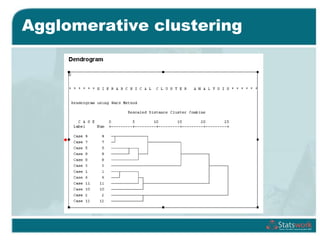
Agglomerative clustering
• Linkage methods
– Single linkage (minimum distance)
– Complete linkage (maximum distance)
– Average linkage
• Ward’s method
1. Compute sum of squared distances within clusters
2. Aggregate clusters with the minimum increase in the overall
sum of squares
• Centroid method
– The distance between two clusters is defined as the
difference between the centroids (cluster averages)
K-means clustering
1. The number k of cluster is fixed
2. An initial set of k “seeds” (aggregation centres) is
provided
• First k elements
• Other seeds
3. Given a certain treshold, all units are assigned to the
nearest cluster seed
4. New seeds are computed
5. Go back to step 3 until no reclassification is necessary
Units can be reassigned in successive steps (optimising
partioning)
Hierarchical vs Non hierarchical methods
Hierarchical clustering
• No decision about the
number of clusters
• Problems when data
contain a high level of
error
• Can be very slow
• Initial decision are more
influential (one-step
only)
Non hierarchical
clustering
• Faster, more reliable
• Need to specify the
number of clusters
(arbitrary)
• Need to set the initial
seeds (arbitrary)
Suggested approach
1. First perform a hierarchical method to define the
number of clusters
2. Then use the k-means procedure to actually form
the clusters
Defining the number of clusters: elbow rule (1)
Agglomeration Schedule
4 7 .015 0 0 4
6 10 .708 0 0 5
8 9 .974 0 0 4
4 8 1.042 1 3 6
1 6 1.100 0 2 7
4 5 3.680 4 0 7
1 4 3.492 5 6 8
1 11 6.744 7 0 9
1 2 8.276 8 0 10
1 12 8.787 9 0 11
1 3 11.403 10 0 0
Stage
1
2
3
4
5
6
7
8
9
10
11
Cluster 1 Cluster 2
Cluster Combined
Coefficients Cluster 1 Cluster 2
Stage Cluster First
Appears
Next Stage
Stage Number of clusters
0 12
1 11
2 10
3 9
4 8
5 7
6 6
7 5
8 4
9 3
10 2
11 1
n
Elbow rule (2): the scree diagram
0
2
4
6
8
10
12
11 10 9 8 7 6 5 4 3 2 1
Number of clusters
Distance
Validating the analysis
• Impact of initial seeds / order of cases
• Impact of the selected method
• Consider the relevance of the chosen set of variables
SPSS Example
Component1
2.01.51.0.50.0-.5-1.0-1.5
Component2
1.5
1.0
.5
0.0
-.5
-1.0
-1.5
-2.0
LUCY
JULIA
FRED
ARTHUR
JENNIFER
THOMAS
MATTHEW
NICOLE
PAMELA
JOHN
SPSS Example
Agglomeration Schedule
3 6 .026 0 0 8
2 5 .078 0 0 7
4 9 .224 0 0 5
1 7 .409 0 0 6
4 10 .849 3 0 8
1 8 1.456 4 0 7
1 2 4.503 6 2 9
3 4 9.878 1 5 9
1 3 18.000 7 8 0
Stage
1
2
3
4
5
6
7
8
9
Cluster 1 Cluster 2
Cluster Combined
Coefficients Cluster 1 Cluster 2
Stage Cluster First
Appears
Next Stage
Number of clusters: 10 – 6 = 4
SPSS Example
Component1
2.01.51.0.50.0-.5-1.0-1.5
Component2
1.5
1.0
.5
0.0
-.5
-1.0
-1.5
-2.0
Cluster Number of Ca
4
3
2
1
LUCY
JULIA
FRED
ARTHUR
JENNIFER
THOMAS
MATTHEW
NICOLE
PAMELA
JOHN
SPSS Example
Open the dataset supermarkets.sav
From your N: directory (if you saved it there last time
Or download it from:
http://www.rdg.ac.uk/~aes02mm/supermarket.sav
• Open it in SPSS
The supermarkets.sav dataset
Run Principal Components Analysis and save scores
• Select the variables to perform the analysis
• Set the rule to extract principal components
• Give instruction to save the principal components as
new variables
Cluster analysis: basic steps
• Apply Ward’s methods on the principal components
score
• Check the agglomeration schedule
• Decide the number of clusters
• Apply the k-means method
Analyse / Classify
Select the component scores
Select from here Untick this
Select Ward’s algorithm
Click
here
first
Select
method
here
Output: Agglomeration schedule
Number of clusters
Identify the step where the “distance coefficients” makes a bigger jump
The scree diagram (Excel needed)
Distance
0
100
200
300
400
500
600
700
800
118
120
122
124
126
128
130
132
134
136
138
140
142
144
146
148
Step
Number of clusters
Number of cases 150
Step of ‘elbow’ 144
__________________________________
Number of clusters 6
Now repeat the analysis
• Choose the k-means technique
• Set 6 as the number of clusters
• Save cluster number for each case
• Run the analysis
K-means
K-means dialog box
Specify
number of
clusters
Save cluster membership
Click here
first Thick here
Final output
Cluster membership
Component meaning (tutorial week 5)
Component Matrixa
.810 -.294 -4.26E-02 .183 .173
.480 -.152 .347 .334 -5.95E-02
.525 -.206 -.475 -4.35E-02 .140
.192 -.345 -.127 .383 .199
.646 -.281 -.134 -.239 -.207
.536 .619 -.102 -.172 6.008E-02
.492 -.186 .190 .460 .342
1.784E-02 -9.24E-02 .647 -.287 .507
.649 .612 .135 -6.12E-02 -3.29E-03
.369 .663 .247 .184 1.694E-02
.124 -9.53E-02 .462 .232 -.529
2.989E-02 .406 -.349 .559 -8.14E-02
.443 -.271 .182 -5.61E-02 -.465
.908 -4.75E-02 -7.46E-02 -.197 -3.26E-02
.891 -5.64E-02 -6.73E-02 -.228 6.942E-04
Monthly amount spent
Meat expenditure
Fish expenditure
Vegetables expenditure
% spent in own-brand
product
Own a car
% spent in organic food
Vegetarian
Household Size
Number of kids
Weekly TV watching
(hours)
Weekly Radio listening
(hours)
Surf the web
Yearly household income
Age of respondent
1 2 3 4 5
Component
Extraction Method: Principal Component Analysis.
5 components extracted.a.
1. “Old Rich Big
Spender” 3. Vegetarian TV
lover
4. Organic radio
listener
2. Family shopper
5. Vegetarian TV and
web hater
Final Cluster Centers
-1.34392 .21758 .13646 .77126 .40776 .72711
.38724 -.57755 -1.12759 .84536 .57109 -.58943
-.22215 -.09743 1.41343 .17812 1.05295 -1.39335
.15052 -.28837 -.30786 1.09055 -1.34106 .04972
.04886 -.93375 1.23631 -.11108 .31902 .87815
REGR factor score
1 for analysis 1
REGR factor score
2 for analysis 1
REGR factor score
3 for analysis 1
REGR factor score
4 for analysis 1
REGR factor score
5 for analysis 1
1 2 3 4 5 6
Cluster
Component meaning (tutorial week 5)
Cluster interpretation through mean component values
• Cluster 1 is very far from profile 1 (-1.34) and more similar to profile
2 (0.38)
• Cluster 2 is very far from profile 5 (-0.93) and not particularly similar
to any profile
• Cluster 3 is extremely similar to profiles 3 and 5 and very far from
profile 2
• Cluster 4 is similar to profiles 2 and 4
• Cluster 5 is very similar to profile 3 and very far from profile 4
• Cluster 6 is very similar to profile 5 and very far from profile 3
Which cluster to target?
• Objective: target the organic consumer
• Which is the cluster that looks more “organic”?
• Compute the descriptive statistics on the original variables for
that cluster
Representation of factors 1 and 4 (and cluster membership)
REGR factor score 1 for analysis 1
210-1-2-3
3
2
1
0
-1
-2
-3
Cluster Number of Ca
6
5
4
3
2
1
Contact Us
PLACE OF BUSINESS
www.statswork.com
No: 10, Kutty Street,
Nungambakkam,
Chennai – 600 034
+91 8754446690
INDIA UK USA
The Portergate
Ecclesall Road
Sheffield, S11 8NX
+44-1143520021
Mockingbird 1341 W
Mockingbird Lane,
Suite 600W,
Dallas, Texas, 75247
+1-9725029262
info@statswork.com

SPSS Step-by-Step Tutorial and Statistical Guides by Statswork

  • 1.
    SPSS Tutorial AEB 37/ AE 802 Marketing Research Methods Week 7
  • 2.
    Cluster Analysis Lecture /Tutorial outline • Cluster analysis • Example of cluster analysis • Work on the assignment
  • 3.
    Cluster Analysis-Contid… • Itis a class of techniques used to classify cases into groups that are relatively homogeneous within themselves and heterogeneous between each other, on the basis of a defined set of variables. These groups are called clusters.
  • 4.
    Cluster Analysis andmarketing research • Market segmentation. E.g. clustering of consumers according to their attribute preferences • Understanding buyers behaviours. Consumers with similar behaviours/characteristics are clustered • Identifying new product opportunities. Clusters of similar brands/products can help identifying competitors / market opportunities • Reducing data. E.g. in preference mapping
  • 5.
    Steps to conducta Cluster Analysis 1. Select a distance measure 2. Select a clustering algorithm 3. Determine the number of clusters 4. Validate the analysis
  • 6.
    REGR factor score2 for analysis 1 43210-1-2-3 3 2 1 0 -1 -2 -3 -4 • Steps to conduct a Cluster Analysis - Contd
  • 7.
    Defining distance: theEuclidean distance   2 1 n ij ki kj k D x x    Dij distance between cases i and j xki value of variable Xk for case j Problems: • Different measures = different weights • Correlation between variables (double counting) Solution: Principal component analysis
  • 8.
    Clustering procedures • Hierarchicalprocedures – Agglomerative (start from n clusters, to get to 1 cluster) – Divisive (start from 1 cluster, to get to n cluster) • Non hierarchical procedures – K-means clustering
  • 9.
  • 10.
    Agglomerative clustering • Linkagemethods – Single linkage (minimum distance) – Complete linkage (maximum distance) – Average linkage • Ward’s method 1. Compute sum of squared distances within clusters 2. Aggregate clusters with the minimum increase in the overall sum of squares • Centroid method – The distance between two clusters is defined as the difference between the centroids (cluster averages)
  • 11.
    K-means clustering 1. Thenumber k of cluster is fixed 2. An initial set of k “seeds” (aggregation centres) is provided • First k elements • Other seeds 3. Given a certain treshold, all units are assigned to the nearest cluster seed 4. New seeds are computed 5. Go back to step 3 until no reclassification is necessary Units can be reassigned in successive steps (optimising partioning)
  • 12.
    Hierarchical vs Nonhierarchical methods Hierarchical clustering • No decision about the number of clusters • Problems when data contain a high level of error • Can be very slow • Initial decision are more influential (one-step only) Non hierarchical clustering • Faster, more reliable • Need to specify the number of clusters (arbitrary) • Need to set the initial seeds (arbitrary)
  • 13.
    Suggested approach 1. Firstperform a hierarchical method to define the number of clusters 2. Then use the k-means procedure to actually form the clusters
  • 14.
    Defining the numberof clusters: elbow rule (1) Agglomeration Schedule 4 7 .015 0 0 4 6 10 .708 0 0 5 8 9 .974 0 0 4 4 8 1.042 1 3 6 1 6 1.100 0 2 7 4 5 3.680 4 0 7 1 4 3.492 5 6 8 1 11 6.744 7 0 9 1 2 8.276 8 0 10 1 12 8.787 9 0 11 1 3 11.403 10 0 0 Stage 1 2 3 4 5 6 7 8 9 10 11 Cluster 1 Cluster 2 Cluster Combined Coefficients Cluster 1 Cluster 2 Stage Cluster First Appears Next Stage Stage Number of clusters 0 12 1 11 2 10 3 9 4 8 5 7 6 6 7 5 8 4 9 3 10 2 11 1 n
  • 15.
    Elbow rule (2):the scree diagram 0 2 4 6 8 10 12 11 10 9 8 7 6 5 4 3 2 1 Number of clusters Distance
  • 16.
    Validating the analysis •Impact of initial seeds / order of cases • Impact of the selected method • Consider the relevance of the chosen set of variables
  • 17.
  • 18.
  • 19.
    Agglomeration Schedule 3 6.026 0 0 8 2 5 .078 0 0 7 4 9 .224 0 0 5 1 7 .409 0 0 6 4 10 .849 3 0 8 1 8 1.456 4 0 7 1 2 4.503 6 2 9 3 4 9.878 1 5 9 1 3 18.000 7 8 0 Stage 1 2 3 4 5 6 7 8 9 Cluster 1 Cluster 2 Cluster Combined Coefficients Cluster 1 Cluster 2 Stage Cluster First Appears Next Stage Number of clusters: 10 – 6 = 4 SPSS Example
  • 20.
    Component1 2.01.51.0.50.0-.5-1.0-1.5 Component2 1.5 1.0 .5 0.0 -.5 -1.0 -1.5 -2.0 Cluster Number ofCa 4 3 2 1 LUCY JULIA FRED ARTHUR JENNIFER THOMAS MATTHEW NICOLE PAMELA JOHN SPSS Example
  • 21.
    Open the datasetsupermarkets.sav From your N: directory (if you saved it there last time Or download it from: http://www.rdg.ac.uk/~aes02mm/supermarket.sav • Open it in SPSS
  • 22.
  • 23.
    Run Principal ComponentsAnalysis and save scores • Select the variables to perform the analysis • Set the rule to extract principal components • Give instruction to save the principal components as new variables
  • 24.
    Cluster analysis: basicsteps • Apply Ward’s methods on the principal components score • Check the agglomeration schedule • Decide the number of clusters • Apply the k-means method
  • 25.
  • 26.
    Select the componentscores Select from here Untick this
  • 27.
  • 28.
  • 29.
    Number of clusters Identifythe step where the “distance coefficients” makes a bigger jump
  • 30.
    The scree diagram(Excel needed) Distance 0 100 200 300 400 500 600 700 800 118 120 122 124 126 128 130 132 134 136 138 140 142 144 146 148 Step
  • 31.
    Number of clusters Numberof cases 150 Step of ‘elbow’ 144 __________________________________ Number of clusters 6
  • 32.
    Now repeat theanalysis • Choose the k-means technique • Set 6 as the number of clusters • Save cluster number for each case • Run the analysis
  • 33.
  • 34.
  • 35.
    Save cluster membership Clickhere first Thick here
  • 36.
  • 37.
  • 38.
    Component meaning (tutorialweek 5) Component Matrixa .810 -.294 -4.26E-02 .183 .173 .480 -.152 .347 .334 -5.95E-02 .525 -.206 -.475 -4.35E-02 .140 .192 -.345 -.127 .383 .199 .646 -.281 -.134 -.239 -.207 .536 .619 -.102 -.172 6.008E-02 .492 -.186 .190 .460 .342 1.784E-02 -9.24E-02 .647 -.287 .507 .649 .612 .135 -6.12E-02 -3.29E-03 .369 .663 .247 .184 1.694E-02 .124 -9.53E-02 .462 .232 -.529 2.989E-02 .406 -.349 .559 -8.14E-02 .443 -.271 .182 -5.61E-02 -.465 .908 -4.75E-02 -7.46E-02 -.197 -3.26E-02 .891 -5.64E-02 -6.73E-02 -.228 6.942E-04 Monthly amount spent Meat expenditure Fish expenditure Vegetables expenditure % spent in own-brand product Own a car % spent in organic food Vegetarian Household Size Number of kids Weekly TV watching (hours) Weekly Radio listening (hours) Surf the web Yearly household income Age of respondent 1 2 3 4 5 Component Extraction Method: Principal Component Analysis. 5 components extracted.a. 1. “Old Rich Big Spender” 3. Vegetarian TV lover 4. Organic radio listener 2. Family shopper 5. Vegetarian TV and web hater
  • 39.
    Final Cluster Centers -1.34392.21758 .13646 .77126 .40776 .72711 .38724 -.57755 -1.12759 .84536 .57109 -.58943 -.22215 -.09743 1.41343 .17812 1.05295 -1.39335 .15052 -.28837 -.30786 1.09055 -1.34106 .04972 .04886 -.93375 1.23631 -.11108 .31902 .87815 REGR factor score 1 for analysis 1 REGR factor score 2 for analysis 1 REGR factor score 3 for analysis 1 REGR factor score 4 for analysis 1 REGR factor score 5 for analysis 1 1 2 3 4 5 6 Cluster Component meaning (tutorial week 5)
  • 40.
    Cluster interpretation throughmean component values • Cluster 1 is very far from profile 1 (-1.34) and more similar to profile 2 (0.38) • Cluster 2 is very far from profile 5 (-0.93) and not particularly similar to any profile • Cluster 3 is extremely similar to profiles 3 and 5 and very far from profile 2 • Cluster 4 is similar to profiles 2 and 4 • Cluster 5 is very similar to profile 3 and very far from profile 4 • Cluster 6 is very similar to profile 5 and very far from profile 3
  • 41.
    Which cluster totarget? • Objective: target the organic consumer • Which is the cluster that looks more “organic”? • Compute the descriptive statistics on the original variables for that cluster
  • 42.
    Representation of factors1 and 4 (and cluster membership) REGR factor score 1 for analysis 1 210-1-2-3 3 2 1 0 -1 -2 -3 Cluster Number of Ca 6 5 4 3 2 1
  • 43.
    Contact Us PLACE OFBUSINESS www.statswork.com No: 10, Kutty Street, Nungambakkam, Chennai – 600 034 +91 8754446690 INDIA UK USA The Portergate Ecclesall Road Sheffield, S11 8NX +44-1143520021 Mockingbird 1341 W Mockingbird Lane, Suite 600W, Dallas, Texas, 75247 +1-9725029262 info@statswork.com