MODULE O05
DESIGN OF SPRINGS
Spring is defined as an elastic machine element(flexible element) that deflects
under the action of load and returns to its original shape when load is removed.
IMPORTANT FUNCTIONS AND APPLICATIONS OF SPRING
1. Springs are used to absorb shocks and vibrations
eg: vehicle suspension springs, railway buffers to control energy, buffer
springs in elevators and vibration mounts for machinery.
2. Measuring forces :Spring balances, gages
3. Storing of energy in clocks ,toys ,novie cameras, circuit breakers ,starters
4. Springs are used to apply force and control motion.
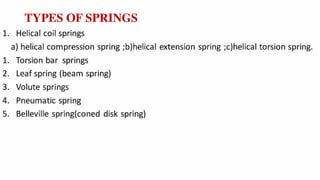
TYPES OF SPRINGS
1. Helical coil springs
a) helical compression spring ;b)helical extension spring ;c)helical torsion spring.
Torsion bar springs
Leaf spring (beam spring)
1.
2.
3. Volute springs
4. Pneumatic spring
5. Belleville spring(coned disk spring)
ody .
.dy
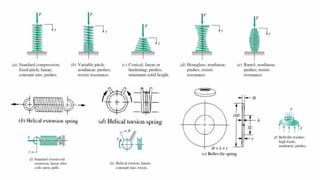
(b) Variable pitch:
nonlinear, pushes;
resists resonance.
(c) Conical; linear or
hardening; pushes;
(a) Standard compression;
fixed pitch; linear;
constant rate; pushes.
oN
(d) Helical torsion spring
ety
(h) Helical torsion; linear;
constant rate, twists.
_ £ te
(b) Helical extension spring
~Tnet
(f) Standard closed-coil
extension; linear after
coils open; pulls.
6
minimum solid height.
(d) Hourglass; nonlinear;
pushes; resists
resonance.
H=h+t
(e) Belleville spring
dy
(e) Barrel; nonlinear;
pushes; resists
resonance.
F
(f) Bellville washer;
high loads;
nonlinear; pushes.
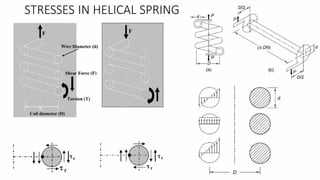
STRESS ,DEFLECTION AND SPRING RATE
OF AXIALLY LOADED HELICAL SPRINGS
int.
2
j-=
32
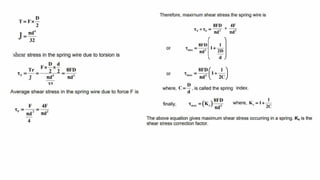
shear stress in the spring wire due to torsion is
wo Sh
_Tr_ **9*>_ 8FD
a ™” nd’ ~~ ea?
29
Average shear stress in the spring wire due to force F is
F 4F
ed nd?
4
Therefore, maximum shear stress the spring wire is
8FD ‘ 4F
ret na ond?
or T = —_—
max ~ nd: 2D
d
8FD 1
or Vmeex = nd° 1 + 2C
D ,
where, C= a’ is called the spring index.
8FD 1
finally, Tmax = (K, ar where, K,=1+>-
The above equation gives maximum shear stress occurring in a spring. K; is the
shear stress correction factor.
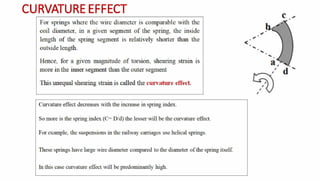
CURVATURE EFFECT
For springs where the wire diameter is comparable with the
coil diameter, in a given segment of the spring, the inside
length of the spring segment is relatively shorter than the <’ oil
outside length. “,
Hence, for a given magnitude of torsion, shearing strain 1s
more in the inner segment than the outer segment
This unequal shearing strain is called the curvature effect. jf
Curvature effect decreases with the increase in spring index.
So more is the spring index (C= D/d) the lesser will be the curvature effect.
For example, the suspensions in the railway carriages use helical springs.
These springs have large wire diameter compared to the diameter of the spring itself.
In this case curvature effect will be predominantly high.
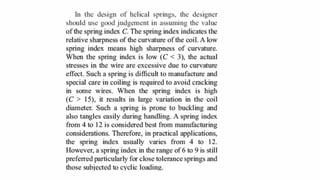
In the design of helical springs, the designer
should use good judgement tn assuming the value
of the spring index C. The spring index indicates the
relative sharpness of the curvature of the coil. A low
spring index means high sharpness of curvature.
When the spring index is low (C < 3), the actual
stresses in the wire are excessive due to curvature
effect. Such a spring is difficult to manufacture and
special care in coiling is required to avoid cracking
in some wires. When the spring index is high
(C > 15), it results in large variation in the coil
diameter. Such a spring is prone to buckling and
also tangles easily during handling. A spring index
from 4 to 12 is considered best from manufacturing
considerations. Therefore, in practical applications,
the spring index usually varies from 4 to 12.
However, a spring index in the range of 6 to 9 is still
preferred particularly for close tolerance springs and
those subjected to cyclic loading.
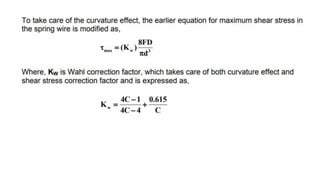
To take care of the curvature effect, the earlier equation for maximum shear stress in
the spring wire is modified as,
8FD
nd°
Tax = CK,)
Where, Kw is Wahl correction factor, which takes care of both curvature effect and
shear stress correction factor and is expressed as,
_4C-1
, 0.615
. €4
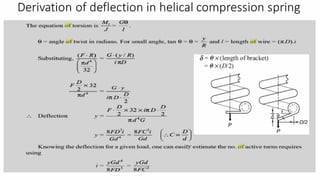
Derivation of deflection in helical compression spring
Bf, OG
—
The equation of torsion is
@ = angle of twist in radians. For small angle, tan 8 = 6 = a and / = length of wire = (1 D).i
(F-R) _ G-(v/R)
Substituting, 6=0 x (length of bracket)
7 rT
(= ‘ =@x(D/2)
D
F > x32 _ Gy
ttal* ; dD
ITt >
F-2 x32 me
2 2
Deflection
=
=
I
nd*G
SFD i SFC i ( D )
¥ = a = (om ¢ = —
Gd Gd d
Knowing the deflection for a given load, one can easilY estimate the no. of active turns requires
using
= vGd* — yGd
SED? SFC
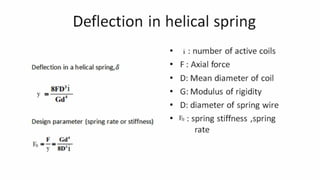
Deflection in helical spring
¢* i:number of active coils
Deflection in a helical spring,6 * F: Axial force
¢ D: Mean diameter of coil
3; o- « che
st ¢ G: Modulus of rigidity
Gd‘
¢ D: diameter of spring wire
¢ Fo: spring stiffness ,spring
rate
Design parameter (spring rate or stiffness)
F Gd‘
ee _ 3.
y 8b1
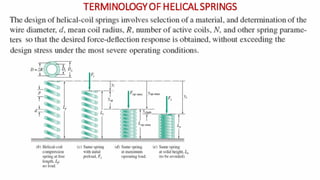
TERMINOLOGY OF HELICAL SPRINGS
The design of helical-coil springs involves selection of a material, and determination of the
wire diameter, d, mean coil radius, R, number of active coils, VN, and other spring parame-
ters so that the desired force-deflection response is obtained, without exceeding the
design stress under the most severe operating conditions.
fo we i ”
Em 4 ey |_|
re Si
(b) Helical-coil (c) Same spring (d) Same spring (e) Same spring
compression with inital at Maximum at solid height, L,
Spring at free preload, F,. operating load. (to be avoided).
length, Ly
no load.
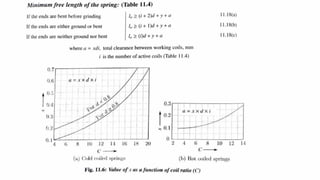
Minimum free length of the spring: (Table 11.4)
If the ends are bent before grinding l,>(it+2)dtyt+a 11.18(a)
If the ends are either ground or bent l,>(@i+t Ddt+yta 11.18(b)
If the ends are neither ground nor bent l,>@d+yta 11.18(c)
where a = xdi, total clearance between working coils, mm
i is the number of active coils (Table 11.4)
0.3
a=xxdXi
0.2
att
Sf)
L 0)
fj 8 1 12 Wd 16 18 20 2 4 6 8 10 12 Ii4
C— ae
(a) Cold coiled springs (b) Hot coiled springs
Fig. 11.6: Value of x as a function of coil ratio (C)
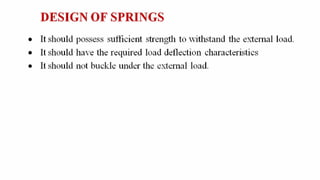
DESIGN OF SPRINGS
It should possess sufficient strength to withstand the external load.
It should have the required load deflection characteristics
It should not buckle under the external load.
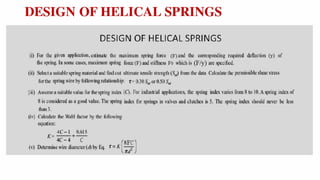
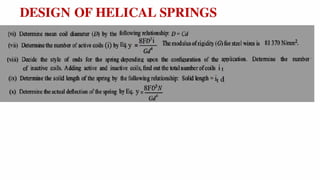
DESIGN OF HELICAL SPRINGS
(i) For the given application, estimate the maximum spring force (F)and the corresponding required deflection (y) of
the spring. In some cases, maximum spring force (F) and stiffness Fo which is (F/y) are specified.
(ii) Selecta suitable spring material and find out ultimate tensile strength (S,,) from the data Calculate the permissible shear stress
for the spring wire by following relationship: t= 0.30 S,, or 0.50 S,,
(iii) Assume a suitable value for the spring index (C). For industrial applications, the spring index varies from 8 to 10. A spring index of
8 is considered as a good value. The spring index for springs in valves and clutches is 5. The spring index should never be less
than 3.
(iv) Calculate the Wahl factor by the following
equation:
4C-1 0.615
4C -4 G LS
nd
(v) Determine wire diameter (d) by Eq. t= 4
DESIGN OF HELICAL SPRINGS
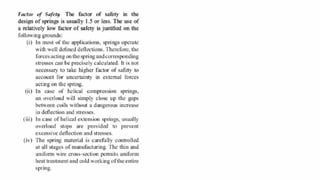
Factor of Safety The factor of safety in the
design of springs is usually 1.5 or less. The use of
a relatively low factor of safety is justified on the
following grounds:
(i)
(11)
(iit)
(iv)
In most of the applications, springs operate
with well defined deflections. Therefore, the
forces acting on the spring and corresponding
stresses can be precisely calculated. It is not
necessary to take higher factor of safety to
account for uncertainty in external forces
acting on the spring.
In case of helical compression springs,
an Overload will simply close up the gaps
between coils without a dangerous increase
in deflection and stresses.
In case of helical extension springs, usually
overload stops are provided to prevent
excessive deflection and stresses.
The spring material is carefully controlled
at all stages of manufacturing. The thin and
uniform wire cross-section permits uniform
heat treatment and cold working of the entire
spring.
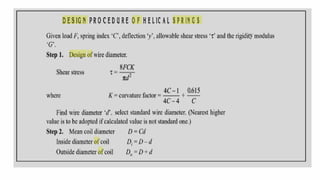
DESIGN PROCEDURE OF HELICAL SPRINGS
Given load F, spring index ‘C’, deflection ‘y’, allowable shear stress ‘t’ and the rigidity modulus
C,
Step 1. Design
of wire diameter.
Shear stress T= =>
where K = curvature factor = el + 0615
4C-4 C
Find wire diameter ‘d’, select standard wire diameter. (Nearest higher
value is to be adopted if calculated value is not standard one.)
Step 2. Meancoil diameter D=Cd
Inside diameter of coil D,=D-d
Outside diameter of coil D,=D+d

SPRING Design & Design parameters details

  • 1.
  • 2.
    Spring is definedas an elastic machine element(flexible element) that deflects under the action of load and returns to its original shape when load is removed. IMPORTANT FUNCTIONS AND APPLICATIONS OF SPRING 1. Springs are used to absorb shocks and vibrations eg: vehicle suspension springs, railway buffers to control energy, buffer springs in elevators and vibration mounts for machinery. 2. Measuring forces :Spring balances, gages 3. Storing of energy in clocks ,toys ,novie cameras, circuit breakers ,starters 4. Springs are used to apply force and control motion.
  • 3.
    TYPES OF SPRINGS 1.Helical coil springs a) helical compression spring ;b)helical extension spring ;c)helical torsion spring. Torsion bar springs Leaf spring (beam spring) 1. 2. 3. Volute springs 4. Pneumatic spring 5. Belleville spring(coned disk spring)
  • 4.
    ody . .dy (b) Variablepitch: nonlinear, pushes; resists resonance. (c) Conical; linear or hardening; pushes; (a) Standard compression; fixed pitch; linear; constant rate; pushes. oN (d) Helical torsion spring ety (h) Helical torsion; linear; constant rate, twists. _ £ te (b) Helical extension spring ~Tnet (f) Standard closed-coil extension; linear after coils open; pulls. 6 minimum solid height. (d) Hourglass; nonlinear; pushes; resists resonance. H=h+t (e) Belleville spring dy (e) Barrel; nonlinear; pushes; resists resonance. F (f) Bellville washer; high loads; nonlinear; pushes.
  • 5.
    STRESS ,DEFLECTION ANDSPRING RATE OF AXIALLY LOADED HELICAL SPRINGS
  • 7.
    int. 2 j-= 32 shear stress inthe spring wire due to torsion is wo Sh _Tr_ **9*>_ 8FD a ™” nd’ ~~ ea? 29 Average shear stress in the spring wire due to force F is F 4F ed nd? 4 Therefore, maximum shear stress the spring wire is 8FD ‘ 4F ret na ond? or T = —_— max ~ nd: 2D d 8FD 1 or Vmeex = nd° 1 + 2C D , where, C= a’ is called the spring index. 8FD 1 finally, Tmax = (K, ar where, K,=1+>- The above equation gives maximum shear stress occurring in a spring. K; is the shear stress correction factor.
  • 8.
    CURVATURE EFFECT For springswhere the wire diameter is comparable with the coil diameter, in a given segment of the spring, the inside length of the spring segment is relatively shorter than the <’ oil outside length. “, Hence, for a given magnitude of torsion, shearing strain 1s more in the inner segment than the outer segment This unequal shearing strain is called the curvature effect. jf Curvature effect decreases with the increase in spring index. So more is the spring index (C= D/d) the lesser will be the curvature effect. For example, the suspensions in the railway carriages use helical springs. These springs have large wire diameter compared to the diameter of the spring itself. In this case curvature effect will be predominantly high.
  • 9.
    In the designof helical springs, the designer should use good judgement tn assuming the value of the spring index C. The spring index indicates the relative sharpness of the curvature of the coil. A low spring index means high sharpness of curvature. When the spring index is low (C < 3), the actual stresses in the wire are excessive due to curvature effect. Such a spring is difficult to manufacture and special care in coiling is required to avoid cracking in some wires. When the spring index is high (C > 15), it results in large variation in the coil diameter. Such a spring is prone to buckling and also tangles easily during handling. A spring index from 4 to 12 is considered best from manufacturing considerations. Therefore, in practical applications, the spring index usually varies from 4 to 12. However, a spring index in the range of 6 to 9 is still preferred particularly for close tolerance springs and those subjected to cyclic loading.
  • 10.
    To take careof the curvature effect, the earlier equation for maximum shear stress in the spring wire is modified as, 8FD nd° Tax = CK,) Where, Kw is Wahl correction factor, which takes care of both curvature effect and shear stress correction factor and is expressed as, _4C-1 , 0.615 . €4
  • 11.
    Derivation of deflectionin helical compression spring Bf, OG — The equation of torsion is @ = angle of twist in radians. For small angle, tan 8 = 6 = a and / = length of wire = (1 D).i (F-R) _ G-(v/R) Substituting, 6=0 x (length of bracket) 7 rT (= ‘ =@x(D/2) D F > x32 _ Gy ttal* ; dD ITt > F-2 x32 me 2 2 Deflection = = I nd*G SFD i SFC i ( D ) ¥ = a = (om ¢ = — Gd Gd d Knowing the deflection for a given load, one can easilY estimate the no. of active turns requires using = vGd* — yGd SED? SFC
  • 12.
    Deflection in helicalspring ¢* i:number of active coils Deflection in a helical spring,6 * F: Axial force ¢ D: Mean diameter of coil 3; o- « che st ¢ G: Modulus of rigidity Gd‘ ¢ D: diameter of spring wire ¢ Fo: spring stiffness ,spring rate Design parameter (spring rate or stiffness) F Gd‘ ee _ 3. y 8b1
  • 13.
    TERMINOLOGY OF HELICALSPRINGS The design of helical-coil springs involves selection of a material, and determination of the wire diameter, d, mean coil radius, R, number of active coils, VN, and other spring parame- ters so that the desired force-deflection response is obtained, without exceeding the design stress under the most severe operating conditions. fo we i ” Em 4 ey |_| re Si (b) Helical-coil (c) Same spring (d) Same spring (e) Same spring compression with inital at Maximum at solid height, L, Spring at free preload, F,. operating load. (to be avoided). length, Ly no load.
  • 15.
    Minimum free lengthof the spring: (Table 11.4) If the ends are bent before grinding l,>(it+2)dtyt+a 11.18(a) If the ends are either ground or bent l,>(@i+t Ddt+yta 11.18(b) If the ends are neither ground nor bent l,>@d+yta 11.18(c) where a = xdi, total clearance between working coils, mm i is the number of active coils (Table 11.4) 0.3 a=xxdXi 0.2 att Sf) L 0) fj 8 1 12 Wd 16 18 20 2 4 6 8 10 12 Ii4 C— ae (a) Cold coiled springs (b) Hot coiled springs Fig. 11.6: Value of x as a function of coil ratio (C)
  • 16.
    DESIGN OF SPRINGS Itshould possess sufficient strength to withstand the external load. It should have the required load deflection characteristics It should not buckle under the external load.
  • 17.
    DESIGN OF HELICALSPRINGS DESIGN OF HELICAL SPRINGS (i) For the given application, estimate the maximum spring force (F)and the corresponding required deflection (y) of the spring. In some cases, maximum spring force (F) and stiffness Fo which is (F/y) are specified. (ii) Selecta suitable spring material and find out ultimate tensile strength (S,,) from the data Calculate the permissible shear stress for the spring wire by following relationship: t= 0.30 S,, or 0.50 S,, (iii) Assume a suitable value for the spring index (C). For industrial applications, the spring index varies from 8 to 10. A spring index of 8 is considered as a good value. The spring index for springs in valves and clutches is 5. The spring index should never be less than 3. (iv) Calculate the Wahl factor by the following equation: 4C-1 0.615 4C -4 G LS nd (v) Determine wire diameter (d) by Eq. t= 4
  • 18.
  • 19.
    Factor of SafetyThe factor of safety in the design of springs is usually 1.5 or less. The use of a relatively low factor of safety is justified on the following grounds: (i) (11) (iit) (iv) In most of the applications, springs operate with well defined deflections. Therefore, the forces acting on the spring and corresponding stresses can be precisely calculated. It is not necessary to take higher factor of safety to account for uncertainty in external forces acting on the spring. In case of helical compression springs, an Overload will simply close up the gaps between coils without a dangerous increase in deflection and stresses. In case of helical extension springs, usually overload stops are provided to prevent excessive deflection and stresses. The spring material is carefully controlled at all stages of manufacturing. The thin and uniform wire cross-section permits uniform heat treatment and cold working of the entire spring.
  • 20.
    DESIGN PROCEDURE OFHELICAL SPRINGS Given load F, spring index ‘C’, deflection ‘y’, allowable shear stress ‘t’ and the rigidity modulus C, Step 1. Design of wire diameter. Shear stress T= => where K = curvature factor = el + 0615 4C-4 C Find wire diameter ‘d’, select standard wire diameter. (Nearest higher value is to be adopted if calculated value is not standard one.) Step 2. Meancoil diameter D=Cd Inside diameter of coil D,=D-d Outside diameter of coil D,=D+d