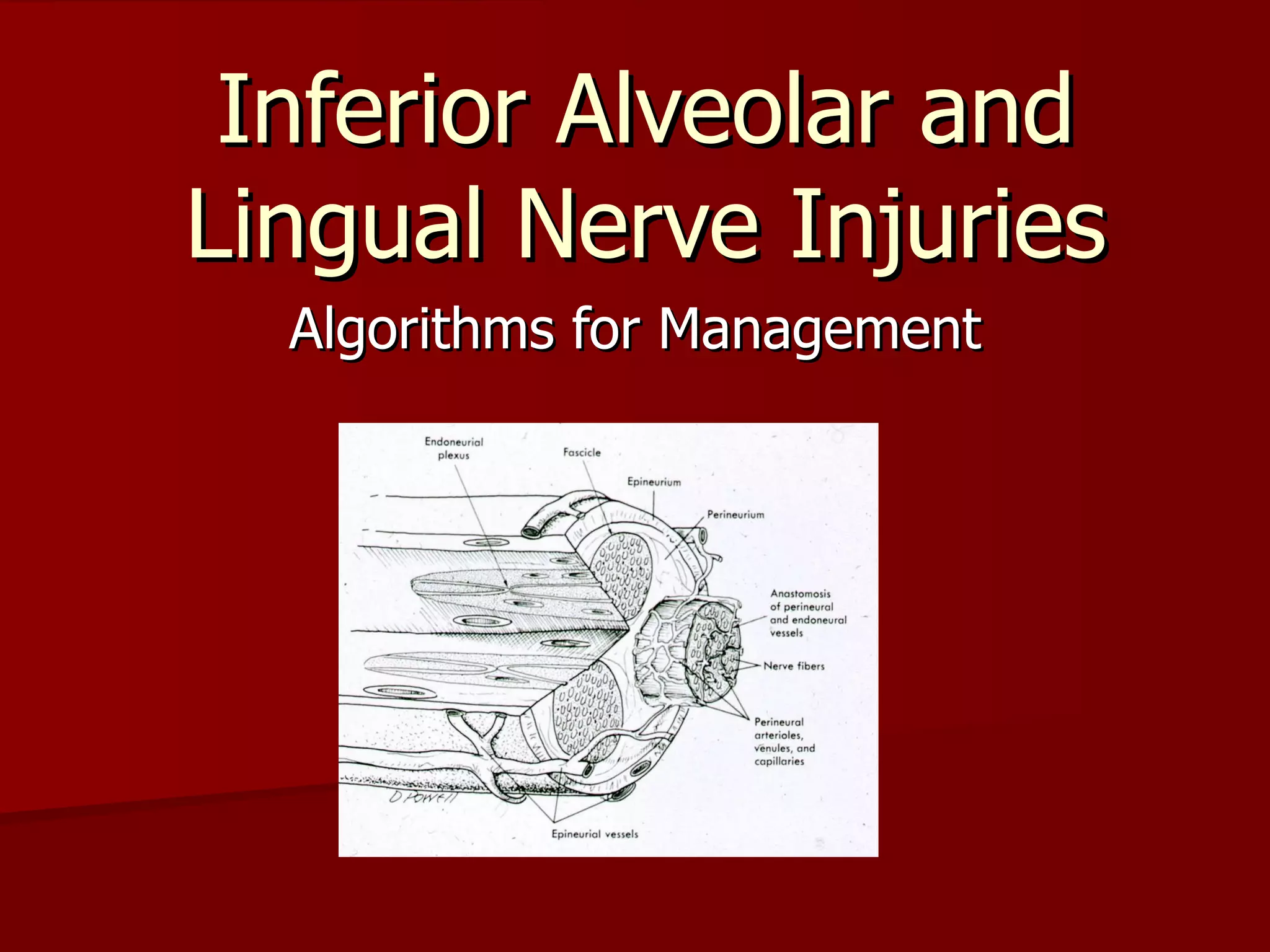
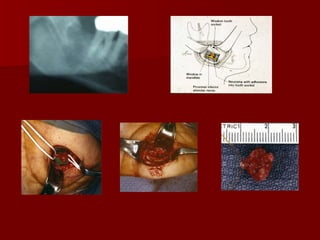
Inferior Alveolar and Lingual Nerve Injuries Algorithms for Management
 
 
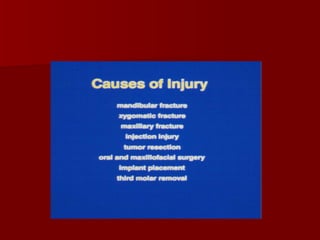
Scenarios of Nerve Injury Inferior Alveolar Nerve Odontectomy Following injection Following endodontics Following implants Following genioplasty with or without BSSO
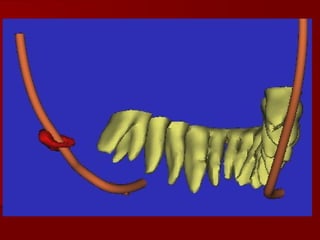
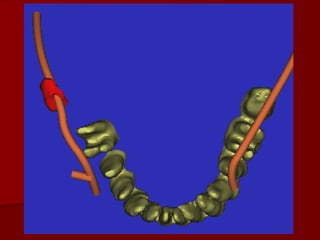
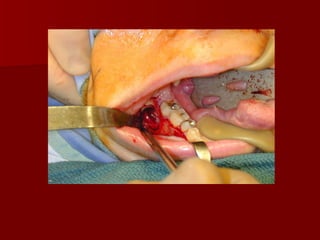
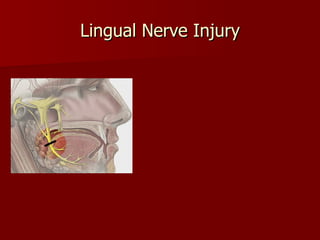
Scenarios of Nerve Injury Lingual Nerve Odontectomy Periodontal surgery Following injection Screws of BSSO fixation
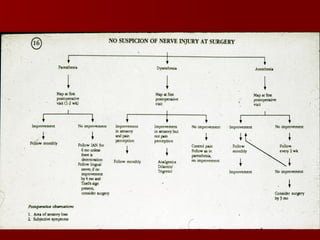
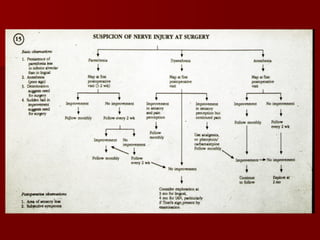
Tests of Nerve Injury Mapping Mapping with tactile, thermal and pulp stimulation Serial tactile and thermal tests Clinical test algorithms with tactile and painful stimuli Somatosensory evoked potentials Microelectroneurography Electronic thermography Taste with vital staining-videomicroscopy Magnetic source imaging


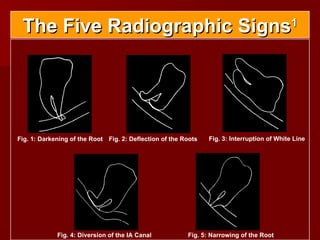
The Five Radiographic Signs 1 Fig. 1: Darkening of the Root Fig. 2: Deflection of of the Roots Fig. 3: Interruption of White Line Fig. 4: Diversion of the IA Canal Fig. 5: Narrowing of the Root The Five Radiographic Signs 1 Fig. 1: Darkening of the Root Fig. 2: Deflection of the Roots Fig. 3: Interruption of White Line Fig. 4: Diversion of the IA Canal Fig. 5: Narrowing of the Root
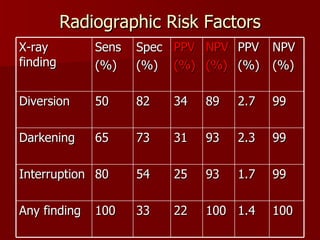
Radiographic Risk Factors X-ray finding Sens (%) Spec (%) PPV (%) NPV (%) PPV (%) NPV (%) Diversion 50 82 34 89 2.7 99 Darkening 65 73 31 93 2.3 99 Interruption 80 54 25 93 1.7 99 Any finding 100 33 22 100 1.4 100


Case for Early Repair Animal studies – most support early repair, but some success late Humans – difficulty comes from comparison of direct repairs vs. grafts, IAN and lingual nerve “lumping”, inconsistent indications and lack of randomized controlled trials for outcomes
Questions for treatment Frame the dilemma as an evidence-based question Retrieve applicable, valid and current evidence to answer the question Appraise the evidence for applicability and validity. What are the results?
Using Ultrasound to Visualize the  Lingual Nerve Presented by James Olsen HSDM 2006 January 20, 2006 http://i.cnn.net/cnn/2003/HEALTH/08/27/ultra.stethoscope/story.portable.ultrasound.jpg
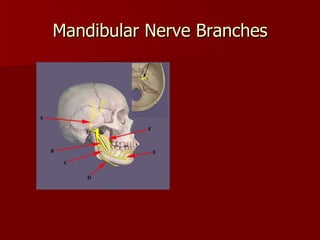
Mandibular Nerve Branches A. Auriculotemporal B. Lingual C. Inferior Alveolar D. N. to the Mylohyoid E. Mental F. Buccal http://www.meddean.luc.edu/lumen/MedEd/GrossAnatomy/h_n/cn/cn1/images/cnb3.jpg
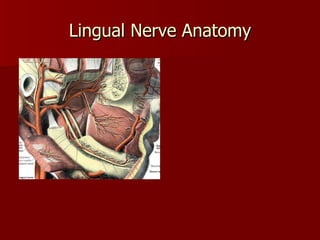
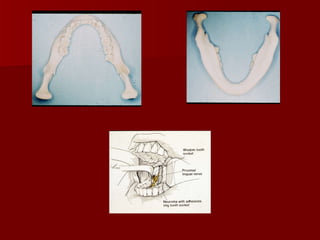
Lingual Nerve Anatomy The lingual nerve crosses the  submandibular duct twice in the paralingual space. http://www.sciential.net/images/Clemente2f.jpg
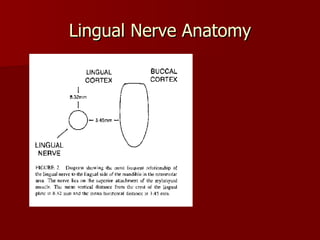
Lingual Nerve Anatomy Pogrel MA, Renaut A, Schmidt B, Ammar A. The relationship of the lingual nerve to the mandibular third molar region: an anatomic study.  J Oral Maxillofacial Surgery,  1995, pp. 1178-81.
Lingual Nerve Injury Loss of taste from anterior 2/3 of tongue  ipsilateral to the lesion (special sensory  component of CN VII)  Loss of general sensation from the tongue  (general sensory component of CN V3).   http://info.med.yale.edu/caim/cnerves/cn7/cn7_graphics/fig7_25.gif
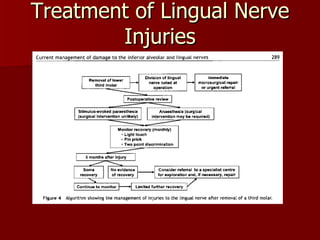
Treatment of Lingual Nerve Injuries Robinson PP, Alison RL, Julian MY, Smith KG. Current management of damage to the inferior alveolar  and lingual nerves as a result of removal of third molars.  British Journal of Oral and  Maxillofacial Surgery , 2004; 42, 285-292
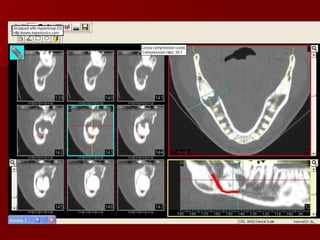
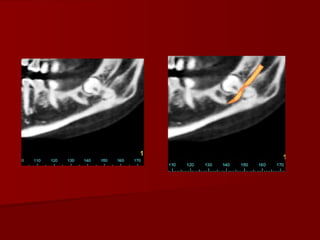
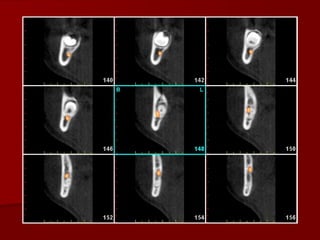
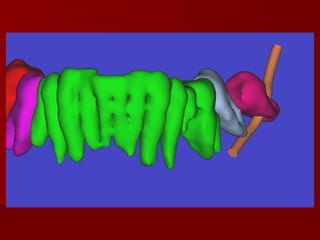
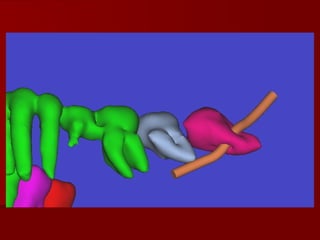
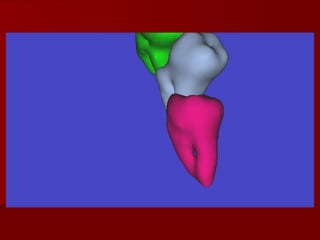
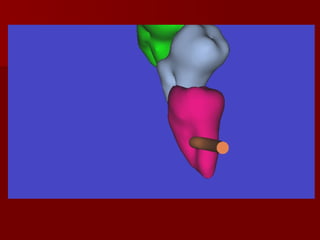
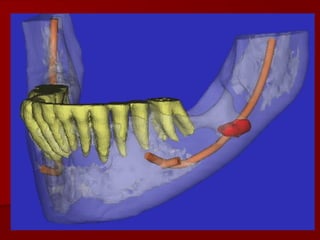
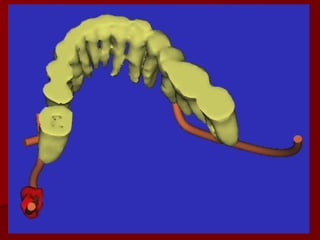
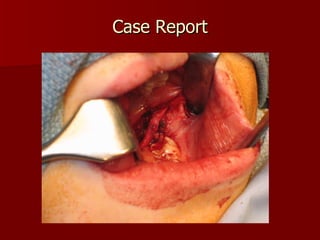
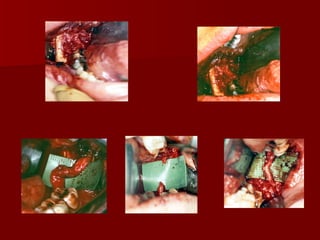
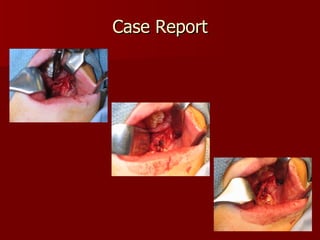
Case Report *Images courtesy of Dr. Donoff
Case Report
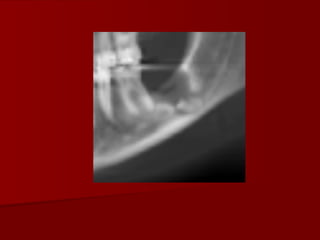
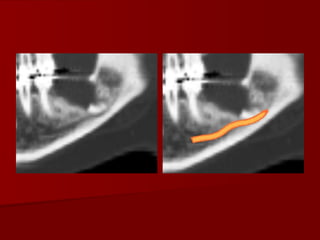
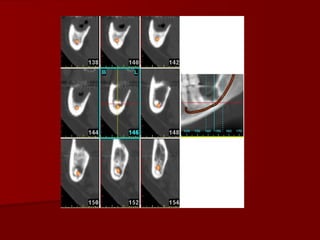
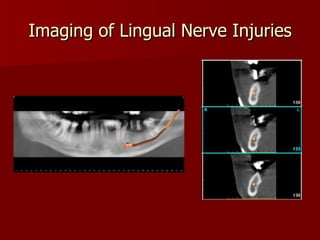
Imaging of Lingual Nerve Injuries CT
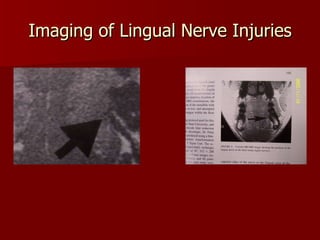
Imaging of Lingual Nerve Injuries Miloro M, Halkias LE, Slone HW, Chakeres DW. Assessment of the Linual Nerve in the Third Molar  Region Using Magnetic Resonance Imaging.  J Oral Maxillofacial Surgery , 1997; 55:134-137. MRI MRI
Using Ultrasound to Visualize the Lingual Nerve http://www.bbc.co.uk/health/images/300/ultrasound.jpg
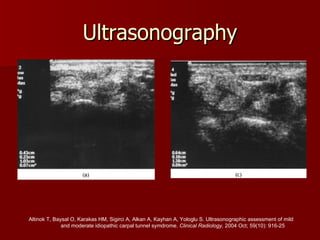
Ultrasonography Altinok T, Baysal O, Karakas HM, Sigirci A, Alkan A, Kayhan A, Yologlu S. Ultrasonographic assessment of mild  and moderate idiopathic carpal tunnel symdrome.  Clinical Radiology,  2004 Oct; 59(10): 916-25
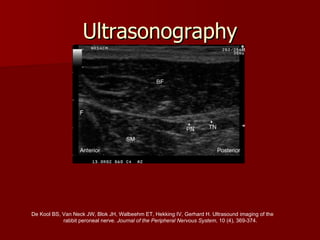
Ultrasonography De Kool BS, Van Neck JW, Blok JH, Walbeehm ET, Hekking IV, Gerhard H. Ultrasound imaging of the  rabbit peroneal nerve.  Journal of the Peripheral Nervous System , 10 (4), 369-374. PN, peroneal nerve; TN, tibial nerve; BF, biceps femoris muscle;  SM, semimembranosus muscle; F, femur
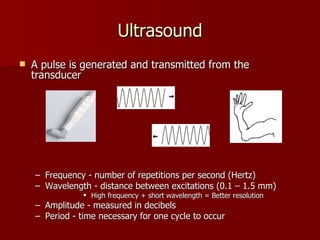
Ultrasound A pulse is generated and transmitted from the transducer Frequency - number of repetitions per second (Hertz) Wavelength - distance between excitations (0.1 – 1.5 mm) High frequency + short wavelength = Better resolution Amplitude - measured in decibels Period - time necessary for one cycle to occur (piezoelectric crystals)
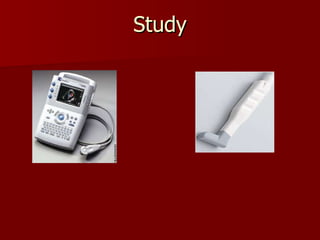
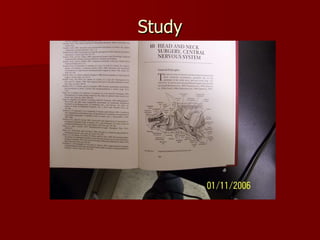
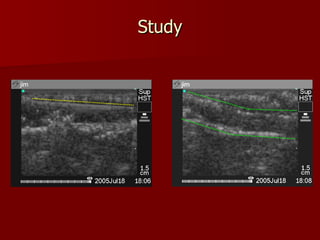
Study HST transducer (25mm, 10-5 MHz). Sonosite  180 Plus
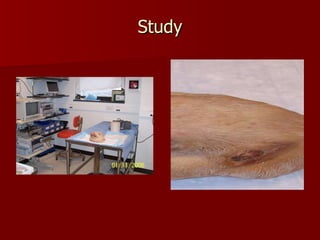
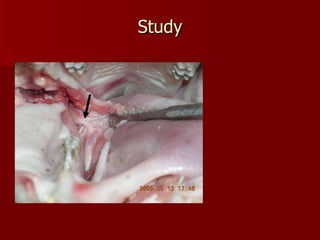
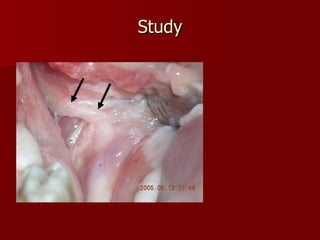
Study Yorkshire  cadaver pig head OMFS Endoscopic Research Center
Study Surgery, Anesthesia, & Experimental Techniques in Swine by M. Michael Swindle, DVM
Study Yorkshire  cadaver pig head
Study
Study
Study
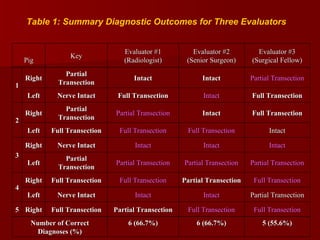
Table 1: Summary Diagnostic Outcomes for Three Evaluators   Average 17 / 27 (63%) Pig Key Evaluator #1 (Radiologist) Evaluator #2 (Senior Surgeon) Evaluator #3 (Surgical Fellow) 1 Right Partial Transection Intact Intact Partial Transection Left Nerve Intact Full Transection Intact Full Transection 2 Right Partial Transection Partial Transection Intact Full Transection Left Full Transection Full Transection Full Transection Intact 3 Right Nerve Intact Intact Intact Intact Left Partial Transection Partial Transection Partial Transection Partial Transection 4 Right Full Transection Full Transection Partial Transection Full Transection Left Nerve Intact Intact Intact Partial Transection 5 Right Full Transection Partial Transection Full Transection Full Transection Number of Correct Diagnoses (%) 6 (66.7%) 6 (66.7%) 5 (55.6%)
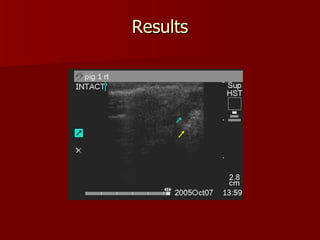
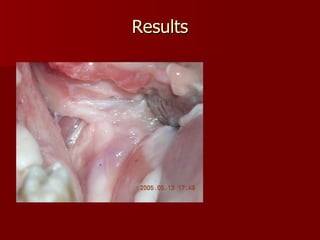
Results
Results
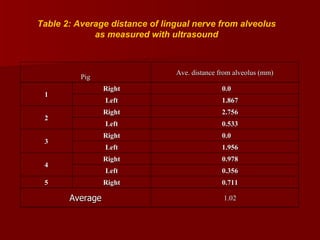
Table 2: Average distance of lingual nerve from alveolus  as measured with ultrasound   Pig Ave. distance from alveolus (mm) 1 Right 0.0 Left 1.867 2 Right 2.756 Left 0.533 3 Right 0.0 Left 1.956 4 Right 0.978 Left 0.356 5 Right 0.711 Average 1.02
Results Yorkshire  cadaver pig head
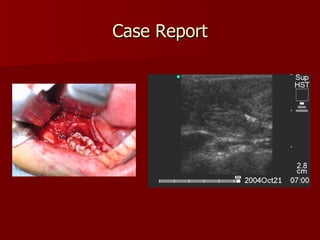
Case Report *Images courtesy of Dr. Donoff
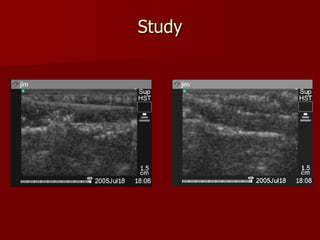
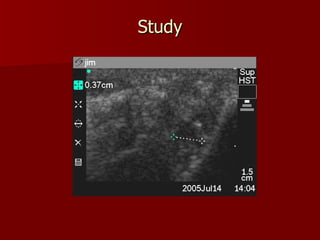
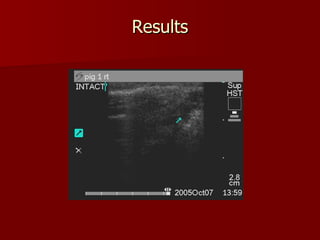
Discussion It is in fact possible to see the lingual nerve with  ultrasound The result is near statistically significance – it is very  likely that a larger sample size is needed to detect the  difference as power may establish statistical  significance for a relatively small effect size. The pig nerve is closer to the alveolus than it is in the  human  Pig nerve is roughly ¼ the size of the human nerve
Conclusion The results of this study show that  ultrasonography can be used to visualize the  lingual nerve.  Further studies and higher  quality imaging are needed in order to  determine the extent of involvement that  ultrasound might have in both the prevention  and surgical planning process of lingual nerve  injuries.


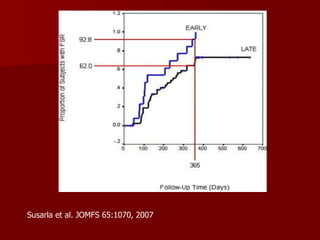
Susarla et al. JOMFS 65:1070, 2007
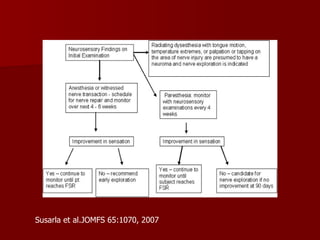
Susarla et al.JOMFS 65:1070, 2007
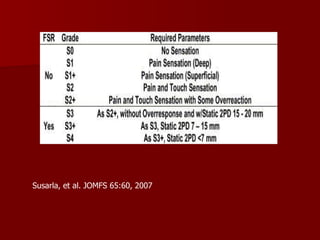
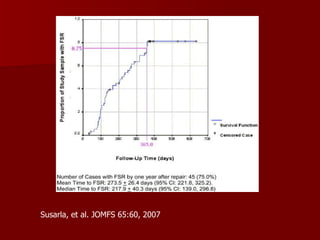
Susarla, et al. JOMFS 65:60, 2007
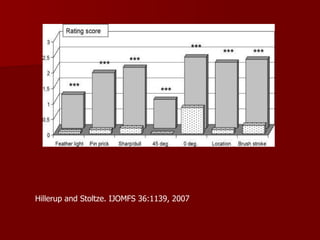
Hillerup and Stoltze. IJOMFS 36:1139, 2007
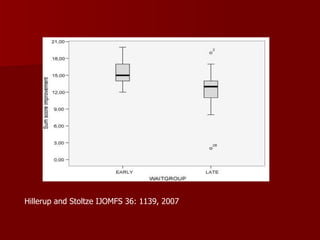
Hillerup and Stoltze IJOMFS 36: 1139, 2007
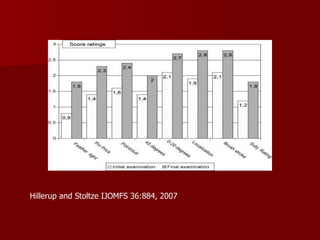
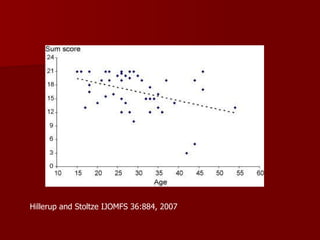
Hillerup and Stoltze IJOMFS 36:884, 2007
Caveats from Experience Lingual nerve injuries usually not painful Trigger in LN injuries with anesthesia positive finding IAN injuries often painful Operated IAN injuries often develop pain syndromes Age is a very important factor Rare for anesthetic lingual nerve patients with Tinel’s like sign to recover
 

SPRING WEBINAR WITH DR. BRUCE DONOFF

  • 1.
    Inferior Alveolar andLingual Nerve Injuries Algorithms for Management
  • 2.
  • 3.
  • 4.
    Scenarios of NerveInjury Inferior Alveolar Nerve Odontectomy Following injection Following endodontics Following implants Following genioplasty with or without BSSO
  • 5.
    Scenarios of NerveInjury Lingual Nerve Odontectomy Periodontal surgery Following injection Screws of BSSO fixation
  • 6.
    Tests of NerveInjury Mapping Mapping with tactile, thermal and pulp stimulation Serial tactile and thermal tests Clinical test algorithms with tactile and painful stimuli Somatosensory evoked potentials Microelectroneurography Electronic thermography Taste with vital staining-videomicroscopy Magnetic source imaging
  • 7.
  • 8.
  • 9.
  • 10.
    The Five RadiographicSigns 1 Fig. 1: Darkening of the Root Fig. 2: Deflection of of the Roots Fig. 3: Interruption of White Line Fig. 4: Diversion of the IA Canal Fig. 5: Narrowing of the Root The Five Radiographic Signs 1 Fig. 1: Darkening of the Root Fig. 2: Deflection of the Roots Fig. 3: Interruption of White Line Fig. 4: Diversion of the IA Canal Fig. 5: Narrowing of the Root
  • 11.
    Radiographic Risk FactorsX-ray finding Sens (%) Spec (%) PPV (%) NPV (%) PPV (%) NPV (%) Diversion 50 82 34 89 2.7 99 Darkening 65 73 31 93 2.3 99 Interruption 80 54 25 93 1.7 99 Any finding 100 33 22 100 1.4 100
  • 12.
  • 13.
  • 14.
  • 15.
  • 16.
  • 17.
  • 18.
  • 19.
  • 20.
  • 21.
  • 22.
  • 23.
  • 24.
  • 25.
  • 26.
  • 27.
  • 28.
  • 29.
  • 30.
    Case for EarlyRepair Animal studies – most support early repair, but some success late Humans – difficulty comes from comparison of direct repairs vs. grafts, IAN and lingual nerve “lumping”, inconsistent indications and lack of randomized controlled trials for outcomes
  • 31.
    Questions for treatmentFrame the dilemma as an evidence-based question Retrieve applicable, valid and current evidence to answer the question Appraise the evidence for applicability and validity. What are the results?
  • 32.
    Using Ultrasound toVisualize the Lingual Nerve Presented by James Olsen HSDM 2006 January 20, 2006 http://i.cnn.net/cnn/2003/HEALTH/08/27/ultra.stethoscope/story.portable.ultrasound.jpg
  • 33.
    Mandibular Nerve BranchesA. Auriculotemporal B. Lingual C. Inferior Alveolar D. N. to the Mylohyoid E. Mental F. Buccal http://www.meddean.luc.edu/lumen/MedEd/GrossAnatomy/h_n/cn/cn1/images/cnb3.jpg
  • 34.
    Lingual Nerve AnatomyThe lingual nerve crosses the submandibular duct twice in the paralingual space. http://www.sciential.net/images/Clemente2f.jpg
  • 35.
    Lingual Nerve AnatomyPogrel MA, Renaut A, Schmidt B, Ammar A. The relationship of the lingual nerve to the mandibular third molar region: an anatomic study. J Oral Maxillofacial Surgery, 1995, pp. 1178-81.
  • 36.
    Lingual Nerve InjuryLoss of taste from anterior 2/3 of tongue ipsilateral to the lesion (special sensory component of CN VII) Loss of general sensation from the tongue (general sensory component of CN V3). http://info.med.yale.edu/caim/cnerves/cn7/cn7_graphics/fig7_25.gif
  • 37.
    Treatment of LingualNerve Injuries Robinson PP, Alison RL, Julian MY, Smith KG. Current management of damage to the inferior alveolar and lingual nerves as a result of removal of third molars. British Journal of Oral and Maxillofacial Surgery , 2004; 42, 285-292
  • 38.
    Case Report *Imagescourtesy of Dr. Donoff
  • 39.
  • 40.
    Imaging of LingualNerve Injuries CT
  • 41.
    Imaging of LingualNerve Injuries Miloro M, Halkias LE, Slone HW, Chakeres DW. Assessment of the Linual Nerve in the Third Molar Region Using Magnetic Resonance Imaging. J Oral Maxillofacial Surgery , 1997; 55:134-137. MRI MRI
  • 42.
    Using Ultrasound toVisualize the Lingual Nerve http://www.bbc.co.uk/health/images/300/ultrasound.jpg
  • 43.
    Ultrasonography Altinok T,Baysal O, Karakas HM, Sigirci A, Alkan A, Kayhan A, Yologlu S. Ultrasonographic assessment of mild and moderate idiopathic carpal tunnel symdrome. Clinical Radiology, 2004 Oct; 59(10): 916-25
  • 44.
    Ultrasonography De KoolBS, Van Neck JW, Blok JH, Walbeehm ET, Hekking IV, Gerhard H. Ultrasound imaging of the rabbit peroneal nerve. Journal of the Peripheral Nervous System , 10 (4), 369-374. PN, peroneal nerve; TN, tibial nerve; BF, biceps femoris muscle; SM, semimembranosus muscle; F, femur
  • 45.
    Ultrasound A pulseis generated and transmitted from the transducer Frequency - number of repetitions per second (Hertz) Wavelength - distance between excitations (0.1 – 1.5 mm) High frequency + short wavelength = Better resolution Amplitude - measured in decibels Period - time necessary for one cycle to occur (piezoelectric crystals)
  • 46.
    Study HST transducer(25mm, 10-5 MHz). Sonosite 180 Plus
  • 47.
    Study Yorkshire cadaver pig head OMFS Endoscopic Research Center
  • 48.
    Study Surgery, Anesthesia,& Experimental Techniques in Swine by M. Michael Swindle, DVM
  • 49.
    Study Yorkshire cadaver pig head
  • 50.
    Study Yorkshire cadaver pig head
  • 51.
  • 52.
  • 53.
  • 54.
    Table 1: SummaryDiagnostic Outcomes for Three Evaluators Average 17 / 27 (63%) Pig Key Evaluator #1 (Radiologist) Evaluator #2 (Senior Surgeon) Evaluator #3 (Surgical Fellow) 1 Right Partial Transection Intact Intact Partial Transection Left Nerve Intact Full Transection Intact Full Transection 2 Right Partial Transection Partial Transection Intact Full Transection Left Full Transection Full Transection Full Transection Intact 3 Right Nerve Intact Intact Intact Intact Left Partial Transection Partial Transection Partial Transection Partial Transection 4 Right Full Transection Full Transection Partial Transection Full Transection Left Nerve Intact Intact Intact Partial Transection 5 Right Full Transection Partial Transection Full Transection Full Transection Number of Correct Diagnoses (%) 6 (66.7%) 6 (66.7%) 5 (55.6%)
  • 55.
  • 56.
  • 57.
    Table 2: Averagedistance of lingual nerve from alveolus as measured with ultrasound Pig Ave. distance from alveolus (mm) 1 Right 0.0 Left 1.867 2 Right 2.756 Left 0.533 3 Right 0.0 Left 1.956 4 Right 0.978 Left 0.356 5 Right 0.711 Average 1.02
  • 58.
    Results Yorkshire cadaver pig head
  • 59.
    Case Report *Imagescourtesy of Dr. Donoff
  • 60.
    Discussion It isin fact possible to see the lingual nerve with ultrasound The result is near statistically significance – it is very likely that a larger sample size is needed to detect the difference as power may establish statistical significance for a relatively small effect size. The pig nerve is closer to the alveolus than it is in the human Pig nerve is roughly ¼ the size of the human nerve
  • 61.
    Conclusion The resultsof this study show that ultrasonography can be used to visualize the lingual nerve.  Further studies and higher quality imaging are needed in order to determine the extent of involvement that ultrasound might have in both the prevention and surgical planning process of lingual nerve injuries.
  • 62.
  • 63.
  • 64.
  • 65.
    Susarla et al.JOMFS 65:1070, 2007
  • 66.
    Susarla et al.JOMFS65:1070, 2007
  • 67.
    Susarla, et al.JOMFS 65:60, 2007
  • 68.
    Susarla, et al.JOMFS 65:60, 2007
  • 69.
    Hillerup and Stoltze.IJOMFS 36:1139, 2007
  • 70.
    Hillerup and StoltzeIJOMFS 36: 1139, 2007
  • 71.
    Hillerup and StoltzeIJOMFS 36:884, 2007
  • 72.
    Hillerup and StoltzeIJOMFS 36:884, 2007
  • 73.
    Caveats from ExperienceLingual nerve injuries usually not painful Trigger in LN injuries with anesthesia positive finding IAN injuries often painful Operated IAN injuries often develop pain syndromes Age is a very important factor Rare for anesthetic lingual nerve patients with Tinel’s like sign to recover
  • 74.