Course Outline
■ Digital Communications Basic Blocks, Introduction
■ Classification of signals ,Deterministic and Random, Periodic
and Non-periodic (Signal, Energy and Power Signals, Analog
and Discrete Signals)
■ Spectral Density, Auto-Correlation,
■ Bandwidth of Digital Signals, Baseband versus Band pass
■ Sampling Theorem, Aliasing, Over Sampling
■ Sampling and Quantizing effects, Channel effects, Signal to
Noise Ratio
■ Pulse Code Modulation, PCM based Time division
multiplexing
Course Outline
■ Uniform and Non Uniform Quantization, Companding
■ Waveform Representation of Binary Digits, M-ary Pulse
Modulation waveforms
■ PCM waveform types, Line Coding
■ Correlative Coding, duo-binary coding and decoding, precoding
■ Error Performance, degradation in Digital Communication
System, Demodulation and detection, SNR parameter in Digital
Communication System
■ Detection of Binary Signals in Gaussian Noise, Matched Filter
Course Outline
■ Inter symbol Interference, Pulse shaping to reduce ISI, Error
Performance
■ Eye Patterns, Digital Demodulation Techniques
■ Spread Spectrum, Frequency Hopping and Direct Sequence
What we discussed in the last
lecture
■ Bandwidth Calculation
■ Inter Symbol Interference
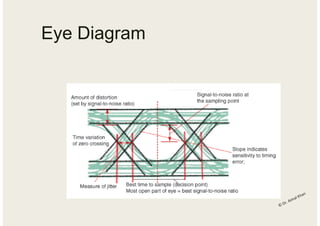
Eye Diagram
How to combat ISI
■ Pulse shaping
By using Nyquist Pulses
■ Using Equalization
Zero Forcing Equalization
Mean Minimum Square Equalizer
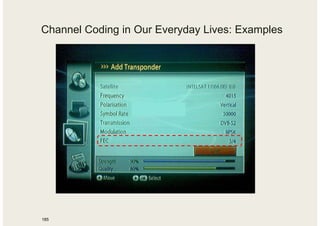
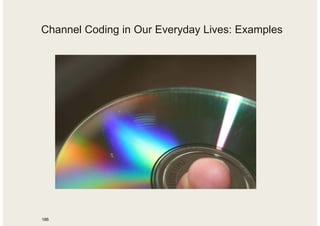
Channel Coding in Our Everyday Lives: Examples
185
Channel Coding in Our Everyday Lives: Examples
186
Channel Coding in Our Everyday Lives: Examples
187
188
What is Channel Coding?
Digital Communications over physical channels is prone to errors
Channel Coding means :
Introducing redundancy (i.e., adding extra
bits) to information messages to protect
against channel errors
4
What is Channel Coding?
Channel coding is the art or science in order to protect data symbols
against transmission/storage errors. Channel coding in only possible in digital
transmission/storage systems.
Redundancy is added to the data at the transmitter side, so that
transmission/storage errors can be detected and/or corrected at the receiver.
Main tasks:
• Error detection
• Error correction
• Error concealment.
Without channel coding, robust data transmission via noisy communication channels
as well as reliable storage is not possible. Therefore, channel coding is applied in many
different applications, particularly in digital transmission systems and in digital
storage systems.
5
Applications of Channel Coding
Digital transmission systems
• mobile radio systems
• data modems, internet
• satellite communication systems, deep-space probes
• underwater communication systems
• optical communication systems
Digital storage systems
• compact disc (CD), digital versatile disc (DVD), coin disc
• digital audio tape (DAT)
• hard disc, magnetic storage systems
6
7
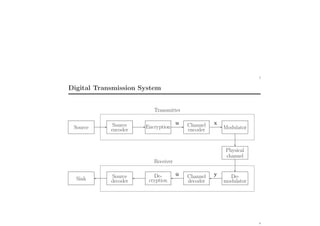
Digital Transmission System
Source E Source
encoder
E
Encryption E Channel
encoder
E
Modulator
c
Physical
channel
c
De-
modulator
'Channel
decoder
'De-
cryption
'Source
decoder
'
Sink
u
ˆu
x
y
Transmitter
Receiver
8
8
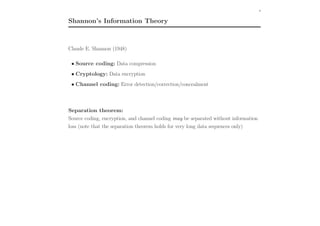
Shannon’s Information Theory
Claude E. Shannon (1948)
• Source coding: Data compression
• Cryptology: Data encryption
• Channel coding: Error detection/correction/concealment
Separation theorem:
Source coding, encryption, and channel coding may be separated without information
loss (note that the separation theorem holds for very long data sequences only)
11
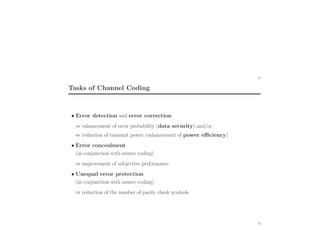
Tasks of Channel Coding
• Error detection and error correction
⇒ enhancement of error probability (data security) and/or
⇒ reduction of transmit power (enhancement of power efficiency)
• Error concealment
(in conjunction with source coding)
⇒ improvement of subjective performance
• Unequal error protection
(in conjunction with source coding)
⇒ reduction of the number of parity check symbols
12
12
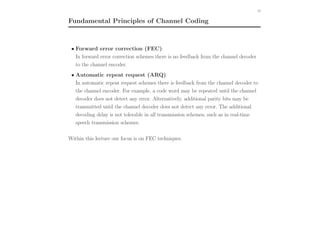
Fundamental Principles of Channel Coding
• Forward error correction (FEC):
In forward error correction schemes there is no feedback from the channel decoder
to the channel encoder.
• Automatic repeat request (ARQ):
In automatic repeat request schemes there is feedback from the channel decoder to
the channel encoder. For example, a code word may be repeated until the channel
decoder does not detect any error. Alternatively, additional parity bits may be
transmitted until the channel decoder does not detect any error. The additional
decoding delay is not tolerable in all transmission schemes, such as in real-time
speech transmission schemes.
Within this lecture our focus is on FEC techniques.
• Cyclic block codes, generator polynomial, parity check polynomial
16
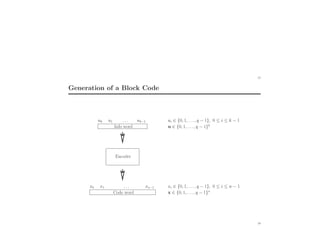
Definition of Block Codes
We denote a sequence u := [u0, u1, . . . , uk−1] of k info symbols as an info word.
The info symbols ui, i = 0, 1, . . . k − 1, are defined over the alphabet {0, 1, . . . , q − 1},
where q is the number of elements (“cardinality”) of the symbol alphabet.
Definition (block code): An (n, k)q block encoder maps an info word
u = [u0, u1, . . . , uk−1] of length k onto a code word x := [x0, x1, . . . , xn−1]
of length n, where n > k.
The code symbols xi, i = 0, 1, . . . , n − 1, are assumed to be within the same alphabet
{0, 1, . . . , q − 1}.
The assignment of code words with respect to the info words is
• unambiguous and reversible: For each code word there is exactly one info word
• time invariant: The mapping rule does not change in time
• memoryless: Each info word effects only one code word
17
Generation of a Block Code
u0 u1
x0 x1 xi ∈ {0, 1, . . . , q − 1}, 0 ≤ i ≤ n − 1
ui ∈ {0, 1, . . . , q − 1}, 0 ≤ i ≤ k − 1
u ∈ {0, 1, . . . , q − 1}k
x ∈ {0, 1, . . . , q − 1}n
xn−1
uk−1
. . .
. . .
Encoder
Code word
Info word
18
18
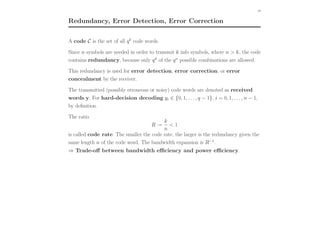
Redundancy, Error Detection, Error Correction
A code C is the set of all qk
code words.
Since n symbols are needed in order to transmit k info symbols, where n > k, the code
contains redundancy, because only qk
of the qn
possible combinations are allowed.
This redundancy is used for error detection, error correction, or error
concealment by the receiver.
The transmitted (possibly erroneous or noisy) code words are denoted as received
words y. For hard-decision decoding yi ∈ {0, 1, . . . , q − 1}, i = 0, 1, . . . , n − 1,
by definition.
The ratio
R :=
k
n
< 1
is called code rate. The smaller the code rate, the larger is the redundancy given the
same length n of the code word. The bandwidth expansion is R−1
.
⇒ Trade-off between bandwidth efficiency and power efficiency.
19
Systematic Codes
Definition (systematic code): A code is called systematic, if the mapping between
info symbols and code symbols is such that the info symbols are explicitly contained in
the code words.
The n − k remaining symbols are called parity check symbols
(q = 2: parity check bits).
Example 1: (3, 2)2 single parity check (SPC) code:
(q = 2, i.e., one symbol corresponds to one bit)
Info word u = [u0, u1] Code word x = [x0, x1, x2]
[00] [000]
[01] [011]
[10] [101]
[11] [110]
Parity check equation: u0 ⊕ u1 ⊕ x2 = 0 (⊕: modulo-q addition)
Code: C = {[000], [011], [101], [110]}
20
• Catastrophic convolutional encoders
66
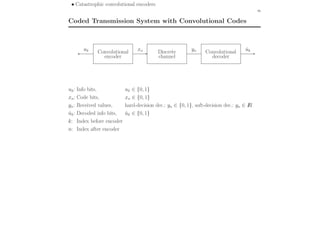
Coded Transmission System with Convolutional Codes
s Convolutional
encoder
E Discrete
channel
Convolutional
decoder
E
uk xn yn ˆuk
uk: Info bits, uk ∈ {0, 1}
xn: Code bits, xn ∈ {0, 1}
yn: Received values, hard-decision dec.: yn ∈ {0, 1}, soft-decision dec.: yn ∈ IR
ˆuk: Decoded info bits, ˆuk ∈ {0, 1}
k: Index before encoder
n: Index after encoder
67
Convolutional Codes
Convolutional codes are able to encode the info bits continuously.
We restrict ourselves to binary convolutional codes. The ratio between the number of
info bits and the number of code bits is called coding rate R.
In practice, information is typically transmitted block-wise, rather than continuously.
The number of info bits per block is denoted as K, i.e., the index before the encoder is
0 ≤ k ≤ K − 1.
The number of coded bits per block is denoted as N, i.e., the index after the encoder is
0 ≤ n ≤ N − 1.
68
68
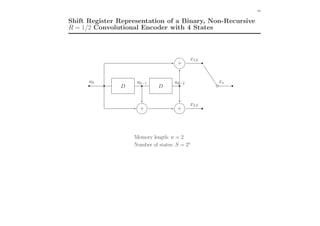
Shift Register Representation of a Binary, Non-Recursive
R = 1/2 Convolutional Encoder with 4 States
u u u
u
u
u uh
E
c c
T
EE
E
D D t
t
t
t
t
t
t
t
&%
'$
&%
'$
&%
'$
+ +
+
uk xnuk−1 uk−2
Memory length: ν = 2
Number of states: S = 2ν
x2,k
x1,k

Basics of channel coding

  • 1.
    Course Outline ■ DigitalCommunications Basic Blocks, Introduction ■ Classification of signals ,Deterministic and Random, Periodic and Non-periodic (Signal, Energy and Power Signals, Analog and Discrete Signals) ■ Spectral Density, Auto-Correlation, ■ Bandwidth of Digital Signals, Baseband versus Band pass ■ Sampling Theorem, Aliasing, Over Sampling ■ Sampling and Quantizing effects, Channel effects, Signal to Noise Ratio ■ Pulse Code Modulation, PCM based Time division multiplexing
  • 2.
    Course Outline ■ Uniformand Non Uniform Quantization, Companding ■ Waveform Representation of Binary Digits, M-ary Pulse Modulation waveforms ■ PCM waveform types, Line Coding ■ Correlative Coding, duo-binary coding and decoding, precoding ■ Error Performance, degradation in Digital Communication System, Demodulation and detection, SNR parameter in Digital Communication System ■ Detection of Binary Signals in Gaussian Noise, Matched Filter
  • 3.
    Course Outline ■ Intersymbol Interference, Pulse shaping to reduce ISI, Error Performance ■ Eye Patterns, Digital Demodulation Techniques ■ Spread Spectrum, Frequency Hopping and Direct Sequence
  • 4.
    What we discussedin the last lecture ■ Bandwidth Calculation ■ Inter Symbol Interference
  • 5.
  • 6.
    How to combatISI ■ Pulse shaping By using Nyquist Pulses ■ Using Equalization Zero Forcing Equalization Mean Minimum Square Equalizer
  • 7.
    Channel Coding inOur Everyday Lives: Examples 185
  • 8.
    Channel Coding inOur Everyday Lives: Examples 186
  • 9.
    Channel Coding inOur Everyday Lives: Examples 187
  • 10.
    188 What is ChannelCoding? Digital Communications over physical channels is prone to errors Channel Coding means : Introducing redundancy (i.e., adding extra bits) to information messages to protect against channel errors
  • 11.
    4 What is ChannelCoding? Channel coding is the art or science in order to protect data symbols against transmission/storage errors. Channel coding in only possible in digital transmission/storage systems. Redundancy is added to the data at the transmitter side, so that transmission/storage errors can be detected and/or corrected at the receiver. Main tasks: • Error detection • Error correction • Error concealment. Without channel coding, robust data transmission via noisy communication channels as well as reliable storage is not possible. Therefore, channel coding is applied in many different applications, particularly in digital transmission systems and in digital storage systems.
  • 12.
    5 Applications of ChannelCoding Digital transmission systems • mobile radio systems • data modems, internet • satellite communication systems, deep-space probes • underwater communication systems • optical communication systems Digital storage systems • compact disc (CD), digital versatile disc (DVD), coin disc • digital audio tape (DAT) • hard disc, magnetic storage systems 6
  • 13.
    7 Digital Transmission System SourceE Source encoder E Encryption E Channel encoder E Modulator c Physical channel c De- modulator 'Channel decoder 'De- cryption 'Source decoder ' Sink u ˆu x y Transmitter Receiver 8
  • 14.
    8 Shannon’s Information Theory ClaudeE. Shannon (1948) • Source coding: Data compression • Cryptology: Data encryption • Channel coding: Error detection/correction/concealment Separation theorem: Source coding, encryption, and channel coding may be separated without information loss (note that the separation theorem holds for very long data sequences only)
  • 15.
    11 Tasks of ChannelCoding • Error detection and error correction ⇒ enhancement of error probability (data security) and/or ⇒ reduction of transmit power (enhancement of power efficiency) • Error concealment (in conjunction with source coding) ⇒ improvement of subjective performance • Unequal error protection (in conjunction with source coding) ⇒ reduction of the number of parity check symbols 12
  • 16.
    12 Fundamental Principles ofChannel Coding • Forward error correction (FEC): In forward error correction schemes there is no feedback from the channel decoder to the channel encoder. • Automatic repeat request (ARQ): In automatic repeat request schemes there is feedback from the channel decoder to the channel encoder. For example, a code word may be repeated until the channel decoder does not detect any error. Alternatively, additional parity bits may be transmitted until the channel decoder does not detect any error. The additional decoding delay is not tolerable in all transmission schemes, such as in real-time speech transmission schemes. Within this lecture our focus is on FEC techniques.
  • 17.
    • Cyclic blockcodes, generator polynomial, parity check polynomial 16 Definition of Block Codes We denote a sequence u := [u0, u1, . . . , uk−1] of k info symbols as an info word. The info symbols ui, i = 0, 1, . . . k − 1, are defined over the alphabet {0, 1, . . . , q − 1}, where q is the number of elements (“cardinality”) of the symbol alphabet. Definition (block code): An (n, k)q block encoder maps an info word u = [u0, u1, . . . , uk−1] of length k onto a code word x := [x0, x1, . . . , xn−1] of length n, where n > k. The code symbols xi, i = 0, 1, . . . , n − 1, are assumed to be within the same alphabet {0, 1, . . . , q − 1}. The assignment of code words with respect to the info words is • unambiguous and reversible: For each code word there is exactly one info word • time invariant: The mapping rule does not change in time • memoryless: Each info word effects only one code word
  • 18.
    17 Generation of aBlock Code u0 u1 x0 x1 xi ∈ {0, 1, . . . , q − 1}, 0 ≤ i ≤ n − 1 ui ∈ {0, 1, . . . , q − 1}, 0 ≤ i ≤ k − 1 u ∈ {0, 1, . . . , q − 1}k x ∈ {0, 1, . . . , q − 1}n xn−1 uk−1 . . . . . . Encoder Code word Info word 18
  • 19.
    18 Redundancy, Error Detection,Error Correction A code C is the set of all qk code words. Since n symbols are needed in order to transmit k info symbols, where n > k, the code contains redundancy, because only qk of the qn possible combinations are allowed. This redundancy is used for error detection, error correction, or error concealment by the receiver. The transmitted (possibly erroneous or noisy) code words are denoted as received words y. For hard-decision decoding yi ∈ {0, 1, . . . , q − 1}, i = 0, 1, . . . , n − 1, by definition. The ratio R := k n < 1 is called code rate. The smaller the code rate, the larger is the redundancy given the same length n of the code word. The bandwidth expansion is R−1 . ⇒ Trade-off between bandwidth efficiency and power efficiency.
  • 20.
    19 Systematic Codes Definition (systematiccode): A code is called systematic, if the mapping between info symbols and code symbols is such that the info symbols are explicitly contained in the code words. The n − k remaining symbols are called parity check symbols (q = 2: parity check bits). Example 1: (3, 2)2 single parity check (SPC) code: (q = 2, i.e., one symbol corresponds to one bit) Info word u = [u0, u1] Code word x = [x0, x1, x2] [00] [000] [01] [011] [10] [101] [11] [110] Parity check equation: u0 ⊕ u1 ⊕ x2 = 0 (⊕: modulo-q addition) Code: C = {[000], [011], [101], [110]} 20
  • 21.
    • Catastrophic convolutionalencoders 66 Coded Transmission System with Convolutional Codes s Convolutional encoder E Discrete channel Convolutional decoder E uk xn yn ˆuk uk: Info bits, uk ∈ {0, 1} xn: Code bits, xn ∈ {0, 1} yn: Received values, hard-decision dec.: yn ∈ {0, 1}, soft-decision dec.: yn ∈ IR ˆuk: Decoded info bits, ˆuk ∈ {0, 1} k: Index before encoder n: Index after encoder
  • 22.
    67 Convolutional Codes Convolutional codesare able to encode the info bits continuously. We restrict ourselves to binary convolutional codes. The ratio between the number of info bits and the number of code bits is called coding rate R. In practice, information is typically transmitted block-wise, rather than continuously. The number of info bits per block is denoted as K, i.e., the index before the encoder is 0 ≤ k ≤ K − 1. The number of coded bits per block is denoted as N, i.e., the index after the encoder is 0 ≤ n ≤ N − 1. 68
  • 23.
    68 Shift Register Representationof a Binary, Non-Recursive R = 1/2 Convolutional Encoder with 4 States u u u u u u uh E c c T EE E D D t t t t t t t t &% '$ &% '$ &% '$ + + + uk xnuk−1 uk−2 Memory length: ν = 2 Number of states: S = 2ν x2,k x1,k