Dr. Ferdinand Gonzales
Consultant-Specialist, College of Nursing
University of Hail
Week 12
MEDICAL SURGICAL NURSING
Health Assessment & Physical
ExaminationPractice - NUR 214
UNIT 3: Physical Examination
Chapter 18:
Musculosketal
STANDARD PROTOCOL
• Perform hand hygiene and put on PPE, if indicated.
• Identify the patient.
• Explain the procedure.
• Provide Privacy. Close curtains around bed and the door to
room, if possible.
SUBJECTIVE DATA
1. Joints
Pain
Stiffness
Swelling, heat, redness
Limitation of movement
2. Knee joint (if injured)
3. Muscles
Pain (cramps)
Weakness
4. Bones
Pain
Deformity
Trauma (fractures, sprains,
dislocations)
5. Functional assessment (ADLs)
6. Patient-centered care
SUBJECTIVE DATA
1. Joints
• Any problems with your joints?
Any pain?
Location: Which joints? On one side
or both sides?
Quality: What does the pain feel like:
aching, stiff, sharp or dull, shooting?
Severity: How strong is it?
Onset: When did it start?
SUBJECTIVE DATA
1. Joints
Timing: What time of day does the
pain occur? How long does it last?
How often does it occur?
Is the pain aggravated by movement,
rest, position, weather?
Is it relieved by rest, medications,
application of heat or ice?
SUBJECTIVE DATA
1. Joints
Is the pain associated with chills,
fever, recent sore throat, trauma,
repetitive activity?
Any stiffness in your joints?
Any swelling, heat, redness in the
joints?
Any tick bite?
Any limitation of movement in any
joint? Which joint?
SUBJECTIVE DATA
2. Knee joint (if injury reported)
• How did you injure your knee? Hit
inside of knee? Outside? Twisting or
pivoting? Overuse such as jumping
or kneeling?
Hear a “pop” at injury? Can you
stand on that leg? Can you flex the
knee? Point to where it hurts the
most.
SUBJECTIVE DATA
3. Muscles
• Any problems in the muscles such as
any pain or cramping? Which
muscles?
If in calf muscles: Is the pain with
walking? Does it go away with rest?
Are your muscle aches associated with
fever, chills, the “flu”?
Any weakness in muscles?
• Location: Where is the weakness?
How long have you noticed it?
Do the muscles look smaller there?
4. Bones
• Any bone pain? Is the pain affected
by movement?
• Any deformity of any bone or
joint? Is the deformity caused by
injury or trauma? Does it affect
ROM?
• Any accidents or trauma ever
affected the bones or joints:
fractures; joint strain, sprain,
dislocation? Which ones?
SUBJECTIVE DATA
4. Bones
• When did this occur? What
treatment was given? Any
problems or limitations now as a
result?
• Any back pain? In which part of
your back? Is pain felt anywhere
else, such as shooting down leg?
• Any numbness and tingling? Any
limping?
SUBJECTIVE DATA
5. Functional assessment (ADLs).
Do your joint (muscle, bone)
problems create any limits on
your usual ADLs? Which ones?
(Note: Ask about each category;
if the person answers “yes,” ask
specifically about each activity in
category.)
SUBJECTIVE DATA
5. Functional assessment (ADLs).
Bathing—Getting in and out of the tub,
turning faucets?
• Bathing—Getting in and out of the
tub, turning faucets?
• Toileting—Urinating, moving bowels,
able to get self on/off toilet, wipe
self?
• Dressing—Doing buttons or zipper,
fastening opening behind neck,
pulling dress or sweater over head,
pulling up pants, tying shoes, getting
shoes that fit?
SUBJECTIVE DATA
5. Functional assessment (ADLs).
Bathing—Getting in and out of the tub,
turning faucets?
• Grooming—Shaving, brushing teeth,
brushing or fixing hair, applying
makeup?
• Eating—Preparing meals, pouring liquids,
cutting up foods, bringing food
to mouth, drinking?
• Mobility—Walking, walking up or down
stairs, getting in/out of bed,
getting out of house?
• Communicating—Talking, using phone,
writing?
SUBJECTIVE DATA
6. Patient-centered care.
Any occupational hazards that
could affect the muscles and
joints? Does your work involve
heavy lifting? Or any repetitive
motion or chronic stress to joints?
Any efforts to alleviate these?
Tell me about your exercise
program. Describe the type of
exercise, frequency, the warm-up
program.
SUBJECTIVE DATA
6. Patient-centered care.
Any pain during exercise? How do you
treat it?
• Have you had any recent weight gain?
Please describe your usual daily diet.
(Note the person’s usual caloric intake,
all four food groups, daily amount
of protein, calcium.)
• Are you taking any medications for
musculoskeletal system: aspirin, anti-
inflammatory, muscle relaxant, pain
reliever? Hormone therapy?
SUBJECTIVE DATA
6. Patient-centered care.
How about supplemental
medications, calcium, or vitamin D?
How many dairy products eaten per
day? How many over-the-counter
(OTC) medications taken daily?
If person has chronic disability or
crippling illness: How has your illness
affected:
Your interaction with family?
Your interaction with friends?
The way you view yourself?
SUBJECTIVE DATA
6. Patient-centered care.
How about cigarettes—How much
do you smoke per day? And
alcohol use—How many drinks
per day? Per week?
SUBJECTIVE DATA
OBJECTIVE DATA
EQUIPMENT
Prepare all required equipment’s and bring
the articles to the
bedside:
• Tape measure
• Skin marking pen
OBJECTIVE DATA
GENERAL PREPARATION
•Make the person comfortable before and throughout the examination. Drape
for full visualization of the body part you are examining without needlessly
exposing the person. Take an orderly approach—head to toe, proximal to distal
(from the midline outward).
• Support each joint at rest. Muscles must be soft and relaxed to assess the joints
under them accurately. Take care when examining any inflamed area where
rough manipulation could cause pain and muscle spasm. To avoid this, use firm
support, gentle movement, and gentle return to a relaxed state.
• Compare corresponding paired joints. Expect symmetry of structure and
function and normal parameters for that joint.
OBJECTIVE DATA Inspection
Temporomandibular Joint
With the person seated, inspect the area
just anterior to the ear. Place the
tips of your first two fingers in front of
each ear and ask the person to open and
close the mouth. Drop your fingers into
the depressed area over the joint and
note smooth motion of the mandible.
OBJECTIVE DATA Inspection
Temporomandibular Joint
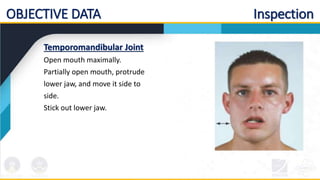
Open mouth maximally.
Partially open mouth, protrude
lower jaw, and move it side to
side.
Stick out lower jaw.
OBJECTIVE DATA Inspection
Temporomandibular Joint
Palpate the contracted temporalis and
masseter muscles as the person
clenches the teeth. Compare right and
left sides for size, firmness, and strength.
OBJECTIVE DATA Inspection
Temporomandibular Joint
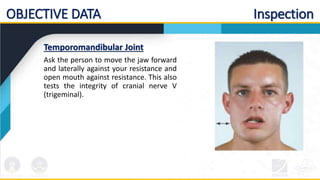
Ask the person to move the jaw forward
and laterally against your resistance and
open mouth against resistance. This also
tests the integrity of cranial nerve V
(trigeminal).
OBJECTIVE DATA Inspection
Temporomandibular Joint
Ask the person to move the jaw forward
and laterally against your resistance and
open mouth against resistance. This also
tests the integrity of cranial nerve V
(trigeminal).
OBJECTIVE DATA Inspection
Cervical Spine
Inspect the alignment of head and
neck. The spine should be straight,
and the head erect. Palpate the
spinous processes and the
sternomastoid, trapezius, and
paravertebral muscles. They should
feel firm, with no muscle spasm or
tenderness. Head tilted to one side.
Asymmetry of muscles. Tenderness
and hard muscles with muscle
spasm. Ask the person to follow
these motions
OBJECTIVE DATA Inspection
Cervical Spine
• Flexion of 45 degrees:
Touch chin to chest
OBJECTIVE DATA Inspection
Cervical Spine
• Lift the chin toward the
ceiling. Hyperextension of
55 degrees.
OBJECTIVE DATA Inspection
Cervical Spine
• Touch each ear toward the
corresponding shoulder.
Do not lift the shoulder.
Lateral bending of 40
degrees
OBJECTIVE DATA Inspection
Cervical Spine
Turn the chin toward each
shoulder. Rotation of 70
degrees
OBJECTIVE DATA Inspection
Cervical Spine
Repeat the motions while
applying opposing force. The
person normally can maintain
flexion against your full
resistance. This also tests the
integrity of cranial nerve XI
(spinal).
OBJECTIVE DATA Inspection
Upper Extremity
Shoulder
Inspect and compare both
shoulders posteriorly and
anteriorly. Check the size and
contour of the joint and compare
shoulders for equality of bony
landmarks. Normally no redness,
muscular atrophy, deformity, or
swelling is present. Check the
anterior aspect of the joint
capsule and the subacromial
bursa for abnormal
swelling.
OBJECTIVE DATA Inspection
Upper Extremity
Turn the chin toward each
shoulder. Rotation of 70
degrees
AFTER PROCEDURE STEPS
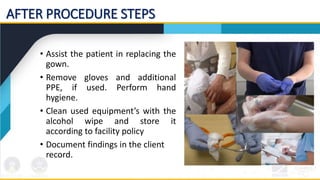
• Assist the patient in replacing the
gown.
• Remove gloves and additional
PPE, if used. Perform hand
hygiene.
• Clean used equipment’s with the
alcohol wipe and store it
according to facility policy
• Document findings in the client
record.

Week 10_HAPE_Musculoskeletal.pptx

  • 1.
    Dr. Ferdinand Gonzales Consultant-Specialist,College of Nursing University of Hail Week 12 MEDICAL SURGICAL NURSING Health Assessment & Physical ExaminationPractice - NUR 214 UNIT 3: Physical Examination Chapter 18: Musculosketal
  • 2.
    STANDARD PROTOCOL • Performhand hygiene and put on PPE, if indicated. • Identify the patient. • Explain the procedure. • Provide Privacy. Close curtains around bed and the door to room, if possible.
  • 3.
    SUBJECTIVE DATA 1. Joints Pain Stiffness Swelling,heat, redness Limitation of movement 2. Knee joint (if injured) 3. Muscles Pain (cramps) Weakness 4. Bones Pain Deformity Trauma (fractures, sprains, dislocations) 5. Functional assessment (ADLs) 6. Patient-centered care
  • 4.
    SUBJECTIVE DATA 1. Joints •Any problems with your joints? Any pain? Location: Which joints? On one side or both sides? Quality: What does the pain feel like: aching, stiff, sharp or dull, shooting? Severity: How strong is it? Onset: When did it start?
  • 5.
    SUBJECTIVE DATA 1. Joints Timing:What time of day does the pain occur? How long does it last? How often does it occur? Is the pain aggravated by movement, rest, position, weather? Is it relieved by rest, medications, application of heat or ice?
  • 6.
    SUBJECTIVE DATA 1. Joints Isthe pain associated with chills, fever, recent sore throat, trauma, repetitive activity? Any stiffness in your joints? Any swelling, heat, redness in the joints? Any tick bite? Any limitation of movement in any joint? Which joint?
  • 7.
    SUBJECTIVE DATA 2. Kneejoint (if injury reported) • How did you injure your knee? Hit inside of knee? Outside? Twisting or pivoting? Overuse such as jumping or kneeling? Hear a “pop” at injury? Can you stand on that leg? Can you flex the knee? Point to where it hurts the most.
  • 8.
    SUBJECTIVE DATA 3. Muscles •Any problems in the muscles such as any pain or cramping? Which muscles? If in calf muscles: Is the pain with walking? Does it go away with rest? Are your muscle aches associated with fever, chills, the “flu”? Any weakness in muscles? • Location: Where is the weakness? How long have you noticed it? Do the muscles look smaller there?
  • 9.
    4. Bones • Anybone pain? Is the pain affected by movement? • Any deformity of any bone or joint? Is the deformity caused by injury or trauma? Does it affect ROM? • Any accidents or trauma ever affected the bones or joints: fractures; joint strain, sprain, dislocation? Which ones? SUBJECTIVE DATA
  • 10.
    4. Bones • Whendid this occur? What treatment was given? Any problems or limitations now as a result? • Any back pain? In which part of your back? Is pain felt anywhere else, such as shooting down leg? • Any numbness and tingling? Any limping? SUBJECTIVE DATA
  • 11.
    5. Functional assessment(ADLs). Do your joint (muscle, bone) problems create any limits on your usual ADLs? Which ones? (Note: Ask about each category; if the person answers “yes,” ask specifically about each activity in category.) SUBJECTIVE DATA
  • 12.
    5. Functional assessment(ADLs). Bathing—Getting in and out of the tub, turning faucets? • Bathing—Getting in and out of the tub, turning faucets? • Toileting—Urinating, moving bowels, able to get self on/off toilet, wipe self? • Dressing—Doing buttons or zipper, fastening opening behind neck, pulling dress or sweater over head, pulling up pants, tying shoes, getting shoes that fit? SUBJECTIVE DATA
  • 13.
    5. Functional assessment(ADLs). Bathing—Getting in and out of the tub, turning faucets? • Grooming—Shaving, brushing teeth, brushing or fixing hair, applying makeup? • Eating—Preparing meals, pouring liquids, cutting up foods, bringing food to mouth, drinking? • Mobility—Walking, walking up or down stairs, getting in/out of bed, getting out of house? • Communicating—Talking, using phone, writing? SUBJECTIVE DATA
  • 14.
    6. Patient-centered care. Anyoccupational hazards that could affect the muscles and joints? Does your work involve heavy lifting? Or any repetitive motion or chronic stress to joints? Any efforts to alleviate these? Tell me about your exercise program. Describe the type of exercise, frequency, the warm-up program. SUBJECTIVE DATA
  • 15.
    6. Patient-centered care. Anypain during exercise? How do you treat it? • Have you had any recent weight gain? Please describe your usual daily diet. (Note the person’s usual caloric intake, all four food groups, daily amount of protein, calcium.) • Are you taking any medications for musculoskeletal system: aspirin, anti- inflammatory, muscle relaxant, pain reliever? Hormone therapy? SUBJECTIVE DATA
  • 16.
    6. Patient-centered care. Howabout supplemental medications, calcium, or vitamin D? How many dairy products eaten per day? How many over-the-counter (OTC) medications taken daily? If person has chronic disability or crippling illness: How has your illness affected: Your interaction with family? Your interaction with friends? The way you view yourself? SUBJECTIVE DATA
  • 17.
    6. Patient-centered care. Howabout cigarettes—How much do you smoke per day? And alcohol use—How many drinks per day? Per week? SUBJECTIVE DATA
  • 18.
    OBJECTIVE DATA EQUIPMENT Prepare allrequired equipment’s and bring the articles to the bedside: • Tape measure • Skin marking pen
  • 19.
    OBJECTIVE DATA GENERAL PREPARATION •Makethe person comfortable before and throughout the examination. Drape for full visualization of the body part you are examining without needlessly exposing the person. Take an orderly approach—head to toe, proximal to distal (from the midline outward). • Support each joint at rest. Muscles must be soft and relaxed to assess the joints under them accurately. Take care when examining any inflamed area where rough manipulation could cause pain and muscle spasm. To avoid this, use firm support, gentle movement, and gentle return to a relaxed state. • Compare corresponding paired joints. Expect symmetry of structure and function and normal parameters for that joint.
  • 20.
    OBJECTIVE DATA Inspection TemporomandibularJoint With the person seated, inspect the area just anterior to the ear. Place the tips of your first two fingers in front of each ear and ask the person to open and close the mouth. Drop your fingers into the depressed area over the joint and note smooth motion of the mandible.
  • 21.
    OBJECTIVE DATA Inspection TemporomandibularJoint Open mouth maximally. Partially open mouth, protrude lower jaw, and move it side to side. Stick out lower jaw.
  • 22.
    OBJECTIVE DATA Inspection TemporomandibularJoint Palpate the contracted temporalis and masseter muscles as the person clenches the teeth. Compare right and left sides for size, firmness, and strength.
  • 23.
    OBJECTIVE DATA Inspection TemporomandibularJoint Ask the person to move the jaw forward and laterally against your resistance and open mouth against resistance. This also tests the integrity of cranial nerve V (trigeminal).
  • 24.
    OBJECTIVE DATA Inspection TemporomandibularJoint Ask the person to move the jaw forward and laterally against your resistance and open mouth against resistance. This also tests the integrity of cranial nerve V (trigeminal).
  • 25.
    OBJECTIVE DATA Inspection CervicalSpine Inspect the alignment of head and neck. The spine should be straight, and the head erect. Palpate the spinous processes and the sternomastoid, trapezius, and paravertebral muscles. They should feel firm, with no muscle spasm or tenderness. Head tilted to one side. Asymmetry of muscles. Tenderness and hard muscles with muscle spasm. Ask the person to follow these motions
  • 26.
    OBJECTIVE DATA Inspection CervicalSpine • Flexion of 45 degrees: Touch chin to chest
  • 27.
    OBJECTIVE DATA Inspection CervicalSpine • Lift the chin toward the ceiling. Hyperextension of 55 degrees.
  • 28.
    OBJECTIVE DATA Inspection CervicalSpine • Touch each ear toward the corresponding shoulder. Do not lift the shoulder. Lateral bending of 40 degrees
  • 29.
    OBJECTIVE DATA Inspection CervicalSpine Turn the chin toward each shoulder. Rotation of 70 degrees
  • 30.
    OBJECTIVE DATA Inspection CervicalSpine Repeat the motions while applying opposing force. The person normally can maintain flexion against your full resistance. This also tests the integrity of cranial nerve XI (spinal).
  • 31.
    OBJECTIVE DATA Inspection UpperExtremity Shoulder Inspect and compare both shoulders posteriorly and anteriorly. Check the size and contour of the joint and compare shoulders for equality of bony landmarks. Normally no redness, muscular atrophy, deformity, or swelling is present. Check the anterior aspect of the joint capsule and the subacromial bursa for abnormal swelling.
  • 32.
    OBJECTIVE DATA Inspection UpperExtremity Turn the chin toward each shoulder. Rotation of 70 degrees
  • 33.
    AFTER PROCEDURE STEPS •Assist the patient in replacing the gown. • Remove gloves and additional PPE, if used. Perform hand hygiene. • Clean used equipment’s with the alcohol wipe and store it according to facility policy • Document findings in the client record.