Presented by:
Kuldeep Garwa
Bael
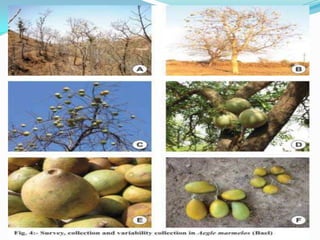
 Bael (Aegle marmelos)
 Family-Rutaceae
 Type of fruit-Berry
 Edible portion-Succulent Placenta
 Origin: It is native to India and found throughout
southeast Asia.
Genetic resources
 CCSHAU, Regional Research Station, Bawal(10)
 ANDUAT, Faizabad(22)
 CIAH, Bikaner(16)
 CISH, Lucknow(44)
 GBPUAT, Pantnagar(10)
 CAZRI, Jodhpur(5)
Cultivars
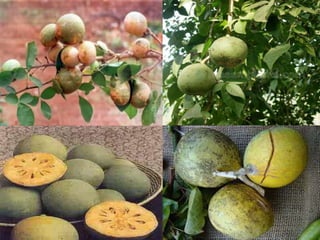
 NB-5 best selection
 NB-7
 CISH B-2
 IC546120 heaviest fruit with highest TSS followed by
IC546131
 Pant Urvasi
 Pant Sujata
 Pant Aparna
 Gonda selection
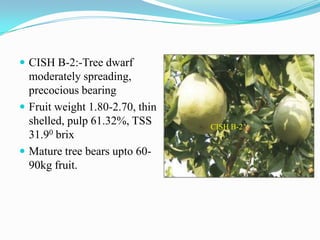
 CISH B-2:-Tree dwarf
moderately spreading,
precocious bearing
 Fruit weight 1.80-2.70, thin
shelled, pulp 61.32%, TSS
31.90 brix
 Mature tree bears upto 60-
90kg fruit.
CISH B-2
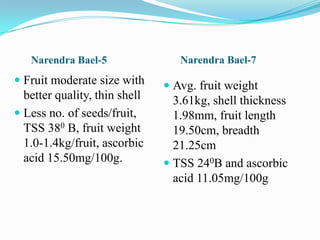
Narendra Bael-5 Narendra Bael-7
 Fruit moderate size with
better quality, thin shell
 Less no. of seeds/fruit,
TSS 380 B, fruit weight
1.0-1.4kg/fruit, ascorbic
acid 15.50mg/100g.
 Avg. fruit weight
3.61kg, shell thickness
1.98mm, fruit length
19.50cm, breadth
21.25cm
 TSS 240B and ascorbic
acid 11.05mg/100g
IMLI
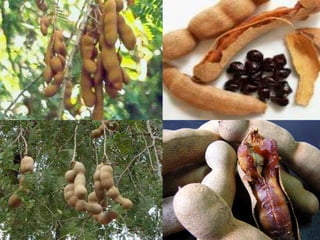
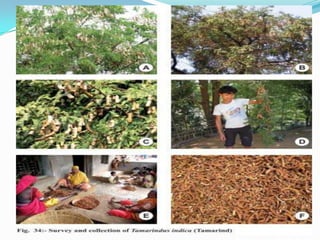
 Tamarind (Tamarindus indica)
 Family-Leguminosae
 Edible portion-Mesocarp
 Chromosome no.-24
 Origin: Origin of tamarind has been reported to be in the
tropical Africa and it still grows wild throughout the
Sudan.
 It is believed to be introduced into India since ancient time
and even occasionally reported as indigenous to India.
Genetic resources
 248 collections have been made by various organization
from Bihar, Jharkhand, Gujarat, Tamil Nadu, Andhra
Pradesh, Madhya Pradesh, Kerala, Karnataka, West
Bengal and north eastern states.
Germplasm
 T-111 faizabad
 PKM-1
 Tamarind-13(Goma Prateek)
 Urigam
 Pratisthan
 Tamarind-263
 Yogeshwari
 DST-1
 IC552913-heavy fruits with small seeds.
Lasoda
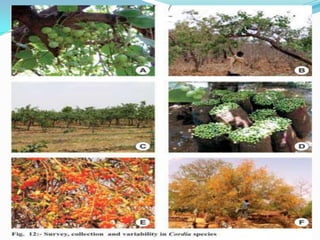
 Lasoda(Cordia myxa)
 Family-Boraginaceae
 Type of fruit-Drupe
 Edible portion-Mesocarp
 Origin and distribution: Native of Northwestern India and
distributed throughout country.
Genetic resources
 CCSHAU, Regional Research Station, Bawal(30)
 CIAH, Bikaner(65)
 NBPGR Regional Station, Jodhpur(73)
 ANDUAT, Faizabad
 Generally collected by NBPGR from Rajasthan, Haryana,
Gujarat, Madhya Pradesh, Himachal Pradesh and Uttar
Pradesh.
Germplasm
 IC546090-high fruit length or width.
 IC564563
 IC564553, IC564548-highest TSS
 IC564547, IC564559, IC564556- pulpiest fruit.
 IC564550, IC564555, IC564563-lightest seeds.
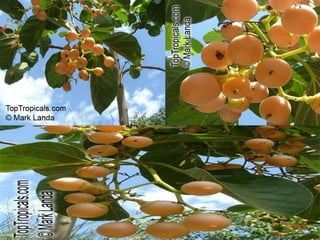
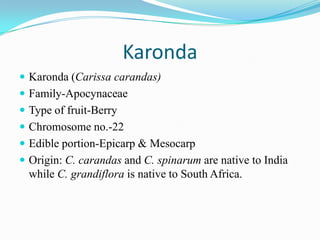
Karonda
 Karonda (Carissa carandas)
 Family-Apocynaceae
 Type of fruit-Berry
 Chromosome no.-22
 Edible portion-Epicarp & Mesocarp
 Origin: C. carandas and C. spinarum are native to India
while C. grandiflora is native to South Africa.
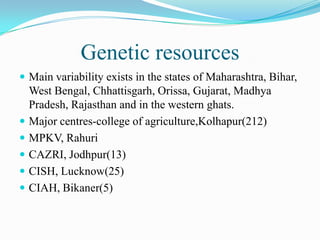
Genetic resources
 Main variability exists in the states of Maharashtra, Bihar,
West Bengal, Chhattisgarh, Orissa, Gujarat, Madhya
Pradesh, Rajasthan and in the western ghats.
 Major centres-college of agriculture,Kolhapur(212)
 MPKV, Rahuri
 CAZRI, Jodhpur(13)
 CISH, Lucknow(25)
 CIAH, Bikaner(5)
Germplasm
 PK-3
 PK-4
 Pant Manohar
 Pant Sudarshan
 Pant suvarna
 CHESK-1
 CHESK-2
 CHESK-1:-peak period of flowering is March and ripens
in the month of June.
 Fruit weight 6.0g, pulp weight 4.64g, TSS 10.60 B
ascorbic acid 26.39mg/100g.
 CHESK-2:-collected from Chirai Gaon, Varanasi. It
ripens in the month of June-July and recorded 4.0g fruit
weight, 10.30 B and ascorbic acid 34.00mg/100g.
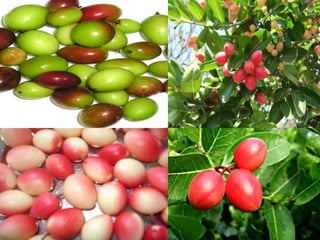
 Pant Manohar:-fruits are attractive deep pinkish blush on
white background, avg. fruit weight 3.49g, pulp
composition is 88.27%, avg. yield/bush is 35 kg.
 Pant Sudarshan:- medium sized bush, fruits are light
pink in colour, avg. fruit weight 3.46g, pulp is 88.47%,
avg. yield is 32kg/bush
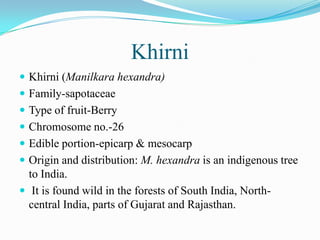
Khirni
 Khirni (Manilkara hexandra)
 Family-sapotaceae
 Type of fruit-Berry
 Chromosome no.-26
 Edible portion-epicarp & mesocarp
 Origin and distribution: M. hexandra is an indigenous tree
to India.
 It is found wild in the forests of South India, North-
central India, parts of Gujarat and Rajasthan.
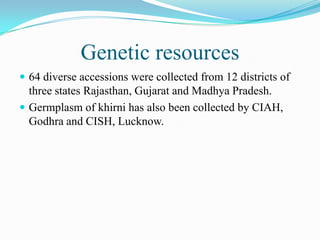
Genetic resources
 64 diverse accessions were collected from 12 districts of
three states Rajasthan, Gujarat and Madhya Pradesh.
 Germplasm of khirni has also been collected by CIAH,
Godhra and CISH, Lucknow.
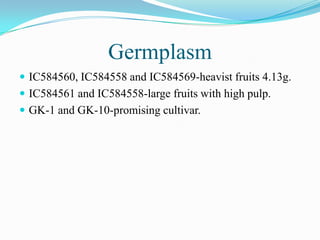
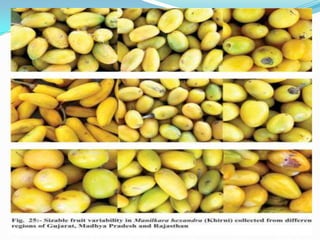
Germplasm
 IC584560, IC584558 and IC584569-heavist fruits 4.13g.
 IC584561 and IC584558-large fruits with high pulp.
 GK-1 and GK-10-promising cultivar.
Mahua
 Mahua (Madhuca latifolia)
 Family-sapotaceae
 Type of fruits-Berry
 Edible portion-Epicarp and mesocarp
 Origin: Originated in Indo-China region and spread upto
Australia.
Genetic resources
 CIAH, Godhra (35)
 CISH, lucknow(8)
 NBPGR, New Delhi(29)
 Promising cultivar:-MH-32, MH-34, MH-35, MH-26,
MH-27, MH-23, MH-33, MH-10, MH-14 etc.
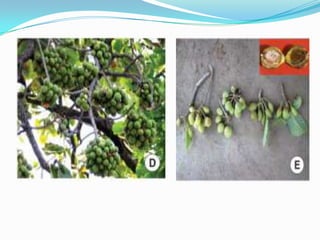
Cultivars
 CISH M-8:- maximum weight 2.63g, TSS 23.260 B with
juice content 64.90%.
 Mahua-10:-superior collection from Vejalpur village,
Gujarat. Weight 2.29g, 65% juice, 26.370 B.
 Mahua-14:-superior collection from Otala village, Gujarat.
Avg. weight 2.24g, 66% juice and 25.00 B.
Jamun
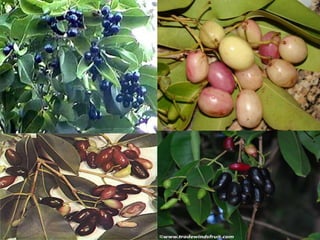
 Jamun (Syzygium cumini)
 Family-Myrtaceae
 Type of fruit-Drupe
 Chromosome no.-40
 Origin and distribution: The jamun is native to India,
Burma, Ceylon and to the Andaman Islands and available
throughout Indian plains up to the height of 1300m.
Genetic resources
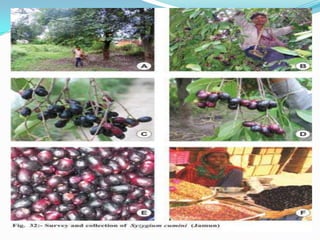
 Germplasm have been collected from various parts of
Maharashtra, Rajasthan, Gujarat, Uttar Pradesh and West
Bengal.
 Survey has been made by CISH, Lucknow in the states of
Uttar Pradesh, Haryana, Maharashtra and Gujarat and 54
accessions have been collected.
 NBPGR, New Delhi have also made extensive collections
in the parts of Haryana and Western Uttar Pradesh in
collaboration with CHES (CIAH) Godhra and CISH,
Lucknow and 20 elite accessions have been collected.
Cultivars
 CISH J-37:-tree height 40-50 ft, avg. fruit weight 24.05g,
pulp 92.26%, TSS 16.40 brix, ascorbic acid 49.88mg/100g
and yield 200-300kg/plant.
 CISH J-42:- seedless, tree height 10-11.5m, fruit weight
6.87g, pulp 97.9%, TSS 180 B, ascorbic acid
34.14mg/100g and yield 180-250kg/plant.
 Jamun GJ-2:-avg. fruit weight 20g recorded, 85.0% pulp,
180 b TSS, 45.43mg/100g ascorbic acid and yield 280
kg/plant
Phalsa
 Botanical name: Grewia subinaequalis
 Common name : Phalsa
 Family: Tiliaceae
 Chromosome no.-36
 Origin: Phalsa tree is native to Western India and spread
throughout south Asia and in the Indian sub-continent.
Genetic resources
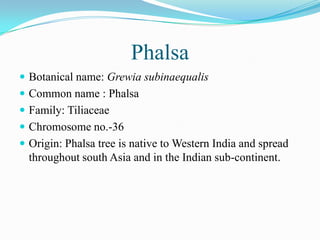
 Phalsa germplasm has been collected from various parts of
country including the states of Rajasthan, Haryana,
Gujarat, Maharashtra and Andhra Pradesh, by NBPGR,
New Delhi, CCSHAU, Hisar and Regional Research
Station of CCSHAU, at Bawal.
 In Phalsa not much variability is reported due to the self
pollination and only two types tall and dwarf have been
collected.
 Germplasm of phalsa is to be identified for bold fruits,
small seeds and synchronized fruit maturity and longer
shelf life of fruits which are important traits.
Minor fruits1
Minor fruits1

Minor fruits1

  • 1.
  • 2.
    Bael  Bael (Aeglemarmelos)  Family-Rutaceae  Type of fruit-Berry  Edible portion-Succulent Placenta  Origin: It is native to India and found throughout southeast Asia.
  • 3.
    Genetic resources  CCSHAU,Regional Research Station, Bawal(10)  ANDUAT, Faizabad(22)  CIAH, Bikaner(16)  CISH, Lucknow(44)  GBPUAT, Pantnagar(10)  CAZRI, Jodhpur(5)
  • 4.
    Cultivars  NB-5 bestselection  NB-7  CISH B-2  IC546120 heaviest fruit with highest TSS followed by IC546131  Pant Urvasi  Pant Sujata  Pant Aparna  Gonda selection
  • 5.
     CISH B-2:-Treedwarf moderately spreading, precocious bearing  Fruit weight 1.80-2.70, thin shelled, pulp 61.32%, TSS 31.90 brix  Mature tree bears upto 60- 90kg fruit. CISH B-2
  • 6.
    Narendra Bael-5 NarendraBael-7  Fruit moderate size with better quality, thin shell  Less no. of seeds/fruit, TSS 380 B, fruit weight 1.0-1.4kg/fruit, ascorbic acid 15.50mg/100g.  Avg. fruit weight 3.61kg, shell thickness 1.98mm, fruit length 19.50cm, breadth 21.25cm  TSS 240B and ascorbic acid 11.05mg/100g
  • 9.
    IMLI  Tamarind (Tamarindusindica)  Family-Leguminosae  Edible portion-Mesocarp  Chromosome no.-24  Origin: Origin of tamarind has been reported to be in the tropical Africa and it still grows wild throughout the Sudan.  It is believed to be introduced into India since ancient time and even occasionally reported as indigenous to India.
  • 10.
    Genetic resources  248collections have been made by various organization from Bihar, Jharkhand, Gujarat, Tamil Nadu, Andhra Pradesh, Madhya Pradesh, Kerala, Karnataka, West Bengal and north eastern states.
  • 11.
    Germplasm  T-111 faizabad PKM-1  Tamarind-13(Goma Prateek)  Urigam  Pratisthan  Tamarind-263  Yogeshwari  DST-1  IC552913-heavy fruits with small seeds.
  • 14.
    Lasoda  Lasoda(Cordia myxa) Family-Boraginaceae  Type of fruit-Drupe  Edible portion-Mesocarp  Origin and distribution: Native of Northwestern India and distributed throughout country.
  • 15.
    Genetic resources  CCSHAU,Regional Research Station, Bawal(30)  CIAH, Bikaner(65)  NBPGR Regional Station, Jodhpur(73)  ANDUAT, Faizabad  Generally collected by NBPGR from Rajasthan, Haryana, Gujarat, Madhya Pradesh, Himachal Pradesh and Uttar Pradesh.
  • 16.
    Germplasm  IC546090-high fruitlength or width.  IC564563  IC564553, IC564548-highest TSS  IC564547, IC564559, IC564556- pulpiest fruit.  IC564550, IC564555, IC564563-lightest seeds.
  • 19.
    Karonda  Karonda (Carissacarandas)  Family-Apocynaceae  Type of fruit-Berry  Chromosome no.-22  Edible portion-Epicarp & Mesocarp  Origin: C. carandas and C. spinarum are native to India while C. grandiflora is native to South Africa.
  • 20.
    Genetic resources  Mainvariability exists in the states of Maharashtra, Bihar, West Bengal, Chhattisgarh, Orissa, Gujarat, Madhya Pradesh, Rajasthan and in the western ghats.  Major centres-college of agriculture,Kolhapur(212)  MPKV, Rahuri  CAZRI, Jodhpur(13)  CISH, Lucknow(25)  CIAH, Bikaner(5)
  • 21.
    Germplasm  PK-3  PK-4 Pant Manohar  Pant Sudarshan  Pant suvarna  CHESK-1  CHESK-2
  • 22.
     CHESK-1:-peak periodof flowering is March and ripens in the month of June.  Fruit weight 6.0g, pulp weight 4.64g, TSS 10.60 B ascorbic acid 26.39mg/100g.  CHESK-2:-collected from Chirai Gaon, Varanasi. It ripens in the month of June-July and recorded 4.0g fruit weight, 10.30 B and ascorbic acid 34.00mg/100g.  Pant Manohar:-fruits are attractive deep pinkish blush on white background, avg. fruit weight 3.49g, pulp composition is 88.27%, avg. yield/bush is 35 kg.  Pant Sudarshan:- medium sized bush, fruits are light pink in colour, avg. fruit weight 3.46g, pulp is 88.47%, avg. yield is 32kg/bush
  • 25.
    Khirni  Khirni (Manilkarahexandra)  Family-sapotaceae  Type of fruit-Berry  Chromosome no.-26  Edible portion-epicarp & mesocarp  Origin and distribution: M. hexandra is an indigenous tree to India.  It is found wild in the forests of South India, North- central India, parts of Gujarat and Rajasthan.
  • 26.
    Genetic resources  64diverse accessions were collected from 12 districts of three states Rajasthan, Gujarat and Madhya Pradesh.  Germplasm of khirni has also been collected by CIAH, Godhra and CISH, Lucknow.
  • 27.
    Germplasm  IC584560, IC584558and IC584569-heavist fruits 4.13g.  IC584561 and IC584558-large fruits with high pulp.  GK-1 and GK-10-promising cultivar.
  • 29.
    Mahua  Mahua (Madhucalatifolia)  Family-sapotaceae  Type of fruits-Berry  Edible portion-Epicarp and mesocarp  Origin: Originated in Indo-China region and spread upto Australia.
  • 30.
    Genetic resources  CIAH,Godhra (35)  CISH, lucknow(8)  NBPGR, New Delhi(29)  Promising cultivar:-MH-32, MH-34, MH-35, MH-26, MH-27, MH-23, MH-33, MH-10, MH-14 etc.
  • 31.
    Cultivars  CISH M-8:-maximum weight 2.63g, TSS 23.260 B with juice content 64.90%.  Mahua-10:-superior collection from Vejalpur village, Gujarat. Weight 2.29g, 65% juice, 26.370 B.  Mahua-14:-superior collection from Otala village, Gujarat. Avg. weight 2.24g, 66% juice and 25.00 B.
  • 33.
    Jamun  Jamun (Syzygiumcumini)  Family-Myrtaceae  Type of fruit-Drupe  Chromosome no.-40  Origin and distribution: The jamun is native to India, Burma, Ceylon and to the Andaman Islands and available throughout Indian plains up to the height of 1300m.
  • 34.
    Genetic resources  Germplasmhave been collected from various parts of Maharashtra, Rajasthan, Gujarat, Uttar Pradesh and West Bengal.  Survey has been made by CISH, Lucknow in the states of Uttar Pradesh, Haryana, Maharashtra and Gujarat and 54 accessions have been collected.  NBPGR, New Delhi have also made extensive collections in the parts of Haryana and Western Uttar Pradesh in collaboration with CHES (CIAH) Godhra and CISH, Lucknow and 20 elite accessions have been collected.
  • 35.
    Cultivars  CISH J-37:-treeheight 40-50 ft, avg. fruit weight 24.05g, pulp 92.26%, TSS 16.40 brix, ascorbic acid 49.88mg/100g and yield 200-300kg/plant.  CISH J-42:- seedless, tree height 10-11.5m, fruit weight 6.87g, pulp 97.9%, TSS 180 B, ascorbic acid 34.14mg/100g and yield 180-250kg/plant.  Jamun GJ-2:-avg. fruit weight 20g recorded, 85.0% pulp, 180 b TSS, 45.43mg/100g ascorbic acid and yield 280 kg/plant
  • 38.
    Phalsa  Botanical name:Grewia subinaequalis  Common name : Phalsa  Family: Tiliaceae  Chromosome no.-36  Origin: Phalsa tree is native to Western India and spread throughout south Asia and in the Indian sub-continent.
  • 39.
    Genetic resources  Phalsagermplasm has been collected from various parts of country including the states of Rajasthan, Haryana, Gujarat, Maharashtra and Andhra Pradesh, by NBPGR, New Delhi, CCSHAU, Hisar and Regional Research Station of CCSHAU, at Bawal.  In Phalsa not much variability is reported due to the self pollination and only two types tall and dwarf have been collected.  Germplasm of phalsa is to be identified for bold fruits, small seeds and synchronized fruit maturity and longer shelf life of fruits which are important traits.