Sher-e-Kashmir
University of Agricultural Sciences
and Technology of Kashmir
Shalimar Campus
Dar Maajid
HISTORY AND EVOLUTION
OF SOME VEGETABLE CROPS
course title Systematics of
vegetable crops(vsc-506)
Presented to Dr. Baseerat Afroza
Presented by Majid Rashid
Afroza Akhter
Danishta yousuf
Dar Maajid
• Rick(1979) suggested that the species of Lycopersicon
have evolved via gene substitution.
• The wild cherry tomato, Lycopersicon esculentum var
cerasiforme, is the ancestor of modern cultivated
tomato.
• The wild form of tomato has originated in the Peru-
Eucador-Bolvia region of the Andes.
• The Veracruz-Puebla region of Mexico is the centre of
domestication of cultivated tomato.
• In India Tomato was introduced during British period in
the year 1828 by Royal Agri-Horticultural Society
Calcutta.
TOMATO
History and Evolution
Dar Maajid
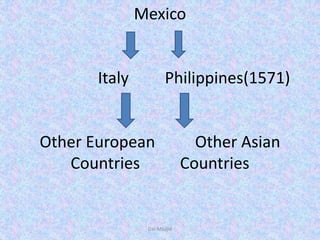
Mexico
Italy Philippines(1571)
Other European Other Asian
Countries Countries
Dar Maajid
There have been natural introgression between
Lycopersicon pimpinellifolium and Lycopersicon
esculentum, primitive cultivars.
The wild out breeding Lycopersicon species of
the western coastal Ecuador and Peru and
introgressions between L. pimpinellifolium and
primitive cultivars of tomato derived from
human selection in L. esculentum var.
cerasiforme in tropical America resulted in
wider genetic base which was utilized by the
breeders to evolve modern cultivars of tomato
by hybridization and selectionDar Maajid
 Brinjal is a native of India and perhaps china is the
secondary centre of origin.
 The first record of eggplant in India was during 300
B.C to 300 A.D. While in China it was Perhaps 6th
century A.D.
 It was cultivated in Africa before the Middle Ages
Around 9th Century A.D. It was known in Italy at end
of 14th century.
It was grown in England in 1896, but it was grown
as an ornamental plant until the 20th century.
BRINJAL
History and Evolution
Dar Maajid
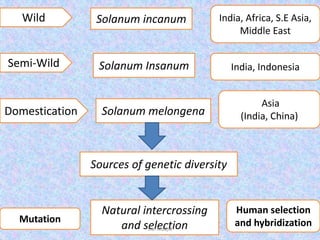
Solanum incanumWild India, Africa, S.E Asia,
Middle East
Solanum InsanumSemi-Wild India, Indonesia
Domestication Solanum melongena
Asia
(India, China)
Sources of genetic diversity
Natural intercrossing
and selection
Human selection
and hybridizationMutation
Dar Maajid
 Columbus brought Chilli/Pepper to Spain in 1493
and then spread to other parts of Mediterranean
region.
 Later it went to England in 1548 and moved to
central Europe in the 16th century.
 It was introduced into India by Portuguese towards
the end of 15th century.
The most recent research shows that chillies were
domesticated more than 6000 years ago in Mexico
and were first self pollinating crops cultivated in
Mexico, central and parts of South America.
CHILLI AND PEPPER
History and Evolution
Dar Maajid
Hot chillies and sweet peppers (Capsicum annum
var. annum) have originated from wild and weedy
species C. annum var. minimum.
The cultivated species C. baccatum var. pendulum of
south America has C. baccatum var. baccatum as its
wild progenitor.
Capsicum chinense has originated from the wild type
of Capsicum frutescens.
Dar Maajid
Potato had its origin in the Andean region of Peru
and Bolivia in South America and was domesticated
about 10000-7000 years ago.
The first domesticated was Solanum stenotomum
which originated from the wild species S.
leptophyes.
The other Progenitors of the present day cultivated
potato were the three wild species S. sparsipilum. S.
acaule and S. megistacrolobum
POTATO
History and Evolution
Dar Maajid
Potato was brought to Europe in the late 16th
century, in France by the middle of17th
century, in Ireland by early 17th century, in
England during early 19th century, in Norway
during mid 18th century.
It was introduced to India and china by the
British missionaries in the late 17th century.
It was grown in Surat and Karnataka around
1675 and later in Nilgiri hills in 1822.
Dar Maajid
Cole crops have originated from a common parent ,
the wild cabbage or “colewart” Brassica oleracea
var. sylvestris.
Cole crops have originated by evolution, mainly
mutation and introgression from wild species,
human selection and adaptation.
Probably kale was the first cole crop to be selected
and adapted by man.
From the leafy kale-like plant , other cole crops like
kale,collard,broccoli,cauliflower,and cabbage
descended.
COLE CROPS
History and Evolution
Dar Maajid
The oldest record of cabbage was in 2000-2500B.C.
The modern day cabbage was selected in Germany
around 1150 A.D. and moved to England in 14th
century.
Genetic diversity in cabbage is mainly found in
North west Europe .
It was introduced in India by Portuguese and it was
grown during the Mughal period. It became
popular during the British period.
CABBAGE
Dar Maajid
It was probably introduced in Italy by the Genoese from
Levant or Cyprus around 1490.
Italy is the centre of genetic diversity for cauliflower
and broccoli where several landraces of these two
crops occur even today.
At the beginning of 17th century cauliflower reached
Germany,France and England.
It was introduced in India from England in 1822 by Dr.
Jemson.
The Royal Agri-horticultural society Calcutta also
introduced cauliflower and other English vegetables in
1824 from South Africa
CAULIFLOWER
Dar Maajid
Onion has originated in central Asia with secondary
center of origin in the Mediterranean region.
Onion dates back to antiquity. It was mentioned in
the Holy Quran, Bible and Early Greek literature.
The use of onion as food, Medicine and religious
object dates back to 3200 B.C in Egypt
The Greeks and Romans were using onion in 400-
300 B.C.
It was being cultivated in India about 600 B.C
ONION
History and Evolution
Dar Maajid
Garlic has its origin in central Asia
Its wild ancestor is Allium longicuspis Regel is native
to central Asia.
It was known in Egypt as early as 3000 B.C. and also
to the ancient Greeks and Romans.
It spread to the eastern Mediterranean region,
Caucasus and North Africa which are considered to
be the secondary centers of diversity.
The Spanish and Portuguese settlers introduced
garlic in North and South America at the beginning
of the 15th century.
GARLIC
History and Evolution
Dar Maajid
The wild radishes, Raphanus raphanistrum, R.
maritimus, R. landra, R. microcarpus and R. rostratus
occur in Mediterranean region.
The Mediterranean region having maximum diversity is,
perhaps the centre o f origin of the European radish.
The origin of the cultivated radish is obscure because
its wild progenitor does not exist.
The species R. sativus was introduced in china more
than 2400 years ago from the Eastern Mediterranean
via the ancient silk route and then to Japan more
than1250 years ago.
RADISH
History and Evolution
Dar Maajid
The Indian group of radishes including the rat tail
radish evolved in the area of their present
distribution in North western region or west Asia
but their ancestors do not exist.
Its domestication in China was in 400 B.C and in
Korea in 100 B.C.
Radish was cultivated in England in early 16th
century.
In India radish is an ancient crop which was
mentioned in Ramayana in 1450 B.C.
Dar Maajid
Afghanistan (western Asia ) is the primary centre of
origin and Ethiopia and North America are the
secondary centers of origin.
Carrots were cultivated in Asia minor in 10th and
11th centuries.
It was introduced in china in 13th or 14th century, in
England during 15th century, in Japan in early 17th
century and in the U.S.A in 1620 A.D.
It was introduced in India from Persia in 13th or 14th
century.
CARROT
History and Evolution
Dar Maajid
Carrot was derived from the wild Daucus carota
ssp. Carota commonly known as queen Ann`s Lace.
The cultivated species D. carota has developed from
the wild species by spontaneous mutation and
human selection.
In India red or purple coloured carrots were the
earliest introduction and the orange forms were
introduced much later, perhaps during the
British period.
Dar Maajid
The two primary centers of origin are in the
Mediterranean region for the temperate European
types and in eastern Afghanistan with adjoining
areas of Pakistan for the Asiatic types.
Asia minor ,trans Caucasus and Iran are the
secondary centers.
Turnip probably originated from biennial oil seed
forms in cooler parts of Europe
It was introduced in England in 1590 A.D, Canada in
1540 and the U.S.A. in 1606.
TURNIP
History and Evolution
Dar Maajid
The turnip, Brassica rapa L. var. glabra Kitamura, is
an important species of the genius Brassica.
According to the recent phylogenetic relationship
studies, turnip is a rosid eudicot belonging to the
clade Brassicales.
Turnip is closely related to Swedes, Brassica napus
L. var. napobrassica Peterm. Swede is commonly
grown in Sweden, Britain, France and other
European countries.
Dar Maajid
The Bottle gourd is indigenous to tropical Africa.
Its domestication was in Africa and India where the
wild forms occurred. Its progenitor is unknown.
It had pre-historic existence in India. It was
cultivated during ancient times.
Archaeological evidences indicated its presence in
Egyptian Tombs in 3000-5000 B.C., Spirit caves of
Thailand, Mexico and Peru.
Its utilization by man is about 16,000 years old in
the old world and 12,000 years in the New world.
BOTTLE GOURD
History and Evolution
Dar Maajid
The Lagenaria sphaerica Naud. and Lagenaria
breviflora G.Roberty are the wild species occurring
in the South Africa and Zimbabwe respectively
Dar Maajid
The French bean had its origin in warm temperate
region of central America(Mexico & Guatemala) and
South America mainly the Andean regions.
It was domesticated in South America from where it
was taken to Central America which has maximum
diversity.
There are two distinct gene pools of French bean , one
of the Andean origin and the other in central America
and Mexico.
It has been reported that most of the french beans had
an Andean origin with introgressions from the central
America and Mexico groups .
FRENCH BEAN
History and Evolution
Dar Maajid

Origin and Evolution of vegetables

  • 1.
    Sher-e-Kashmir University of AgriculturalSciences and Technology of Kashmir Shalimar Campus Dar Maajid
  • 2.
    HISTORY AND EVOLUTION OFSOME VEGETABLE CROPS course title Systematics of vegetable crops(vsc-506) Presented to Dr. Baseerat Afroza Presented by Majid Rashid Afroza Akhter Danishta yousuf Dar Maajid
  • 3.
    • Rick(1979) suggestedthat the species of Lycopersicon have evolved via gene substitution. • The wild cherry tomato, Lycopersicon esculentum var cerasiforme, is the ancestor of modern cultivated tomato. • The wild form of tomato has originated in the Peru- Eucador-Bolvia region of the Andes. • The Veracruz-Puebla region of Mexico is the centre of domestication of cultivated tomato. • In India Tomato was introduced during British period in the year 1828 by Royal Agri-Horticultural Society Calcutta. TOMATO History and Evolution Dar Maajid
  • 4.
    Mexico Italy Philippines(1571) Other EuropeanOther Asian Countries Countries Dar Maajid
  • 5.
    There have beennatural introgression between Lycopersicon pimpinellifolium and Lycopersicon esculentum, primitive cultivars. The wild out breeding Lycopersicon species of the western coastal Ecuador and Peru and introgressions between L. pimpinellifolium and primitive cultivars of tomato derived from human selection in L. esculentum var. cerasiforme in tropical America resulted in wider genetic base which was utilized by the breeders to evolve modern cultivars of tomato by hybridization and selectionDar Maajid
  • 6.
     Brinjal isa native of India and perhaps china is the secondary centre of origin.  The first record of eggplant in India was during 300 B.C to 300 A.D. While in China it was Perhaps 6th century A.D.  It was cultivated in Africa before the Middle Ages Around 9th Century A.D. It was known in Italy at end of 14th century. It was grown in England in 1896, but it was grown as an ornamental plant until the 20th century. BRINJAL History and Evolution Dar Maajid
  • 7.
    Solanum incanumWild India,Africa, S.E Asia, Middle East Solanum InsanumSemi-Wild India, Indonesia Domestication Solanum melongena Asia (India, China) Sources of genetic diversity Natural intercrossing and selection Human selection and hybridizationMutation Dar Maajid
  • 8.
     Columbus broughtChilli/Pepper to Spain in 1493 and then spread to other parts of Mediterranean region.  Later it went to England in 1548 and moved to central Europe in the 16th century.  It was introduced into India by Portuguese towards the end of 15th century. The most recent research shows that chillies were domesticated more than 6000 years ago in Mexico and were first self pollinating crops cultivated in Mexico, central and parts of South America. CHILLI AND PEPPER History and Evolution Dar Maajid
  • 9.
    Hot chillies andsweet peppers (Capsicum annum var. annum) have originated from wild and weedy species C. annum var. minimum. The cultivated species C. baccatum var. pendulum of south America has C. baccatum var. baccatum as its wild progenitor. Capsicum chinense has originated from the wild type of Capsicum frutescens. Dar Maajid
  • 10.
    Potato had itsorigin in the Andean region of Peru and Bolivia in South America and was domesticated about 10000-7000 years ago. The first domesticated was Solanum stenotomum which originated from the wild species S. leptophyes. The other Progenitors of the present day cultivated potato were the three wild species S. sparsipilum. S. acaule and S. megistacrolobum POTATO History and Evolution Dar Maajid
  • 11.
    Potato was broughtto Europe in the late 16th century, in France by the middle of17th century, in Ireland by early 17th century, in England during early 19th century, in Norway during mid 18th century. It was introduced to India and china by the British missionaries in the late 17th century. It was grown in Surat and Karnataka around 1675 and later in Nilgiri hills in 1822. Dar Maajid
  • 12.
    Cole crops haveoriginated from a common parent , the wild cabbage or “colewart” Brassica oleracea var. sylvestris. Cole crops have originated by evolution, mainly mutation and introgression from wild species, human selection and adaptation. Probably kale was the first cole crop to be selected and adapted by man. From the leafy kale-like plant , other cole crops like kale,collard,broccoli,cauliflower,and cabbage descended. COLE CROPS History and Evolution Dar Maajid
  • 13.
    The oldest recordof cabbage was in 2000-2500B.C. The modern day cabbage was selected in Germany around 1150 A.D. and moved to England in 14th century. Genetic diversity in cabbage is mainly found in North west Europe . It was introduced in India by Portuguese and it was grown during the Mughal period. It became popular during the British period. CABBAGE Dar Maajid
  • 14.
    It was probablyintroduced in Italy by the Genoese from Levant or Cyprus around 1490. Italy is the centre of genetic diversity for cauliflower and broccoli where several landraces of these two crops occur even today. At the beginning of 17th century cauliflower reached Germany,France and England. It was introduced in India from England in 1822 by Dr. Jemson. The Royal Agri-horticultural society Calcutta also introduced cauliflower and other English vegetables in 1824 from South Africa CAULIFLOWER Dar Maajid
  • 15.
    Onion has originatedin central Asia with secondary center of origin in the Mediterranean region. Onion dates back to antiquity. It was mentioned in the Holy Quran, Bible and Early Greek literature. The use of onion as food, Medicine and religious object dates back to 3200 B.C in Egypt The Greeks and Romans were using onion in 400- 300 B.C. It was being cultivated in India about 600 B.C ONION History and Evolution Dar Maajid
  • 16.
    Garlic has itsorigin in central Asia Its wild ancestor is Allium longicuspis Regel is native to central Asia. It was known in Egypt as early as 3000 B.C. and also to the ancient Greeks and Romans. It spread to the eastern Mediterranean region, Caucasus and North Africa which are considered to be the secondary centers of diversity. The Spanish and Portuguese settlers introduced garlic in North and South America at the beginning of the 15th century. GARLIC History and Evolution Dar Maajid
  • 17.
    The wild radishes,Raphanus raphanistrum, R. maritimus, R. landra, R. microcarpus and R. rostratus occur in Mediterranean region. The Mediterranean region having maximum diversity is, perhaps the centre o f origin of the European radish. The origin of the cultivated radish is obscure because its wild progenitor does not exist. The species R. sativus was introduced in china more than 2400 years ago from the Eastern Mediterranean via the ancient silk route and then to Japan more than1250 years ago. RADISH History and Evolution Dar Maajid
  • 18.
    The Indian groupof radishes including the rat tail radish evolved in the area of their present distribution in North western region or west Asia but their ancestors do not exist. Its domestication in China was in 400 B.C and in Korea in 100 B.C. Radish was cultivated in England in early 16th century. In India radish is an ancient crop which was mentioned in Ramayana in 1450 B.C. Dar Maajid
  • 19.
    Afghanistan (western Asia) is the primary centre of origin and Ethiopia and North America are the secondary centers of origin. Carrots were cultivated in Asia minor in 10th and 11th centuries. It was introduced in china in 13th or 14th century, in England during 15th century, in Japan in early 17th century and in the U.S.A in 1620 A.D. It was introduced in India from Persia in 13th or 14th century. CARROT History and Evolution Dar Maajid
  • 20.
    Carrot was derivedfrom the wild Daucus carota ssp. Carota commonly known as queen Ann`s Lace. The cultivated species D. carota has developed from the wild species by spontaneous mutation and human selection. In India red or purple coloured carrots were the earliest introduction and the orange forms were introduced much later, perhaps during the British period. Dar Maajid
  • 21.
    The two primarycenters of origin are in the Mediterranean region for the temperate European types and in eastern Afghanistan with adjoining areas of Pakistan for the Asiatic types. Asia minor ,trans Caucasus and Iran are the secondary centers. Turnip probably originated from biennial oil seed forms in cooler parts of Europe It was introduced in England in 1590 A.D, Canada in 1540 and the U.S.A. in 1606. TURNIP History and Evolution Dar Maajid
  • 22.
    The turnip, Brassicarapa L. var. glabra Kitamura, is an important species of the genius Brassica. According to the recent phylogenetic relationship studies, turnip is a rosid eudicot belonging to the clade Brassicales. Turnip is closely related to Swedes, Brassica napus L. var. napobrassica Peterm. Swede is commonly grown in Sweden, Britain, France and other European countries. Dar Maajid
  • 23.
    The Bottle gourdis indigenous to tropical Africa. Its domestication was in Africa and India where the wild forms occurred. Its progenitor is unknown. It had pre-historic existence in India. It was cultivated during ancient times. Archaeological evidences indicated its presence in Egyptian Tombs in 3000-5000 B.C., Spirit caves of Thailand, Mexico and Peru. Its utilization by man is about 16,000 years old in the old world and 12,000 years in the New world. BOTTLE GOURD History and Evolution Dar Maajid
  • 24.
    The Lagenaria sphaericaNaud. and Lagenaria breviflora G.Roberty are the wild species occurring in the South Africa and Zimbabwe respectively Dar Maajid
  • 25.
    The French beanhad its origin in warm temperate region of central America(Mexico & Guatemala) and South America mainly the Andean regions. It was domesticated in South America from where it was taken to Central America which has maximum diversity. There are two distinct gene pools of French bean , one of the Andean origin and the other in central America and Mexico. It has been reported that most of the french beans had an Andean origin with introgressions from the central America and Mexico groups . FRENCH BEAN History and Evolution Dar Maajid