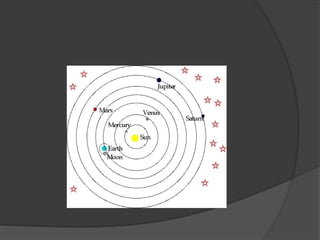
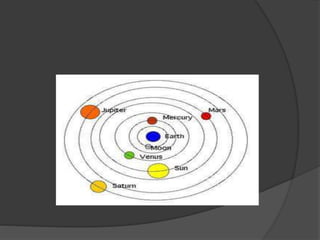
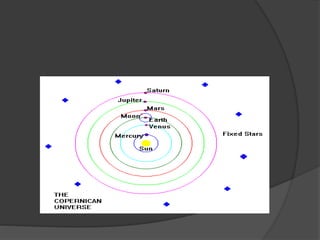
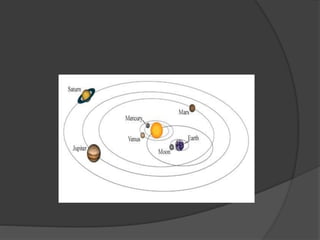
Claudius Ptolemy was a 2nd century Greek writer known for his work in mathematics, astronomy, geography, astrology, and poetry. He lived in Alexandria, Egypt and wrote in Greek. He is best known for publishing the Almagest, which supported the theory that the Earth is at the center of the universe. Nicolaus Copernicus was a 16th century mathematician and astronomer who formulated a model of the universe that placed the Sun, not the Earth, at the center. Tycho Brahe was a 16th century Danish astronomer known for his accurate astronomical and planetary observations, which were five times more accurate than previous observations. His data helped advance the Copernican model. Galileo Galilei was a 17th

![Spherical EARTH
Claudius Ptolemy (/ˈtɒləmi/; Greek: Κλαύδιος
Πτολεμαῖος, Klaúdios Ptolemaîos [kláwdios
ptolɛmɛ́ːos]; Latin: Claudius Ptolemaeus; c. AD 100 –
c. 170)[2] was a Greek[3][4][5] writer, known as
a mathematician, astronomer, geographer,astrologer, and
poet of a single epigram in the Greek Anthology.[6][7] He
lived in the city of Alexandria in the Roman province of
Egypt, wrote in Koine Greek, and held Roman
citizenship.[8] Beyond that, few reliable details of his life
are known. His birthplace has been given as Ptolemais
Hermiou in the Thebaid in an uncorroborated statement
by the 14th-century astronomer Theodore
Meliteniotes.[9] This is a very late attestation, however,
and there is no other reason to suppose that he ever lived
elsewhere than Alexandria,[9] where he died around
AD 168.[10]](https://image.slidesharecdn.com/sphericalearth-170321085035/85/Spherical-earth-2-320.jpg)
![ Nicolaus Copernicus (/koʊˈpɜːrnɪkəs, kə-
/;[1][2][3] Polish: Mikołaj Kopernik [miˈkɔwaj
kɔˈpɛrɲik] ( listen); German:Nikolaus
Kopernikus; 19 February 1473 – 24 May 1543)
was a Renaissance mathematician and
astronomer who formulated a model of the
universe that placed the Sun rather than the
Earth at the center of the universe, likely
independently of Aristarchus of Samos, who
had formulated such a model some eighteen
centuries earlier.[a]](https://image.slidesharecdn.com/sphericalearth-170321085035/85/Spherical-earth-4-320.jpg)
![ Tycho Brahe (/ˌtaɪkoʊ ˈbrɑːhi, ˈbrɑː, ˈbrɑːə/),
born Tyge Ottesen Brahe (Danish: [ˈtˢyːə ˈʌd̥ əsn̩
ˈb̥ ʁɑː];[n 1] 14 December 1546 – 24 October 1601),
was a Danish nobleman known for his accurate and
comprehensive astronomical and
planetary observations. He was born in the then
Danish peninsula of Scania. Well known in his
lifetime as anastronomer, astrologer and alchemist,
he has been described as "the first competent mind
in modern astronomy to feel ardently the passion for
exact empirical facts."[1] His observations were some
five times more accurate than the best available
observations at the time.](https://image.slidesharecdn.com/sphericalearth-170321085035/85/Spherical-earth-6-320.jpg)
![ Galileo Galilei (Italian: [ɡaliˈlɛːo ɡaliˈlɛi]; 15 February
1564[3] – 8 January 1642) was
an Italian polymath: astronomer,physicist, engineer,
philosopher, and mathematician.
He played a major role in the scientific revolution of
the seventeenth century. His contributions to
observational astronomy include the telescopic
confirmation of the phases of Venus, the discovery of
the four largest satellites ofJupiter (named
the Galilean moons in his honour), and the
observation and analysis of sunspots. Galileo also
worked in applied science and technology, inventing
an improved military compass and other instruments.](https://image.slidesharecdn.com/sphericalearth-170321085035/85/Spherical-earth-8-320.jpg)