Astronomy
Ancient Astronomy
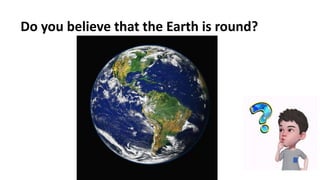
Do you believe that the Earth is round?
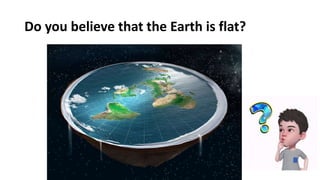
Do you believe that the Earth is flat?
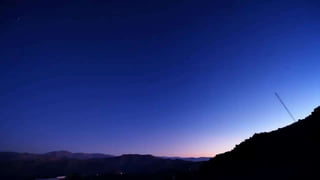
•What you have seen on the video?
•What did you noticed about the
movement of the objects in the sky.
•Describe the changes in position of
the stars at different hours of the
night.
Terms used in astronomy
•Cosmogony
•Astronomy
•Equinox
•Diurnal motion
•Annual motion
•Celestial sphere
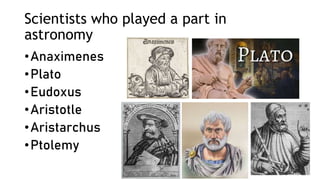
Scientists who played a part in
astronomy
•Anaximenes
•Plato
•Eudoxus
•Aristotle
•Aristarchus
•Ptolemy
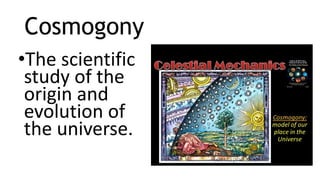
Cosmogony
•The scientific
study of the
origin and
evolution of
the universe.
Astronomy
•The study of
the planetary
motions and
relative
positions of
celestial bodies.
Earliest Developments in Ancient
Astronomy
• Even before the discovery of telescope, there were
celestial phenomena already known to astronomers
in ancient civilizations like China, Mesopotamia and
Egypt.
• Calendars were already established using the suns
movement.
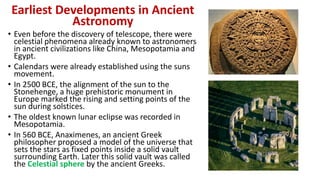
• In 2500 BCE, the alignment of the sun to the
Stonehenge, a huge prehistoric monument in
Europe marked the rising and setting points of the
sun during solstices.
• The oldest known lunar eclipse was recorded in
Mesopotamia.
• In 560 BCE, Anaximenes, an ancient Greek
philosopher proposed a model of the universe that
sets the stars as fixed points inside a solid vault
surrounding Earth. Later this solid vault was called
the Celestial sphere by the ancient Greeks.
Celestial sphere
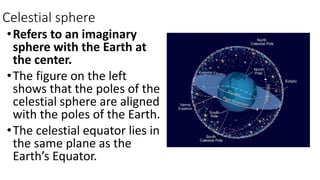
•Refers to an imaginary
sphere with the Earth at
the center.
•The figure on the left
shows that the poles of the
celestial sphere are aligned
with the poles of the Earth.
•The celestial equator lies in
the same plane as the
Earth’s Equator.
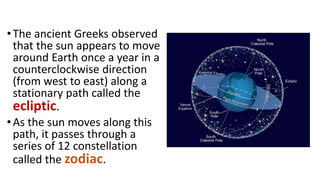
•The ancient Greeks observed
that the sun appears to move
around Earth once a year in a
counterclockwise direction
(from west to east) along a
stationary path called the
ecliptic.
•As the sun moves along this
path, it passes through a
series of 12 constellation
called the zodiac.
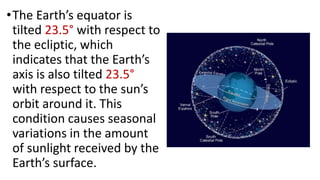
•The Earth’s equator is
tilted 23.5° with respect to
the ecliptic, which
indicates that the Earth’s
axis is also tilted 23.5°
with respect to the sun’s
orbit around it. This
condition causes seasonal
variations in the amount
of sunlight received by the
Earth’s surface.
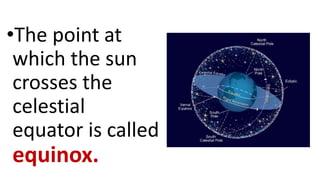
•The point at
which the sun
crosses the
celestial
equator is called
equinox.
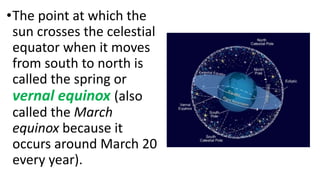
•The point at which the
sun crosses the celestial
equator when it moves
from south to north is
called the spring or
vernal equinox (also
called the March
equinox because it
occurs around March 20
every year).
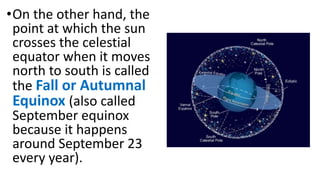
•On the other hand, the
point at which the sun
crosses the celestial
equator when it moves
north to south is called
the Fall or Autumnal
Equinox (also called
September equinox
because it happens
around September 23
every year).

Ancient astronomy.pptx

  • 1.
  • 2.
    Do you believethat the Earth is round?
  • 3.
    Do you believethat the Earth is flat?
  • 5.
    •What you haveseen on the video? •What did you noticed about the movement of the objects in the sky. •Describe the changes in position of the stars at different hours of the night.
  • 6.
    Terms used inastronomy •Cosmogony •Astronomy •Equinox •Diurnal motion •Annual motion •Celestial sphere
  • 7.
    Scientists who playeda part in astronomy •Anaximenes •Plato •Eudoxus •Aristotle •Aristarchus •Ptolemy
  • 8.
    Cosmogony •The scientific study ofthe origin and evolution of the universe.
  • 9.
    Astronomy •The study of theplanetary motions and relative positions of celestial bodies.
  • 10.
    Earliest Developments inAncient Astronomy • Even before the discovery of telescope, there were celestial phenomena already known to astronomers in ancient civilizations like China, Mesopotamia and Egypt. • Calendars were already established using the suns movement. • In 2500 BCE, the alignment of the sun to the Stonehenge, a huge prehistoric monument in Europe marked the rising and setting points of the sun during solstices. • The oldest known lunar eclipse was recorded in Mesopotamia. • In 560 BCE, Anaximenes, an ancient Greek philosopher proposed a model of the universe that sets the stars as fixed points inside a solid vault surrounding Earth. Later this solid vault was called the Celestial sphere by the ancient Greeks.
  • 11.
    Celestial sphere •Refers toan imaginary sphere with the Earth at the center. •The figure on the left shows that the poles of the celestial sphere are aligned with the poles of the Earth. •The celestial equator lies in the same plane as the Earth’s Equator.
  • 12.
    •The ancient Greeksobserved that the sun appears to move around Earth once a year in a counterclockwise direction (from west to east) along a stationary path called the ecliptic. •As the sun moves along this path, it passes through a series of 12 constellation called the zodiac.
  • 13.
    •The Earth’s equatoris tilted 23.5° with respect to the ecliptic, which indicates that the Earth’s axis is also tilted 23.5° with respect to the sun’s orbit around it. This condition causes seasonal variations in the amount of sunlight received by the Earth’s surface.
  • 14.
    •The point at whichthe sun crosses the celestial equator is called equinox.
  • 15.
    •The point atwhich the sun crosses the celestial equator when it moves from south to north is called the spring or vernal equinox (also called the March equinox because it occurs around March 20 every year).
  • 16.
    •On the otherhand, the point at which the sun crosses the celestial equator when it moves north to south is called the Fall or Autumnal Equinox (also called September equinox because it happens around September 23 every year).