Speech Recognition


          BY
          GIRISH JOSHI
Introduction
‱ What is Speech Recognition?
  also known as automatic speech recognition or
   computer speech recognition which means
   understanding voice by the computer and
   performing any required task.
‱ Where can it be used?

   - Dictation

   - System control/navigation

   - Commercial/Industrial applications

   - Voice dialing
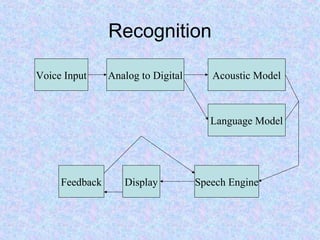
Recognition

Voice Input     Analog to Digital      Acoustic Model


                                       Language Model


     Feedback      Display          Speech Engine
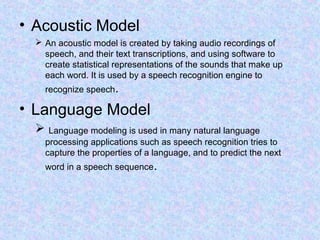
‱ Acoustic Model
   An acoustic model is created by taking audio recordings of
    speech, and their text transcriptions, and using software to
    create statistical representations of the sounds that make up
    each word. It is used by a speech recognition engine to
    recognize speech.

‱ Language Model
   Language modeling is used in many natural language
    processing applications such as speech recognition tries to
    capture the properties of a language, and to predict the next
    word in a speech sequence.
TYPES OF VOICE RECOGNITION

‱ There are two types of speech recognition. One is called
  speaker-dependent and the other isspeaker-independent
  . Speaker-dependent software is commonly used for
  dictation software, while speaker-independent software
  is more commonly found in telephone applications.
‱ Speaker-dependent software works by learning the
  unique characteristics of a single person’s voice, in a
  way similar to voice recognition. New users must first
  “train” the software by speaking to it, so the computer
  can analyze how the person talks. This often means
  users have to read a few pages of text to the computer
  before they can use the speech recognition software.
TYPES OF VOICE RECOGNITION
‱ Speaker-independent software is designed to recognize
  anyone’s voice, so no training is involved. This means it
  is the only real option for applications such as interactive
  voice response systems — where businesses can’t ask
  callers to read pages of text before using the system.
  The downside is that speaker-independent software is
  generally less accurate than speaker-dependent
  software.
‱ Speech recognition engines that are speaker
  independent generally deal with this fact by limiting the
  grammars they use. By using a smaller list of recognized
  words, the speech engine is more likely to correctly
  recognize what a speaker said.
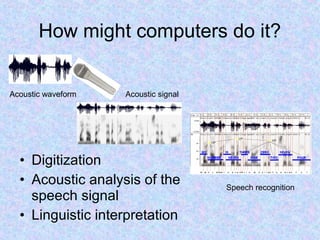
How might computers do it?


Acoustic waveform   Acoustic signal


  ‱ Digitization
  ‱ Acoustic analysis of the          Speech recognition
    speech signal
  ‱ Linguistic interpretation
DIFFERENT PROCESSES
               INVOLVED
‱ Digitization
    – Converting analogue signal into digital representation
‱ Signal processing
    – Separating speech from background noise
‱ Phonetics
    – Variability in human speech
‱ Phonology
    – Recognizing individual sound distinctions (similar phonemes)
    –    is the systematic use of sound to encode meaning in any
        spoken human language
‱ Lexicology and syntax
    – Lexicology is that part of linguistics which studies words, their nature and
      meaning, words' elements, relations between words,words groups and the whole
        lexicon.   .
DIFFERENT PROCESSES
         INVOLVED(CONTD.)
‱ Syntax and pragmatics
   – Semantics tells about the meaning
   – Pragmatics is concerned with bridging the explanatory gap
     between sentence meaning and speaker's meaning
Digitization
‱ Analogue to digital conversion
‱ Sampling and quantizing
   Sampling is converting a continuous signal into a discrete signal

   Quantizing is the process of approximating a continuous range of values

‱ Use filters to measure energy levels for various
  points on the frequency spectrum
‱ Knowing the relative importance of different
  frequency bands (for speech) makes this
  process more efficient
‱ E.g. high frequency sounds are less informative,
  so can be sampled using a broader bandwidth
  (log scale)
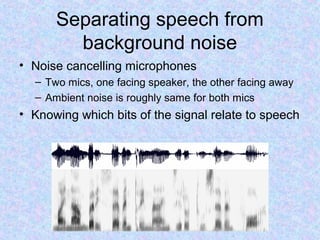
Separating speech from
        background noise
‱ Noise cancelling microphones
  – Two mics, one facing speaker, the other facing away
  – Ambient noise is roughly same for both mics
‱ Knowing which bits of the signal relate to speech
Speaker Recognition
‱ Definition
  – It is the method of recognizing a person based on
    his voice
  – It is one of the forms of biometric identification
‱ Depends of speaker specific
  characteristics.
ADVANTAGES
‱ Advantages
  –   People with disabilities
  –   Organizations - Increases productivity, reduces costs and errors.
  –   Lower operational Costs
  –   Advances in technology will allow consumers and businesses to
      implement speech recognition systems at a relatively low cost.
       ‱ Cell-phone users can dial pre-programmed numbers by voice
         command.
       ‱ Users can trade stocks through a voice-activated trading system.
       ‱ Speech recognition technology can also replace touch-tone dialing
         resulting in the ability to target customers that speak different
         languages
DISADVANTAGES
‱ Difficult to build a perfect system.
‱ Conversations
  – Involves more than just words (non-verbal
    communication; stutters etc.
  – Every human being has differences such as
    their voice, mouth, and speaking style.
‱ Filtering background noise is a task that
  can even be difficult for humans to
  accomplish.
Future of Speech Recognition
‱ Accuracy will become better and better.
‱ Dictation speech recognition will gradually become
  accepted.
‱ Small hand-held writing tablets for computer speech
  recognition dictation and data entry will be developed, as
  faster processors and more memory become available.
‱ Greater use will be made of "intelligent systems" which
  will attempt to guess what the speaker intended to say,
  rather than what was actually said, as people often
  misspeak and make unintentional mistakes.
‱ Microphone and sound systems will be designed to
  adapt more quickly to changing background noise levels,
  different environments, with better recognition of
  extraneous material to be discarded.

Speechrecognition 100423091251-phpapp01

  • 1.
    Speech Recognition BY GIRISH JOSHI
  • 2.
    Introduction ‱ What isSpeech Recognition? also known as automatic speech recognition or computer speech recognition which means understanding voice by the computer and performing any required task.
  • 3.
    ‱ Where canit be used? - Dictation - System control/navigation - Commercial/Industrial applications - Voice dialing
  • 4.
    Recognition Voice Input Analog to Digital Acoustic Model Language Model Feedback Display Speech Engine
  • 5.
    ‱ Acoustic Model  An acoustic model is created by taking audio recordings of speech, and their text transcriptions, and using software to create statistical representations of the sounds that make up each word. It is used by a speech recognition engine to recognize speech. ‱ Language Model  Language modeling is used in many natural language processing applications such as speech recognition tries to capture the properties of a language, and to predict the next word in a speech sequence.
  • 6.
    TYPES OF VOICERECOGNITION ‱ There are two types of speech recognition. One is called speaker-dependent and the other isspeaker-independent . Speaker-dependent software is commonly used for dictation software, while speaker-independent software is more commonly found in telephone applications. ‱ Speaker-dependent software works by learning the unique characteristics of a single person’s voice, in a way similar to voice recognition. New users must first “train” the software by speaking to it, so the computer can analyze how the person talks. This often means users have to read a few pages of text to the computer before they can use the speech recognition software.
  • 7.
    TYPES OF VOICERECOGNITION ‱ Speaker-independent software is designed to recognize anyone’s voice, so no training is involved. This means it is the only real option for applications such as interactive voice response systems — where businesses can’t ask callers to read pages of text before using the system. The downside is that speaker-independent software is generally less accurate than speaker-dependent software. ‱ Speech recognition engines that are speaker independent generally deal with this fact by limiting the grammars they use. By using a smaller list of recognized words, the speech engine is more likely to correctly recognize what a speaker said.
  • 8.
    How might computersdo it? Acoustic waveform Acoustic signal ‱ Digitization ‱ Acoustic analysis of the Speech recognition speech signal ‱ Linguistic interpretation
  • 9.
    DIFFERENT PROCESSES INVOLVED ‱ Digitization – Converting analogue signal into digital representation ‱ Signal processing – Separating speech from background noise ‱ Phonetics – Variability in human speech ‱ Phonology – Recognizing individual sound distinctions (similar phonemes) – is the systematic use of sound to encode meaning in any spoken human language ‱ Lexicology and syntax – Lexicology is that part of linguistics which studies words, their nature and meaning, words' elements, relations between words,words groups and the whole lexicon. .
  • 10.
    DIFFERENT PROCESSES INVOLVED(CONTD.) ‱ Syntax and pragmatics – Semantics tells about the meaning – Pragmatics is concerned with bridging the explanatory gap between sentence meaning and speaker's meaning
  • 11.
    Digitization ‱ Analogue todigital conversion ‱ Sampling and quantizing  Sampling is converting a continuous signal into a discrete signal  Quantizing is the process of approximating a continuous range of values ‱ Use filters to measure energy levels for various points on the frequency spectrum ‱ Knowing the relative importance of different frequency bands (for speech) makes this process more efficient ‱ E.g. high frequency sounds are less informative, so can be sampled using a broader bandwidth (log scale)
  • 12.
    Separating speech from background noise ‱ Noise cancelling microphones – Two mics, one facing speaker, the other facing away – Ambient noise is roughly same for both mics ‱ Knowing which bits of the signal relate to speech
  • 13.
    Speaker Recognition ‱ Definition – It is the method of recognizing a person based on his voice – It is one of the forms of biometric identification ‱ Depends of speaker specific characteristics.
  • 14.
    ADVANTAGES ‱ Advantages – People with disabilities – Organizations - Increases productivity, reduces costs and errors. – Lower operational Costs – Advances in technology will allow consumers and businesses to implement speech recognition systems at a relatively low cost. ‱ Cell-phone users can dial pre-programmed numbers by voice command. ‱ Users can trade stocks through a voice-activated trading system. ‱ Speech recognition technology can also replace touch-tone dialing resulting in the ability to target customers that speak different languages
  • 15.
    DISADVANTAGES ‱ Difficult tobuild a perfect system. ‱ Conversations – Involves more than just words (non-verbal communication; stutters etc. – Every human being has differences such as their voice, mouth, and speaking style. ‱ Filtering background noise is a task that can even be difficult for humans to accomplish.
  • 16.
    Future of SpeechRecognition ‱ Accuracy will become better and better. ‱ Dictation speech recognition will gradually become accepted. ‱ Small hand-held writing tablets for computer speech recognition dictation and data entry will be developed, as faster processors and more memory become available. ‱ Greater use will be made of "intelligent systems" which will attempt to guess what the speaker intended to say, rather than what was actually said, as people often misspeak and make unintentional mistakes. ‱ Microphone and sound systems will be designed to adapt more quickly to changing background noise levels, different environments, with better recognition of extraneous material to be discarded.