SPEECH TO TEXT
CONVERSION
Why this project?
 Speech recognition technology is one from the fast growing
engineering technologies.
 Nearly 20% people of the world are suffering from various
disabilities; many of them are blind or unable to use their
hands effectively. they can share information with people by
operating computer through voice input.
 Our project is capable to recognize the speech and convert
the input audio into text; it also enables a user to perform
operations such as open calculator, wordpad, notepad, log off
computer.
APPLICATIONS
 In Car Systems
 Health Care
 Military
 Training air traffic controllers
 Telephony and other domains
 Usage in education and daily life
PERFORMANCE
The performance of speech recognition systems is usually
evaluated in terms of accuracy and speed. Accuracy is
usually rated with word error rate (WER), whereas speed is
measured with the real time factor. Other measures of
accuracy include Single Word Error Rate (SWER)
and Command Success Rate (CSR).
Accuracy
Accuracy of speech recognition vary
with the following:
 Vocabulary size and confusability
 Speaker dependence vs. independence
 Isolated, discontinuous, or continuous speech
 Task and language constraints
 Read vs. spontaneous speech
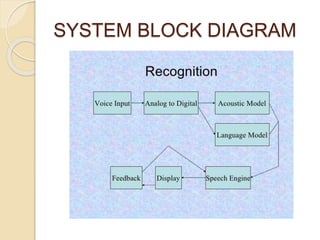
SYSTEM BLOCK DIAGRAM
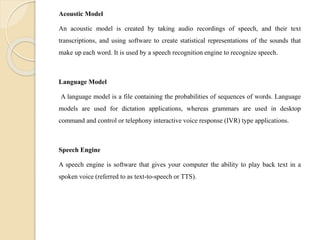
Acoustic Model
An acoustic model is created by taking audio recordings of speech, and their text
transcriptions, and using software to create statistical representations of the sounds that
make up each word. It is used by a speech recognition engine to recognize speech.
Language Model
A language model is a file containing the probabilities of sequences of words. Language
models are used for dictation applications, whereas grammars are used in desktop
command and control or telephony interactive voice response (IVR) type applications.
Speech Engine
A speech engine is software that gives your computer the ability to play back text in a
spoken voice (referred to as text-to-speech or TTS).
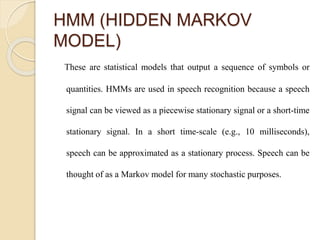
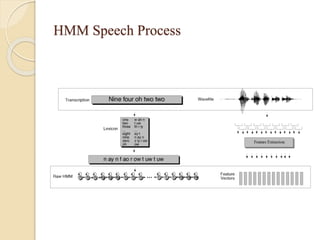
HMM (HIDDEN MARKOV
MODEL)
These are statistical models that output a sequence of symbols or
quantities. HMMs are used in speech recognition because a speech
signal can be viewed as a piecewise stationary signal or a short-time
stationary signal. In a short time-scale (e.g., 10 milliseconds),
speech can be approximated as a stationary process. Speech can be
thought of as a Markov model for many stochastic purposes.
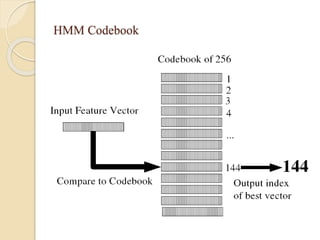
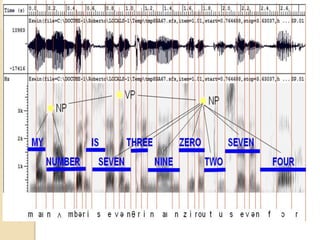
HMM Codebook
HMM Speech Process
Advantages
 Able to write the text both through keyboard and voice input .
 Voice recognition of different notepad commands such as
open save and clear.
 Open different windows soft wares, based on voice input.
 Lower operational costs.
 Provide significant help for the people with disabilities.
 Requires less consumption of time in writing text.
WEAKNESS
Homonyms:
Are the words that are differently spelled and have the different meaning but
acquires the same meaning, for example “there” “their”, “be” and “bee”. This is a
challenge for computer machine to distinguish between such types of phrases that
sound alike.
Speeches:
A second challenge in the process, is to understand the speech uttered by different
users, current systems have a difficulty to separate simultaneous speeches form
multiple users.
Noise factor:
the program requires hearing the words uttered by a human distinctly and clearly.
Any extra sound can create interference, first you need to place system away from
noisy environments and then speak clearly else the machine will confuse and will
mix up the words.
FUTURE SCOPE
 Accuracy will become better and better
 Dictation speech recognition will gradually become accepted
 Greater use will be made of “intelligent systems” which will
attempt to guess what the speaker intended to say, rather than what
was actually said, as people often misspeak and make unintentional
mistakes.
 Microphone and sound systems will be designed to adapt more
quickly to changing background noise levels, different
environments, with better recognition of extraneous material to be
discarded.

Speech to text conversion

  • 1.
  • 2.
    Why this project? Speech recognition technology is one from the fast growing engineering technologies.  Nearly 20% people of the world are suffering from various disabilities; many of them are blind or unable to use their hands effectively. they can share information with people by operating computer through voice input.  Our project is capable to recognize the speech and convert the input audio into text; it also enables a user to perform operations such as open calculator, wordpad, notepad, log off computer.
  • 3.
    APPLICATIONS  In CarSystems  Health Care  Military  Training air traffic controllers  Telephony and other domains  Usage in education and daily life
  • 4.
    PERFORMANCE The performance ofspeech recognition systems is usually evaluated in terms of accuracy and speed. Accuracy is usually rated with word error rate (WER), whereas speed is measured with the real time factor. Other measures of accuracy include Single Word Error Rate (SWER) and Command Success Rate (CSR).
  • 5.
    Accuracy Accuracy of speechrecognition vary with the following:  Vocabulary size and confusability  Speaker dependence vs. independence  Isolated, discontinuous, or continuous speech  Task and language constraints  Read vs. spontaneous speech
  • 6.
  • 7.
    Acoustic Model An acousticmodel is created by taking audio recordings of speech, and their text transcriptions, and using software to create statistical representations of the sounds that make up each word. It is used by a speech recognition engine to recognize speech. Language Model A language model is a file containing the probabilities of sequences of words. Language models are used for dictation applications, whereas grammars are used in desktop command and control or telephony interactive voice response (IVR) type applications. Speech Engine A speech engine is software that gives your computer the ability to play back text in a spoken voice (referred to as text-to-speech or TTS).
  • 8.
    HMM (HIDDEN MARKOV MODEL) Theseare statistical models that output a sequence of symbols or quantities. HMMs are used in speech recognition because a speech signal can be viewed as a piecewise stationary signal or a short-time stationary signal. In a short time-scale (e.g., 10 milliseconds), speech can be approximated as a stationary process. Speech can be thought of as a Markov model for many stochastic purposes.
  • 9.
  • 10.
  • 12.
    Advantages  Able towrite the text both through keyboard and voice input .  Voice recognition of different notepad commands such as open save and clear.  Open different windows soft wares, based on voice input.  Lower operational costs.  Provide significant help for the people with disabilities.  Requires less consumption of time in writing text.
  • 13.
    WEAKNESS Homonyms: Are the wordsthat are differently spelled and have the different meaning but acquires the same meaning, for example “there” “their”, “be” and “bee”. This is a challenge for computer machine to distinguish between such types of phrases that sound alike. Speeches: A second challenge in the process, is to understand the speech uttered by different users, current systems have a difficulty to separate simultaneous speeches form multiple users. Noise factor: the program requires hearing the words uttered by a human distinctly and clearly. Any extra sound can create interference, first you need to place system away from noisy environments and then speak clearly else the machine will confuse and will mix up the words.
  • 14.
    FUTURE SCOPE  Accuracywill become better and better  Dictation speech recognition will gradually become accepted  Greater use will be made of “intelligent systems” which will attempt to guess what the speaker intended to say, rather than what was actually said, as people often misspeak and make unintentional mistakes.  Microphone and sound systems will be designed to adapt more quickly to changing background noise levels, different environments, with better recognition of extraneous material to be discarded.