Automatic Speech
Recognition
Slides now available at
www.informatics.manchester.ac.uk/~harold/LELA300431/
2/34
Automatic speech recognition
• What is the task?
• What are the main difficulties?
• How is it approached?
• How good is it?
• How much better could it be?
3/34
What is the task?
• Getting a computer to understand spoken
language
• By “understand” we might mean
– React appropriately
– Convert the input speech into another
medium, e.g. text
• Several variables impinge on this (see
later)
4/34
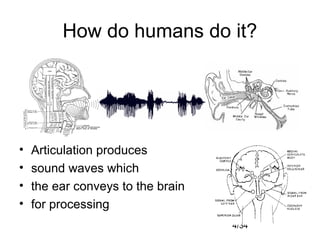
How do humans do it?
• Articulation produces
• sound waves which
• the ear conveys to the brain
• for processing
5/34
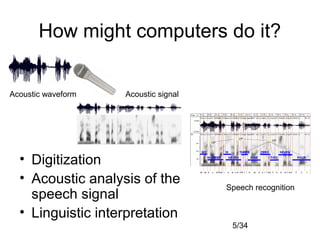
How might computers do it?
• Digitization
• Acoustic analysis of the
speech signal
• Linguistic interpretation
Acoustic waveform Acoustic signal
Speech recognition
6/34
What’s hard about that?
• Digitization
– Converting analogue signal into digital representation
• Signal processing
– Separating speech from background noise
• Phonetics
– Variability in human speech
• Phonology
– Recognizing individual sound distinctions (similar phonemes)
• Lexicology and syntax
– Disambiguating homophones
– Features of continuous speech
• Syntax and pragmatics
– Interpreting prosodic features
• Pragmatics
– Filtering of performance errors (disfluencies)
7/34
Digitization
• Analogue to digital conversion
• Sampling and quantizing
• Use filters to measure energy levels for various
points on the frequency spectrum
• Knowing the relative importance of different
frequency bands (for speech) makes this
process more efficient
• E.g. high frequency sounds are less informative,
so can be sampled using a broader bandwidth
(log scale)
8/34
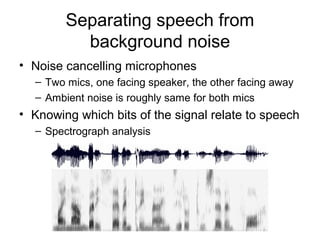
Separating speech from
background noise
• Noise cancelling microphones
– Two mics, one facing speaker, the other facing away
– Ambient noise is roughly same for both mics
• Knowing which bits of the signal relate to speech
– Spectrograph analysis
9/34
Variability in individuals’ speech
• Variation among speakers due to
– Vocal range (f0, and pitch range – see later)
– Voice quality (growl, whisper, physiological elements
such as nasality, adenoidality, etc)
– ACCENT !!! (especially vowel systems, but also
consonants, allophones, etc.)
• Variation within speakers due to
– Health, emotional state
– Ambient conditions
• Speech style: formal read vs spontaneous
10/34
Speaker-(in)dependent systems
• Speaker-dependent systems
– Require “training” to “teach” the system your individual
idiosyncracies
• The more the merrier, but typically nowadays 5 or 10 minutes is
enough
• User asked to pronounce some key words which allow computer to
infer details of the user’s accent and voice
• Fortunately, languages are generally systematic
– More robust
– But less convenient
– And obviously less portable
• Speaker-independent systems
– Language coverage is reduced to compensate need to be
flexible in phoneme identification
– Clever compromise is to learn on the fly
11/34
Identifying phonemes
• Differences between some phonemes are
sometimes very small
– May be reflected in speech signal (eg vowels
have more or less distinctive f1 and f2)
– Often show up in coarticulation effects
(transition to next sound)
• e.g. aspiration of voiceless stops in English
– Allophonic variation
12/34
Disambiguating homophones
• Mostly differences are recognised by humans by
context and need to make sense
It’s hard to wreck a nice beach
What dime’s a neck’s drain to stop port?
• Systems can only recognize words that are in
their lexicon, so limiting the lexicon is an obvious
ploy
• Some ASR systems include a grammar which
can help disambiguation
13/34
(Dis)continuous speech
• Discontinuous speech much easier to
recognize
– Single words tend to be pronounced more
clearly
• Continuous speech involves contextual
coarticulation effects
– Weak forms
– Assimilation
– Contractions
14/34
Interpreting prosodic features
• Pitch, length and loudness are used to
indicate “stress”
• All of these are relative
– On a speaker-by-speaker basis
– And in relation to context
• Pitch and length are phonemic in some
languages
15/34
Pitch
• Pitch contour can be extracted from
speech signal
– But pitch differences are relative
– One man’s high is another (wo)man’s low
– Pitch range is variable
• Pitch contributes to intonation
– But has other functions in tone languages
• Intonation can convey meaning
16/34
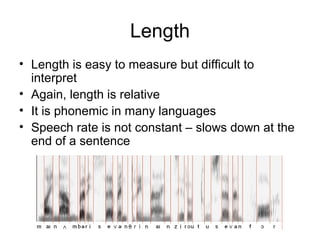
Length
• Length is easy to measure but difficult to
interpret
• Again, length is relative
• It is phonemic in many languages
• Speech rate is not constant – slows down at the
end of a sentence
17/34
Loudness
• Loudness is easy to measure but difficult
to interpret
• Again, loudness is relative
18/34
Performance errors
• Performance “errors” include
– Non-speech sounds
– Hesitations
– False starts, repetitions
• Filtering implies handling at syntactic level
or above
• Some disfluencies are deliberate and have
pragmatic effect – this is not something we
can handle in the near future
19/34
Approaches to ASR
• Template matching
• Knowledge-based (or rule-based)
approach
• Statistical approach:
– Noisy channel model + machine learning
20/34
Template-based approach
• Store examples of units (words,
phonemes), then find the example that
most closely fits the input
• Extract features from speech signal, then
it’s “just” a complex similarity matching
problem, using solutions developed for all
sorts of applications
• OK for discrete utterances, and a single
user
21/34
Template-based approach
• Hard to distinguish very similar templates
• And quickly degrades when input differs
from templates
• Therefore needs techniques to mitigate
this degradation:
– More subtle matching techniques
– Multiple templates which are aggregated
• Taken together, these suggested …
22/34
Rule-based approach
• Use knowledge of phonetics and
linguistics to guide search process
• Templates are replaced by rules
expressing everything (anything) that
might help to decode:
– Phonetics, phonology, phonotactics
– Syntax
– Pragmatics
23/34
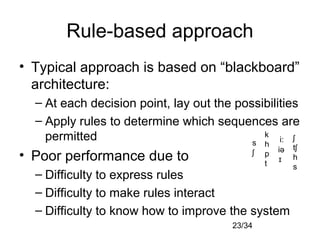
Rule-based approach
• Typical approach is based on “blackboard”
architecture:
– At each decision point, lay out the possibilities
– Apply rules to determine which sequences are
permitted
• Poor performance due to
– Difficulty to express rules
– Difficulty to make rules interact
– Difficulty to know how to improve the system
s
ʃ
k
h
p
t
i:
iə
ɪ
ʃ
tʃ
h
s
24/34
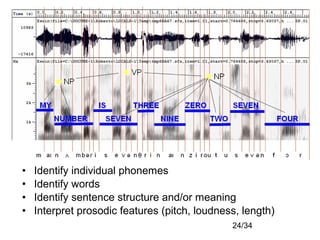
• Identify individual phonemes
• Identify words
• Identify sentence structure and/or meaning
• Interpret prosodic features (pitch, loudness, length)
25/34
Statistics-based approach
• Can be seen as extension of template-
based approach, using more powerful
mathematical and statistical tools
• Sometimes seen as “anti-linguistic”
approach
– Fred Jelinek (IBM, 1988): “Every time I fire a
linguist my system improves”
26/34
Statistics-based approach
• Collect a large corpus of transcribed
speech recordings
• Train the computer to learn the
correspondences (“machine learning”)
• At run time, apply statistical processes to
search through the space of all possible
solutions, and pick the statistically most
likely one
27/34
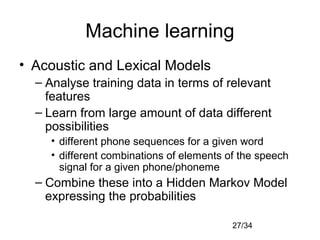
Machine learning
• Acoustic and Lexical Models
– Analyse training data in terms of relevant
features
– Learn from large amount of data different
possibilities
• different phone sequences for a given word
• different combinations of elements of the speech
signal for a given phone/phoneme
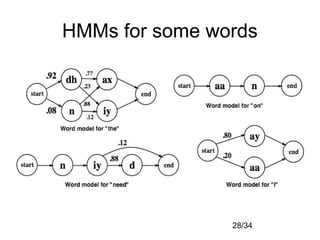
– Combine these into a Hidden Markov Model
expressing the probabilities
28/34
HMMs for some words
29/34
Language model
• Models likelihood of word given previous
word(s)
• n-gram models:
– Build the model by calculating bigram or
trigram probabilities from text training corpus
– Smoothing issues
30/34
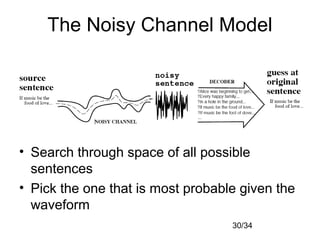
The Noisy Channel Model
• Search through space of all possible
sentences
• Pick the one that is most probable given the
waveform
31/34
The Noisy Channel Model
• Use the acoustic model to give a set of
likely phone sequences
• Use the lexical and language models to
judge which of these are likely to result in
probable word sequences
• The trick is having sophisticated
algorithms to juggle the statistics
• A bit like the rule-based approach except
that it is all learned automatically from
data
32/34
Evaluation
• Funders have been very keen on
competitive quantitative evaluation
• Subjective evaluations are informative, but
not cost-effective
• For transcription tasks, word-error rate is
popular (though can be misleading: all
words are not equally important)
• For task-based dialogues, other measures
of understanding are needed
33/34
Comparing ASR systems
• Factors include
– Speaking mode: isolated words vs continuous speech
– Speaking style: read vs spontaneous
– “Enrollment”: speaker (in)dependent
– Vocabulary size (small <20 … large > 20,000)
– Equipment: good quality noise-cancelling mic …
telephone
– Size of training set (if appropriate) or rule set
– Recognition method
34/34
Remaining problems
• Robustness – graceful degradation, not catastrophic failure
• Portability – independence of computing platform
• Adaptability – to changing conditions (different mic, background
noise, new speaker, new task domain, new language even)
• Language Modelling – is there a role for linguistics in improving the
language models?
• Confidence Measures – better methods to evaluate the absolute
correctness of hypotheses.
• Out-of-Vocabulary (OOV) Words – Systems must have some
method of detecting OOV words, and dealing with them in a
sensible way.
• Spontaneous Speech – disfluencies (filled pauses, false starts,
hesitations, ungrammatical constructions etc) remain a problem.
• Prosody –Stress, intonation, and rhythm convey important
information for word recognition and the user's intentions (e.g.,
sarcasm, anger)
• Accent, dialect and mixed language – non-native speech is a
huge problem, especially where code-switching is commonplace

Automatic speech recognition

  • 1.
    Automatic Speech Recognition Slides nowavailable at www.informatics.manchester.ac.uk/~harold/LELA300431/
  • 2.
    2/34 Automatic speech recognition •What is the task? • What are the main difficulties? • How is it approached? • How good is it? • How much better could it be?
  • 3.
    3/34 What is thetask? • Getting a computer to understand spoken language • By “understand” we might mean – React appropriately – Convert the input speech into another medium, e.g. text • Several variables impinge on this (see later)
  • 4.
    4/34 How do humansdo it? • Articulation produces • sound waves which • the ear conveys to the brain • for processing
  • 5.
    5/34 How might computersdo it? • Digitization • Acoustic analysis of the speech signal • Linguistic interpretation Acoustic waveform Acoustic signal Speech recognition
  • 6.
    6/34 What’s hard aboutthat? • Digitization – Converting analogue signal into digital representation • Signal processing – Separating speech from background noise • Phonetics – Variability in human speech • Phonology – Recognizing individual sound distinctions (similar phonemes) • Lexicology and syntax – Disambiguating homophones – Features of continuous speech • Syntax and pragmatics – Interpreting prosodic features • Pragmatics – Filtering of performance errors (disfluencies)
  • 7.
    7/34 Digitization • Analogue todigital conversion • Sampling and quantizing • Use filters to measure energy levels for various points on the frequency spectrum • Knowing the relative importance of different frequency bands (for speech) makes this process more efficient • E.g. high frequency sounds are less informative, so can be sampled using a broader bandwidth (log scale)
  • 8.
    8/34 Separating speech from backgroundnoise • Noise cancelling microphones – Two mics, one facing speaker, the other facing away – Ambient noise is roughly same for both mics • Knowing which bits of the signal relate to speech – Spectrograph analysis
  • 9.
    9/34 Variability in individuals’speech • Variation among speakers due to – Vocal range (f0, and pitch range – see later) – Voice quality (growl, whisper, physiological elements such as nasality, adenoidality, etc) – ACCENT !!! (especially vowel systems, but also consonants, allophones, etc.) • Variation within speakers due to – Health, emotional state – Ambient conditions • Speech style: formal read vs spontaneous
  • 10.
    10/34 Speaker-(in)dependent systems • Speaker-dependentsystems – Require “training” to “teach” the system your individual idiosyncracies • The more the merrier, but typically nowadays 5 or 10 minutes is enough • User asked to pronounce some key words which allow computer to infer details of the user’s accent and voice • Fortunately, languages are generally systematic – More robust – But less convenient – And obviously less portable • Speaker-independent systems – Language coverage is reduced to compensate need to be flexible in phoneme identification – Clever compromise is to learn on the fly
  • 11.
    11/34 Identifying phonemes • Differencesbetween some phonemes are sometimes very small – May be reflected in speech signal (eg vowels have more or less distinctive f1 and f2) – Often show up in coarticulation effects (transition to next sound) • e.g. aspiration of voiceless stops in English – Allophonic variation
  • 12.
    12/34 Disambiguating homophones • Mostlydifferences are recognised by humans by context and need to make sense It’s hard to wreck a nice beach What dime’s a neck’s drain to stop port? • Systems can only recognize words that are in their lexicon, so limiting the lexicon is an obvious ploy • Some ASR systems include a grammar which can help disambiguation
  • 13.
    13/34 (Dis)continuous speech • Discontinuousspeech much easier to recognize – Single words tend to be pronounced more clearly • Continuous speech involves contextual coarticulation effects – Weak forms – Assimilation – Contractions
  • 14.
    14/34 Interpreting prosodic features •Pitch, length and loudness are used to indicate “stress” • All of these are relative – On a speaker-by-speaker basis – And in relation to context • Pitch and length are phonemic in some languages
  • 15.
    15/34 Pitch • Pitch contourcan be extracted from speech signal – But pitch differences are relative – One man’s high is another (wo)man’s low – Pitch range is variable • Pitch contributes to intonation – But has other functions in tone languages • Intonation can convey meaning
  • 16.
    16/34 Length • Length iseasy to measure but difficult to interpret • Again, length is relative • It is phonemic in many languages • Speech rate is not constant – slows down at the end of a sentence
  • 17.
    17/34 Loudness • Loudness iseasy to measure but difficult to interpret • Again, loudness is relative
  • 18.
    18/34 Performance errors • Performance“errors” include – Non-speech sounds – Hesitations – False starts, repetitions • Filtering implies handling at syntactic level or above • Some disfluencies are deliberate and have pragmatic effect – this is not something we can handle in the near future
  • 19.
    19/34 Approaches to ASR •Template matching • Knowledge-based (or rule-based) approach • Statistical approach: – Noisy channel model + machine learning
  • 20.
    20/34 Template-based approach • Storeexamples of units (words, phonemes), then find the example that most closely fits the input • Extract features from speech signal, then it’s “just” a complex similarity matching problem, using solutions developed for all sorts of applications • OK for discrete utterances, and a single user
  • 21.
    21/34 Template-based approach • Hardto distinguish very similar templates • And quickly degrades when input differs from templates • Therefore needs techniques to mitigate this degradation: – More subtle matching techniques – Multiple templates which are aggregated • Taken together, these suggested …
  • 22.
    22/34 Rule-based approach • Useknowledge of phonetics and linguistics to guide search process • Templates are replaced by rules expressing everything (anything) that might help to decode: – Phonetics, phonology, phonotactics – Syntax – Pragmatics
  • 23.
    23/34 Rule-based approach • Typicalapproach is based on “blackboard” architecture: – At each decision point, lay out the possibilities – Apply rules to determine which sequences are permitted • Poor performance due to – Difficulty to express rules – Difficulty to make rules interact – Difficulty to know how to improve the system s ʃ k h p t i: iə ɪ ʃ tʃ h s
  • 24.
    24/34 • Identify individualphonemes • Identify words • Identify sentence structure and/or meaning • Interpret prosodic features (pitch, loudness, length)
  • 25.
    25/34 Statistics-based approach • Canbe seen as extension of template- based approach, using more powerful mathematical and statistical tools • Sometimes seen as “anti-linguistic” approach – Fred Jelinek (IBM, 1988): “Every time I fire a linguist my system improves”
  • 26.
    26/34 Statistics-based approach • Collecta large corpus of transcribed speech recordings • Train the computer to learn the correspondences (“machine learning”) • At run time, apply statistical processes to search through the space of all possible solutions, and pick the statistically most likely one
  • 27.
    27/34 Machine learning • Acousticand Lexical Models – Analyse training data in terms of relevant features – Learn from large amount of data different possibilities • different phone sequences for a given word • different combinations of elements of the speech signal for a given phone/phoneme – Combine these into a Hidden Markov Model expressing the probabilities
  • 28.
  • 29.
    29/34 Language model • Modelslikelihood of word given previous word(s) • n-gram models: – Build the model by calculating bigram or trigram probabilities from text training corpus – Smoothing issues
  • 30.
    30/34 The Noisy ChannelModel • Search through space of all possible sentences • Pick the one that is most probable given the waveform
  • 31.
    31/34 The Noisy ChannelModel • Use the acoustic model to give a set of likely phone sequences • Use the lexical and language models to judge which of these are likely to result in probable word sequences • The trick is having sophisticated algorithms to juggle the statistics • A bit like the rule-based approach except that it is all learned automatically from data
  • 32.
    32/34 Evaluation • Funders havebeen very keen on competitive quantitative evaluation • Subjective evaluations are informative, but not cost-effective • For transcription tasks, word-error rate is popular (though can be misleading: all words are not equally important) • For task-based dialogues, other measures of understanding are needed
  • 33.
    33/34 Comparing ASR systems •Factors include – Speaking mode: isolated words vs continuous speech – Speaking style: read vs spontaneous – “Enrollment”: speaker (in)dependent – Vocabulary size (small <20 … large > 20,000) – Equipment: good quality noise-cancelling mic … telephone – Size of training set (if appropriate) or rule set – Recognition method
  • 34.
    34/34 Remaining problems • Robustness– graceful degradation, not catastrophic failure • Portability – independence of computing platform • Adaptability – to changing conditions (different mic, background noise, new speaker, new task domain, new language even) • Language Modelling – is there a role for linguistics in improving the language models? • Confidence Measures – better methods to evaluate the absolute correctness of hypotheses. • Out-of-Vocabulary (OOV) Words – Systems must have some method of detecting OOV words, and dealing with them in a sensible way. • Spontaneous Speech – disfluencies (filled pauses, false starts, hesitations, ungrammatical constructions etc) remain a problem. • Prosody –Stress, intonation, and rhythm convey important information for word recognition and the user's intentions (e.g., sarcasm, anger) • Accent, dialect and mixed language – non-native speech is a huge problem, especially where code-switching is commonplace