Ethnicity and
Social Networks
Chapter 8
Hello!
Ade Yunita
155110101111025
Sociolinguistics (A)
😉
Learning
Objectives ETHNICITY
▹African American
Vernacular English
▹British Black English
▹Maori New
Zealanders
SOCIAL NETWORKS
▹Communities of
practice and the
construction of social
identity
Ethnicity
What is ethnicity?
What is an ethnic group?
1
“
Ethnicity is considered to be shared
characteristics such as culture, language,
religion, and traditions, which contribute
to a person or group’s identity.
Ethnic Group
An ‘ethnic group’ has been
defined as a group that
regards itself or is regarded
by others as a distinct
community by virtue of
certain characteristics that
will help to distinguish the
group from the surrounding
community.
Ethnicity
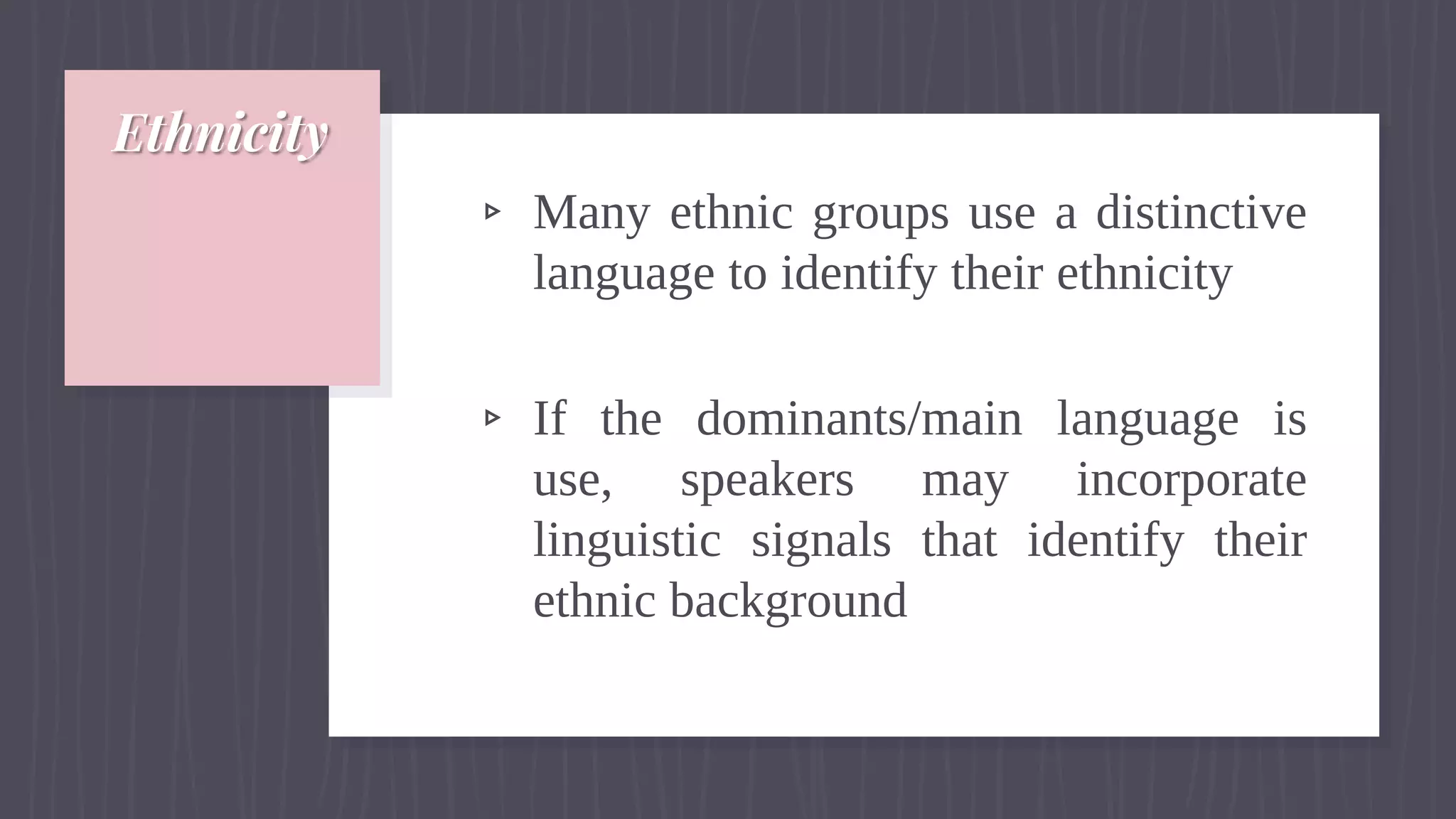
▹ Many ethnic groups use a distinctive
language to identify their ethnicity
▹ If the dominants/main language is
use, speakers may incorporate
linguistic signals that identify their
ethnic background
Examples
▹ New Zealanders use Maori
linguistic signals like kia
ora, eki, ne to express
their ethnic identity
▹ Chinese Singaporeans in
Singapore use the tag la to
express solidarity
▹ Italians in Boston and
Sydney use particular high
percentage of vernacular
pronunciations of certain
vowels
▹ Scottish people in New
Zealand retain the [r]
sound
▹ Jewish people in Boston
and New York use
marked linguistic tags
such as oy vay, and
Yiddish vocabulary items
such as bagel
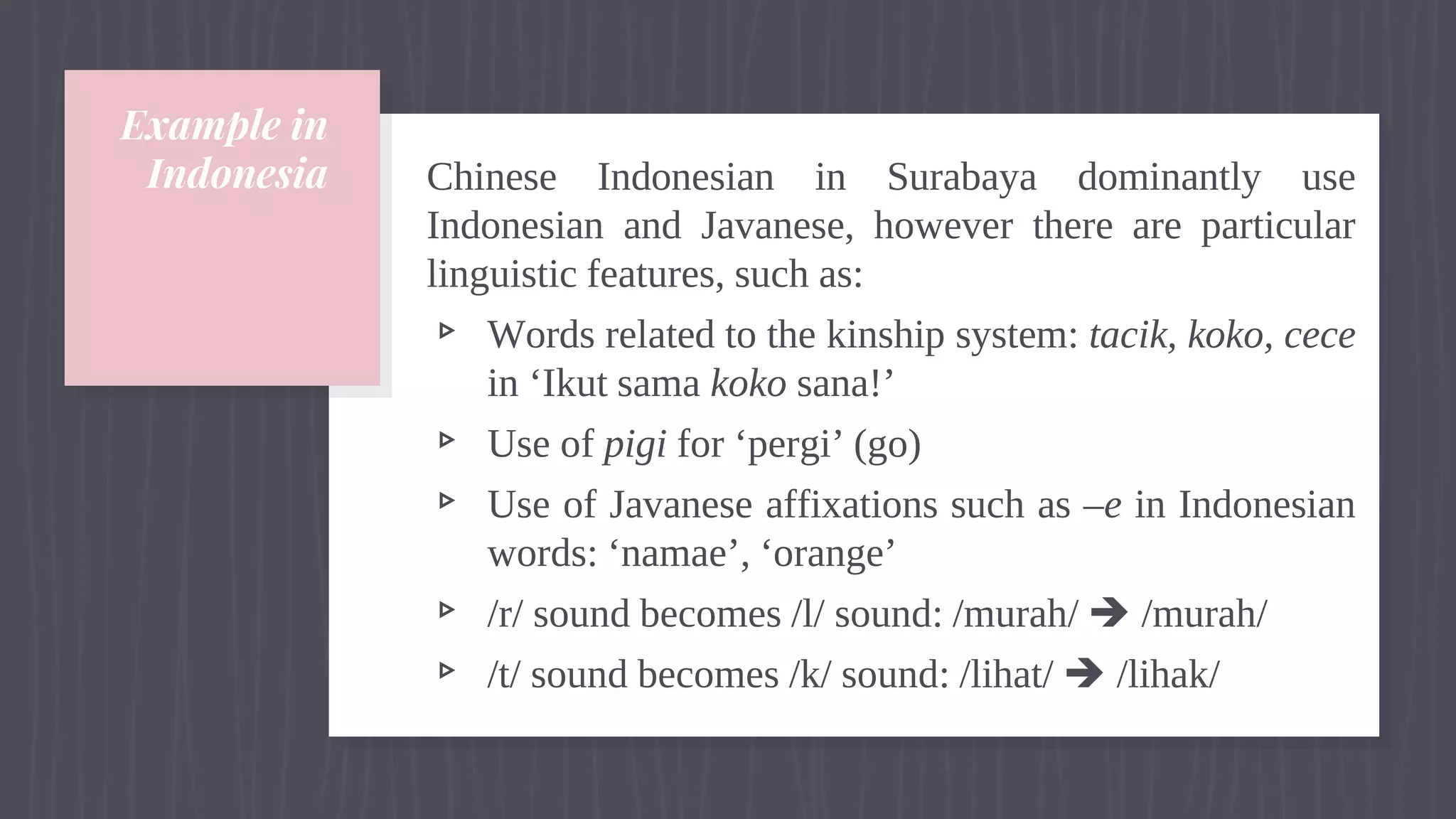
Example in
Indonesia Chinese Indonesian in Surabaya dominantly use
Indonesian and Javanese, however there are particular
linguistic features, such as:
▹ Words related to the kinship system: tacik, koko, cece
in ‘Ikut sama koko sana!’
▹ Use of pigi for ‘pergi’ (go)
▹ Use of Javanese affixations such as –e in Indonesian
words: ‘namae’, ‘orange’
▹ /r/ sound becomes /l/ sound: /murah/  /murah/
▹ /t/ sound becomes /k/ sound: /lihat/  /lihak/
African American
Vernacular English
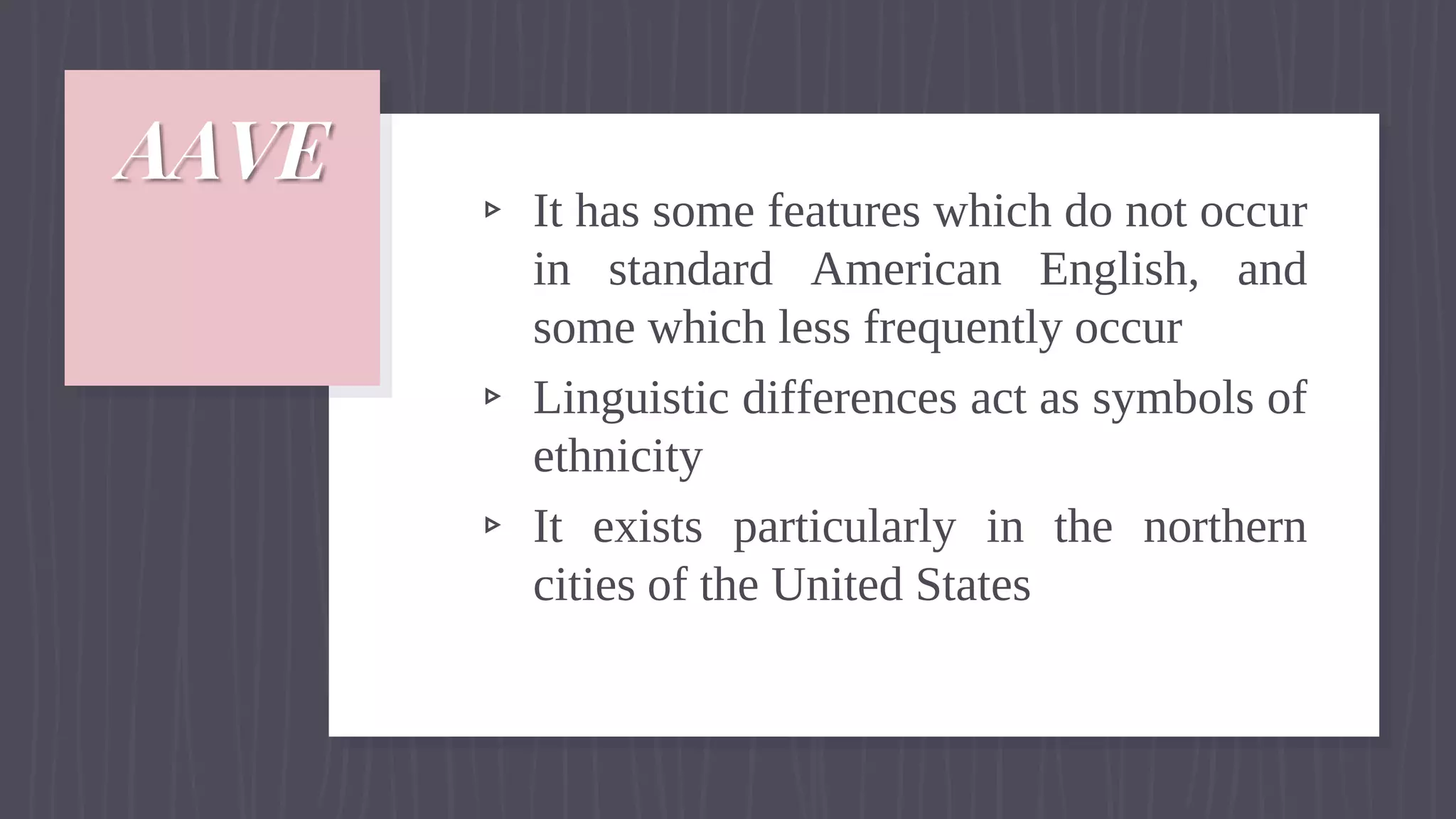
AAVE
▹ It has some features which do not occur
in standard American English, and
some which less frequently occur
▹ Linguistic differences act as symbols of
ethnicity
▹ It exists particularly in the northern
cities of the United States
Linguistic
features
represent
cultural
distinctiveness
▹ Absence of copula be (e.g. ‘she very nice’,
‘he a teacher’
▹ Use of copula be to signal recurring actions
(e.g. ‘she be at school on weekdays’)
▹ Multiple negation (e.g. ‘I don’t have no
money’)
▹ Consonant cluster simplification (aks in
place of ‘asks’, las in place of ‘last’)
British Black
English
British
Black
English
▹ Members of British Black community
(born in England) speak a variety of
Jamaican Creole, also known as Patois
▹ Patois used as symbol of ethnic identity.
Those who are not fluent in Patois use
English with Patois features. This way,
their English is marked as “Black” which
signals the identity of the speaker
Patois
Linguistic
Features
Vocabulary
Lick meaning:
‘kick’
Kenge meaning:
‘weak’
Pronunciation
[den], [tin] for
‘then’ and ‘thin’
[niem] for
‘name’
Morphology, syntax
Plural forms without
/s/ suffix: ‘many cow’
Verbs are not marked
for tenses: walk, jump
for ‘walked’, ‘jumped’
Simplified pronouns:
[mi] for I, me, my and
[dem] for they, them,
and their
Maori New
Zealanders
Linguistic
Features
Pronunciation
Use of [d]
sound: then
pronounce as
‘den’, the
pronounce as
‘de’
Vocabulary
Kia ora for
greetings
Tangi meaning
‘funeral’
Kuia meaning
‘old woman’
Grammar
Vernacular present
tense forms: with /s/
 ‘I says you wanna
bet’
Vernacular past tense
 ‘She seen it
happen…’
Social Networks
People’s speech reflects the types of
networks they belong to.
2
Features of
Social
Networks
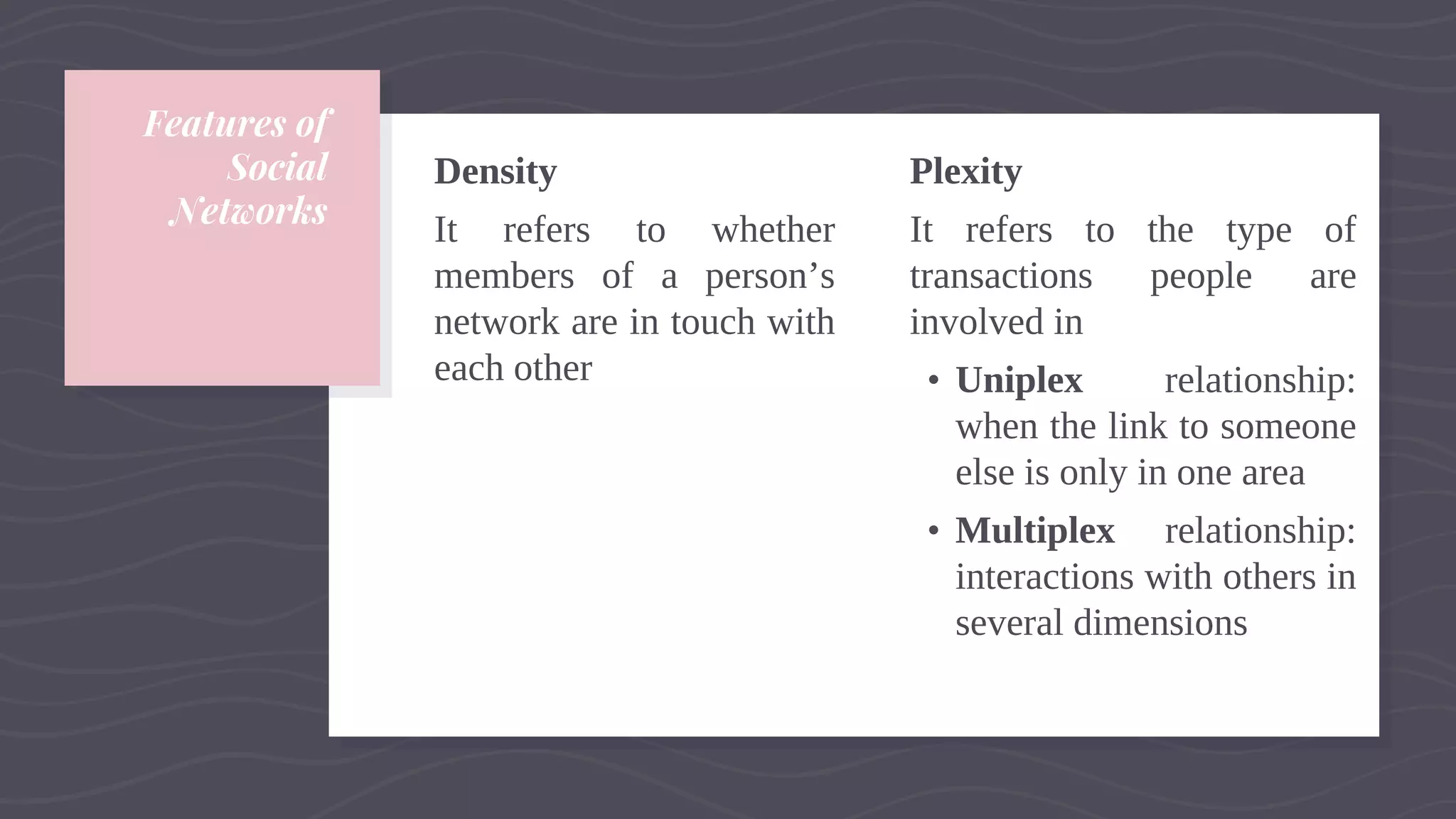
Density
It refers to whether
members of a person’s
network are in touch with
each other
Plexity
It refers to the type of
transactions people are
involved in
• Uniplex relationship:
when the link to someone
else is only in one area
• Multiplex relationship:
interactions with others in
several dimensions
Communities of practice develop
around the activities which group
members engage in together, and their
shared objectives and attitudes.
Communities of practice
and the construction of
social identity
▹ Linguistic patterns described by
sociolinguists correlate to macro-level
categories such as gender, age, ethnicity
and class
▹ The concept of community of practice is
aimed at understanding the complexities
of belonging to a certain group
Thanks!
End of presentation

Ch. 8 ethnicity and social networks

  • 1.
  • 2.
  • 3.
    Learning Objectives ETHNICITY ▹African American VernacularEnglish ▹British Black English ▹Maori New Zealanders SOCIAL NETWORKS ▹Communities of practice and the construction of social identity
  • 4.
    Ethnicity What is ethnicity? Whatis an ethnic group? 1
  • 5.
    “ Ethnicity is consideredto be shared characteristics such as culture, language, religion, and traditions, which contribute to a person or group’s identity.
  • 6.
    Ethnic Group An ‘ethnicgroup’ has been defined as a group that regards itself or is regarded by others as a distinct community by virtue of certain characteristics that will help to distinguish the group from the surrounding community.
  • 7.
    Ethnicity ▹ Many ethnicgroups use a distinctive language to identify their ethnicity ▹ If the dominants/main language is use, speakers may incorporate linguistic signals that identify their ethnic background
  • 8.
    Examples ▹ New Zealandersuse Maori linguistic signals like kia ora, eki, ne to express their ethnic identity ▹ Chinese Singaporeans in Singapore use the tag la to express solidarity ▹ Italians in Boston and Sydney use particular high percentage of vernacular pronunciations of certain vowels ▹ Scottish people in New Zealand retain the [r] sound ▹ Jewish people in Boston and New York use marked linguistic tags such as oy vay, and Yiddish vocabulary items such as bagel
  • 9.
    Example in Indonesia ChineseIndonesian in Surabaya dominantly use Indonesian and Javanese, however there are particular linguistic features, such as: ▹ Words related to the kinship system: tacik, koko, cece in ‘Ikut sama koko sana!’ ▹ Use of pigi for ‘pergi’ (go) ▹ Use of Javanese affixations such as –e in Indonesian words: ‘namae’, ‘orange’ ▹ /r/ sound becomes /l/ sound: /murah/  /murah/ ▹ /t/ sound becomes /k/ sound: /lihat/  /lihak/
  • 10.
  • 11.
    AAVE ▹ It hassome features which do not occur in standard American English, and some which less frequently occur ▹ Linguistic differences act as symbols of ethnicity ▹ It exists particularly in the northern cities of the United States
  • 12.
    Linguistic features represent cultural distinctiveness ▹ Absence ofcopula be (e.g. ‘she very nice’, ‘he a teacher’ ▹ Use of copula be to signal recurring actions (e.g. ‘she be at school on weekdays’) ▹ Multiple negation (e.g. ‘I don’t have no money’) ▹ Consonant cluster simplification (aks in place of ‘asks’, las in place of ‘last’)
  • 13.
  • 14.
    British Black English ▹ Members ofBritish Black community (born in England) speak a variety of Jamaican Creole, also known as Patois ▹ Patois used as symbol of ethnic identity. Those who are not fluent in Patois use English with Patois features. This way, their English is marked as “Black” which signals the identity of the speaker
  • 15.
    Patois Linguistic Features Vocabulary Lick meaning: ‘kick’ Kenge meaning: ‘weak’ Pronunciation [den],[tin] for ‘then’ and ‘thin’ [niem] for ‘name’ Morphology, syntax Plural forms without /s/ suffix: ‘many cow’ Verbs are not marked for tenses: walk, jump for ‘walked’, ‘jumped’ Simplified pronouns: [mi] for I, me, my and [dem] for they, them, and their
  • 16.
  • 17.
    Linguistic Features Pronunciation Use of [d] sound:then pronounce as ‘den’, the pronounce as ‘de’ Vocabulary Kia ora for greetings Tangi meaning ‘funeral’ Kuia meaning ‘old woman’ Grammar Vernacular present tense forms: with /s/  ‘I says you wanna bet’ Vernacular past tense  ‘She seen it happen…’
  • 18.
    Social Networks People’s speechreflects the types of networks they belong to. 2
  • 19.
    Features of Social Networks Density It refersto whether members of a person’s network are in touch with each other Plexity It refers to the type of transactions people are involved in • Uniplex relationship: when the link to someone else is only in one area • Multiplex relationship: interactions with others in several dimensions
  • 20.
    Communities of practicedevelop around the activities which group members engage in together, and their shared objectives and attitudes. Communities of practice and the construction of social identity
  • 21.
    ▹ Linguistic patternsdescribed by sociolinguists correlate to macro-level categories such as gender, age, ethnicity and class ▹ The concept of community of practice is aimed at understanding the complexities of belonging to a certain group
  • 22.

Editor's Notes

  • #19 Social networks can help us understand speech patterns as the language and variety we use is influenced by the people we spend time with
  • #22 Describing day-to-day interactions between individuals requires categories of social network and community of practice.