


The ‘specification’ is probably the easiest part of
the design process.
It is one that pupils tend to neglect or write
incorrectly.
It is usually a list of points, with each point
referring to the research work.
Have been used historically in public
contracting for buildings, highways and other
public works.
Specification in Design
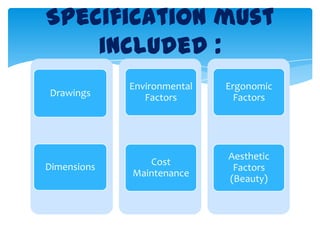
Specification must
included :
Drawings
Dimensions
Environmental
Factors
Cost
Maintenance
Ergonomic
Factors
Aesthetic
Factors
(Beauty)
Documentation
Quality Safety
Description
Needed for :
Analyzing in
Specification
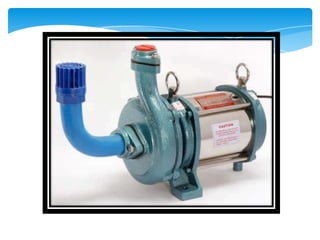
Pump Equipment
Transfer of liquid from one place to another
place.
e.g. water from an underground aquifer into a
water storage tank.
Circulate liquid around a system.
e.g. cooling water or lubricants through
machines and equipment
Purposes of Pump
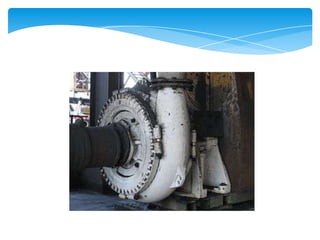
Centrifugal Pump
A sub-class of dynamic axisymmetric work-absorbing
turbo machinery.
Used to transport fluids by the conversion of rotational
kinetic energy to the hydrodynamic energy of the fluid
flow.
The rotational energy typically comes from an engine or
electric motor.
The fluid enters the pump impeller along or near to the
rotating axis and is accelerated by the impeller, flowing
radially outward into a diffuser or volute chamber
(casing), from where it exits.
Introduction
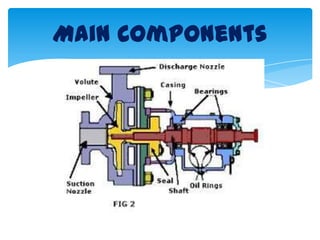
Main Components
1. Impeller
It consists of a series of backward curved vanes. The impeller
is mounted on a shaft which is connected to the shaft of an
electric motor.
2. Casing
Provide a pressure boundary for the pump and contains
channels to properly direct the suction and discharge flow.
3. Suction pipe with a foot valve and a strainer
A pipe whose one end is connected to the inlet of the pump
and other end dips into water in a sump
4. Delivery pipe
A pipe whose one end is connected to the outlet of the pump
and other end delivers the water at a required height
Centrifugal pump works by the conversion of
the rotational kinetic energy, typically from an
electric motor or turbine to an increased static
fluid pressure.
Centrifugal pump works by spinning water with
propellers inside an housing or casing.
During the spinning, pressure builds outwards.
The pressure propels the water through the
desired path.
How it work?
• Cavitation - The net positive suction head (NPSH) of the
system is too low for the selected pump
• Wear of the Impeller - Can be worsened by suspended
solids
• Corrosion inside the pump caused by the fluid properties
• Overheating due to low flow
• Leakage along rotating shaft
• Lack of prime - centrifugal pumps must be filled (with
the fluid to be pumped) in order to operate
• Surge.
Problems

Specification in Design

  • 1.
    The ‘specification’ isprobably the easiest part of the design process. It is one that pupils tend to neglect or write incorrectly. It is usually a list of points, with each point referring to the research work. Have been used historically in public contracting for buildings, highways and other public works. Specification in Design
  • 2.
  • 3.
  • 4.
  • 6.
    Transfer of liquidfrom one place to another place. e.g. water from an underground aquifer into a water storage tank. Circulate liquid around a system. e.g. cooling water or lubricants through machines and equipment Purposes of Pump
  • 7.
  • 9.
    A sub-class ofdynamic axisymmetric work-absorbing turbo machinery. Used to transport fluids by the conversion of rotational kinetic energy to the hydrodynamic energy of the fluid flow. The rotational energy typically comes from an engine or electric motor. The fluid enters the pump impeller along or near to the rotating axis and is accelerated by the impeller, flowing radially outward into a diffuser or volute chamber (casing), from where it exits. Introduction
  • 10.
  • 11.
    1. Impeller It consistsof a series of backward curved vanes. The impeller is mounted on a shaft which is connected to the shaft of an electric motor. 2. Casing Provide a pressure boundary for the pump and contains channels to properly direct the suction and discharge flow. 3. Suction pipe with a foot valve and a strainer A pipe whose one end is connected to the inlet of the pump and other end dips into water in a sump 4. Delivery pipe A pipe whose one end is connected to the outlet of the pump and other end delivers the water at a required height
  • 12.
    Centrifugal pump worksby the conversion of the rotational kinetic energy, typically from an electric motor or turbine to an increased static fluid pressure. Centrifugal pump works by spinning water with propellers inside an housing or casing. During the spinning, pressure builds outwards. The pressure propels the water through the desired path. How it work?
  • 13.
    • Cavitation -The net positive suction head (NPSH) of the system is too low for the selected pump • Wear of the Impeller - Can be worsened by suspended solids • Corrosion inside the pump caused by the fluid properties • Overheating due to low flow • Leakage along rotating shaft • Lack of prime - centrifugal pumps must be filled (with the fluid to be pumped) in order to operate • Surge. Problems