MAJOR ASSIGNMENT
SUBJECT-R.A.C.
TOPIC –ANALYSIS OF CENTRIFUGAL PUMP
SUBMITTED BY SUBMITTED TO
MOHAMMAD SHAHBAZ MR. ADITYA
MISHRA
U.I.D.-K10611 ASST. PROFESSOR M.E.
BRANCH-M.E. DEPT. CPU
WHAT IS CENTRIFUGAL PUMP?
WORKING MECHANISM OF A
CENTRIFUGAL PUMP
POWER AND EFFICIENCY
CALCULATION.
COMPONENTS OF CENTRIFUGAL
PUMPS
ADVANTEGAES AND
DISADVANTAGES OF
CENTRIFUGAL PUMPS
 Convert the mechanical
energy into hydraulic energy
by centrifugal force on the
liquid
 Constitute the most common
type of pumping machinery
 Used to move liquids through
a piping system
 Has two main components:
1. Stationary componets,
casing, casing cover and
bearings
2. Rotating components,
impeller and shaft
 Classified into three
categories ; Radial Flow,
Mixed Flow, Axial Flow
Simplest piece of
equipment in any process
plant
Energy changes occur by
virtue of impeller and
volute
Liquid is fed into the
pump at the center of a
rotating impeller and
thrown outward by
centrifugal force
The conversion of kinetic
energy into pressure
energy supplies the
pressure difference
between the suction side
and delivery side of the
pump
Liquid flow path
inside a
centrifugal pump
•The power supplied to the pump:
Where m=mass flow rate, kg/s
∆H= total discharge head,
N.m/kg
η=efficiency
…………(1)
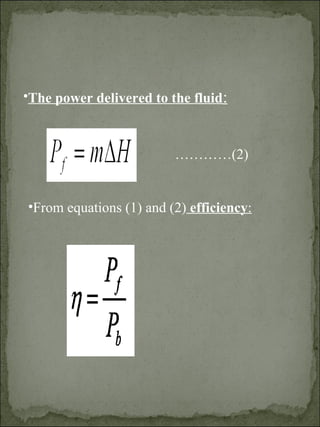
•The power delivered to the fluid:
…………(2)
•From equations (1) and (2) efficiency:
nq is the specific speed for a unit machine that
is geometric similar to a machine with the head
Hq = 1 m and flow rate Q = 1 m3
/s
43q
H
Q
nn ⋅=
qs nn ⋅= 55,51
Three basic
components:
Volute, casing,
body
or Diffuser
Impeller
or impellers
Driver (motor)
Centrifugal Pumps
Vanes
Direction of
rotation
Centrifugal Pumps
• Open
• Semi-open
• Closed
- Single suction
- Double suction
• Non-clogging
• Axial flow
• Mixed flow
Maximum efficiency lies in the
range:
2000<NS<3000
High head, low capacity pumps:
500<NS<1000
Low head, large capacity pumps:
NS>15000
Centrifugal Pumps
Rotation
Impeller
Blades
Vt
V
r
V
s
Vr = Radial Velocity
Vt = Tangential Velocity
Vs = Vector Sum Velocity
Centrifugal Pumps
Suction Eye
Cutwater
Arrows represent the
direction of water flow Discharge
Nozzle
Advantages
Simple in construction and cheap
Handle liquid with large amounts of
solids
No metal to metal fits
No valves involved in pump operation
Maintenance costs are lower
Disadvantages
Cannot handle highly viscous fluids efficiently
Cannot be operated at high heads
Maximum efficiency holds over a narrow range
of conditions
k10611 rac

k10611 rac

  • 1.
    MAJOR ASSIGNMENT SUBJECT-R.A.C. TOPIC –ANALYSISOF CENTRIFUGAL PUMP SUBMITTED BY SUBMITTED TO MOHAMMAD SHAHBAZ MR. ADITYA MISHRA U.I.D.-K10611 ASST. PROFESSOR M.E. BRANCH-M.E. DEPT. CPU
  • 2.
    WHAT IS CENTRIFUGALPUMP? WORKING MECHANISM OF A CENTRIFUGAL PUMP POWER AND EFFICIENCY CALCULATION. COMPONENTS OF CENTRIFUGAL PUMPS ADVANTEGAES AND DISADVANTAGES OF CENTRIFUGAL PUMPS
  • 3.
     Convert themechanical energy into hydraulic energy by centrifugal force on the liquid  Constitute the most common type of pumping machinery  Used to move liquids through a piping system  Has two main components: 1. Stationary componets, casing, casing cover and bearings 2. Rotating components, impeller and shaft  Classified into three categories ; Radial Flow, Mixed Flow, Axial Flow
  • 4.
    Simplest piece of equipmentin any process plant Energy changes occur by virtue of impeller and volute Liquid is fed into the pump at the center of a rotating impeller and thrown outward by centrifugal force The conversion of kinetic energy into pressure energy supplies the pressure difference between the suction side and delivery side of the pump Liquid flow path inside a centrifugal pump
  • 5.
    •The power suppliedto the pump: Where m=mass flow rate, kg/s ∆H= total discharge head, N.m/kg η=efficiency …………(1)
  • 6.
    •The power deliveredto the fluid: …………(2) •From equations (1) and (2) efficiency:
  • 7.
    nq is thespecific speed for a unit machine that is geometric similar to a machine with the head Hq = 1 m and flow rate Q = 1 m3 /s 43q H Q nn ⋅= qs nn ⋅= 55,51
  • 8.
    Three basic components: Volute, casing, body orDiffuser Impeller or impellers Driver (motor)
  • 9.
  • 10.
    Centrifugal Pumps • Open •Semi-open • Closed - Single suction - Double suction • Non-clogging • Axial flow • Mixed flow
  • 11.
    Maximum efficiency liesin the range: 2000<NS<3000 High head, low capacity pumps: 500<NS<1000 Low head, large capacity pumps: NS>15000
  • 12.
    Centrifugal Pumps Rotation Impeller Blades Vt V r V s Vr =Radial Velocity Vt = Tangential Velocity Vs = Vector Sum Velocity
  • 13.
    Centrifugal Pumps Suction Eye Cutwater Arrowsrepresent the direction of water flow Discharge Nozzle
  • 14.
    Advantages Simple in constructionand cheap Handle liquid with large amounts of solids No metal to metal fits No valves involved in pump operation Maintenance costs are lower
  • 15.
    Disadvantages Cannot handle highlyviscous fluids efficiently Cannot be operated at high heads Maximum efficiency holds over a narrow range of conditions