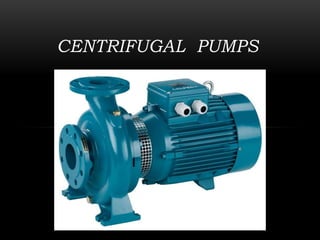
CENTRIFUGAL PUMPS
TURBINES AND PUMPS
Pumps
Turbines
Mechanical
energy
Hydraulic energy
Input energy
Hydraulic energy
Mechanical
energy
Output energy
Turbine runner rotates in the
OPPOSITE direction of a pump
impeller
Direction of
rotation
The same direction in both modes
Direction of
torque
No gases or
vapor can be
Can handle up to
40% of gases
Cavitation
TURBINES AND PUMPS
Type of Pumps:
Rotodynamic
Axial flow
Mixed
flow
Radial
flow
Positive
displacement
pump
USAGE OF PUMPS
• Empting storage tanks.
• Providing emergency fire water.
• Circulating cooling tower water.
ADVANTAGES OF PUMPS
• The cost is less as it has fewer parts.
• Installation and maintenance is easier and cheaper.
• Its discharging capacity is mush greater than that of
reciprocating pumps.
• It can be employed for lifting highly viscous liquids
(muddy and sewage water, oil, … etc.).
• It can be operated at a very high speeds without any danger of
separation and cavitation.
• It can be directly coupled to an electric motor or an oil engine.
• The torque on the power and the output from the pump are
uniform.
CLASSIFICATIONS:
1) Type of casing
i. Volute pump
ii. Diffusion pump
CLASSIFICATIONS:
2) Working head
i. Low lift centrifugal pump
(up to 15m)
ii. Medium lift centrifugal
pump (as high as 40m)
iii. High lift centrifugal pump
(above 40m)
CLASSIFICATIONS:
3) Liquid handled
i. Closed impeller pump
ii. Semi-closed impeller
pump
iii. Open impeller pump
CLASSIFICATIONS:
4) Number of impellers per
shaft
i. Single stage
ii. Multi-stage
CLASSIFICATIONS:
5) Number of entrances to the
impeller
i. Single entry
ii. Doubled entry
CLASSIFICATIONS:
6) Relative direction of flow
through impeller
i. Radial flow pump
ii. Axial flow pump
iii. Mixed flow pump
COMPONENT PARTS
1) Impeller
2) Casing
3) Suction pipe
4) Delivery pipe
COMPONENT PARTS
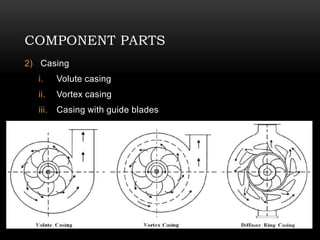
2) Casing
i. Volute casing
ii. Vortex casing
iii. Casing with guide blades
COMPONENT PARTS
3) Suction pipe: i. Strainer. ii. Non-return
valve.
COMPONENT PARTS
4) Delivery pipe: i. Delivery flange.
FOLLOWING POINTS, REGARDING TO
IMPELLERS ARE WORTH-NOTING:
WORKING OF A CENTRIFUGAL PUMP
PRIMING
CAVITATION
• Vacuum cavitation at the inlet (low pressure)
• Too large suction pipe
• Too long plumbing run
• Temperature drop before arriving to the inlet
Cavitation causes:
• Loss in
performance
• Flactuating flow
• Wear
• Noise
WORK DONE BY THE IMPELLER
• Equations.

centerifugal.pptx