Collision Detection: an Overview

          James McLaren
           June 19 2009
About this talk
• Brief overview of the Collision detection.
• Deliberately not heavy on the math
  (Otherwise I’ll stand here all day).
• Not exhaustive – It’s a big area, lots of ways of
  doing things. Hopefully this will provide some
  kind of cook book.
Stages of Collision Detection
• Broad Phase
   – Use a some kind of Spatial Subdivision to reduce our
     algorithmic complexity.
• Narrow Phase
   – Volume x Volume
   – Polygon tests
• Response
   – Try to do something sensible when collisions occur.
• Ray Casts
   – Auxiliary tests used for line of sight, bullets etc.
Broad Phase
• Naïve checking of all objects against each
  other would be O(n2) == BAD!
• Need to find ways to trivially reject objects
  that are far away
• Typically use a spatial data structure
• May also take advantage of frame to frame
  coherence.
Spatial Data Structures
•   Uniform Grids
•   Hierarchical Grids
•   Octree/Quad-Tree
•   BSP-Tree
•   KD-Tree
•   Axis sorted lists (i.e. Sweep and Prune)
Uniform Grid
•   Simply divide geometry/objects into a grid
•   Easy to work with.
•   Fast insertion.
•   Grid size is important.
    – Objects can be in many cells.
    – Too small -> explosion in storage
    – Too large -> reduced benefit
• Can be combined with hashing.
• Various hierarchical schemes exist.
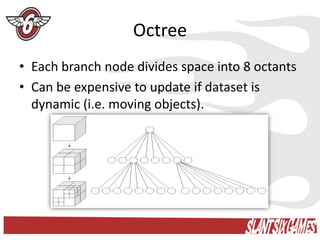
Octree
• Each branch node divides space into 8 octants
• Can be expensive to update if dataset is
  dynamic (i.e. moving objects).
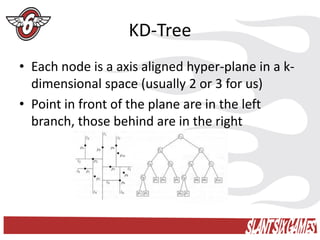
KD-Tree
• Each node is a axis aligned hyper-plane in a k-
  dimensional space (usually 2 or 3 for us)
• Point in front of the plane are in the left
  branch, those behind are in the right
Binary Space Partition Tree
• Same principle as a KD-Tree, but more
  generalized.
• Each node stores a full plane (no axis alignment
  restrictions).
• For our purposes leaf nodes usually end up
  containing convex sets of polygons .
• Often used for Ray casting
• Also useful for rendering (can easily sort polygons
  back to front with respect to the camera)
Binary Space Partition Tree
Sweep and Prune
• Popular Broad Phase method for dealing with
  lots of dynamic objects.
• Makes good use of frame to frame coherence
• Objects are represented by an axis aligned
  bounding box
• Algorithm maintains sorted lists of min and
  max edges for each dimension (typically 3)
• Also maintains a set of objects that are
  currently overlapping
Sweep and Prune
• Each frame an insertion sort is performed on
  each list with the objects new positions
• When min and max edges are swapped for two
  objects we know a collision may have occurred,
  or that the objects no longer overlap.
• AABB tests can be done to confirm an overlap
• A bit set for each object-object pair can also be
  used (less testing but much bigger memory
  overhead).
Sweep and Prune
Broad Phase Considerations
• Many options, important to appropriate data
  structures.
• Often best to treat static and dynamic objects
  differently. Some Data structures handle real
  time updates much better than others i.e.
  – Grids/ Sweep and Prune good for dynamic scenes.
  – Octree/BSP Tree etc often better suited to static
    scenes.
Broad Phase Considerations
• An important recent consideration for the Broad
  Phase is multi-core. If possible we want to
  identify “Islands” of objects that for the purposes
  of this time step can be treated independently
  (possibly by multiple cores).
• Proximity queries can be integrated into the
  broad phase (Tell me all the objects in this area).
• Often want to filter based on object groups (No
  point checking bullets vs bullets or proximity
  checks vs proximity checks).
Narrow Phase
• Need to perform more exact tests on the set
  of potentially colliding candidates found in the
  Broad Phase
• Object representations will typically take the
  form of either:
  – A bounding volume (usually convex)
  – A hierarchy of bounding volumes
  – Polygon soup (possibly underneath the volumes)
Bounding Volumes
• Objects can be represented as a single
  bounding volume.
• Usually these are convex
  – Simpler to deal with than non-convex
  – Can make use of Separating Axis Theorem:
  – Several popular algorithms based on convexity
Separating Axis Theorem
• Theorem: “Given two convex shapes, there exists an axis
  where their projections can be separated if and only if they
  are not intersecting”.
• Is the basis of many collision detection checks.
• Typically there are a fixed number of axis that need to be
  checked in order to guarantee there is no collision.
   – For OBB-OBB checks, this is 15 (6 for the axis for each box, and 9 from
     the cross products between them).
• Often gives good “early out” behaviour.
   – If the objects don’t collide, we will usually find a separating axis after
     the first few tests.
Separating Axis
Typical bounding volumes
•   Spheres
•   Ellipsoids (easy to reduce to being spheres)
•   Oriented bounding box
•   Capsules
•   Cylinders
•   Convex hulls
V-Clip
• One of several algorithms which work with pairs
  of convex hulls.
• Theorem: Let FA and FB be a pair of features from
  two disjoint convex polyhedra, A and B, and let
  VR(FA) and VR(FB) denote their Voronoi regions.
  Let PA ∈ FA and PB ∈ FB be a pair of closest points
  between the features. Then, if PA ∈ VR(FB) and PB
  ∈ VR(FA), FA and FB are a globally closest pair of
  features and PA and PB are a globally closest pair
  of points between A and B (albeit not necessarily
  unique).
V-Clip
• Based on the Voronoi diagrams of the two hulls
• Makes use of frame to frame coherence by
  tracking the closest features between the two
  objects
• In most cases the closest features from the last
  frame will be the same.
• If not then we search for the new closest features
  using the old ones as an initial best guess
V-Clip


• The vertex feature pair V and F constitute the
  closest pair of features and containing the closest
  pair of points Pa and Pb
Bounding Volume Hierarchies
• Convex volumes often don’t give a very good
  representation of the object
• Subdividing using a hierarchy of volumes allows us to
  represent more complex shapes.
• (Yes this is another spatial data structure!)
• Sphere trees and OBB trees are both popular.
Triangle tests
• Often at the bottom of our hierarchy we need to
  test against the individual triangles of our mesh.
• This might be a test against other triangles, or
  possibly simple volumes such as a sphere.
• Several well know algorithms for these tests.
• If there is a collision then we want to return the
  position , time and normal of the collision.
• Also need to return the penetration distance if
  the objects intersect.
Collision Response
• Once we have detected a collision, we need to
  resolve it somehow.
• Dependent on the requirements of the simulation
• In a physics based simulation will probably either:
   – Apply impulses to the objects to instantaneously
     change their velocity.
   – Let objects penetrate and apply repulsion forces
     based on the penetration distance ( Can have some
     instability issues).
   – Possibly also generate contact points to specify
     constraints.
Collision Response
• If we are non physics based:
  – We can just wind the objects back to the point of
    collision, and inform the game.
  – Punt and just inform the game.
  – We also have the freedom to move objects in turn
    rather than together, at fast frame rates the effects of
    this can be negligable
• Must also take note of the fact that if we are
  simulating collisions mid frame, then our objects
  now have the potential to collide with different
  objects
Penetration
• In an ideal world we detect all our collisions at the
  instant they occur.
• However, various things can cause this to not be the
  case:
   – We are not using swept collision tests
   – We are dealing with rotating objects
   – The game logic has decided to teleport you somewhere 
• Finding the right direction to move objects to stop
  penetrating can be challenging.
   – Resolving one penetration may well cause another
   – Often use relaxation (resolve, check, resolve, check) until
     we are ok, or hit some maximum iteration count.
Wonderful Rotation
• Most of the standard swept primitive/volume
  algorithms quietly ignore the angular velocity.
• This means that you have to make instantaneous
  changes in rotation combined with swept
  updates along the velocity vector.
• When this causes a penetration you have to
  either:
  – Move the objects out of each other.
  – Subdivide down to a smaller fraction of your time step
    and try again.
Ray Casts
• The other main form of collision query in games.
• Used for line of sight checks, bullets etc.
• Rich history in Ray Tracing literature.
• Also generally make use of some form of spatial
  data structure to accelerate the checks
• Test can be optimized if the ray is walked from
  front to back through the spatial subdivision.
• Also possible to batch ray traversals to try to get
  better cache behavior.
Ray Traversal
• Example below is a ray walking over a uniform grid
  (Technique used in PMC and FTB3).
• Note the difference from typical Bresenham line.
• We can early out the algorithm once we detect a collision.
• This kind of traversal is also possible with BSP/Octrees etc.
References
• Real-Time Collision Detection by Christer
  Ericson.
• http://realtimecollisiondetection.net/
• http://www.its.caltech.edu/~jiegao/collision-
  detection.html
Questions?

Collision Detection an Overview

  • 1.
    Collision Detection: anOverview James McLaren June 19 2009
  • 2.
    About this talk •Brief overview of the Collision detection. • Deliberately not heavy on the math (Otherwise I’ll stand here all day). • Not exhaustive – It’s a big area, lots of ways of doing things. Hopefully this will provide some kind of cook book.
  • 3.
    Stages of CollisionDetection • Broad Phase – Use a some kind of Spatial Subdivision to reduce our algorithmic complexity. • Narrow Phase – Volume x Volume – Polygon tests • Response – Try to do something sensible when collisions occur. • Ray Casts – Auxiliary tests used for line of sight, bullets etc.
  • 4.
    Broad Phase • Naïvechecking of all objects against each other would be O(n2) == BAD! • Need to find ways to trivially reject objects that are far away • Typically use a spatial data structure • May also take advantage of frame to frame coherence.
  • 5.
    Spatial Data Structures • Uniform Grids • Hierarchical Grids • Octree/Quad-Tree • BSP-Tree • KD-Tree • Axis sorted lists (i.e. Sweep and Prune)
  • 6.
    Uniform Grid • Simply divide geometry/objects into a grid • Easy to work with. • Fast insertion. • Grid size is important. – Objects can be in many cells. – Too small -> explosion in storage – Too large -> reduced benefit • Can be combined with hashing. • Various hierarchical schemes exist.
  • 7.
    Octree • Each branchnode divides space into 8 octants • Can be expensive to update if dataset is dynamic (i.e. moving objects).
  • 8.
    KD-Tree • Each nodeis a axis aligned hyper-plane in a k- dimensional space (usually 2 or 3 for us) • Point in front of the plane are in the left branch, those behind are in the right
  • 9.
    Binary Space PartitionTree • Same principle as a KD-Tree, but more generalized. • Each node stores a full plane (no axis alignment restrictions). • For our purposes leaf nodes usually end up containing convex sets of polygons . • Often used for Ray casting • Also useful for rendering (can easily sort polygons back to front with respect to the camera)
  • 10.
  • 11.
    Sweep and Prune •Popular Broad Phase method for dealing with lots of dynamic objects. • Makes good use of frame to frame coherence • Objects are represented by an axis aligned bounding box • Algorithm maintains sorted lists of min and max edges for each dimension (typically 3) • Also maintains a set of objects that are currently overlapping
  • 12.
    Sweep and Prune •Each frame an insertion sort is performed on each list with the objects new positions • When min and max edges are swapped for two objects we know a collision may have occurred, or that the objects no longer overlap. • AABB tests can be done to confirm an overlap • A bit set for each object-object pair can also be used (less testing but much bigger memory overhead).
  • 13.
  • 14.
    Broad Phase Considerations •Many options, important to appropriate data structures. • Often best to treat static and dynamic objects differently. Some Data structures handle real time updates much better than others i.e. – Grids/ Sweep and Prune good for dynamic scenes. – Octree/BSP Tree etc often better suited to static scenes.
  • 15.
    Broad Phase Considerations •An important recent consideration for the Broad Phase is multi-core. If possible we want to identify “Islands” of objects that for the purposes of this time step can be treated independently (possibly by multiple cores). • Proximity queries can be integrated into the broad phase (Tell me all the objects in this area). • Often want to filter based on object groups (No point checking bullets vs bullets or proximity checks vs proximity checks).
  • 16.
    Narrow Phase • Needto perform more exact tests on the set of potentially colliding candidates found in the Broad Phase • Object representations will typically take the form of either: – A bounding volume (usually convex) – A hierarchy of bounding volumes – Polygon soup (possibly underneath the volumes)
  • 17.
    Bounding Volumes • Objectscan be represented as a single bounding volume. • Usually these are convex – Simpler to deal with than non-convex – Can make use of Separating Axis Theorem: – Several popular algorithms based on convexity
  • 18.
    Separating Axis Theorem •Theorem: “Given two convex shapes, there exists an axis where their projections can be separated if and only if they are not intersecting”. • Is the basis of many collision detection checks. • Typically there are a fixed number of axis that need to be checked in order to guarantee there is no collision. – For OBB-OBB checks, this is 15 (6 for the axis for each box, and 9 from the cross products between them). • Often gives good “early out” behaviour. – If the objects don’t collide, we will usually find a separating axis after the first few tests.
  • 19.
  • 20.
    Typical bounding volumes • Spheres • Ellipsoids (easy to reduce to being spheres) • Oriented bounding box • Capsules • Cylinders • Convex hulls
  • 21.
    V-Clip • One ofseveral algorithms which work with pairs of convex hulls. • Theorem: Let FA and FB be a pair of features from two disjoint convex polyhedra, A and B, and let VR(FA) and VR(FB) denote their Voronoi regions. Let PA ∈ FA and PB ∈ FB be a pair of closest points between the features. Then, if PA ∈ VR(FB) and PB ∈ VR(FA), FA and FB are a globally closest pair of features and PA and PB are a globally closest pair of points between A and B (albeit not necessarily unique).
  • 22.
    V-Clip • Based onthe Voronoi diagrams of the two hulls • Makes use of frame to frame coherence by tracking the closest features between the two objects • In most cases the closest features from the last frame will be the same. • If not then we search for the new closest features using the old ones as an initial best guess
  • 23.
    V-Clip • The vertexfeature pair V and F constitute the closest pair of features and containing the closest pair of points Pa and Pb
  • 24.
    Bounding Volume Hierarchies •Convex volumes often don’t give a very good representation of the object • Subdividing using a hierarchy of volumes allows us to represent more complex shapes. • (Yes this is another spatial data structure!) • Sphere trees and OBB trees are both popular.
  • 25.
    Triangle tests • Oftenat the bottom of our hierarchy we need to test against the individual triangles of our mesh. • This might be a test against other triangles, or possibly simple volumes such as a sphere. • Several well know algorithms for these tests. • If there is a collision then we want to return the position , time and normal of the collision. • Also need to return the penetration distance if the objects intersect.
  • 26.
    Collision Response • Oncewe have detected a collision, we need to resolve it somehow. • Dependent on the requirements of the simulation • In a physics based simulation will probably either: – Apply impulses to the objects to instantaneously change their velocity. – Let objects penetrate and apply repulsion forces based on the penetration distance ( Can have some instability issues). – Possibly also generate contact points to specify constraints.
  • 27.
    Collision Response • Ifwe are non physics based: – We can just wind the objects back to the point of collision, and inform the game. – Punt and just inform the game. – We also have the freedom to move objects in turn rather than together, at fast frame rates the effects of this can be negligable • Must also take note of the fact that if we are simulating collisions mid frame, then our objects now have the potential to collide with different objects
  • 28.
    Penetration • In anideal world we detect all our collisions at the instant they occur. • However, various things can cause this to not be the case: – We are not using swept collision tests – We are dealing with rotating objects – The game logic has decided to teleport you somewhere  • Finding the right direction to move objects to stop penetrating can be challenging. – Resolving one penetration may well cause another – Often use relaxation (resolve, check, resolve, check) until we are ok, or hit some maximum iteration count.
  • 29.
    Wonderful Rotation • Mostof the standard swept primitive/volume algorithms quietly ignore the angular velocity. • This means that you have to make instantaneous changes in rotation combined with swept updates along the velocity vector. • When this causes a penetration you have to either: – Move the objects out of each other. – Subdivide down to a smaller fraction of your time step and try again.
  • 30.
    Ray Casts • Theother main form of collision query in games. • Used for line of sight checks, bullets etc. • Rich history in Ray Tracing literature. • Also generally make use of some form of spatial data structure to accelerate the checks • Test can be optimized if the ray is walked from front to back through the spatial subdivision. • Also possible to batch ray traversals to try to get better cache behavior.
  • 31.
    Ray Traversal • Examplebelow is a ray walking over a uniform grid (Technique used in PMC and FTB3). • Note the difference from typical Bresenham line. • We can early out the algorithm once we detect a collision. • This kind of traversal is also possible with BSP/Octrees etc.
  • 32.
    References • Real-Time CollisionDetection by Christer Ericson. • http://realtimecollisiondetection.net/ • http://www.its.caltech.edu/~jiegao/collision- detection.html
  • 33.