SCHEMAS FOR
MULTIDIMENSIONAL
DATABASES
Sarvajanik College of Engineering &Technology
Computer (Shift-1) 7th year
Presented by:
Yazad H. Dumasia
What is Schema?
 Database uses relational model while data warehouse
requires Schema.
 Schema is a logical description of the entire
database.
 It includes the name and description of records.
 Much like a database, a data warehouse also requires
to maintain a schema.
Types of Schemas
 Star Schema
 Snowflake Schema
 Galaxy Schema
Fact Table
 Contains primary information of the warehouse.
 Contain the contents of the data warehouse and store
different types of measures.
 Located at center in Star or Snowflake Schema
surrounded by dimensional tables.
 Two columns: Measurements(numeric values)and
Foreign keys to dimension tables.
Dimension Table
 Contain information about a particular dimension.
 Textual information of the business
 Stores attributes or dimensions that describes
the objects in a fact table.
 Dimension table has a surrogate key column that
uniquely identifies each dimension record.
 It is de-normalized because built to analyze data as easily as
possible.
Star Schema
 Star schema is a relational model with
one-to-many relationship between the fact table and
the dimension tables.
 De-normalized model.
 Easy for users to understand.
 Easy querying and data analysis.
 Ability to drill down or roll up.
Star Schema
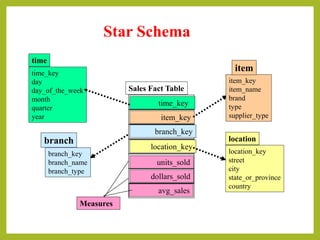
 Each dimension in a star schema is represented
with only one-dimension table.
 This dimension table contains the set of attributes.
 There is a fact table at the center. It contains the
keys to each of four dimensions.
 The fact table also contains the attributes, namely
dollars sold and units sold.
Star Schema
time_key
day
day_of_the_week
month
quarter
year
time
location_key
street
city
state_or_province
country
location
Sales Fact Table
time_key
item_key
branch_key
location_key
units_sold
dollars_sold
avg_sales
Measures
item_key
item_name
brand
type
supplier_type
item
branch_key
branch_name
branch_type
branch
Star Schema
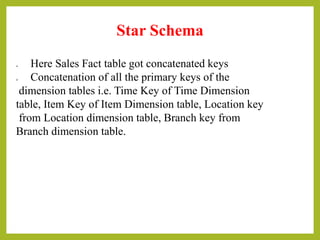
 Here Sales Fact table got concatenated keys
 Concatenation of all the primary keys of the
dimension tables i.e. Time Key of Time Dimension
table, Item Key of Item Dimension table, Location key
from Location dimension table, Branch key from
Branch dimension table.
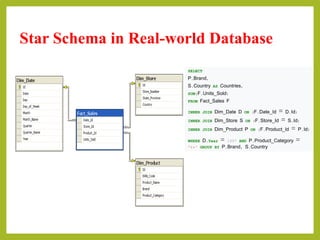
Star Schema in Real-world Database
SELECT
P.Brand,
S.Country AS Countries,
SUM(F.Units_Sold)
FROM Fact_Sales F
INNER JOIN Dim_Date D ON (F.Date_Id = D.Id)
INNER JOIN Dim_Store S ON (F.Store_Id = S.Id)
INNER JOIN Dim_Product P ON (F.Product_Id = P.Id)
WHERE D.Year = 1997 AND P.Product_Category =
'tv' GROUP BY P.Brand, S.Country
Benefits Star Schema
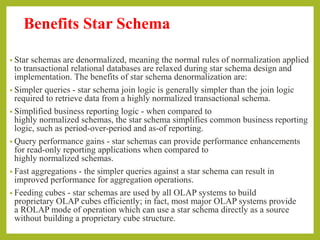
• Star schemas are denormalized, meaning the normal rules of normalization applied
to transactional relational databases are relaxed during star schema design and
implementation. The benefits of star schema denormalization are:
• Simpler queries - star schema join logic is generally simpler than the join logic
required to retrieve data from a highly normalized transactional schema.
• Simplified business reporting logic - when compared to
highly normalized schemas, the star schema simplifies common business reporting
logic, such as period-over-period and as-of reporting.
• Query performance gains - star schemas can provide performance enhancements
for read-only reporting applications when compared to
highly normalized schemas.
• Fast aggregations - the simpler queries against a star schema can result in
improved performance for aggregation operations.
• Feeding cubes - star schemas are used by all OLAP systems to build
proprietary OLAP cubes efficiently; in fact, most major OLAP systems provide
a ROLAP mode of operation which can use a star schema directly as a source
without building a proprietary cube structure.
Demerits
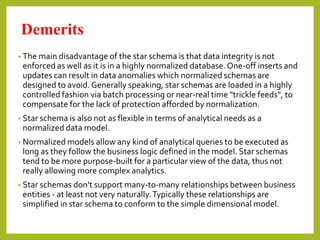
• The main disadvantage of the star schema is that data integrity is not
enforced as well as it is in a highly normalized database.One-off inserts and
updates can result in data anomalies which normalized schemas are
designed to avoid.Generally speaking, star schemas are loaded in a highly
controlled fashion via batch processing or near-real time "trickle feeds", to
compensate for the lack of protection afforded by normalization.
• Star schema is also not as flexible in terms of analytical needs as a
normalized data model.
• Normalized models allow any kind of analytical queries to be executed as
long as they follow the business logic defined in the model. Star schemas
tend to be more purpose-built for a particular view of the data, thus not
really allowing more complex analytics.
• Star schemas don't support many-to-many relationships between business
entities - at least not very naturally.Typically these relationships are
simplified in star schema to conform to the simple dimensional model.
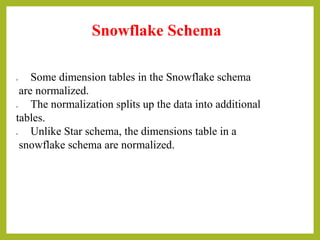
Snowflake Schema
 Some dimension tables in the Snowflake schema
are normalized.
 The normalization splits up the data into additional
tables.
 Unlike Star schema, the dimensions table in a
snowflake schema are normalized.
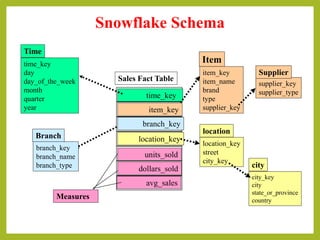
Snowflake Schema
time_key
day
day_of_the_week
month
quarter
year
Time
location_key
street
city_key
location
Sales Fact Table
time_key
item_key
branch_key
location_key
units_sold
dollars_sold
avg_sales
Measures
item_key
item_name
brand
type
supplier_key
Item
branch_key
branch_name
branch_type
Branch
supplier_key
supplier_type
Supplier
city_key
city
state_or_province
country
city
Snowflake Schema
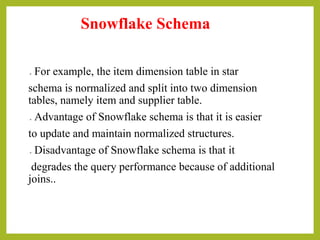
 For example, the item dimension table in star
schema is normalized and split into two dimension
tables, namely item and supplier table.
 Advantage of Snowflake schema is that it is easier
to update and maintain normalized structures.
 Disadvantage of Snowflake schema is that it
degrades the query performance because of additional
joins..
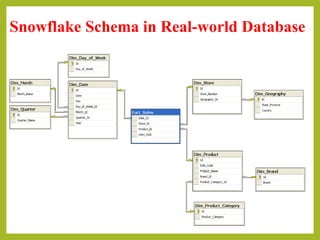
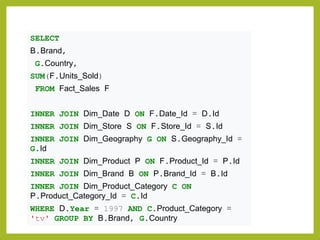
Snowflake Schema in Real-world Database
SELECT
B.Brand,
G.Country,
SUM(F.Units_Sold)
FROM Fact_Sales F
INNER JOIN Dim_Date D ON F.Date_Id = D.Id
INNER JOIN Dim_Store S ON F.Store_Id = S.Id
INNER JOIN Dim_Geography G ON S.Geography_Id =
G.Id
INNER JOIN Dim_Product P ON F.Product_Id = P.Id
INNER JOIN Dim_Brand B ON P.Brand_Id = B.Id
INNER JOIN Dim_Product_Category C ON
P.Product_Category_Id = C.Id
WHERE D.Year = 1997 AND C.Product_Category =
'tv' GROUP BY B.Brand, G.Country
Benefits Snowflake Schema
• The snowflake schema is in the same family as the star schema logical
model.
• In fact, the star schema is considered a special case of the snowflake
schema. The snowflake schema provides some advantages over the star
schema in certain situations, including:
• Some OLAP multidimensional database modeling tools are optimized for
snowflake schemas.
• Normalizing attributes results in storage savings, the tradeoff being
additional complexity in source query joins.
Demerits
• The primary disadvantage of the snowflake schema is that the additional
levels of attribute normalization adds complexity to source query joins, when
compared to the star schema.
• Snowflake schemas, in contrast to flat single table dimensions, have been
heavily criticized. Their goal is assumed to be an efficient and compact
storage of normalized data but this is at the significant cost of poor
performance when browsing the joins required in this dimension.[3] This
disadvantage may have reduced in the years since it was first recognized,
owing to better query performance within the browsing tools.
• When compared to a highly normalized transactional schema, the snowflake
schema's denormalization removes the data integrity assurances provided by
normalized schemas. Data loads into the snowflake schema must be highly
controlled and managed to avoid update and insert anomalies.
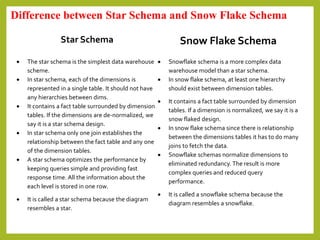
Star Schema Snow Flake Schema
 The star schema is the simplest data warehouse
scheme.
 In star schema, each of the dimensions is
represented in a single table. It should not have
any hierarchies between dims.
 It contains a fact table surrounded by dimension
tables. If the dimensions are de-normalized, we
say it is a star schema design.
 In star schema only one join establishes the
relationship between the fact table and any one
of the dimension tables.
 A star schema optimizes the performance by
keeping queries simple and providing fast
response time. All the information about the
each level is stored in one row.
 It is called a star schema because the diagram
resembles a star.
 Snowflake schema is a more complex data
warehouse model than a star schema.
 In snow flake schema, at least one hierarchy
should exist between dimension tables.
 It contains a fact table surrounded by dimension
tables. If a dimension is normalized, we say it is a
snow flaked design.
 In snow flake schema since there is relationship
between the dimensions tables it has to do many
joins to fetch the data.
 Snowflake schemas normalize dimensions to
eliminated redundancy. The result is more
complex queries and reduced query
performance.
 It is called a snowflake schema because the
diagram resembles a snowflake.
Difference between Star Schema and Snow Flake Schema
Fact Constellation Schema
 A fact constellation has multiple fact tables.
 It is also known as galaxy schema.
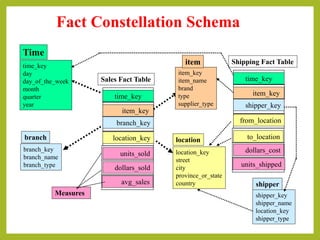
 The following diagram shows two fact tables,
namely sales and shipping.
Fact Constellation Schema
time_key
day
day_of_the_week
month
quarter
year
Time
location_key
street
city
province_or_state
country
location
Sales Fact Table
time_key
item_key
branch_key
location_key
units_sold
dollars_sold
avg_sales
Measures
item_key
item_name
brand
type
supplier_type
item
branch_key
branch_name
branch_type
branch
Shipping Fact Table
time_key
item_key
shipper_key
from_location
to_location
dollars_cost
units_shipped
shipper_key
shipper_name
location_key
shipper_type
shipper
Fact Constellation Schema
 The sales fact table is same as that in the star
schema.
 Shipping fact table contains three dimensions.
 It is also possible to share dimension tables between
fact tables.
 For example item and location dimension tables
are shared between the sales and shipping fact table.
 It is a collection of schema in which multiple fact
tables share dimension tables. Sophisticated application
requires such schema.
Schemas for multidimensional databases

Schemas for multidimensional databases

  • 1.
    SCHEMAS FOR MULTIDIMENSIONAL DATABASES Sarvajanik Collegeof Engineering &Technology Computer (Shift-1) 7th year
  • 2.
  • 3.
    What is Schema? Database uses relational model while data warehouse requires Schema.  Schema is a logical description of the entire database.  It includes the name and description of records.  Much like a database, a data warehouse also requires to maintain a schema.
  • 4.
    Types of Schemas Star Schema  Snowflake Schema  Galaxy Schema
  • 5.
    Fact Table  Containsprimary information of the warehouse.  Contain the contents of the data warehouse and store different types of measures.  Located at center in Star or Snowflake Schema surrounded by dimensional tables.  Two columns: Measurements(numeric values)and Foreign keys to dimension tables.
  • 6.
    Dimension Table  Containinformation about a particular dimension.  Textual information of the business  Stores attributes or dimensions that describes the objects in a fact table.  Dimension table has a surrogate key column that uniquely identifies each dimension record.  It is de-normalized because built to analyze data as easily as possible.
  • 7.
    Star Schema  Starschema is a relational model with one-to-many relationship between the fact table and the dimension tables.  De-normalized model.  Easy for users to understand.  Easy querying and data analysis.  Ability to drill down or roll up.
  • 8.
    Star Schema  Eachdimension in a star schema is represented with only one-dimension table.  This dimension table contains the set of attributes.  There is a fact table at the center. It contains the keys to each of four dimensions.  The fact table also contains the attributes, namely dollars sold and units sold.
  • 9.
    Star Schema time_key day day_of_the_week month quarter year time location_key street city state_or_province country location Sales FactTable time_key item_key branch_key location_key units_sold dollars_sold avg_sales Measures item_key item_name brand type supplier_type item branch_key branch_name branch_type branch
  • 10.
    Star Schema  HereSales Fact table got concatenated keys  Concatenation of all the primary keys of the dimension tables i.e. Time Key of Time Dimension table, Item Key of Item Dimension table, Location key from Location dimension table, Branch key from Branch dimension table.
  • 11.
    Star Schema inReal-world Database SELECT P.Brand, S.Country AS Countries, SUM(F.Units_Sold) FROM Fact_Sales F INNER JOIN Dim_Date D ON (F.Date_Id = D.Id) INNER JOIN Dim_Store S ON (F.Store_Id = S.Id) INNER JOIN Dim_Product P ON (F.Product_Id = P.Id) WHERE D.Year = 1997 AND P.Product_Category = 'tv' GROUP BY P.Brand, S.Country
  • 12.
    Benefits Star Schema •Star schemas are denormalized, meaning the normal rules of normalization applied to transactional relational databases are relaxed during star schema design and implementation. The benefits of star schema denormalization are: • Simpler queries - star schema join logic is generally simpler than the join logic required to retrieve data from a highly normalized transactional schema. • Simplified business reporting logic - when compared to highly normalized schemas, the star schema simplifies common business reporting logic, such as period-over-period and as-of reporting. • Query performance gains - star schemas can provide performance enhancements for read-only reporting applications when compared to highly normalized schemas. • Fast aggregations - the simpler queries against a star schema can result in improved performance for aggregation operations. • Feeding cubes - star schemas are used by all OLAP systems to build proprietary OLAP cubes efficiently; in fact, most major OLAP systems provide a ROLAP mode of operation which can use a star schema directly as a source without building a proprietary cube structure.
  • 13.
    Demerits • The maindisadvantage of the star schema is that data integrity is not enforced as well as it is in a highly normalized database.One-off inserts and updates can result in data anomalies which normalized schemas are designed to avoid.Generally speaking, star schemas are loaded in a highly controlled fashion via batch processing or near-real time "trickle feeds", to compensate for the lack of protection afforded by normalization. • Star schema is also not as flexible in terms of analytical needs as a normalized data model. • Normalized models allow any kind of analytical queries to be executed as long as they follow the business logic defined in the model. Star schemas tend to be more purpose-built for a particular view of the data, thus not really allowing more complex analytics. • Star schemas don't support many-to-many relationships between business entities - at least not very naturally.Typically these relationships are simplified in star schema to conform to the simple dimensional model.
  • 14.
    Snowflake Schema  Somedimension tables in the Snowflake schema are normalized.  The normalization splits up the data into additional tables.  Unlike Star schema, the dimensions table in a snowflake schema are normalized.
  • 15.
    Snowflake Schema time_key day day_of_the_week month quarter year Time location_key street city_key location Sales FactTable time_key item_key branch_key location_key units_sold dollars_sold avg_sales Measures item_key item_name brand type supplier_key Item branch_key branch_name branch_type Branch supplier_key supplier_type Supplier city_key city state_or_province country city
  • 16.
    Snowflake Schema  Forexample, the item dimension table in star schema is normalized and split into two dimension tables, namely item and supplier table.  Advantage of Snowflake schema is that it is easier to update and maintain normalized structures.  Disadvantage of Snowflake schema is that it degrades the query performance because of additional joins..
  • 17.
    Snowflake Schema inReal-world Database
  • 18.
    SELECT B.Brand, G.Country, SUM(F.Units_Sold) FROM Fact_Sales F INNERJOIN Dim_Date D ON F.Date_Id = D.Id INNER JOIN Dim_Store S ON F.Store_Id = S.Id INNER JOIN Dim_Geography G ON S.Geography_Id = G.Id INNER JOIN Dim_Product P ON F.Product_Id = P.Id INNER JOIN Dim_Brand B ON P.Brand_Id = B.Id INNER JOIN Dim_Product_Category C ON P.Product_Category_Id = C.Id WHERE D.Year = 1997 AND C.Product_Category = 'tv' GROUP BY B.Brand, G.Country
  • 19.
    Benefits Snowflake Schema •The snowflake schema is in the same family as the star schema logical model. • In fact, the star schema is considered a special case of the snowflake schema. The snowflake schema provides some advantages over the star schema in certain situations, including: • Some OLAP multidimensional database modeling tools are optimized for snowflake schemas. • Normalizing attributes results in storage savings, the tradeoff being additional complexity in source query joins.
  • 20.
    Demerits • The primarydisadvantage of the snowflake schema is that the additional levels of attribute normalization adds complexity to source query joins, when compared to the star schema. • Snowflake schemas, in contrast to flat single table dimensions, have been heavily criticized. Their goal is assumed to be an efficient and compact storage of normalized data but this is at the significant cost of poor performance when browsing the joins required in this dimension.[3] This disadvantage may have reduced in the years since it was first recognized, owing to better query performance within the browsing tools. • When compared to a highly normalized transactional schema, the snowflake schema's denormalization removes the data integrity assurances provided by normalized schemas. Data loads into the snowflake schema must be highly controlled and managed to avoid update and insert anomalies.
  • 21.
    Star Schema SnowFlake Schema  The star schema is the simplest data warehouse scheme.  In star schema, each of the dimensions is represented in a single table. It should not have any hierarchies between dims.  It contains a fact table surrounded by dimension tables. If the dimensions are de-normalized, we say it is a star schema design.  In star schema only one join establishes the relationship between the fact table and any one of the dimension tables.  A star schema optimizes the performance by keeping queries simple and providing fast response time. All the information about the each level is stored in one row.  It is called a star schema because the diagram resembles a star.  Snowflake schema is a more complex data warehouse model than a star schema.  In snow flake schema, at least one hierarchy should exist between dimension tables.  It contains a fact table surrounded by dimension tables. If a dimension is normalized, we say it is a snow flaked design.  In snow flake schema since there is relationship between the dimensions tables it has to do many joins to fetch the data.  Snowflake schemas normalize dimensions to eliminated redundancy. The result is more complex queries and reduced query performance.  It is called a snowflake schema because the diagram resembles a snowflake. Difference between Star Schema and Snow Flake Schema
  • 22.
    Fact Constellation Schema A fact constellation has multiple fact tables.  It is also known as galaxy schema.  The following diagram shows two fact tables, namely sales and shipping.
  • 23.
    Fact Constellation Schema time_key day day_of_the_week month quarter year Time location_key street city province_or_state country location SalesFact Table time_key item_key branch_key location_key units_sold dollars_sold avg_sales Measures item_key item_name brand type supplier_type item branch_key branch_name branch_type branch Shipping Fact Table time_key item_key shipper_key from_location to_location dollars_cost units_shipped shipper_key shipper_name location_key shipper_type shipper
  • 24.
    Fact Constellation Schema The sales fact table is same as that in the star schema.  Shipping fact table contains three dimensions.  It is also possible to share dimension tables between fact tables.  For example item and location dimension tables are shared between the sales and shipping fact table.  It is a collection of schema in which multiple fact tables share dimension tables. Sophisticated application requires such schema.