Multidimensional Schema
of Data Warehouse
Kunjan Shah
170 410 107 103
Batch C
DMBI
What is Multidimensional schema?
● Schema is a logical description of the entire database.
● Designed to model data warehouse systems
● It includes the name and description of records of all record types
including all associated data-items and aggregates.
● A database uses relational model, while a data warehouse
uses Star, Snowflake, and Fact Constellation schema.
Types of Multidimensional Schemas
● Star Schema
● Snowflake Schema
● Fact Constellation Schema or Galaxy Schema
What is a Star Schema?
● The simplest type of Data Warehouse schema
● Structure resembles a star.
● Each dimension in a star schema is represented with only one-dimension
table.
● This dimension table contains the set of attributes.
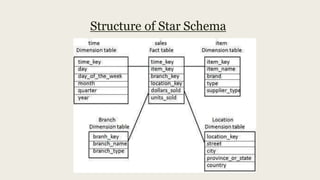
● There is a fact table at the center. It contains the keys to each of four
dimensions.
Structure of Star Schema
Advantage of Star Schema
● Easy for Users to Understand
● Optimizes Navigation
● Most Suitable for Query Processing(against an OLTP
system)
Disadvantages of Star Schema
● Data integrity is not enforced.
● Not as flexible in terms of analytical needs.
● Star schemas don’t reinforce many-to-many relationships within
business entities – at least not frequently.
● Uses large disk space
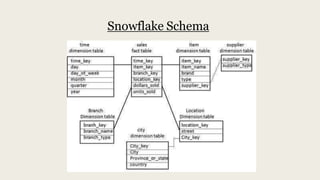
What is Snowflake Schema?
● Represented by centralized fact tables which are connected to multiple
dimensions tables.
● The principle behind snowflaking is normalization of the dimension tables
by removing low cardinality attributes and forming separate tables.
● It normalizes dimensions to eliminate redundancy
Snowflake Schema
Advantages of Snowflake Schema
● Reduces the the problem of data
integrity
● Uses small disk space
● Improvement in query performance
● Easy to understand.
Disadvantages of Snowflakes Schema
● Adds complexity to source query joins
● Additional maintenance efforts needed due to the increase number of lookup
tables.
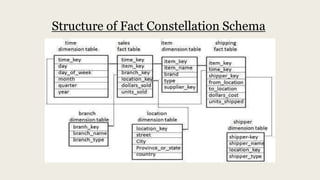
What is Galaxy or Fact constellation Schema?
● Combination other two schemas
● Constitutes of multiple fact tables sharing dimension tables.
Structure of Fact Constellation Schema
When to choose ?
● while introducing hierarchies in dimension.
● In order to deals with bigger dimension tables.
● helpful for aggregating fact tables.
Advantages of Fact ConstellationSchema
● Provides a flexible schema.
○ Improved data retrival
○ Simplified business logic
○ Better understanding
○ Fast aggregation
○ Extensibility
Disadvantages of Fact ConstellationSchema
● difficult to maintain
● more complex than star and snowflake schemas
RealWorldScenario
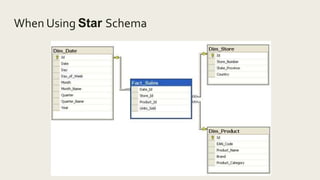
■ Consider a database for a retailer that has many stores, with each store selling many
products in many product categories and of various brands.A data warehouse or
data mart for such a retailer would need to provide analysts the ability to run sales
reports grouped by store, date (or month, quarter or year), or product category or
brand.
When Using Star Schema
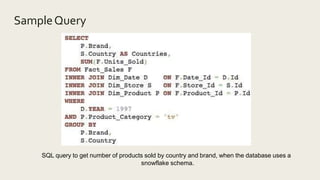
SampleQuery
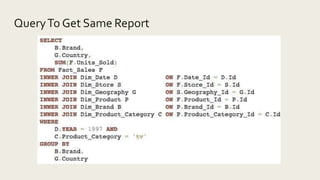
SQL query to get number of products sold by country and brand, when the database uses a
snowflake schema.
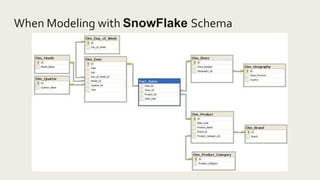
When Modeling with SnowFlake Schema
QueryTo Get Same Report
ThankYou &
HappyWorld Sleep Day !!

Multidimensional schema of data warehouse

  • 1.
    Multidimensional Schema of DataWarehouse Kunjan Shah 170 410 107 103 Batch C DMBI
  • 2.
    What is Multidimensionalschema? ● Schema is a logical description of the entire database. ● Designed to model data warehouse systems ● It includes the name and description of records of all record types including all associated data-items and aggregates. ● A database uses relational model, while a data warehouse uses Star, Snowflake, and Fact Constellation schema.
  • 3.
    Types of MultidimensionalSchemas ● Star Schema ● Snowflake Schema ● Fact Constellation Schema or Galaxy Schema
  • 4.
    What is aStar Schema? ● The simplest type of Data Warehouse schema ● Structure resembles a star. ● Each dimension in a star schema is represented with only one-dimension table. ● This dimension table contains the set of attributes. ● There is a fact table at the center. It contains the keys to each of four dimensions.
  • 5.
  • 6.
    Advantage of StarSchema ● Easy for Users to Understand ● Optimizes Navigation ● Most Suitable for Query Processing(against an OLTP system)
  • 7.
    Disadvantages of StarSchema ● Data integrity is not enforced. ● Not as flexible in terms of analytical needs. ● Star schemas don’t reinforce many-to-many relationships within business entities – at least not frequently. ● Uses large disk space
  • 8.
    What is SnowflakeSchema? ● Represented by centralized fact tables which are connected to multiple dimensions tables. ● The principle behind snowflaking is normalization of the dimension tables by removing low cardinality attributes and forming separate tables. ● It normalizes dimensions to eliminate redundancy
  • 9.
  • 10.
    Advantages of SnowflakeSchema ● Reduces the the problem of data integrity ● Uses small disk space ● Improvement in query performance ● Easy to understand.
  • 11.
    Disadvantages of SnowflakesSchema ● Adds complexity to source query joins ● Additional maintenance efforts needed due to the increase number of lookup tables.
  • 12.
    What is Galaxyor Fact constellation Schema? ● Combination other two schemas ● Constitutes of multiple fact tables sharing dimension tables.
  • 13.
    Structure of FactConstellation Schema
  • 14.
    When to choose? ● while introducing hierarchies in dimension. ● In order to deals with bigger dimension tables. ● helpful for aggregating fact tables.
  • 15.
    Advantages of FactConstellationSchema ● Provides a flexible schema. ○ Improved data retrival ○ Simplified business logic ○ Better understanding ○ Fast aggregation ○ Extensibility
  • 16.
    Disadvantages of FactConstellationSchema ● difficult to maintain ● more complex than star and snowflake schemas
  • 17.
    RealWorldScenario ■ Consider adatabase for a retailer that has many stores, with each store selling many products in many product categories and of various brands.A data warehouse or data mart for such a retailer would need to provide analysts the ability to run sales reports grouped by store, date (or month, quarter or year), or product category or brand.
  • 18.
  • 19.
    SampleQuery SQL query toget number of products sold by country and brand, when the database uses a snowflake schema.
  • 20.
    When Modeling withSnowFlake Schema
  • 21.
  • 22.