Dir. HANA PERVEZ
3RD year resident (FCPS)
Department of orthodontics
In the mixed dentition stage, space related problems are of two
types
• Lack of space causing the permanent teeth to erupt an
abnormal position
• Interferences with eruption preventing a permanent
tooth from erupting on a normal schedule and
secondarily lead to space problems due to teeth drifting
Different scenarios in space related problems are
 Excess space
 Premature tooth loss with adequate space
 Localized space loss (3mm or less) SPACE
regaining
 Mild to moderate crowding of incisors with
adequate space
 Moderate and severe generalized crowding
*
Generalized spacing of permanent teeth
Maxillary midline diastema
Maxillary dental protusion and spacing
Missing permanent teeth
EXCESS SPACE
GENERALIZED SPACING OF PERMANENT
TEETH
• It could be due to small sized teeth in normal sized
arches or normal sized teeth in large arches
• Infrequent finding in mixed dentition stage
• Allow the eruption of all the permanent teeth before
closing space with fixed appliance
MAXILLARY MIDLINE DIASTEMA
• Due to superior and distal positioning of permanent
canines in relation to lateral incisor roots forces central
and lateral roots toward the midline while their crowns
diverge distally
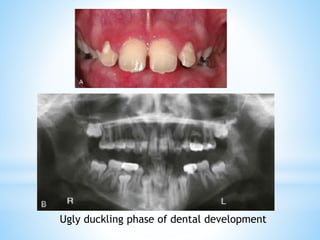
• This stage known as ugly duckling stage of development
• Corrects spontaneously as canines erupt
Ugly duckling phase of dental development
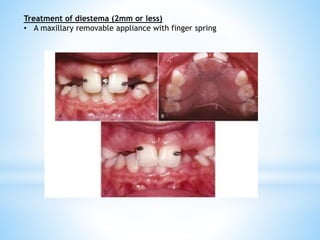
Treatment of diestema (2mm or less)
• A maxillary removable appliance with finger spring
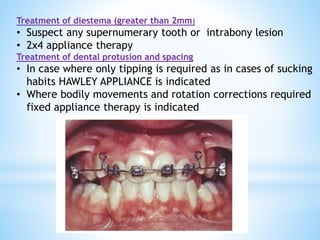
Treatment of diestema (greater than 2mm)
• Suspect any supernumerary tooth or intrabony lesion
• 2x4 appliance therapy
Treatment of dental protusion and spacing
• In case where only tipping is required as in cases of sucking
habits HAWLEY APPLIANCE is indicated
• Where bodily movements and rotation corrections required
fixed appliance therapy is indicated
MISSING PERMANENT TEETH
Missing second premolars
• Keep deciduous second molar as longsas possible to maintain alveolar
bone
• If profile is somewhat protrusive extract deciduous at the age of 7 to 9 yrs
• It allows first molar to drift into the space
• Should be done when extractions are planned in opposing arches
Missing maxillary lateral incisors
• Canine substitution for laterals
• Prosthetic replacement of laterals
Auto transplantation
• When two third root is formed, means in the mixed dentition stage
• Commonly used to move premolars for incisors and or to replace first
molar with third molar
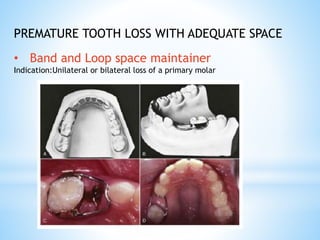
PREMATURE TOOTH LOSS WITH ADEQUATE SPACE
• Band and Loop space maintainer
Indication:Unilateral or bilateral loss of a primary molar
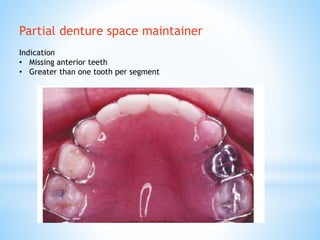
Partial denture space maintainer
Indication
• Missing anterior teeth
• Greater than one tooth per segment
DISTAL SHOE SPACE MAINTAINER
Indications
• When E’s are lost prior to eruption of first permanent molar
• Consists of guide plate along which 6 erupts
• Guide plate must extend 1 mm below MMR ( mesial marginal ridge)
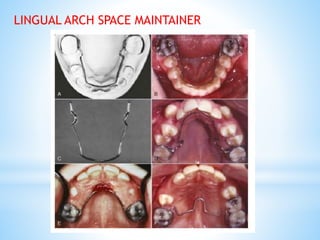
LINGUAL ARCH SPACE MAINTAINER
LOCALIZED SPACE LOSS (3mm
or less) SPACE REGAINING
• Maxillary space regaining
• Mandibular space regaining
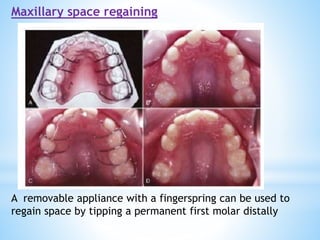
Maxillary space regaining
A removable appliance with a fingerspring can be used to
regain space by tipping a permanent first molar distally
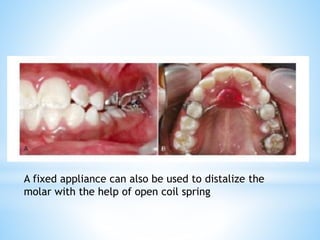
A fixed appliance can also be used to distalize the
molar with the help of open coil spring
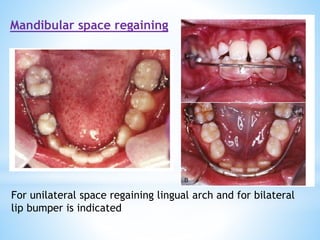
Mandibular space regaining
For unilateral space regaining lingual arch and for bilateral
lip bumper is indicated
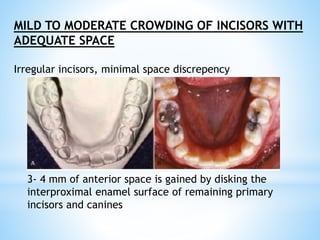
MILD TO MODERATE CROWDING OF INCISORS WITH
ADEQUATE SPACE
Irregular incisors, minimal space discrepency
3- 4 mm of anterior space is gained by disking the
interproximal enamel surface of remaining primary
incisors and canines
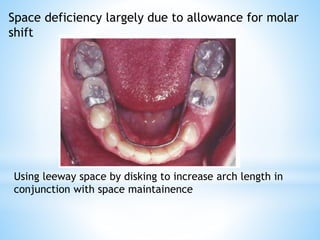
Space deficiency largely due to allowance for molar
shift
Using leeway space by disking to increase arch length in
conjunction with space maintainence
Moderate and severe generalized crowding
EARLY TREATMENT OF SEVERE CROWDING
• Maxillary dental or skeletal expansion, moving the
teeth facially or opening the midpalatal suture
• Mandibular buccal segment expansion by facial
movement of the teeth
• Advancement of incisors and distal movement of molars
in either arch
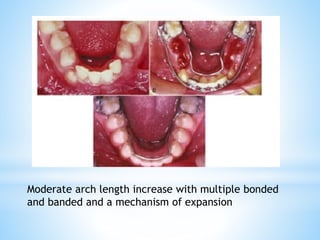
Moderate arch length increase with multiple bonded
and banded and a mechanism of expansion
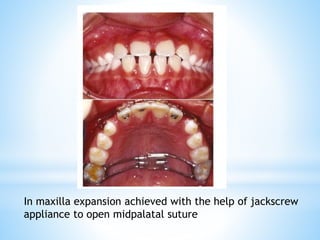
In maxilla expansion achieved with the help of jackscrew
appliance to open midpalatal suture
LATE MIXED DENTITION TREATMENT FOR
SEVERE CROWDING
Options available to treat crowding in the
late mixed dentition stage
• Distal molar movement
• Extraoral appliance(headgears)
• Serial extraction
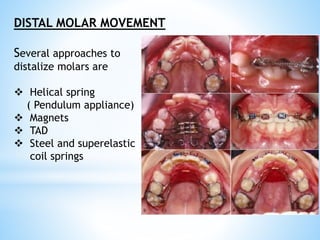
DISTAL MOLAR MOVEMENT
Several approaches to
distalize molars are
 Helical spring
( Pendulum appliance)
 Magnets
 TAD
 Steel and superelastic
coil springs
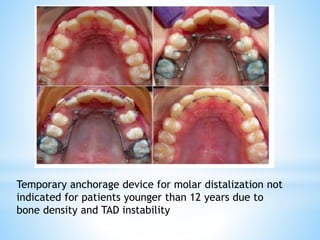
Temporary anchorage device for molar distalization not
indicated for patients younger than 12 years due to
bone density and TAD instability
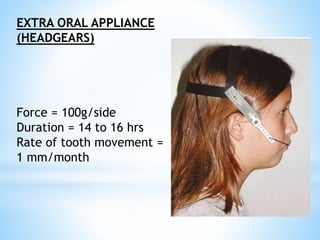
EXTRA ORAL APPLIANCE
(HEADGEARS)
Force = 100g/side
Duration = 14 to 16 hrs
Rate of tooth movement =
1 mm/month
EARLY SERIAL EXTRACTION
Indication:
• Space discrepency is greater than 10mm
• No skeletal discrepency of jaws
• Normal overjet and overbite
• Class 1 molar relation
• Straight profile
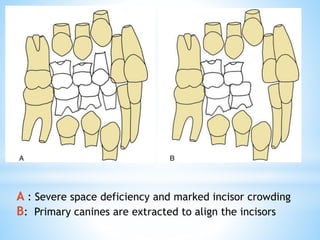
A : Severe space deficiency and marked incisor crowding
B: Primary canines are extracted to align the incisors
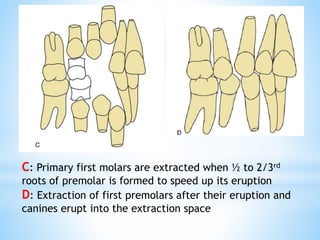
C: Primary first molars are extracted when ½ to 2/3rd
roots of premolar is formed to speed up its eruption
D: Extraction of first premolars after their eruption and
canines erupt into the extraction space
ALTERNATIVE APPROACH
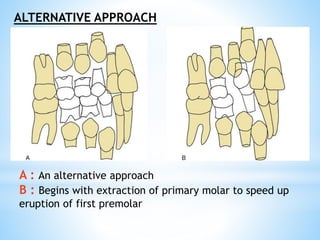
A : An alternative approach
B : Begins with extraction of primary molar to speed up
eruption of first premolar
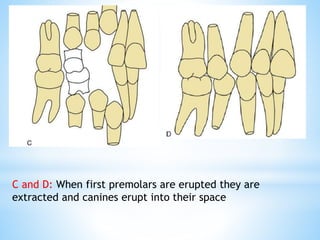
C and D: When first premolars are erupted they are
extracted and canines erupt into their space
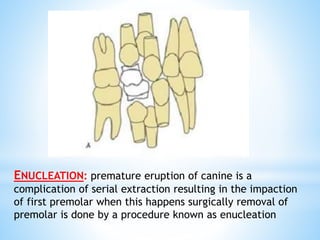
ENUCLEATION: premature eruption of canine is a
complication of serial extraction resulting in the impaction
of first premolar when this happens surgically removal of
premolar is done by a procedure known as enucleation
Space supervision and gross discripency

Space supervision and gross discripency

  • 1.
    Dir. HANA PERVEZ 3RDyear resident (FCPS) Department of orthodontics
  • 2.
    In the mixeddentition stage, space related problems are of two types • Lack of space causing the permanent teeth to erupt an abnormal position • Interferences with eruption preventing a permanent tooth from erupting on a normal schedule and secondarily lead to space problems due to teeth drifting
  • 3.
    Different scenarios inspace related problems are  Excess space  Premature tooth loss with adequate space  Localized space loss (3mm or less) SPACE regaining  Mild to moderate crowding of incisors with adequate space  Moderate and severe generalized crowding
  • 4.
    * Generalized spacing ofpermanent teeth Maxillary midline diastema Maxillary dental protusion and spacing Missing permanent teeth EXCESS SPACE
  • 5.
    GENERALIZED SPACING OFPERMANENT TEETH • It could be due to small sized teeth in normal sized arches or normal sized teeth in large arches • Infrequent finding in mixed dentition stage • Allow the eruption of all the permanent teeth before closing space with fixed appliance MAXILLARY MIDLINE DIASTEMA • Due to superior and distal positioning of permanent canines in relation to lateral incisor roots forces central and lateral roots toward the midline while their crowns diverge distally • This stage known as ugly duckling stage of development • Corrects spontaneously as canines erupt
  • 6.
    Ugly duckling phaseof dental development
  • 7.
    Treatment of diestema(2mm or less) • A maxillary removable appliance with finger spring
  • 8.
    Treatment of diestema(greater than 2mm) • Suspect any supernumerary tooth or intrabony lesion • 2x4 appliance therapy Treatment of dental protusion and spacing • In case where only tipping is required as in cases of sucking habits HAWLEY APPLIANCE is indicated • Where bodily movements and rotation corrections required fixed appliance therapy is indicated
  • 9.
    MISSING PERMANENT TEETH Missingsecond premolars • Keep deciduous second molar as longsas possible to maintain alveolar bone • If profile is somewhat protrusive extract deciduous at the age of 7 to 9 yrs • It allows first molar to drift into the space • Should be done when extractions are planned in opposing arches Missing maxillary lateral incisors • Canine substitution for laterals • Prosthetic replacement of laterals Auto transplantation • When two third root is formed, means in the mixed dentition stage • Commonly used to move premolars for incisors and or to replace first molar with third molar
  • 10.
    PREMATURE TOOTH LOSSWITH ADEQUATE SPACE • Band and Loop space maintainer Indication:Unilateral or bilateral loss of a primary molar
  • 11.
    Partial denture spacemaintainer Indication • Missing anterior teeth • Greater than one tooth per segment
  • 12.
    DISTAL SHOE SPACEMAINTAINER Indications • When E’s are lost prior to eruption of first permanent molar • Consists of guide plate along which 6 erupts • Guide plate must extend 1 mm below MMR ( mesial marginal ridge)
  • 13.
  • 14.
    LOCALIZED SPACE LOSS(3mm or less) SPACE REGAINING • Maxillary space regaining • Mandibular space regaining
  • 15.
    Maxillary space regaining Aremovable appliance with a fingerspring can be used to regain space by tipping a permanent first molar distally
  • 16.
    A fixed appliancecan also be used to distalize the molar with the help of open coil spring
  • 17.
    Mandibular space regaining Forunilateral space regaining lingual arch and for bilateral lip bumper is indicated
  • 18.
    MILD TO MODERATECROWDING OF INCISORS WITH ADEQUATE SPACE Irregular incisors, minimal space discrepency 3- 4 mm of anterior space is gained by disking the interproximal enamel surface of remaining primary incisors and canines
  • 19.
    Space deficiency largelydue to allowance for molar shift Using leeway space by disking to increase arch length in conjunction with space maintainence
  • 20.
    Moderate and severegeneralized crowding EARLY TREATMENT OF SEVERE CROWDING • Maxillary dental or skeletal expansion, moving the teeth facially or opening the midpalatal suture • Mandibular buccal segment expansion by facial movement of the teeth • Advancement of incisors and distal movement of molars in either arch
  • 21.
    Moderate arch lengthincrease with multiple bonded and banded and a mechanism of expansion
  • 22.
    In maxilla expansionachieved with the help of jackscrew appliance to open midpalatal suture
  • 23.
    LATE MIXED DENTITIONTREATMENT FOR SEVERE CROWDING Options available to treat crowding in the late mixed dentition stage • Distal molar movement • Extraoral appliance(headgears) • Serial extraction
  • 24.
    DISTAL MOLAR MOVEMENT Severalapproaches to distalize molars are  Helical spring ( Pendulum appliance)  Magnets  TAD  Steel and superelastic coil springs
  • 25.
    Temporary anchorage devicefor molar distalization not indicated for patients younger than 12 years due to bone density and TAD instability
  • 26.
    EXTRA ORAL APPLIANCE (HEADGEARS) Force= 100g/side Duration = 14 to 16 hrs Rate of tooth movement = 1 mm/month
  • 27.
    EARLY SERIAL EXTRACTION Indication: •Space discrepency is greater than 10mm • No skeletal discrepency of jaws • Normal overjet and overbite • Class 1 molar relation • Straight profile
  • 28.
    A : Severespace deficiency and marked incisor crowding B: Primary canines are extracted to align the incisors
  • 29.
    C: Primary firstmolars are extracted when ½ to 2/3rd roots of premolar is formed to speed up its eruption D: Extraction of first premolars after their eruption and canines erupt into the extraction space
  • 30.
    ALTERNATIVE APPROACH A :An alternative approach B : Begins with extraction of primary molar to speed up eruption of first premolar
  • 31.
    C and D:When first premolars are erupted they are extracted and canines erupt into their space
  • 32.
    ENUCLEATION: premature eruptionof canine is a complication of serial extraction resulting in the impaction of first premolar when this happens surgically removal of premolar is done by a procedure known as enucleation