Dr shabeel pn ANTERIOR  TEETH    SELECTION dr shabeel's presentations
  THE ANTERIOR TEETH ARE  PRIMARILY SELECTED TO SATISFY THE ESTHETIC REQUIREMENT,WHERE AS THE POSTERIOR TEETH ARE PRIMARILY SELECTED TO  SATISFY THE FUNCTIONAL REQUIREMENTS THE  ANTERIOR TEETH ARE  COMPOSED OF SIX MAXILLARY AND SIX  MANDIBULAR TEETH. INTRODUCTION
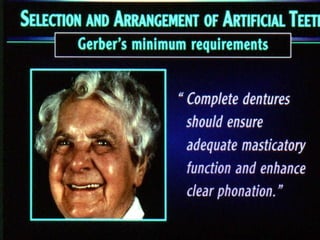
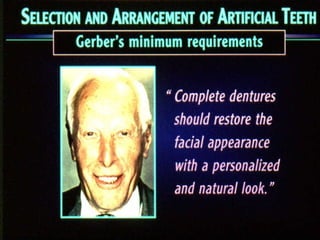
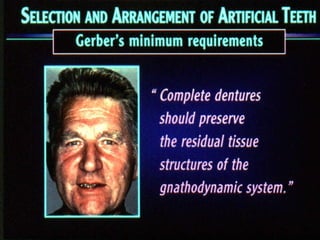
OBJECTIVES FOR TOOTH SELECTION   TO CONSTRUCT THE COMPLETE DENTURE THAT………… 1. FUNCTION WELL EFFICIENT    FOR MASTICATION. 2. ALLOW PATIENT TO SPEAK NORMALLY. 3. ESTHETICALLY PLEASING. 4. WILL NOT ABUSE TISSUE OVER     RESIDUAL RIDGE. 5. SHOULD MAINTAIN THE VERTICAL  DIMENSION


FACTORS FOR SELECTION  OF ANTERIOR TEETH 1.  SIZE OF THE TEETH   2.  FORM OF THE TEETH    3.  COLOR / SHADE OF THE TEETH   4.  COMPOSITION OF MATERIAL OF TEETH
  SIZE OF THE TEETH   There are seven anatomic entities are used as anatomic guides for the selection of anterior teeth for   size 1.   SIZE OF THE FACE 2. SIZE OF THE MAXILLARY ARCH 3. INCISAL PAPILLA  AND CUSPID EMINENCES    4. MAXILLO MANDIBULAR RELATIONS 5. THE CONTOUR OF THE RESIDUAL RIDGE 6. VERTICAL DISTANCE  B\W THE RIDGES 7. THE LIPS
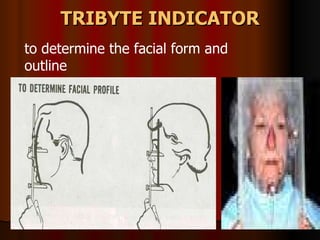
1. SIZE OF THE FACE The average width of the maxillary central incisor is estimated to be one sixteenth of the face measured between the zygoma. The size of the maxillary central incisor is important for they are the most prominent teeth in arch as individual is viewed from frontal position. “ the tribute tooth indicator” is useful in determining the maxillary central incisor.
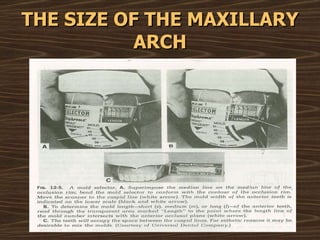
2. SIZE OF THE MAXILLARY ARCH The mold selector can be used to make measurement of the maxillary cast. Accurately contoured occlusion rims are required The measurements are made from the midline on the maxillary occlusion rim to the distal of the cuspid eminence Measure the distance from the distal of one cuspid eminence to the distal of the other with a flexible.
THE SIZE OF THE MAXILLARY ARCH
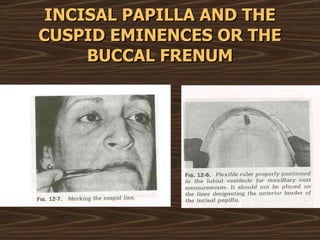
3. INCISAL PAPPILAE & THE CUSPID  EMINENCE OR THE BUCCAL FRENUM If the cuspid eminence are visible, a line can be placed on the cast at the distal termination of the eminence. If the cuspid eminence are not visible the attachment of the buccal frenum can be used. A line placed slightly anterior to the frenum attachment will be distal of the eminence. Measure the distance from the distal of one cuspid eminence to the distal of the other with a flexible ruler. The ruler should follow the contour of the ridge and as it reaches midline, it should be placed on the anterior border of the incisal papilla.  The combined width of the six max anterior teeth is determined in mms.
INCISAL PAPILLA AND THE CUSPID EMINENCES OR THE BUCCAL FRENUM
4.MAXILLO MANDIBULAR RELATIONS Any disproportion in size between the maxillary and mandibular arches influence the length, width, and the position of the teeth. In instances of protruded mandible, the mandibular anterior teeth are frequently larger than normal. If the mandible are retruded the mandibular anterior teeth are frequently smaller.
5. CONTOUR OF THE RESIDUAL RIDGE The artificial teeth should be placed to follow the contour of the residual ridges that existed when the natural teeth were present. The loss of contour as a result of resorption, accident or surgery makes this a difficult task.  As resorption occurs, the maxillary arch appears smaller and the mandibular arch larger.
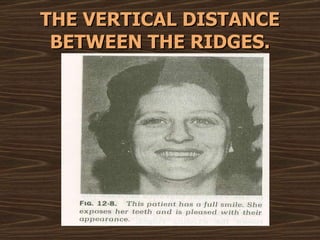
6. THE VERTICAL DISTANCE BETWEEN THE RIDGES The length of the teeth is determined by the available space between the existing ridges. When the space is available, it is more esthetically acceptable to use a tooth long enough to eliminate the display of the denture base. Teeth are more attractive in appearance than denture base material.
THE VERTICAL DISTANCE BETWEEN THE RIDGES.
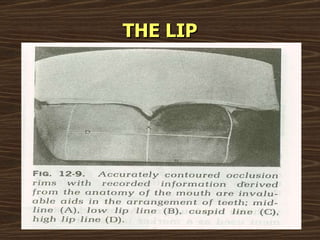
7.THE LIP When the lips are relaxed and apart the labial surface of the maxillary anterior teeth support the upper lip. The incisal edge extends inferior to or slightly below the lip margin. When the teeth are in occlusion and the lips are together, the labial incisal 3 rd  of the max anterior teeth supports the superior border of the lower lip In speech the incisal edges of the max anterior teeth contact the lower lip at the junction of the moist and dry surfaces of the vermillion border.
THE LIP
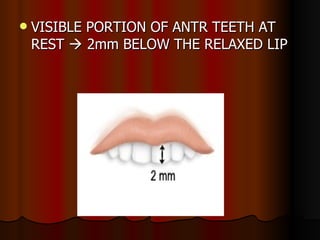
VISIBLE PORTION OF ANTR TEETH AT REST    2mm BELOW THE RELAXED LIP
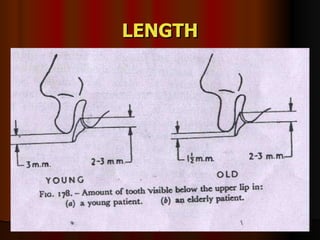
The  length  and the  width  are the only two dimensions which need to determining the size of the teeth Length The length of the upper six anterior teeth is normally such that the neck of the teeth will overlap the anterior ridge by 2-3mm Cervically up the incisive edges of the centrals will show below the relaxed lip. Length of the teeth depends on the following factors - length of the upper lip  - mobility of the upper lip - vertical height of occlusion - overbite
LENGTH
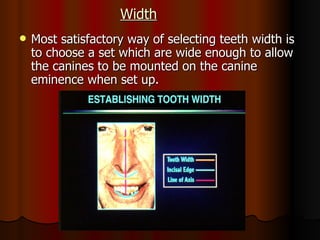
Width Most satisfactory way of selecting teeth width is to choose a set which are wide enough to allow the canines to be mounted on the canine eminence when set up.
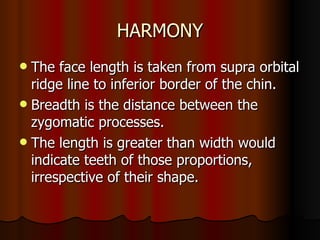
HARMONY The face length is taken from supra orbital ridge line to inferior border of the chin. Breadth is the distance between the zygomatic processes. The length is greater than width would indicate teeth of those proportions, irrespective of their shape.
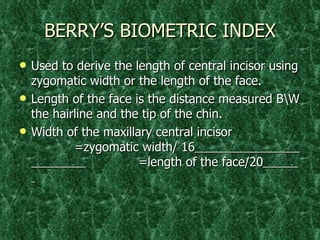
BERRY’S BIOMETRIC INDEX Used to derive the length of central incisor using zygomatic width or the length of the face. Length of the face is the distance measured B\W the hairline and the tip of the chin.  Width of the maxillary central incisor    =zygomatic width/ 16     =length of the face/20
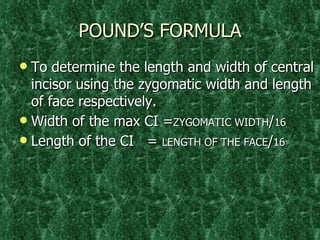
POUND’S FORMULA To determine the length and width of central incisor using the zygomatic width and length of face respectively. Width of the max CI = ZYGOMATIC WIDTH / 16 Length of the CI  =  LENGTH OF THE FACE / 16
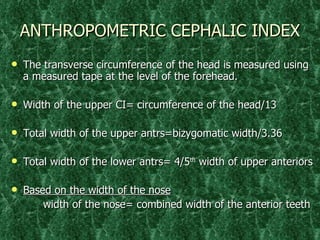
ANTHROPOMETRIC CEPHALIC INDEX The transverse circumference of the head is measured using a measured tape at the level of the forehead. Width of the upper CI= circumference of the head/13 Total width of the upper antrs=bizygomatic width/3.36 Total width of the lower antrs= 4/5 th  width of upper anteriors Based on the width of the nose width of the nose= combined width of the anterior teeth
METHODS USING  PRE-EXTRACTION RECORDS DIAGNOSTIC CASTS PRE-EXTRACTION PHOTOGRAPHS PRE-EXTRACTION RADIO GRAPHS TEETH OF CLOSE RELATIVES PRESERVED EXTRACTED TEETH
Methods using theoretical concept Winkler's concept According to Winkler,  THE TEETH SHOULD BE SELECTED BASED ON THREE DIFFERENT VIEWS A – PHYSIOLOGICAL B – PSYCHOLOGICAL C - BIOMECHANICAL
PHYSIOLOGICAL The facial musculature contributes to esthetics of the patient Increasing the thickness of the denture base in the labial and the buccal sulci can produce a puffy appearance. Facial wrinkles fade when when the vertical dimension is increased.
PSYCHOLOGICAL A patient with a +ve self evaluation shows a broad smile up the one width a negative self evaluation shows a tight lipped small smile  The campers line the psychological plane of orientation (superior border of the tragas of ear to inferior border of the ala of the nose).  It is raised in happy people and is tilted down ward in depressed people.
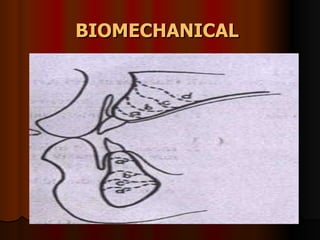
BIOMECHANICAL The teeth should be placed such that  they fulfill the biomechanics of the denture. The teeth should be set in the neutral zone.
BIOMECHANICAL
 
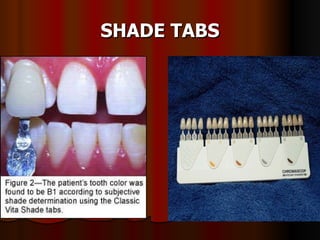
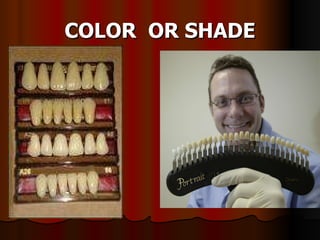
COLOR/SHADE OF THE TEETH Color is described by means of - hue  - value - chroma Tooth shade must be compatible with the patient’s facial expression and eye color The color must be in harmony with surrounding environment like hair, skin and eyes. The neck of the teeth has a more pronounced color than incisive edge. Incisive edge is more translucent than body of tooth
Older people have dark and opaque teeth and are more shiny also, than young people in people who are smokers, alcoholics and chewers have discolored teeth due to stains porcelain teeth are preferred since they don’t allow percolation. The color of the teeth chosen should be in harmony with the complexion of the patient.
COLOR  OR SHADE
SHADE TABS
 
 
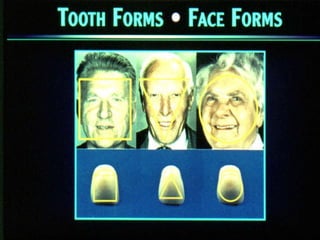
FORM OF THE ANTERIOR TEETH The form of the teeth should be conformed to contour of the face as considered from the labial, mesial, distal and incisal aspect The general outline of the tooth should conform to the general outline of the face when viewed from frontal aspect. Three factors are used as guides in the selection of anterior teeth for form. The form and contour of the face  SEX AGE
THE FORM AND CONTOUR OF THE FACE According to  Leon Williams  classification face Three types  Square Tapering Ovoid
TRIBYTE INDICATOR to determine the facial form and outline
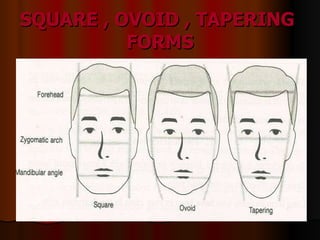
SQUARE Facial form - the width of the forehead, zygomatic arch and mandibular angle is equal. Profile - straight and flat ala area Incisal form - mesial and distal lines are almost parallel till the length of 2/3 rd  from incisal edge.
ovoid Facial form - width of zygomatic arch is wider than the distance of forehead. Profile  - ovoid ala area Incisal form - mesial and distal lines are curved.
Tapering   Facial form  - the width becomes narrow from forehead towards to zygomatic arch and mandibular angle. Profile - curved or flat Incisal form - mesial and distal lines become narrow from incisal edge to cervical end.
SQUARE , OVOID , TAPERING  FORMS
 
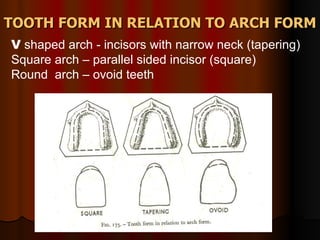
TOOTH FORM IN RELATION TO ARCH FORM V  shaped arch - incisors with narrow neck (tapering) Square arch – parallel sided incisor (square) Round  arch – ovoid teeth
 
Dentogenic concept (SPA) Sex, personality, age are the factors which will determine the form of the antr teeth
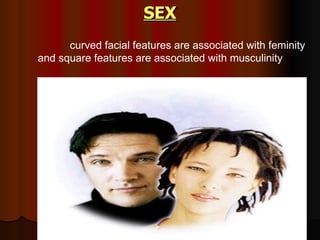
SEX curved facial features are associated with feminity and square features are associated with musculinity
MUSCULINE Prominent teeth Large sized teeth  Square arch form Square labial surface Square incisal edges and corners Darker shade Flat smiling line Canine – cervical area is more visible and prominent  Feminine   Smaller teeth Round corners  Curved contours & arch form Curved labial surface Round incisal edges and corners Delicate appearance Curved smiling line Canine – mesial 3 rd  only seen
Personality   The dentist should select and arrange teeth so that it improves the patient’s personality. The patient can be vigorous or delicate. More squarish and large teeth are selected for vigorous people For executives, the anteriors should be in a flat plane and the teeth should be relatively smaller and more symmetrically arranged.
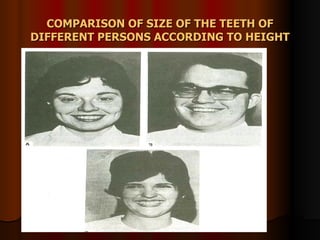
COMPARISON OF SIZE OF THE TEETH OF DIFFERENT PERSONS ACCORDING TO HEIGHT
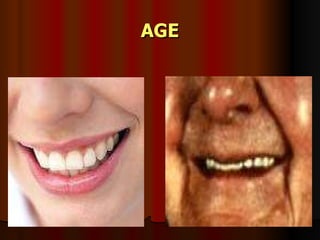
AGE
Age  Younger people   Lighter shade More incisal  translucency Minimal wear of incisal edge Curved smiling line Pointed canines Older people Darker shade Less incisal translucency increased wear of incisal edges Flat smiling line Loss of tips of canine
 
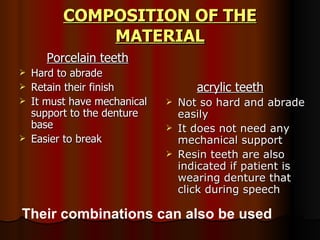
COMPOSITION OF THE MATERIAL   Porcelain teeth Hard to abrade Retain their finish It must have mechanical support to the denture base Easier to break acrylic teeth Not so hard and abrade easily It does not need any mechanical support Resin teeth are also indicated if patient is wearing denture that click during speech Their combinations can also be used
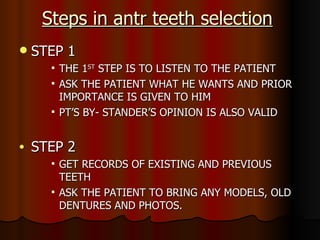
Steps in antr teeth selection STEP 1 THE 1 ST  STEP IS TO LISTEN TO THE PATIENT ASK THE PATIENT WHAT HE WANTS AND PRIOR IMPORTANCE IS GIVEN TO HIM PT’S BY- STANDER’S OPINION IS ALSO VALID STEP 2 GET RECORDS OF EXISTING AND PREVIOUS TEETH ASK THE PATIENT TO BRING ANY MODELS, OLD DENTURES AND PHOTOS.
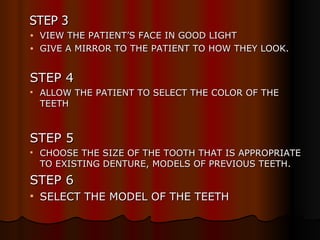
  STEP 3 VIEW THE PATIENT’S FACE IN GOOD LIGHT GIVE A MIRROR TO THE PATIENT TO HOW THEY LOOK. STEP 4 ALLOW THE PATIENT TO SELECT THE COLOR OF THE TEETH STEP 5 CHOOSE THE SIZE OF THE TOOTH THAT IS APPROPRIATE TO EXISTING DENTURE, MODELS OF PREVIOUS TEETH. STEP 6 SELECT THE MODEL OF THE TEETH
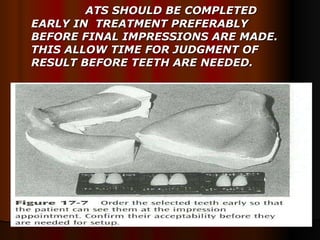
ATS SHOULD BE COMPLETED EARLY IN  TREATMENT PREFERABLY BEFORE FINAL IMPRESSIONS ARE MADE. THIS ALLOW TIME FOR JUDGMENT OF RESULT BEFORE TEETH ARE NEEDED.
CONCLUSION ATS  IS THE AREA OF PROSTHODONTIC CARE IN WHICH THE PATIENT SHOULD BE GIVEN A PRIMARY RESPONSIBILITY TO DETERMINE THE ESTHETIC OUT COME.  SO, A DENTIST SHOULD ASSIST THE PATIENT IN MAKING THE BEST DECISION.
THANK  YOU…

anterior tooth selection

  • 1.
    Dr shabeel pnANTERIOR TEETH SELECTION dr shabeel's presentations
  • 2.
    THEANTERIOR TEETH ARE PRIMARILY SELECTED TO SATISFY THE ESTHETIC REQUIREMENT,WHERE AS THE POSTERIOR TEETH ARE PRIMARILY SELECTED TO SATISFY THE FUNCTIONAL REQUIREMENTS THE ANTERIOR TEETH ARE COMPOSED OF SIX MAXILLARY AND SIX MANDIBULAR TEETH. INTRODUCTION
  • 3.
    OBJECTIVES FOR TOOTHSELECTION TO CONSTRUCT THE COMPLETE DENTURE THAT………… 1. FUNCTION WELL EFFICIENT FOR MASTICATION. 2. ALLOW PATIENT TO SPEAK NORMALLY. 3. ESTHETICALLY PLEASING. 4. WILL NOT ABUSE TISSUE OVER RESIDUAL RIDGE. 5. SHOULD MAINTAIN THE VERTICAL DIMENSION
  • 4.
  • 5.
  • 6.
  • 7.
  • 8.
    FACTORS FOR SELECTION OF ANTERIOR TEETH 1. SIZE OF THE TEETH 2. FORM OF THE TEETH 3. COLOR / SHADE OF THE TEETH 4. COMPOSITION OF MATERIAL OF TEETH
  • 9.
    SIZEOF THE TEETH There are seven anatomic entities are used as anatomic guides for the selection of anterior teeth for size 1. SIZE OF THE FACE 2. SIZE OF THE MAXILLARY ARCH 3. INCISAL PAPILLA AND CUSPID EMINENCES 4. MAXILLO MANDIBULAR RELATIONS 5. THE CONTOUR OF THE RESIDUAL RIDGE 6. VERTICAL DISTANCE B\W THE RIDGES 7. THE LIPS
  • 10.
    1. SIZE OFTHE FACE The average width of the maxillary central incisor is estimated to be one sixteenth of the face measured between the zygoma. The size of the maxillary central incisor is important for they are the most prominent teeth in arch as individual is viewed from frontal position. “ the tribute tooth indicator” is useful in determining the maxillary central incisor.
  • 11.
    2. SIZE OFTHE MAXILLARY ARCH The mold selector can be used to make measurement of the maxillary cast. Accurately contoured occlusion rims are required The measurements are made from the midline on the maxillary occlusion rim to the distal of the cuspid eminence Measure the distance from the distal of one cuspid eminence to the distal of the other with a flexible.
  • 12.
    THE SIZE OFTHE MAXILLARY ARCH
  • 13.
    3. INCISAL PAPPILAE& THE CUSPID EMINENCE OR THE BUCCAL FRENUM If the cuspid eminence are visible, a line can be placed on the cast at the distal termination of the eminence. If the cuspid eminence are not visible the attachment of the buccal frenum can be used. A line placed slightly anterior to the frenum attachment will be distal of the eminence. Measure the distance from the distal of one cuspid eminence to the distal of the other with a flexible ruler. The ruler should follow the contour of the ridge and as it reaches midline, it should be placed on the anterior border of the incisal papilla. The combined width of the six max anterior teeth is determined in mms.
  • 14.
    INCISAL PAPILLA ANDTHE CUSPID EMINENCES OR THE BUCCAL FRENUM
  • 15.
    4.MAXILLO MANDIBULAR RELATIONSAny disproportion in size between the maxillary and mandibular arches influence the length, width, and the position of the teeth. In instances of protruded mandible, the mandibular anterior teeth are frequently larger than normal. If the mandible are retruded the mandibular anterior teeth are frequently smaller.
  • 16.
    5. CONTOUR OFTHE RESIDUAL RIDGE The artificial teeth should be placed to follow the contour of the residual ridges that existed when the natural teeth were present. The loss of contour as a result of resorption, accident or surgery makes this a difficult task. As resorption occurs, the maxillary arch appears smaller and the mandibular arch larger.
  • 17.
    6. THE VERTICALDISTANCE BETWEEN THE RIDGES The length of the teeth is determined by the available space between the existing ridges. When the space is available, it is more esthetically acceptable to use a tooth long enough to eliminate the display of the denture base. Teeth are more attractive in appearance than denture base material.
  • 18.
    THE VERTICAL DISTANCEBETWEEN THE RIDGES.
  • 19.
    7.THE LIP Whenthe lips are relaxed and apart the labial surface of the maxillary anterior teeth support the upper lip. The incisal edge extends inferior to or slightly below the lip margin. When the teeth are in occlusion and the lips are together, the labial incisal 3 rd of the max anterior teeth supports the superior border of the lower lip In speech the incisal edges of the max anterior teeth contact the lower lip at the junction of the moist and dry surfaces of the vermillion border.
  • 20.
  • 21.
    VISIBLE PORTION OFANTR TEETH AT REST  2mm BELOW THE RELAXED LIP
  • 22.
    The length and the width are the only two dimensions which need to determining the size of the teeth Length The length of the upper six anterior teeth is normally such that the neck of the teeth will overlap the anterior ridge by 2-3mm Cervically up the incisive edges of the centrals will show below the relaxed lip. Length of the teeth depends on the following factors - length of the upper lip - mobility of the upper lip - vertical height of occlusion - overbite
  • 23.
  • 24.
    Width Most satisfactoryway of selecting teeth width is to choose a set which are wide enough to allow the canines to be mounted on the canine eminence when set up.
  • 25.
    HARMONY The facelength is taken from supra orbital ridge line to inferior border of the chin. Breadth is the distance between the zygomatic processes. The length is greater than width would indicate teeth of those proportions, irrespective of their shape.
  • 26.
    BERRY’S BIOMETRIC INDEXUsed to derive the length of central incisor using zygomatic width or the length of the face. Length of the face is the distance measured B\W the hairline and the tip of the chin. Width of the maxillary central incisor =zygomatic width/ 16 =length of the face/20
  • 27.
    POUND’S FORMULA Todetermine the length and width of central incisor using the zygomatic width and length of face respectively. Width of the max CI = ZYGOMATIC WIDTH / 16 Length of the CI = LENGTH OF THE FACE / 16
  • 28.
    ANTHROPOMETRIC CEPHALIC INDEXThe transverse circumference of the head is measured using a measured tape at the level of the forehead. Width of the upper CI= circumference of the head/13 Total width of the upper antrs=bizygomatic width/3.36 Total width of the lower antrs= 4/5 th width of upper anteriors Based on the width of the nose width of the nose= combined width of the anterior teeth
  • 29.
    METHODS USING PRE-EXTRACTION RECORDS DIAGNOSTIC CASTS PRE-EXTRACTION PHOTOGRAPHS PRE-EXTRACTION RADIO GRAPHS TEETH OF CLOSE RELATIVES PRESERVED EXTRACTED TEETH
  • 30.
    Methods using theoreticalconcept Winkler's concept According to Winkler, THE TEETH SHOULD BE SELECTED BASED ON THREE DIFFERENT VIEWS A – PHYSIOLOGICAL B – PSYCHOLOGICAL C - BIOMECHANICAL
  • 31.
    PHYSIOLOGICAL The facialmusculature contributes to esthetics of the patient Increasing the thickness of the denture base in the labial and the buccal sulci can produce a puffy appearance. Facial wrinkles fade when when the vertical dimension is increased.
  • 32.
    PSYCHOLOGICAL A patientwith a +ve self evaluation shows a broad smile up the one width a negative self evaluation shows a tight lipped small smile The campers line the psychological plane of orientation (superior border of the tragas of ear to inferior border of the ala of the nose). It is raised in happy people and is tilted down ward in depressed people.
  • 33.
    BIOMECHANICAL The teethshould be placed such that they fulfill the biomechanics of the denture. The teeth should be set in the neutral zone.
  • 34.
  • 35.
  • 36.
    COLOR/SHADE OF THETEETH Color is described by means of - hue - value - chroma Tooth shade must be compatible with the patient’s facial expression and eye color The color must be in harmony with surrounding environment like hair, skin and eyes. The neck of the teeth has a more pronounced color than incisive edge. Incisive edge is more translucent than body of tooth
  • 37.
    Older people havedark and opaque teeth and are more shiny also, than young people in people who are smokers, alcoholics and chewers have discolored teeth due to stains porcelain teeth are preferred since they don’t allow percolation. The color of the teeth chosen should be in harmony with the complexion of the patient.
  • 38.
    COLOR ORSHADE
  • 39.
  • 40.
  • 41.
  • 42.
    FORM OF THEANTERIOR TEETH The form of the teeth should be conformed to contour of the face as considered from the labial, mesial, distal and incisal aspect The general outline of the tooth should conform to the general outline of the face when viewed from frontal aspect. Three factors are used as guides in the selection of anterior teeth for form. The form and contour of the face SEX AGE
  • 43.
    THE FORM ANDCONTOUR OF THE FACE According to Leon Williams classification face Three types Square Tapering Ovoid
  • 44.
    TRIBYTE INDICATOR todetermine the facial form and outline
  • 45.
    SQUARE Facial form- the width of the forehead, zygomatic arch and mandibular angle is equal. Profile - straight and flat ala area Incisal form - mesial and distal lines are almost parallel till the length of 2/3 rd from incisal edge.
  • 46.
    ovoid Facial form- width of zygomatic arch is wider than the distance of forehead. Profile - ovoid ala area Incisal form - mesial and distal lines are curved.
  • 47.
    Tapering Facial form - the width becomes narrow from forehead towards to zygomatic arch and mandibular angle. Profile - curved or flat Incisal form - mesial and distal lines become narrow from incisal edge to cervical end.
  • 48.
    SQUARE , OVOID, TAPERING FORMS
  • 49.
  • 50.
    TOOTH FORM INRELATION TO ARCH FORM V shaped arch - incisors with narrow neck (tapering) Square arch – parallel sided incisor (square) Round arch – ovoid teeth
  • 51.
  • 52.
    Dentogenic concept (SPA)Sex, personality, age are the factors which will determine the form of the antr teeth
  • 53.
    SEX curved facialfeatures are associated with feminity and square features are associated with musculinity
  • 54.
    MUSCULINE Prominent teethLarge sized teeth Square arch form Square labial surface Square incisal edges and corners Darker shade Flat smiling line Canine – cervical area is more visible and prominent Feminine Smaller teeth Round corners Curved contours & arch form Curved labial surface Round incisal edges and corners Delicate appearance Curved smiling line Canine – mesial 3 rd only seen
  • 55.
    Personality The dentist should select and arrange teeth so that it improves the patient’s personality. The patient can be vigorous or delicate. More squarish and large teeth are selected for vigorous people For executives, the anteriors should be in a flat plane and the teeth should be relatively smaller and more symmetrically arranged.
  • 56.
    COMPARISON OF SIZEOF THE TEETH OF DIFFERENT PERSONS ACCORDING TO HEIGHT
  • 57.
  • 58.
    Age Youngerpeople Lighter shade More incisal translucency Minimal wear of incisal edge Curved smiling line Pointed canines Older people Darker shade Less incisal translucency increased wear of incisal edges Flat smiling line Loss of tips of canine
  • 59.
  • 60.
    COMPOSITION OF THEMATERIAL Porcelain teeth Hard to abrade Retain their finish It must have mechanical support to the denture base Easier to break acrylic teeth Not so hard and abrade easily It does not need any mechanical support Resin teeth are also indicated if patient is wearing denture that click during speech Their combinations can also be used
  • 61.
    Steps in antrteeth selection STEP 1 THE 1 ST STEP IS TO LISTEN TO THE PATIENT ASK THE PATIENT WHAT HE WANTS AND PRIOR IMPORTANCE IS GIVEN TO HIM PT’S BY- STANDER’S OPINION IS ALSO VALID STEP 2 GET RECORDS OF EXISTING AND PREVIOUS TEETH ASK THE PATIENT TO BRING ANY MODELS, OLD DENTURES AND PHOTOS.
  • 62.
    STEP3 VIEW THE PATIENT’S FACE IN GOOD LIGHT GIVE A MIRROR TO THE PATIENT TO HOW THEY LOOK. STEP 4 ALLOW THE PATIENT TO SELECT THE COLOR OF THE TEETH STEP 5 CHOOSE THE SIZE OF THE TOOTH THAT IS APPROPRIATE TO EXISTING DENTURE, MODELS OF PREVIOUS TEETH. STEP 6 SELECT THE MODEL OF THE TEETH
  • 63.
    ATS SHOULD BECOMPLETED EARLY IN TREATMENT PREFERABLY BEFORE FINAL IMPRESSIONS ARE MADE. THIS ALLOW TIME FOR JUDGMENT OF RESULT BEFORE TEETH ARE NEEDED.
  • 64.
    CONCLUSION ATS IS THE AREA OF PROSTHODONTIC CARE IN WHICH THE PATIENT SHOULD BE GIVEN A PRIMARY RESPONSIBILITY TO DETERMINE THE ESTHETIC OUT COME. SO, A DENTIST SHOULD ASSIST THE PATIENT IN MAKING THE BEST DECISION.
  • 65.