CROSS BITE
By: Aditi Singh
P.G Dept of pediatric dentistry
SDCH
DEFINING THE PROBLEM….
• A Condition where one or more teeth may be
malposed abnormally buccally lingually or
labially with reference to opposing tooth or
teeth. - Graber
• Moyers defines a simple anterior tooth
crossbite as a dental malocclusion resulting
from the abnormal axial inclination of one or
more maxillary teeth
WHY IS IT AN EMERGENCY..?
• Anterior dental crossbite requires early and
immediate treatment to prevent abnormal
enamel abrasion, anterior teeth mobility and
fracture, periodontal pathosis and
temporomandibular joint disturbance.
• The main goal of treatment is to tip the affected
maxillary tooth or teeth labially to the point
where a stable overbite relationship exists.
• Relapse is usually prevented by the normal
overjet/overbite relationship that is achieved.

Bayrak S,Tunc ES;Treatment of Anterior Dental Crossbite Using Bonded Resin-Composite Slopes:Cas
Reports;EurJournOfDent;2008;2(1)
CAUSE…
DENTAL

• ANOMALIES OF NUMBER
• ANOMALIES OF TOOTH SIZE
• ANOMALIES OF TOOTH SHAPE
• PREMATURE LOSS OF DECIDUOUS
&/OR PERMANENT TEETH
• PROLONGED RETENTION OF
DECIDUOUS TEETH
• DELAYED ERUPTION OF
PERMANENT TEETH
• ABNORMAL ERUPTIVE PATH
• TOOTH ANKYLOSIS

SKELETAL
• HEREDITARY
• CONGENITAL
• TRAUMA AT BIRTH
• TRAUMA DURING GROWTH
• TRAUMA AFTER COMPLETION OF
GROWTH
• HABITS
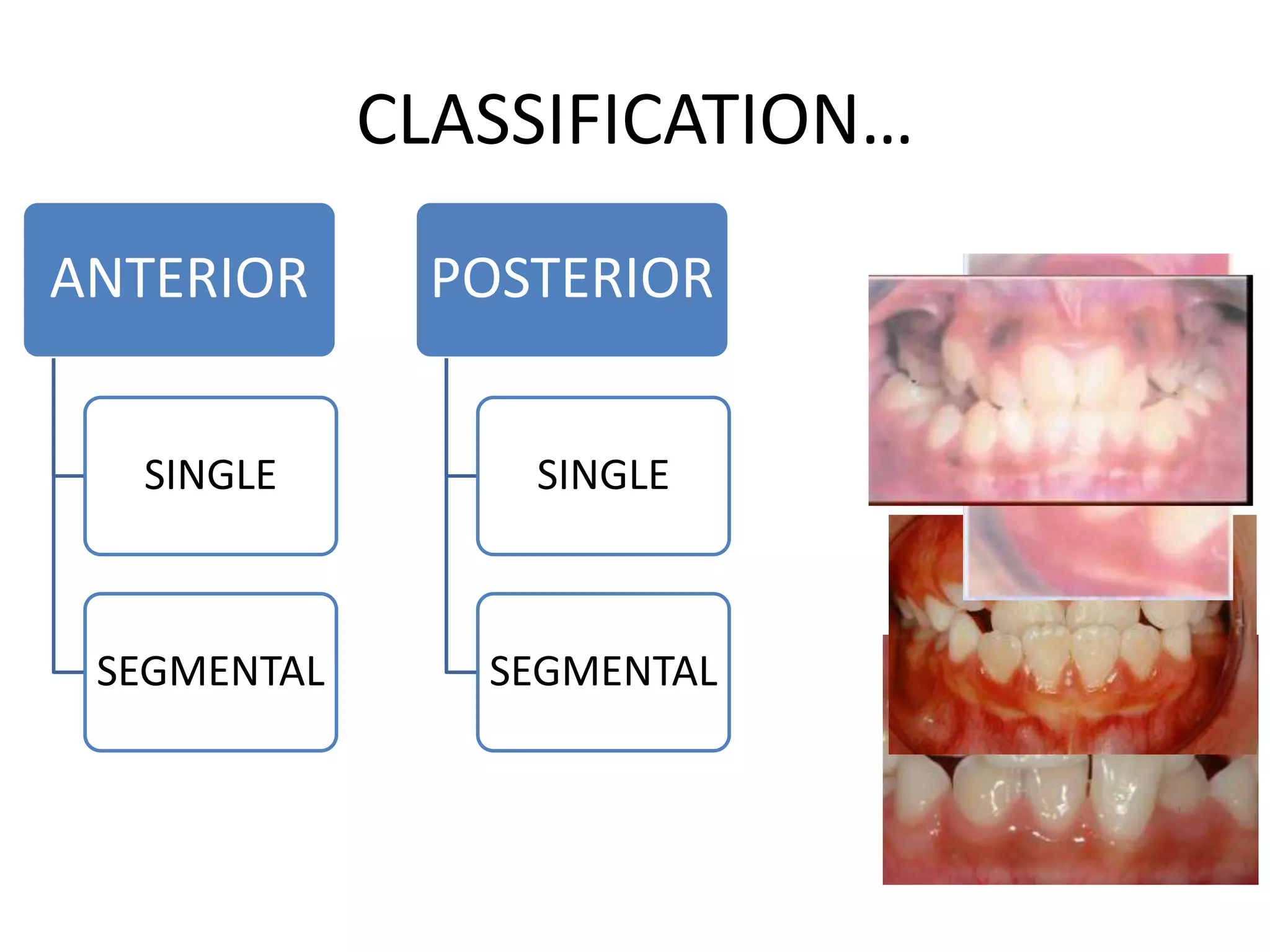
CLASSIFICATION…
ANTERIOR

POSTERIOR

SINGLE

SINGLE

SEGMENTAL

SEGMENTAL
POSTERIOR CROSSBITE …

SIMPLE

BUCCAL NON
OCCLUSION

LINGUAL
NON
OCCLUSION
CLASSIFICATION…
DENTAL
SKELETAL

FUNCTIONAL
DIAGNOSIS
• NUMBER OF TEETH INVOLVED
• INCLINATION OF THE INCISORS
• FACIAL PROFILE & MANDIBULAR CLOSURE
PATTERN
• FAMILIAL APPEARANCE
• CEPHALOMETRIC ANALYSIS
• EVALUATION OF BIOMECHANICAL DECISION
FACTORS

McDonald RE, Avery DR, Dean J; Dentistry for the child and adolescent;9Ed;Mosby Elsevier
NUMBER OF TEETH
• Single tooth involved --- dentoalveolar
crossbite
• Complete segment involved--- skeletal
crossbite
INCLINATION OF INCISORS
• Dentoalveolar & functional crossbite ---lingual inclination of maxillary incisors &
normal to slight labioversion of lower incisors
• Skeletal crossbite ---- lower incisors are
retroclined & maxillary incisors are normal to
proclined
FACIAL PROFILE & MANDIBULAR
CLOSURE PATTERN
• DENTOALVEOLAR CROSSBITE --- facial profile
& buccal occlusion should be in neutroclusion
• FUNCTIONAL CROSSBITE --- In full closure the
facial profile becomes prognathic from a
normative profile present at rest. Class III
buccal pattern seen
• SKELETAL CROSSBITE --- smooth closure in
class III molar relation and prognathic facial
profile present at all the time
CEPHALOMETRICS
DOWN’S ANALYSIS
• Increased facial angle seen
in skeletal class III
• Decreased angle of
convexity
• Positive A-B Plane angle
• Y-axis less than 53 indicative
skeletal class III

STEINER’S ANALYSIS
• SNA Angle : less than 82
• SNB Angle : more than 80
• ANB Angle : negative & less
than 2
TWEED ANALYSIS
• FMA : more than 25
• IMPA : less than 90
BIOMECHANICAL DECISION FACTORS
INCISOR POSTION & SPACING PRESENT : If
spacing present & root of lingual tooth is in
same position as it would occupy in normal
occlusion then simple labial tipping forces on
maxillary incisors can be applied
STAGE OF ERUPTION : Simple leverage forces
can be used if tooth is in active eruption stage
CONSIDERATIONS…..
• Presence or absence of an anterior mandibular
displacement
• Possible damage that has or might occur to the
dentition through excessive tooth wear, or to the
supporting periodontal structures
• Prevention of establishment of the developing
malocclusion
• Space availability – this may be rectified by the early
removal of both the upper deciduous canines
• The position of the developing permanent canines in
relation to the roots of the lateral incisors
• The depth of the overbite
CONSIDERATIONS…..
• The magnitude of the crossbite —does it
involve a single tooth or an entire segment?
• Is there a displacement associated with the
crossbite?
• How significant is the skeletal component
and will it be possible to compensate for this
discrepancy with tooth movement only?
THE SOLUTION..

PRIMARY / MIXED DENTITION
PERMANENT DENTITION
PRIMARY/MIXED DENTITION
(PREVENTIVE ORTHODONTICS)
• Elimination of the factors that may lead to the
anterior cross bite
• Removal occlusal prematurities
• Extraction of supernumerary tooth before
they cause displacement of other tooth
• Habit breaking appliance.
PRIMARY / MIXED DENTITION
(INTERCEPTIVE ORTHODONTICS)

ANTERIOR CROSSBITE
•
•
•
•
•

TONGUE BLADE/ POPSICLE STICK THERAPY
REVERSED STAINLESS STEEL CROWN
BONDED RESIN COMPOSITE SLOPE
LOWER INCLINED PLANE.
PALATAL SPRING APPLIANCES (REMOVABLE
HAWLEY OR FIXED PALATAL WIRE)
• FIXED TRANSPALATAL WIRE WITH SPRINGS
TONGUE BLADE
• INDICATIONS : Used when cross bite is seen at
the time the permanent teeth are making an
appearance in the oral cavity
• Its placed inside the mouth contacting the palatal
aspect of the maxillary teeth.
• Upon slight closure of jaw the opposing side of
the stick come in contact with the labial aspect of
the opposing mandibular tooth acts as a fulcrum.
• This is continued for 1-2 hours for about
2
weeks
Drawbacks of using tongue blade
• Only effective till the clinical crown not
completely erupted in the oral cavity
• Used only if sufficient space is available for the
correction
• Patient co-operation is required.
CATLAN’S APPLIANCE
• INDICATIONS : Used only in those cases where
the crossbite is due to a palataly placed
maxillary incisors.
(Constructed at 45o angulations on the lower
anterior teeth by acrylic or cast metal.
DISADVANTAGES OF CATLAN’S
APPLIANCE
•
•
•
•

Difficulty in speech and chewing
Patient co-operation required
Required frequent recementation
Catalan’s appliance also as an anterior bite
plane.
• Cannot be given if mandibular incisors are
maligned or they are periodontally
compromised.
DOUBLE CANTILEVER SPRING /
Z-SPRING
• INDICATION
Used when anterior cross bite
involving 1 or 2 maxillary
anterior teeth
• DISADVANTAGES
Effective only when there is
enough space for aligning the
teeth
• POSTERIOR DENTAL CROSS BITE
• CROSS-ARCH ELASTICS followed by retentive
appliance.
• COFFIN SPRING
• CROSS BITE ELASTICS:
• INDICATION : Single
tooth cross bite
involving molars can be
treated by elastics
• Elastics are stretched
between the maxillary
palatal surfaces and
mandibular buccal
surfaces.
• .
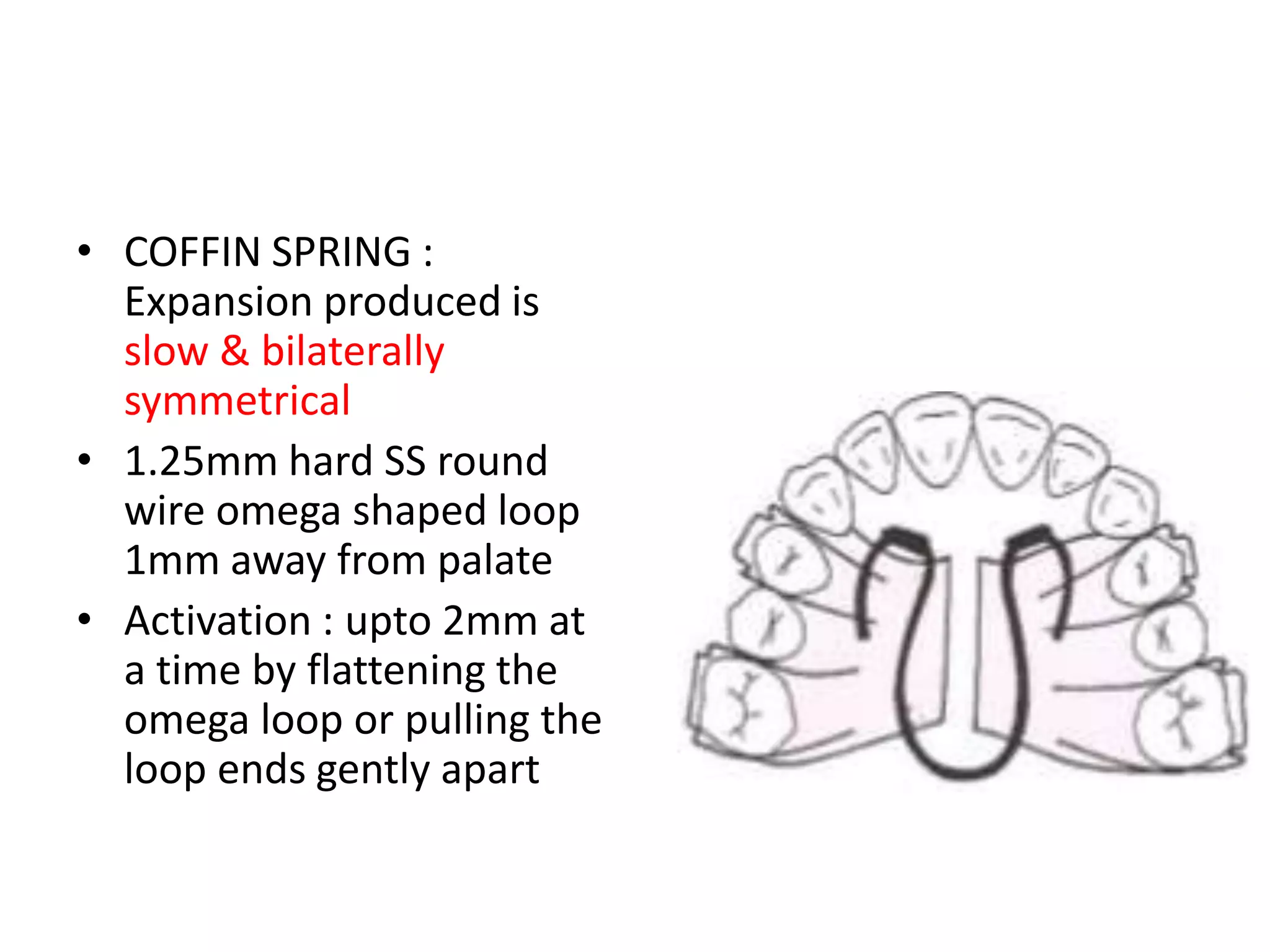
• COFFIN SPRING :
Expansion produced is
slow & bilaterally
symmetrical
• 1.25mm hard SS round
wire omega shaped loop
1mm away from palate
• Activation : upto 2mm at
a time by flattening the
omega loop or pulling the
loop ends gently apart
POSTERIOR CROSS BITE
(FUNCTIONAL OR SKELETAL)
• SELECTIVE EQUILIBRATION

• MAXILLARY EXPANSION

McDonald RE, Avery DR, Dean J; Dentistry for the child and adolescent;9Ed;Mosby Elsevier
SELECTIVE EQUILIBRATION
• Selective reduction(slanting) of lingual aspect
of upper primary canine & labial reduction of
lower primary canine.
• Maxillary intercanine width is larger than
mandibular intercanine width by a positive 23mm before selective grinding
• When lower intercanine width is more or
equivalent to that of upper intercanine width
upper arch expansion is a must
McDonald RE, Avery DR, Dean J; Dentistry for the child and adolescent;9Ed;Mosby Elsevier
FIXED PALATAL WIRE DESIGN
• W – ARCH
• QUAD HELIX
W ARCH / PORTER’S APPLIANCE
• 19 gauge wire that
rests 1-1.5mm off
the palate

• Bilateral
constriction in the
primary dentition

Proffit W ,Fields H, Sarver D; CONTEMPORARY ORTHODONTICS 4 ed 2007; Elsevier
QUAD HELIX
• The quad helix is a more
flexible version of the Warch.
• The helices in the anterior
palate are bulky, which
can effectively serve as a
reminder to aid in
stopping habit.
• The combination of a
posterior crossbite and a
finger-sucking habit is the
best indication for this
appliance.
Proffit W ,Fields H ,Sarver D; CONTEMPORARY ORTHODONTICS 4 ed 2007; Elsevier
APPLIANCES WITH SCREWS
• FIXED : HYRAX
RPE OF HAAS
• REMOVABLE :
• REMOVABLE APPLIANCE WITH MINI SCREWS
• REMOVABLE APPLIANCE WITH MEDIUM
SCREWS
• REMOVABLE APPLIANCE WITH 3D SCREWS
SCREWS…
• Active component
providing intermittent
force
• ACTIVATION : quarter
turn 3-7 days which
would produce 0.20.25mm movement per
quarter turn.
• Movement produced is
direct function of the
thread height,more the
opening higher the forces
generated
SCREW APPLIANCE
• MICRO SCREW : used on
single tooth
• MINI SCREW : Capable of
moving up to 2 teeth
• MEDIUM SCREW : Used to
correct segmental cross bite
• 3-D screw : capable of
correcting posterior as well
as anterior cross bite
ORTHOPEDIC APPLIANCES
• FACE MASK ALONG WITH RME
• FRANKEL III
• CHIN CAP APPLIANCE
FACEMASK WITH RME
CHIN CAP APPLIANCE
THE 2 X 4 APPLIANCE……
• ADVANTAGE….ease with which space
opening can be controlled with a fixed
appliance, and also that the force
magnitude and vector can be controlled
much more precisely than with a
removable appliance.

P. Dowsing,P. J. Sandler ; How to effectively use a 2 X 4 appliance; Journal of Orthodontics;2004;31:248–258
A CASE REPORT
• 9 YEAR & 5 MONTH OLD MALE PATIENT

• c/o : MALALIGNED TEETH
CLINICAL EXAMINATION
• Mesofacial symmetrical face & a slightly concave
profile.
• Early mixed dentition
• Maxillary 1st molar were mesially tilted & rotated due
to early loss of his primary maxillary second molars.
• End on class II molar with -2.5 mm overjet & 30%
overbite.
• Mandibular dental midline was deviated to the right
about 1mm
• Gingival recession on right mandibular central incisor.
RADIOGRAPHIC EXAMINATION
• Skeletal class III (ANB = -2.5mm overjet & 30%
overbite) with hypodivergent growth pattern
i.e (SN-MP: 31.6o)
• Maxillary incisors showed slight retroclination
(U1 to SN :101.5o)
• Mandibular incisors are retroclined (IMPA :
85.4o)
Our Goal is to …….
•
•
•
•
•

Correct anterior cross bite
Establish class I molar relation
Improve the localized gingival recession
Improve patient’s smile & esthetics.
Monitor development of permanent dentition
along with mixed dentition space to estimate
the size of unerupted permanent teeth.
T/t plan
• Phase I : MMMDA followed by W Arch fixed
expander. (5 months)
• Phase II : routine orthodontic treatment
followed by twist flex wire bonded from lateral
incisor to lateral incisor on maxillary arch &
canine to canine on mandibular arch.
• Phase II Treatment started when patient was
13y 2 month old & completed within 13
months
• 0.032” SS wire and run across
the lingual surface of maxillary
anterior teeth to the posterior
anchorage teeth ( primary
maxillary first molar bands or
permanent maxillary first
premolar bands)
• 0.032 SS wire soldered b/w
lateral incisor and canine and
0.024” Co-Cr finger spring
• Additional 0.032” SS wire
soldered to distalize the
molars in the right direction
FINALLY…
DISCUSSION
• The treatment strategies QH, expansion
plates, and RME are effective in the early
mixed dentition at a high success rate.
However, there is no scientific evidence
available that shows which of the treatment
modalities, grinding, Quad Helix, expansion
plates, or RME, is the most effective.

Petre S,Bondemark L,Soderfeldt B;A Systematic Review Concerning Early Orthodontic Treatment of Unilateral Posterior Crossbite; Angle
Orthodontist;2003;73(5):
• Cemented appliances had a tendency to work
within 3weeks and fixed appliances correcting
the crossbite within 6 weeks to 3 months.

Petre S,Bondemark L,Soderfeldt B;A Systematic Review Concerning Early Orthodontic Treatment of Unilateral Posterior Crossbite; Angle
Orthodontist;2003;73(5):
ROOT RESORPTION…
• Early treatment might reduce the extent of root
resorption, as long as the treatment is of a short
duration.
• Reitan,when studying apical root
resorption, suggested that there was a protective
mechanism of precementum and predentine
located at young apices and this may be an
influencing factor regarding the prevention of
root resorption
FIXED Vs REMOVABLE
Advantages of fixed appliances
• Minimal discomfort
• Reduces need for patient cooperation
• Increase control of tooth
movements
• Movement possible in all three
planes of space

Disadvantages of removable
appliances
• Appliance rarely worn full time
• Appliance damage/lost
appliances
• Difficulty in speech/eating
• Gagging
• Decalcification/caries
• Gingivitis/palatal
hyperplasia/fungal infections
• Incorrect activation produces
unhelpful changes
• Allow only tipping of teeth

P. Dowsing,P. J. Sandler ; How to effectively use a 2 X 4 appliance; Journal of Orthodontics;2004;31:248–258
DRAWBACKS….
• Reverse SS Crown
• Tongue blade
• Acrylic bite planes with springs

Bayrak S,Tunc ES;Treatment of Anterior Dental Crossbite Using Bonded ResinComposite Slopes:Case Reports;EurJournOfDent;2008;2(1)

Crossbite

  • 2.
    CROSS BITE By: AditiSingh P.G Dept of pediatric dentistry SDCH
  • 3.
    DEFINING THE PROBLEM…. •A Condition where one or more teeth may be malposed abnormally buccally lingually or labially with reference to opposing tooth or teeth. - Graber • Moyers defines a simple anterior tooth crossbite as a dental malocclusion resulting from the abnormal axial inclination of one or more maxillary teeth
  • 4.
    WHY IS ITAN EMERGENCY..? • Anterior dental crossbite requires early and immediate treatment to prevent abnormal enamel abrasion, anterior teeth mobility and fracture, periodontal pathosis and temporomandibular joint disturbance. • The main goal of treatment is to tip the affected maxillary tooth or teeth labially to the point where a stable overbite relationship exists. • Relapse is usually prevented by the normal overjet/overbite relationship that is achieved. Bayrak S,Tunc ES;Treatment of Anterior Dental Crossbite Using Bonded Resin-Composite Slopes:Cas Reports;EurJournOfDent;2008;2(1)
  • 5.
    CAUSE… DENTAL • ANOMALIES OFNUMBER • ANOMALIES OF TOOTH SIZE • ANOMALIES OF TOOTH SHAPE • PREMATURE LOSS OF DECIDUOUS &/OR PERMANENT TEETH • PROLONGED RETENTION OF DECIDUOUS TEETH • DELAYED ERUPTION OF PERMANENT TEETH • ABNORMAL ERUPTIVE PATH • TOOTH ANKYLOSIS SKELETAL • HEREDITARY • CONGENITAL • TRAUMA AT BIRTH • TRAUMA DURING GROWTH • TRAUMA AFTER COMPLETION OF GROWTH • HABITS
  • 6.
  • 7.
    POSTERIOR CROSSBITE … SIMPLE BUCCALNON OCCLUSION LINGUAL NON OCCLUSION
  • 8.
  • 9.
    DIAGNOSIS • NUMBER OFTEETH INVOLVED • INCLINATION OF THE INCISORS • FACIAL PROFILE & MANDIBULAR CLOSURE PATTERN • FAMILIAL APPEARANCE • CEPHALOMETRIC ANALYSIS • EVALUATION OF BIOMECHANICAL DECISION FACTORS McDonald RE, Avery DR, Dean J; Dentistry for the child and adolescent;9Ed;Mosby Elsevier
  • 10.
    NUMBER OF TEETH •Single tooth involved --- dentoalveolar crossbite • Complete segment involved--- skeletal crossbite
  • 11.
    INCLINATION OF INCISORS •Dentoalveolar & functional crossbite ---lingual inclination of maxillary incisors & normal to slight labioversion of lower incisors • Skeletal crossbite ---- lower incisors are retroclined & maxillary incisors are normal to proclined
  • 12.
    FACIAL PROFILE &MANDIBULAR CLOSURE PATTERN • DENTOALVEOLAR CROSSBITE --- facial profile & buccal occlusion should be in neutroclusion • FUNCTIONAL CROSSBITE --- In full closure the facial profile becomes prognathic from a normative profile present at rest. Class III buccal pattern seen • SKELETAL CROSSBITE --- smooth closure in class III molar relation and prognathic facial profile present at all the time
  • 13.
    CEPHALOMETRICS DOWN’S ANALYSIS • Increasedfacial angle seen in skeletal class III • Decreased angle of convexity • Positive A-B Plane angle • Y-axis less than 53 indicative skeletal class III STEINER’S ANALYSIS • SNA Angle : less than 82 • SNB Angle : more than 80 • ANB Angle : negative & less than 2 TWEED ANALYSIS • FMA : more than 25 • IMPA : less than 90
  • 14.
    BIOMECHANICAL DECISION FACTORS INCISORPOSTION & SPACING PRESENT : If spacing present & root of lingual tooth is in same position as it would occupy in normal occlusion then simple labial tipping forces on maxillary incisors can be applied STAGE OF ERUPTION : Simple leverage forces can be used if tooth is in active eruption stage
  • 15.
    CONSIDERATIONS….. • Presence orabsence of an anterior mandibular displacement • Possible damage that has or might occur to the dentition through excessive tooth wear, or to the supporting periodontal structures • Prevention of establishment of the developing malocclusion • Space availability – this may be rectified by the early removal of both the upper deciduous canines • The position of the developing permanent canines in relation to the roots of the lateral incisors • The depth of the overbite
  • 16.
    CONSIDERATIONS….. • The magnitudeof the crossbite —does it involve a single tooth or an entire segment? • Is there a displacement associated with the crossbite? • How significant is the skeletal component and will it be possible to compensate for this discrepancy with tooth movement only?
  • 17.
    THE SOLUTION.. PRIMARY /MIXED DENTITION PERMANENT DENTITION
  • 18.
    PRIMARY/MIXED DENTITION (PREVENTIVE ORTHODONTICS) •Elimination of the factors that may lead to the anterior cross bite • Removal occlusal prematurities • Extraction of supernumerary tooth before they cause displacement of other tooth • Habit breaking appliance.
  • 19.
    PRIMARY / MIXEDDENTITION (INTERCEPTIVE ORTHODONTICS) ANTERIOR CROSSBITE • • • • • TONGUE BLADE/ POPSICLE STICK THERAPY REVERSED STAINLESS STEEL CROWN BONDED RESIN COMPOSITE SLOPE LOWER INCLINED PLANE. PALATAL SPRING APPLIANCES (REMOVABLE HAWLEY OR FIXED PALATAL WIRE) • FIXED TRANSPALATAL WIRE WITH SPRINGS
  • 20.
    TONGUE BLADE • INDICATIONS: Used when cross bite is seen at the time the permanent teeth are making an appearance in the oral cavity • Its placed inside the mouth contacting the palatal aspect of the maxillary teeth. • Upon slight closure of jaw the opposing side of the stick come in contact with the labial aspect of the opposing mandibular tooth acts as a fulcrum. • This is continued for 1-2 hours for about 2 weeks
  • 21.
    Drawbacks of usingtongue blade • Only effective till the clinical crown not completely erupted in the oral cavity • Used only if sufficient space is available for the correction • Patient co-operation is required.
  • 22.
    CATLAN’S APPLIANCE • INDICATIONS: Used only in those cases where the crossbite is due to a palataly placed maxillary incisors. (Constructed at 45o angulations on the lower anterior teeth by acrylic or cast metal.
  • 23.
    DISADVANTAGES OF CATLAN’S APPLIANCE • • • • Difficultyin speech and chewing Patient co-operation required Required frequent recementation Catalan’s appliance also as an anterior bite plane. • Cannot be given if mandibular incisors are maligned or they are periodontally compromised.
  • 24.
    DOUBLE CANTILEVER SPRING/ Z-SPRING • INDICATION Used when anterior cross bite involving 1 or 2 maxillary anterior teeth • DISADVANTAGES Effective only when there is enough space for aligning the teeth
  • 25.
    • POSTERIOR DENTALCROSS BITE • CROSS-ARCH ELASTICS followed by retentive appliance. • COFFIN SPRING
  • 26.
    • CROSS BITEELASTICS: • INDICATION : Single tooth cross bite involving molars can be treated by elastics • Elastics are stretched between the maxillary palatal surfaces and mandibular buccal surfaces. • .
  • 27.
    • COFFIN SPRING: Expansion produced is slow & bilaterally symmetrical • 1.25mm hard SS round wire omega shaped loop 1mm away from palate • Activation : upto 2mm at a time by flattening the omega loop or pulling the loop ends gently apart
  • 28.
    POSTERIOR CROSS BITE (FUNCTIONALOR SKELETAL) • SELECTIVE EQUILIBRATION • MAXILLARY EXPANSION McDonald RE, Avery DR, Dean J; Dentistry for the child and adolescent;9Ed;Mosby Elsevier
  • 29.
    SELECTIVE EQUILIBRATION • Selectivereduction(slanting) of lingual aspect of upper primary canine & labial reduction of lower primary canine. • Maxillary intercanine width is larger than mandibular intercanine width by a positive 23mm before selective grinding • When lower intercanine width is more or equivalent to that of upper intercanine width upper arch expansion is a must McDonald RE, Avery DR, Dean J; Dentistry for the child and adolescent;9Ed;Mosby Elsevier
  • 30.
    FIXED PALATAL WIREDESIGN • W – ARCH • QUAD HELIX
  • 31.
    W ARCH /PORTER’S APPLIANCE • 19 gauge wire that rests 1-1.5mm off the palate • Bilateral constriction in the primary dentition Proffit W ,Fields H, Sarver D; CONTEMPORARY ORTHODONTICS 4 ed 2007; Elsevier
  • 32.
    QUAD HELIX • Thequad helix is a more flexible version of the Warch. • The helices in the anterior palate are bulky, which can effectively serve as a reminder to aid in stopping habit. • The combination of a posterior crossbite and a finger-sucking habit is the best indication for this appliance. Proffit W ,Fields H ,Sarver D; CONTEMPORARY ORTHODONTICS 4 ed 2007; Elsevier
  • 33.
    APPLIANCES WITH SCREWS •FIXED : HYRAX RPE OF HAAS • REMOVABLE : • REMOVABLE APPLIANCE WITH MINI SCREWS • REMOVABLE APPLIANCE WITH MEDIUM SCREWS • REMOVABLE APPLIANCE WITH 3D SCREWS
  • 34.
    SCREWS… • Active component providingintermittent force • ACTIVATION : quarter turn 3-7 days which would produce 0.20.25mm movement per quarter turn. • Movement produced is direct function of the thread height,more the opening higher the forces generated
  • 36.
    SCREW APPLIANCE • MICROSCREW : used on single tooth • MINI SCREW : Capable of moving up to 2 teeth • MEDIUM SCREW : Used to correct segmental cross bite • 3-D screw : capable of correcting posterior as well as anterior cross bite
  • 37.
    ORTHOPEDIC APPLIANCES • FACEMASK ALONG WITH RME • FRANKEL III • CHIN CAP APPLIANCE
  • 38.
  • 39.
  • 40.
    THE 2 X4 APPLIANCE…… • ADVANTAGE….ease with which space opening can be controlled with a fixed appliance, and also that the force magnitude and vector can be controlled much more precisely than with a removable appliance. P. Dowsing,P. J. Sandler ; How to effectively use a 2 X 4 appliance; Journal of Orthodontics;2004;31:248–258
  • 41.
    A CASE REPORT •9 YEAR & 5 MONTH OLD MALE PATIENT • c/o : MALALIGNED TEETH
  • 42.
    CLINICAL EXAMINATION • Mesofacialsymmetrical face & a slightly concave profile. • Early mixed dentition • Maxillary 1st molar were mesially tilted & rotated due to early loss of his primary maxillary second molars. • End on class II molar with -2.5 mm overjet & 30% overbite. • Mandibular dental midline was deviated to the right about 1mm • Gingival recession on right mandibular central incisor.
  • 43.
    RADIOGRAPHIC EXAMINATION • Skeletalclass III (ANB = -2.5mm overjet & 30% overbite) with hypodivergent growth pattern i.e (SN-MP: 31.6o) • Maxillary incisors showed slight retroclination (U1 to SN :101.5o) • Mandibular incisors are retroclined (IMPA : 85.4o)
  • 44.
    Our Goal isto ……. • • • • • Correct anterior cross bite Establish class I molar relation Improve the localized gingival recession Improve patient’s smile & esthetics. Monitor development of permanent dentition along with mixed dentition space to estimate the size of unerupted permanent teeth.
  • 45.
    T/t plan • PhaseI : MMMDA followed by W Arch fixed expander. (5 months) • Phase II : routine orthodontic treatment followed by twist flex wire bonded from lateral incisor to lateral incisor on maxillary arch & canine to canine on mandibular arch. • Phase II Treatment started when patient was 13y 2 month old & completed within 13 months
  • 46.
    • 0.032” SSwire and run across the lingual surface of maxillary anterior teeth to the posterior anchorage teeth ( primary maxillary first molar bands or permanent maxillary first premolar bands) • 0.032 SS wire soldered b/w lateral incisor and canine and 0.024” Co-Cr finger spring • Additional 0.032” SS wire soldered to distalize the molars in the right direction
  • 47.
  • 48.
    DISCUSSION • The treatmentstrategies QH, expansion plates, and RME are effective in the early mixed dentition at a high success rate. However, there is no scientific evidence available that shows which of the treatment modalities, grinding, Quad Helix, expansion plates, or RME, is the most effective. Petre S,Bondemark L,Soderfeldt B;A Systematic Review Concerning Early Orthodontic Treatment of Unilateral Posterior Crossbite; Angle Orthodontist;2003;73(5):
  • 49.
    • Cemented applianceshad a tendency to work within 3weeks and fixed appliances correcting the crossbite within 6 weeks to 3 months. Petre S,Bondemark L,Soderfeldt B;A Systematic Review Concerning Early Orthodontic Treatment of Unilateral Posterior Crossbite; Angle Orthodontist;2003;73(5):
  • 50.
    ROOT RESORPTION… • Earlytreatment might reduce the extent of root resorption, as long as the treatment is of a short duration. • Reitan,when studying apical root resorption, suggested that there was a protective mechanism of precementum and predentine located at young apices and this may be an influencing factor regarding the prevention of root resorption
  • 51.
    FIXED Vs REMOVABLE Advantagesof fixed appliances • Minimal discomfort • Reduces need for patient cooperation • Increase control of tooth movements • Movement possible in all three planes of space Disadvantages of removable appliances • Appliance rarely worn full time • Appliance damage/lost appliances • Difficulty in speech/eating • Gagging • Decalcification/caries • Gingivitis/palatal hyperplasia/fungal infections • Incorrect activation produces unhelpful changes • Allow only tipping of teeth P. Dowsing,P. J. Sandler ; How to effectively use a 2 X 4 appliance; Journal of Orthodontics;2004;31:248–258
  • 52.
    DRAWBACKS…. • Reverse SSCrown • Tongue blade • Acrylic bite planes with springs Bayrak S,Tunc ES;Treatment of Anterior Dental Crossbite Using Bonded ResinComposite Slopes:Case Reports;EurJournOfDent;2008;2(1)