Space Development in
Independent India
Bygone times….
• India's experience in rocketry began in ancient times
when fireworks were first used in the country.
• Military use of rockets by Tipu Sultan during the
Mysore War inspired William Congreve to invent the
Congreve rocket.
After Independence
• Indian scientists and politicians recognized the potential of
rocket technology in both defence applications and for
research and development.
• A country as demographically large as India would require its
own independent space capabilities in various fields.
Dr Vikram Sarabhai
• Dr. Vikram Sarabhai is the father of the Indian
space program.
• Established the Indian National Committee for Sapce
Research (INCOSPAR) with Homi Bhabha in 1962.
• On August 15th 1969 ISRO was created
from the INCOSPAR programme.
1970-1980:1970-1980:
1970-1980:
• In the 1960s Sarabhai had taken part in an early study
with NASA.
• India began developing satellite technology
anticipating the remote sensing and communication
needs of the future.
• India’s first satellite was launched in 1975
1990-2000:
• In 1993 the time had come for the maiden flight of the PSLV.
• PSLV became the workhorse launch vehicle.
• It placed both remote sensing and communications
satellites into orbit.
• Many INSAT satellites were launched during this period.
• Created the largest cluster in the world and provided
unique data to Indian industry and agriculture..
21st
CENTURY
• Currently the most powerful Indian launch vehicle in operation;
the first flight of the GSLV took place in 2001.
• ISRO entered the lucrative market of launching payloads of
other nations.
• On April 28, 2008 ISRO successfully launched 10 satellites in a
single mission further boosting it's capabilities in space.
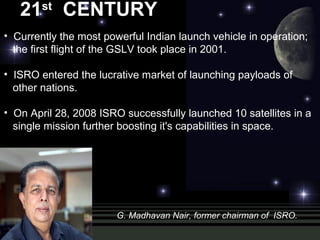
G. Madhavan Nair, former chairman of ISRO.
The moon vehicle…
The Moon vehicle…...
CHANDRAYAAN
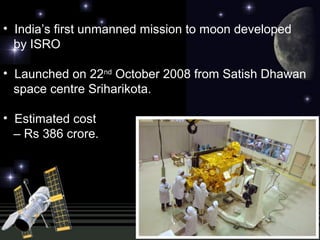
• India’s first unmanned mission to moon developed
by ISRO
• Launched on 22nd
October 2008 from Satish Dhawan
space centre Sriharikota.
• Estimated cost
– Rs 386 crore.
OBJECTIVES:
• Simaltanous mineralogical, chemical and photo
geological mapping.
• High resolution mapping of the lunar surface to
identify minerals.
• 3D mapping of lunar surface at very high resolution to
attract young minds in space and planetary science.
Future space missions..
• ISRO plans to launch a number of new-generation Earth
Observation Satellites in the near future.
• The ISRO is preparing for Mangalyam, an orbiter mission to Mars
to be launched in November 2013
• Developing Reusable launch vehicles (RLV).
• ISRO is planning a mission to Venus by May
2015 to study its atmosphere.
•ISRO plans to carry out an unmanned mission to
the Sun by the year 2014.
Manned moon mission by 2020.
Space 2013

Space 2013

  • 2.
  • 3.
    Bygone times…. • India'sexperience in rocketry began in ancient times when fireworks were first used in the country. • Military use of rockets by Tipu Sultan during the Mysore War inspired William Congreve to invent the Congreve rocket.
  • 4.
    After Independence • Indianscientists and politicians recognized the potential of rocket technology in both defence applications and for research and development. • A country as demographically large as India would require its own independent space capabilities in various fields.
  • 5.
    Dr Vikram Sarabhai •Dr. Vikram Sarabhai is the father of the Indian space program. • Established the Indian National Committee for Sapce Research (INCOSPAR) with Homi Bhabha in 1962. • On August 15th 1969 ISRO was created from the INCOSPAR programme.
  • 6.
    1970-1980:1970-1980: 1970-1980: • In the1960s Sarabhai had taken part in an early study with NASA. • India began developing satellite technology anticipating the remote sensing and communication needs of the future. • India’s first satellite was launched in 1975
  • 8.
    1990-2000: • In 1993the time had come for the maiden flight of the PSLV. • PSLV became the workhorse launch vehicle. • It placed both remote sensing and communications satellites into orbit. • Many INSAT satellites were launched during this period. • Created the largest cluster in the world and provided unique data to Indian industry and agriculture..
  • 9.
    21st CENTURY • Currently themost powerful Indian launch vehicle in operation; the first flight of the GSLV took place in 2001. • ISRO entered the lucrative market of launching payloads of other nations. • On April 28, 2008 ISRO successfully launched 10 satellites in a single mission further boosting it's capabilities in space. G. Madhavan Nair, former chairman of ISRO.
  • 10.
    The moon vehicle… TheMoon vehicle…... CHANDRAYAAN
  • 11.
    • India’s firstunmanned mission to moon developed by ISRO • Launched on 22nd October 2008 from Satish Dhawan space centre Sriharikota. • Estimated cost – Rs 386 crore.
  • 12.
    OBJECTIVES: • Simaltanous mineralogical,chemical and photo geological mapping. • High resolution mapping of the lunar surface to identify minerals. • 3D mapping of lunar surface at very high resolution to attract young minds in space and planetary science.
  • 14.
    Future space missions.. •ISRO plans to launch a number of new-generation Earth Observation Satellites in the near future. • The ISRO is preparing for Mangalyam, an orbiter mission to Mars to be launched in November 2013 • Developing Reusable launch vehicles (RLV).
  • 15.
    • ISRO isplanning a mission to Venus by May 2015 to study its atmosphere. •ISRO plans to carry out an unmanned mission to the Sun by the year 2014. Manned moon mission by 2020.