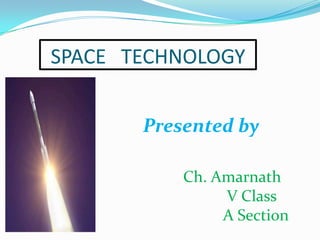
SPACE TECHNOLOGY
Presented by
Ch. Amarnath
V Class
A Section
Introduction
 What is space technology?

Space technology is the technology, related to
Entering, retrieving objects or life forms from
Space
 Space technology has several applications . It is used in
1.WEATHERING FORECASTING
2REMOTE SENSING
3.SATELLITES TELEVISION
4.LONG DISTANCE COMMUNICATION
5.ASTRONOMY
6.EARTH SCIENCES VIA REMOTE SENSING
 Space technology was vastly developed

Mainly because of cold war between USA and
RUSSIA. The other countries includes our INDIA
are who showing tremendous development in
space technologies.
Top 10 countries in space technology are;
1.USA
2.RUSSIA
3.CHINA
4.FRANCE
5.INDIA
6.UK
7.JAPAN
8.SOUTH KOREA
9.IRAN
10.ISRAEL
• My presentation is mainly confined to
space technology in India.

• In India space technology has been growing
through IRSO i.e INDIAN SPACE RESEARCH
ORGANISATION, established in 1969, AUGUST
• Its headquarters is located in BANGLORE.
• Its Chairman is K.RADHA KRISHNAN.

• Its primary objective is to advance space
technology and use it Applications for national
benefit.
• ISRO is the largest government space agency in the
world.
ISRO is under the administrative control of the
Department of Space, Government of India.
ISRO has achieved numerous milestones.
1. It built India's first satellite, Aryabhatta, which
was launched by the Soviet Union in 1975.
2. In 1980, Rohini, became the first satellite to be placed in
orbit by an Indian-made launch vehicle, SLV-3.
3. ISRO subsequently developed two other rockets: the
Polar Satellite Launch Vehicle (PSLV) for launching
satellites into polar orbits.
4.

Geosynchronous Satellite Launch Vehicle (GSLV) for
placing satellites into geostationary orbits.
5. These rockets have launched numerous
communications satellites and earth observation
satellite. In 2008, Chandrayaan-1, India sent its first
mission to the Moon.
6. In 2008, Chandrayaan-1 India sent its first
mission to the Moon.
7. In 2013, ISRO launched its Mars Orbiter Mission,
which is currently on-route to Mars.
Dr. Vikram Sarabhai considered the the father of
India's Space Programme as indian space
programme was driven by the vision of Dr. Vikram
Sarabhai

Dr. Vikram Sarabhai
Satellite Launch Vehicle (SLV)

Comparison of Indian carrier rockets. Left to right: SLV, ASLV , PSLV, GSLV
, GSLV III
Satellite Launch Vehicle (SLV)

•During the 1960s and 1970s, India initiated its own
launch vehicle programme for geopolitical and
economic considerations.
•In the 1960s–1970s, the country successfully developed
a Satellite Launch Vehicle, SLV .
Augmented Satellite Launch Vehicle (ASLV)

The Augmented Satellite Launch Vehicle, usually
known by its abbreviation ASLV was a 5-stage solid
propellant rocket with the capability of placing a
150 kg satellite into orbit.
Polar Satellite Launch Vehicle (PSLV)

The Polar Satellite Launch Vehicle, usually known
by its abbreviation PSLV, is an expendable launch
system developed to allow India to launch its Indian
Remote Sensing (IRS) satellites into sun
synchronous orbits .
It has launched 55 satellites / spacecraft ( 26 Indian
and 29 Foreign Satellites) into a variety of orbits so
far with a 95 percent success rate.
Geosynchronous Satellite Launch Vehicle (GSLV)
•It is an expendable launch system developed to enable India
to launch its INSAT -type satellites into geostationary orbit
and to make India less dependent on foreign rockets.
• In a setback for ISRO, the attempt to launch the GSLV, GSLVF06 carrying GSAT-5P, failed on 25 December 2010.
•On 5 January 2014, GSLV D5 successfully launched GSAT-14
into intended orbit.
•India is the sixth country to have this technology in the world.
Development of crew vehicle

GSLV Mk III payload fairing assembly mockup
Geosynchronous Satellite Launch Vehicle Mark-III (GSLV III)

•The Geosynchronous Satellite Launch Vehicle Mark-III is
a launch vehicle currently under development by the
Indian Space Research Organisation. It is intended to
launch heavy satellites into geostationary orbit.
• According to latest information available maiden flight
is scheduled to take place in April 2014.
The INSAT series
•INSAT (Indian National Satellite System) is a series of
multipurpose geostationary satellites launched by ISRO to
satisfy the telecommunications, broadcasting,
meteorology and search-and-rescue needs of India.
Commissioned in 1983,
•INSAT is the largest domestic communication system in
the Asia-Pacific Region.
The IRS series

•Indian Remote Sensing satellites (IRS) are a
series of earth observation
satellites, built, launched and maintained by
ISRO. The IRS series provides remote sensing
services to the country.
Radar Imaging Satellites

•ISRO currently operates two Radar Imaging
Satellites RISAT-1was launched from Sriharikota
Spaceport on 26 April 2012 on board.
• India also operates RISAT-2 which was launched
in 2009
The IRNSS series

•ISRO on 1 July 2013, at 23:41Hrs IST launched from Sriharikota
the First Indian Navigation Satellite the IRNSS-1A.
• The IRNSS-1A was launched aboard PSLV-C22.

•The constellation would be comprising 7 satellites of I-1K
bus each weighing around 1450 Kilograms, with three satellites
in the Geostationary Earth Orbit(GEO) and
4 in Geosynchronous Earth Orbit(GSO).
•The constellation would be completed around 2015.
Other satellites

ISRO has also launched a set
of experimental
geostationary satellites
known as the GSAT series.
Kalpana-1.
ISRO has also successfully
launched the Indo-French
satellite SARAL on 25
February 2013.

SARAL Satellite
Satellites launched by INDIA during 2012-2014
Launch
Vehicle

Satellite

Launch Date

Type of Satellite

GSAT-14

05.01.2014

GSLV-D5 Geo-Stationary Satellite

Mars Orbiter
MissionSpacecraft

05.11.2013

PSLV-C25 Space Mission

GSAT-7

30.08.2013

Ariane-5
Geo-Stationary Satellite
VA-215

INSAT-3D

26.07.2013

Ariane-5 Geo-stationary/Meteorological
VA-214
Satellite

IRNSS-1A

01.07.2013

PSLV-C22 Navigation Satellite

SARAL

25.02.2013

PSLV-C20 Earth Observation Satellite

GSAT-10

29.09.2012

Ariane-5
Geo-Stationary Satellite
VA-209

RISAT-1

26.04.2012

PSLV-C19 Earth Observation Satellite
Conclusion

•Indian scientists have been working in space technology in
competent with other developed countries.
•Let us hope in future India will stand in first position in
the world.
THANK YOU

Space technology,ch. amarnath ,v class

  • 1.
    SPACE TECHNOLOGY Presented by Ch.Amarnath V Class A Section
  • 2.
    Introduction  What isspace technology? Space technology is the technology, related to Entering, retrieving objects or life forms from Space  Space technology has several applications . It is used in 1.WEATHERING FORECASTING 2REMOTE SENSING 3.SATELLITES TELEVISION 4.LONG DISTANCE COMMUNICATION 5.ASTRONOMY 6.EARTH SCIENCES VIA REMOTE SENSING
  • 3.
     Space technologywas vastly developed Mainly because of cold war between USA and RUSSIA. The other countries includes our INDIA are who showing tremendous development in space technologies.
  • 4.
    Top 10 countriesin space technology are; 1.USA 2.RUSSIA 3.CHINA 4.FRANCE 5.INDIA 6.UK 7.JAPAN 8.SOUTH KOREA 9.IRAN 10.ISRAEL
  • 5.
    • My presentationis mainly confined to space technology in India. • In India space technology has been growing through IRSO i.e INDIAN SPACE RESEARCH ORGANISATION, established in 1969, AUGUST • Its headquarters is located in BANGLORE. • Its Chairman is K.RADHA KRISHNAN. • Its primary objective is to advance space technology and use it Applications for national benefit.
  • 6.
    • ISRO isthe largest government space agency in the world. ISRO is under the administrative control of the Department of Space, Government of India.
  • 7.
    ISRO has achievednumerous milestones. 1. It built India's first satellite, Aryabhatta, which was launched by the Soviet Union in 1975. 2. In 1980, Rohini, became the first satellite to be placed in orbit by an Indian-made launch vehicle, SLV-3. 3. ISRO subsequently developed two other rockets: the Polar Satellite Launch Vehicle (PSLV) for launching satellites into polar orbits. 4. Geosynchronous Satellite Launch Vehicle (GSLV) for placing satellites into geostationary orbits.
  • 8.
    5. These rocketshave launched numerous communications satellites and earth observation satellite. In 2008, Chandrayaan-1, India sent its first mission to the Moon. 6. In 2008, Chandrayaan-1 India sent its first mission to the Moon. 7. In 2013, ISRO launched its Mars Orbiter Mission, which is currently on-route to Mars.
  • 9.
    Dr. Vikram Sarabhaiconsidered the the father of India's Space Programme as indian space programme was driven by the vision of Dr. Vikram Sarabhai Dr. Vikram Sarabhai
  • 10.
    Satellite Launch Vehicle(SLV) Comparison of Indian carrier rockets. Left to right: SLV, ASLV , PSLV, GSLV , GSLV III
  • 11.
    Satellite Launch Vehicle(SLV) •During the 1960s and 1970s, India initiated its own launch vehicle programme for geopolitical and economic considerations. •In the 1960s–1970s, the country successfully developed a Satellite Launch Vehicle, SLV .
  • 12.
    Augmented Satellite LaunchVehicle (ASLV) The Augmented Satellite Launch Vehicle, usually known by its abbreviation ASLV was a 5-stage solid propellant rocket with the capability of placing a 150 kg satellite into orbit.
  • 13.
    Polar Satellite LaunchVehicle (PSLV) The Polar Satellite Launch Vehicle, usually known by its abbreviation PSLV, is an expendable launch system developed to allow India to launch its Indian Remote Sensing (IRS) satellites into sun synchronous orbits . It has launched 55 satellites / spacecraft ( 26 Indian and 29 Foreign Satellites) into a variety of orbits so far with a 95 percent success rate.
  • 14.
    Geosynchronous Satellite LaunchVehicle (GSLV) •It is an expendable launch system developed to enable India to launch its INSAT -type satellites into geostationary orbit and to make India less dependent on foreign rockets. • In a setback for ISRO, the attempt to launch the GSLV, GSLVF06 carrying GSAT-5P, failed on 25 December 2010. •On 5 January 2014, GSLV D5 successfully launched GSAT-14 into intended orbit. •India is the sixth country to have this technology in the world.
  • 15.
    Development of crewvehicle GSLV Mk III payload fairing assembly mockup
  • 16.
    Geosynchronous Satellite LaunchVehicle Mark-III (GSLV III) •The Geosynchronous Satellite Launch Vehicle Mark-III is a launch vehicle currently under development by the Indian Space Research Organisation. It is intended to launch heavy satellites into geostationary orbit. • According to latest information available maiden flight is scheduled to take place in April 2014.
  • 17.
  • 18.
    •INSAT (Indian NationalSatellite System) is a series of multipurpose geostationary satellites launched by ISRO to satisfy the telecommunications, broadcasting, meteorology and search-and-rescue needs of India. Commissioned in 1983, •INSAT is the largest domestic communication system in the Asia-Pacific Region.
  • 19.
    The IRS series •IndianRemote Sensing satellites (IRS) are a series of earth observation satellites, built, launched and maintained by ISRO. The IRS series provides remote sensing services to the country.
  • 20.
    Radar Imaging Satellites •ISROcurrently operates two Radar Imaging Satellites RISAT-1was launched from Sriharikota Spaceport on 26 April 2012 on board. • India also operates RISAT-2 which was launched in 2009
  • 21.
    The IRNSS series •ISROon 1 July 2013, at 23:41Hrs IST launched from Sriharikota the First Indian Navigation Satellite the IRNSS-1A. • The IRNSS-1A was launched aboard PSLV-C22. •The constellation would be comprising 7 satellites of I-1K bus each weighing around 1450 Kilograms, with three satellites in the Geostationary Earth Orbit(GEO) and 4 in Geosynchronous Earth Orbit(GSO). •The constellation would be completed around 2015.
  • 22.
    Other satellites ISRO hasalso launched a set of experimental geostationary satellites known as the GSAT series. Kalpana-1. ISRO has also successfully launched the Indo-French satellite SARAL on 25 February 2013. SARAL Satellite
  • 23.
    Satellites launched byINDIA during 2012-2014 Launch Vehicle Satellite Launch Date Type of Satellite GSAT-14 05.01.2014 GSLV-D5 Geo-Stationary Satellite Mars Orbiter MissionSpacecraft 05.11.2013 PSLV-C25 Space Mission GSAT-7 30.08.2013 Ariane-5 Geo-Stationary Satellite VA-215 INSAT-3D 26.07.2013 Ariane-5 Geo-stationary/Meteorological VA-214 Satellite IRNSS-1A 01.07.2013 PSLV-C22 Navigation Satellite SARAL 25.02.2013 PSLV-C20 Earth Observation Satellite GSAT-10 29.09.2012 Ariane-5 Geo-Stationary Satellite VA-209 RISAT-1 26.04.2012 PSLV-C19 Earth Observation Satellite
  • 24.
    Conclusion •Indian scientists havebeen working in space technology in competent with other developed countries. •Let us hope in future India will stand in first position in the world.
  • 25.