ISRO
Indian space research organization
Powering India 's space journey ✈️
By - Parineeta from - B. Sc. (H) Chemistry
Introduction of ISRO
• ISRO - The Indian space research organization
• Started in - 1969
• By - Dr. Vikram Sarabhai.
• headquartered - in Bengaluru, Karnataka
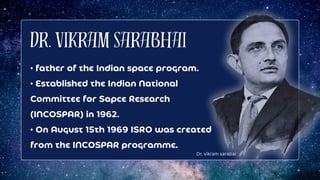
Dr. Vikram Sarabhai
• father of the Indian space program.
• Established the Indian National
Committee for Sapce Research
(INCOSPAR) in 1962.
• On August 15th 1969 ISRO was created
from the INCOSPAR programme.
Dr. vikram sarabai
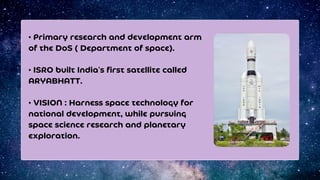
• Primary research and development arm
of the DoS ( Department of space).
• ISRO built India's first satellite called
ARYABHATT.
• VISION : Harness space technology for
national development, while pursuing
space science research and planetary
exploration.
ISRO's activities include building and launching satellites,
developing launch vehicles, and providing services like
communication, television broadcasting, meteorological
forecasting, and resource monitoring.
MISSION ACTIVITIES
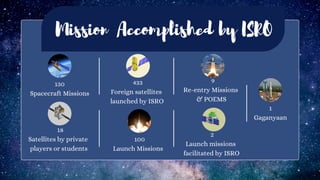
18
Satellites by private
players or students
433
Foreign satellites
launched by ISRO
100
Launch Missions
Mission Accomplished by ISRO
130
Spacecraft Missions
9
Re-entry Missions
& POEMS
2
Launch missions
facilitated by ISRO
1
Gaganyaan
INDIA'S FIRST SATELLITE..
ARYABHATT
India launched it's first satellite Aryabhatt in 1975 from.
Kapustin Yar.
Named after the great Indian astronomer of the same
name.
Aryabhata was built to conduct X ray astronomy,
aeronomics, and solar physics.
Mars Orbiter Mission (MOM)
Mangalyaan
"Mars-craft" is a Mars orbiter launched into Earth orbit
on 5 November 2013 by ISRO.
It was successfully inserted into orbit of Mars on 24
September 2014, making India the first country in the
world to successfully send a spacecraft to Mars on its
very first attempt.
cheapest mars mission ever.
INDIA'S FIRST MISSION TO MOON
CHANDRAYAAN-1
launched on : October 22, 2008
from : the Satish Dhawan Space Centre in Sriharikota
The spacecraft orbited the Moon at 100 km
Objective : To map the Moon's surface, identify its
chemical and mineral composition, and search for water
ice.
The mission confirmed the presence of water molecules
on the Moon.
India's First satellite launch vehicle
SLV - 3
•India's first experimental satellite launch vehicle
•An all solid, four stage vehicle weighing 17 tonnes with
a height of 22m and capable of placing 40 kg class
payloads in Low Earth Orbit
• The SLV-3 carried the Rohini satellite (RS-1)
• successfully launched on July 18, 1980
E
a
r
l
y
M
i
l
e
s
t
o
n
s
Launched
Vehicles
By ISRO: ASLV, PSLV, GSLV and LVM 3.
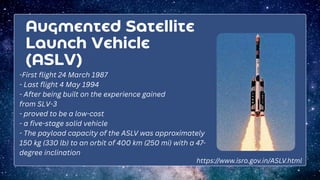
Augmented Satellite
Launch Vehicle
(ASLV)
-First flight 24 March 1987
- Last flight 4 May 1994
- After being built on the experience gained
from SLV-3
- proved to be a low-cost
- a five-stage solid vehicle
- The payload capacity of the ASLV was approximately
150 kg (330 lb) to an orbit of 400 km (250 mi) with a 47-
degree inclination
https://www.isro.gov.in/ASLV.html
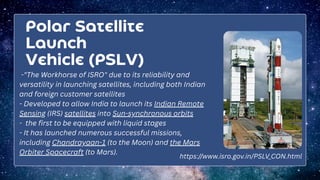
Polar Satellite
Launch
Vehicle (PSLV)
-"The Workhorse of ISRO" due to its reliability and
versatility in launching satellites, including both Indian
and foreign customer satellites
- Developed to allow India to launch its Indian Remote
Sensing (IRS) satellites into Sun-synchronous orbits
- the first to be equipped with liquid stages
- It has launched numerous successful missions,
including Chandrayaan-1 (to the Moon) and the Mars
Orbiter Spacecraft (to Mars).
https://www.isro.gov.in/PSLV_CON.html
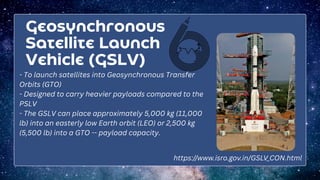
Geosynchronous
Satellite Launch
Vehicle (GSLV)
- To launch satellites into Geosynchronous Transfer
Orbits (GTO)
- Designed to carry heavier payloads compared to the
PSLV
- The GSLV can place approximately 5,000 kg (11,000
lb) into an easterly low Earth orbit (LEO) or 2,500 kg
(5,500 lb) into a GTO -- payload capacity.
https://www.isro.gov.in/GSLV_CON.html
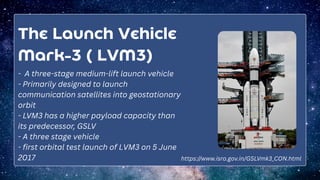
The Launch Vehicle
Mark-3 ( LVM3)
- A three-stage medium-lift launch vehicle
- Primarily designed to launch
communication satellites into geostationary
orbit
- LVM3 has a higher payload capacity than
its predecessor, GSLV
- A three stage vehicle
- first orbital test launch of LVM3 on 5 June
2017 https://www.isro.gov.in/GSLVmk3_CON.html
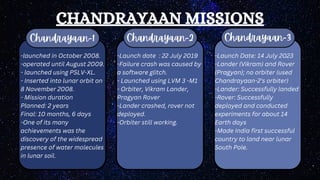
CHANDRAYAAN MISSIONS
Chandrayaan-1 Chandrayaan-2 Chandrayaan-3
-launched in October 2008.
-operated until August 2009.
- launched using PSLV-XL.
- Inserted into lunar orbit on
8 November 2008.
- Mission duration
Planned: 2 years
Final: 10 months, 6 days
-One of its many
achievements was the
discovery of the widespread
presence of water molecules
in lunar soil.
-Launch date : 22 July 2019
-Failure crash was caused by
a software glitch.
- Launched using LVM 3 -M1
- Orbiter, Vikram Lander,
Pragyan Rover
-Lander crashed, rover not
deployed.
-Orbiter still working.
-Launch Date: 14 July 2023
-Lander (Vikram) and Rover
(Pragyan); no orbiter (used
Chandrayaan-2's orbiter)
-Lander: Successfully landed
-Rover: Successfully
deployed and conducted
experiments for about 14
Earth days
-Made India first successful
country to land near lunar
South Pole.
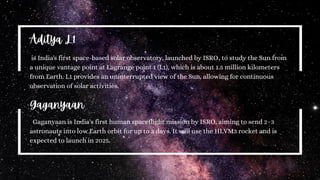
is India's first space-based solar observatory, launched by ISRO, to study the Sun from
a unique vantage point at Lagrange point 1 (L1), which is about 1.5 million kilometers
from Earth. L1 provides an uninterrupted view of the Sun, allowing for continuous
observation of solar activities.
Aditya L1
Gaganyaan
Gaganyaan is India's first human spaceflight mission by ISRO, aiming to send 2–3
astronauts into low Earth orbit for up to 3 days. It will use the HLVM3 rocket and is
expected to launch in 2025.
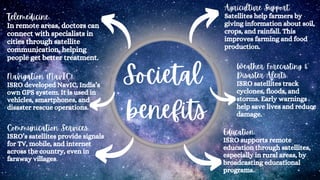
Societal
benefits
Agriculture Support:
Satellites help farmers by
giving information about soil,
crops, and rainfall. This
improves farming and food
production.
Education:
ISRO supports remote
education through satellites,
especially in rural areas, by
broadcasting educational
programs.
Weather Forecasting &
Disaster Alerts:
ISRO satellites track
cyclones, floods, and
storms. Early warnings
help save lives and reduce
damage.
Telemedicine:
In remote areas, doctors can
connect with specialists in
cities through satellite
communication, helping
people get better treatment.
Navigation (NavIC):
ISRO developed NavIC, India’s
own GPS system. It is used in
vehicles, smartphones, and
disaster rescue operations.
Communication Services:
ISRO’s satellites provide signals
for TV, mobile, and internet
across the country, even in
faraway villages.
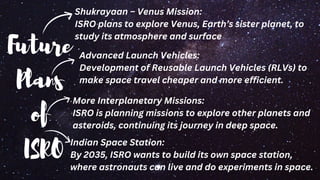
Future
Plans
of
ISRO
Advanced Launch Vehicles:
Development of Reusable Launch Vehicles (RLVs) to
make space travel cheaper and more efficient.
More Interplanetary Missions:
ISRO is planning missions to explore other planets and
asteroids, continuing its journey in deep space.
Indian Space Station:
By 2035, ISRO wants to build its own space station,
where astronauts can live and do experiments in space.
Shukrayaan – Venus Mission:
ISRO plans to explore Venus, Earth’s sister planet, to
study its atmosphere and surface
Conclusion
-ISRO started small but has made huge achievements—like
missions to the Moon, Mars, and Sun.
-It helps India grow using satellites for communication, farming,
weather, and more.
-Known for low-cost, high-impact missions, ISRO is now respected
worldwide.
-With bold future plans, ISRO continues to inspire young minds and
push the boundaries of space exploration.
~Thank you~
Isro (Indian space research organization)

  • 1.
    ISRO Indian space researchorganization Powering India 's space journey ✈️ By - Parineeta from - B. Sc. (H) Chemistry
  • 2.
    Introduction of ISRO •ISRO - The Indian space research organization • Started in - 1969 • By - Dr. Vikram Sarabhai. • headquartered - in Bengaluru, Karnataka
  • 3.
    Dr. Vikram Sarabhai •father of the Indian space program. • Established the Indian National Committee for Sapce Research (INCOSPAR) in 1962. • On August 15th 1969 ISRO was created from the INCOSPAR programme. Dr. vikram sarabai
  • 4.
    • Primary researchand development arm of the DoS ( Department of space). • ISRO built India's first satellite called ARYABHATT. • VISION : Harness space technology for national development, while pursuing space science research and planetary exploration.
  • 5.
    ISRO's activities includebuilding and launching satellites, developing launch vehicles, and providing services like communication, television broadcasting, meteorological forecasting, and resource monitoring. MISSION ACTIVITIES
  • 6.
    18 Satellites by private playersor students 433 Foreign satellites launched by ISRO 100 Launch Missions Mission Accomplished by ISRO 130 Spacecraft Missions 9 Re-entry Missions & POEMS 2 Launch missions facilitated by ISRO 1 Gaganyaan
  • 7.
    INDIA'S FIRST SATELLITE.. ARYABHATT Indialaunched it's first satellite Aryabhatt in 1975 from. Kapustin Yar. Named after the great Indian astronomer of the same name. Aryabhata was built to conduct X ray astronomy, aeronomics, and solar physics. Mars Orbiter Mission (MOM) Mangalyaan "Mars-craft" is a Mars orbiter launched into Earth orbit on 5 November 2013 by ISRO. It was successfully inserted into orbit of Mars on 24 September 2014, making India the first country in the world to successfully send a spacecraft to Mars on its very first attempt. cheapest mars mission ever. INDIA'S FIRST MISSION TO MOON CHANDRAYAAN-1 launched on : October 22, 2008 from : the Satish Dhawan Space Centre in Sriharikota The spacecraft orbited the Moon at 100 km Objective : To map the Moon's surface, identify its chemical and mineral composition, and search for water ice. The mission confirmed the presence of water molecules on the Moon. India's First satellite launch vehicle SLV - 3 •India's first experimental satellite launch vehicle •An all solid, four stage vehicle weighing 17 tonnes with a height of 22m and capable of placing 40 kg class payloads in Low Earth Orbit • The SLV-3 carried the Rohini satellite (RS-1) • successfully launched on July 18, 1980 E a r l y M i l e s t o n s
  • 8.
    Launched Vehicles By ISRO: ASLV,PSLV, GSLV and LVM 3.
  • 9.
    Augmented Satellite Launch Vehicle (ASLV) -Firstflight 24 March 1987 - Last flight 4 May 1994 - After being built on the experience gained from SLV-3 - proved to be a low-cost - a five-stage solid vehicle - The payload capacity of the ASLV was approximately 150 kg (330 lb) to an orbit of 400 km (250 mi) with a 47- degree inclination https://www.isro.gov.in/ASLV.html
  • 10.
    Polar Satellite Launch Vehicle (PSLV) -"TheWorkhorse of ISRO" due to its reliability and versatility in launching satellites, including both Indian and foreign customer satellites - Developed to allow India to launch its Indian Remote Sensing (IRS) satellites into Sun-synchronous orbits - the first to be equipped with liquid stages - It has launched numerous successful missions, including Chandrayaan-1 (to the Moon) and the Mars Orbiter Spacecraft (to Mars). https://www.isro.gov.in/PSLV_CON.html
  • 11.
    Geosynchronous Satellite Launch Vehicle (GSLV) -To launch satellites into Geosynchronous Transfer Orbits (GTO) - Designed to carry heavier payloads compared to the PSLV - The GSLV can place approximately 5,000 kg (11,000 lb) into an easterly low Earth orbit (LEO) or 2,500 kg (5,500 lb) into a GTO -- payload capacity. https://www.isro.gov.in/GSLV_CON.html
  • 12.
    The Launch Vehicle Mark-3( LVM3) - A three-stage medium-lift launch vehicle - Primarily designed to launch communication satellites into geostationary orbit - LVM3 has a higher payload capacity than its predecessor, GSLV - A three stage vehicle - first orbital test launch of LVM3 on 5 June 2017 https://www.isro.gov.in/GSLVmk3_CON.html
  • 14.
    CHANDRAYAAN MISSIONS Chandrayaan-1 Chandrayaan-2Chandrayaan-3 -launched in October 2008. -operated until August 2009. - launched using PSLV-XL. - Inserted into lunar orbit on 8 November 2008. - Mission duration Planned: 2 years Final: 10 months, 6 days -One of its many achievements was the discovery of the widespread presence of water molecules in lunar soil. -Launch date : 22 July 2019 -Failure crash was caused by a software glitch. - Launched using LVM 3 -M1 - Orbiter, Vikram Lander, Pragyan Rover -Lander crashed, rover not deployed. -Orbiter still working. -Launch Date: 14 July 2023 -Lander (Vikram) and Rover (Pragyan); no orbiter (used Chandrayaan-2's orbiter) -Lander: Successfully landed -Rover: Successfully deployed and conducted experiments for about 14 Earth days -Made India first successful country to land near lunar South Pole.
  • 15.
    is India's firstspace-based solar observatory, launched by ISRO, to study the Sun from a unique vantage point at Lagrange point 1 (L1), which is about 1.5 million kilometers from Earth. L1 provides an uninterrupted view of the Sun, allowing for continuous observation of solar activities. Aditya L1 Gaganyaan Gaganyaan is India's first human spaceflight mission by ISRO, aiming to send 2–3 astronauts into low Earth orbit for up to 3 days. It will use the HLVM3 rocket and is expected to launch in 2025.
  • 16.
    Societal benefits Agriculture Support: Satellites helpfarmers by giving information about soil, crops, and rainfall. This improves farming and food production. Education: ISRO supports remote education through satellites, especially in rural areas, by broadcasting educational programs. Weather Forecasting & Disaster Alerts: ISRO satellites track cyclones, floods, and storms. Early warnings help save lives and reduce damage. Telemedicine: In remote areas, doctors can connect with specialists in cities through satellite communication, helping people get better treatment. Navigation (NavIC): ISRO developed NavIC, India’s own GPS system. It is used in vehicles, smartphones, and disaster rescue operations. Communication Services: ISRO’s satellites provide signals for TV, mobile, and internet across the country, even in faraway villages.
  • 17.
    Future Plans of ISRO Advanced Launch Vehicles: Developmentof Reusable Launch Vehicles (RLVs) to make space travel cheaper and more efficient. More Interplanetary Missions: ISRO is planning missions to explore other planets and asteroids, continuing its journey in deep space. Indian Space Station: By 2035, ISRO wants to build its own space station, where astronauts can live and do experiments in space. Shukrayaan – Venus Mission: ISRO plans to explore Venus, Earth’s sister planet, to study its atmosphere and surface
  • 18.
    Conclusion -ISRO started smallbut has made huge achievements—like missions to the Moon, Mars, and Sun. -It helps India grow using satellites for communication, farming, weather, and more. -Known for low-cost, high-impact missions, ISRO is now respected worldwide. -With bold future plans, ISRO continues to inspire young minds and push the boundaries of space exploration. ~Thank you~