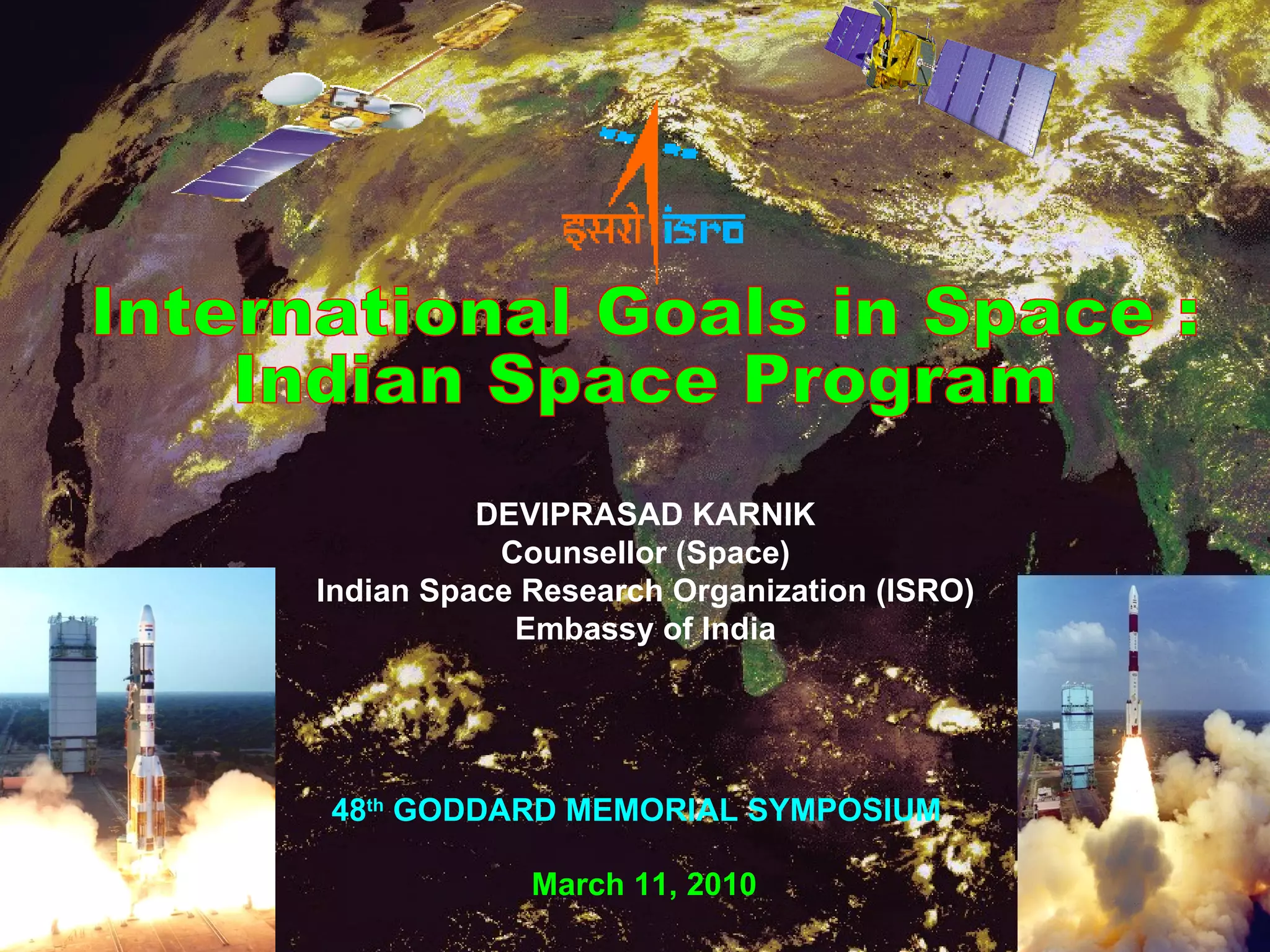

International Goals in Space :  Indian Space Program DEVIPRASAD KARNIK Counsellor (Space) Indian Space Research Organization (ISRO) Embassy of India March 11, 2010 48 th  GODDARD MEMORIAL SYMPOSIUM
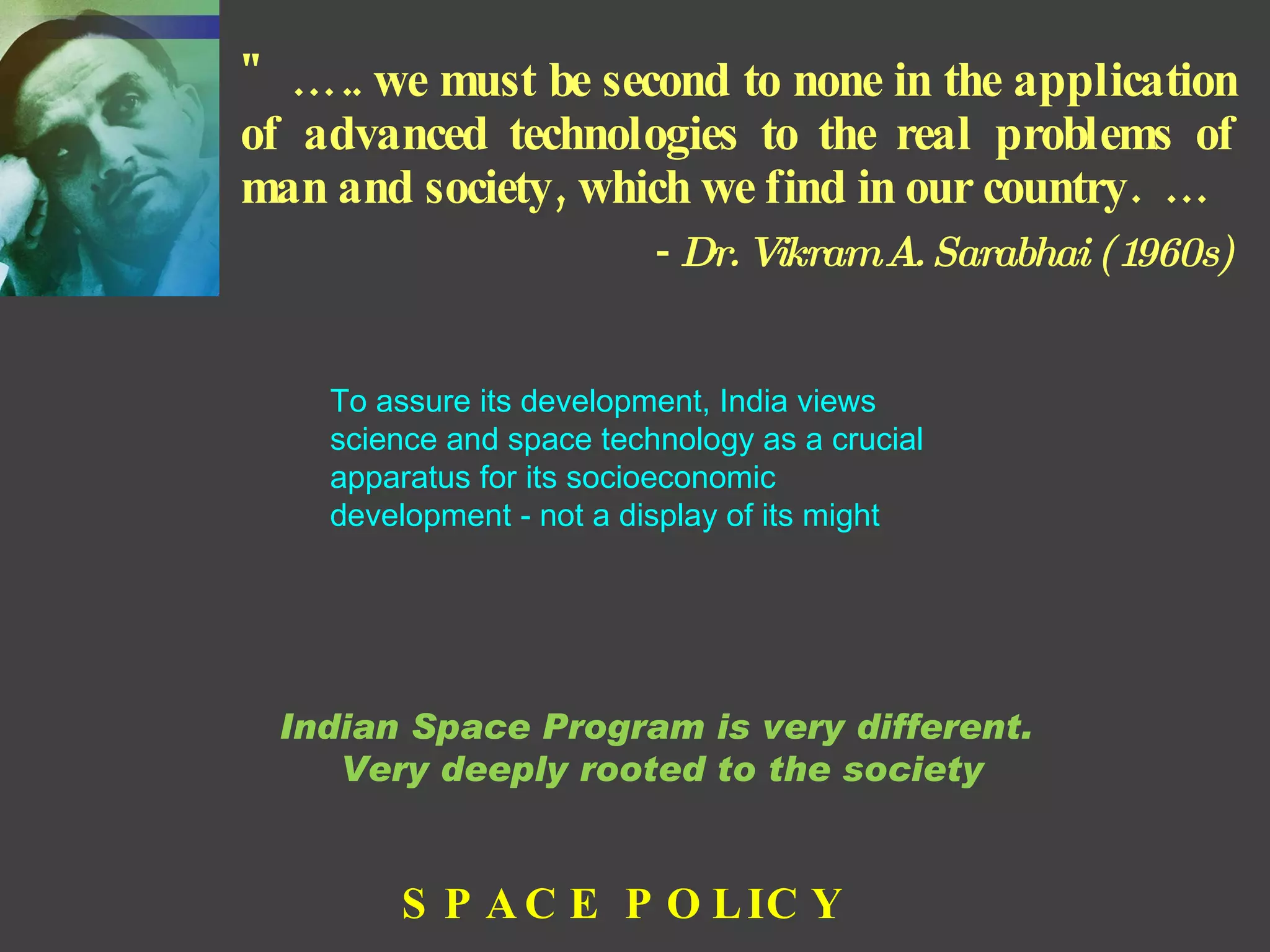
"  ….. we must be second to none in the application of advanced technologies to the real problems of man and society, which we find in our country.  … -  Dr. Vikram A. Sarabhai (1960s) Indian Space Program is very different.  Very deeply rooted to the society SPACE POLICY  To assure its development, India views science and space technology as a crucial apparatus for its socioeconomic development - not a display of its might
 
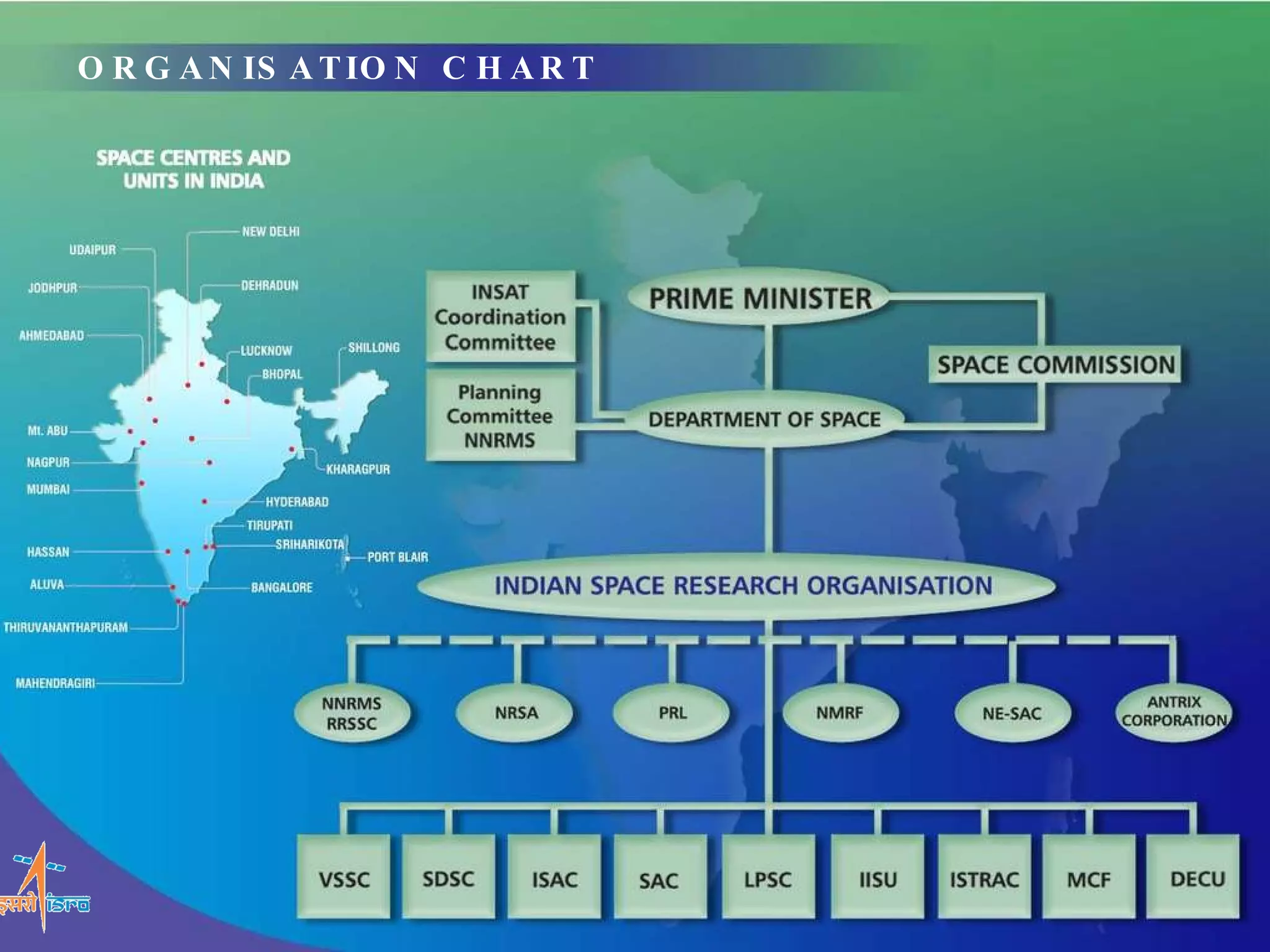
ORGANISATION CHART


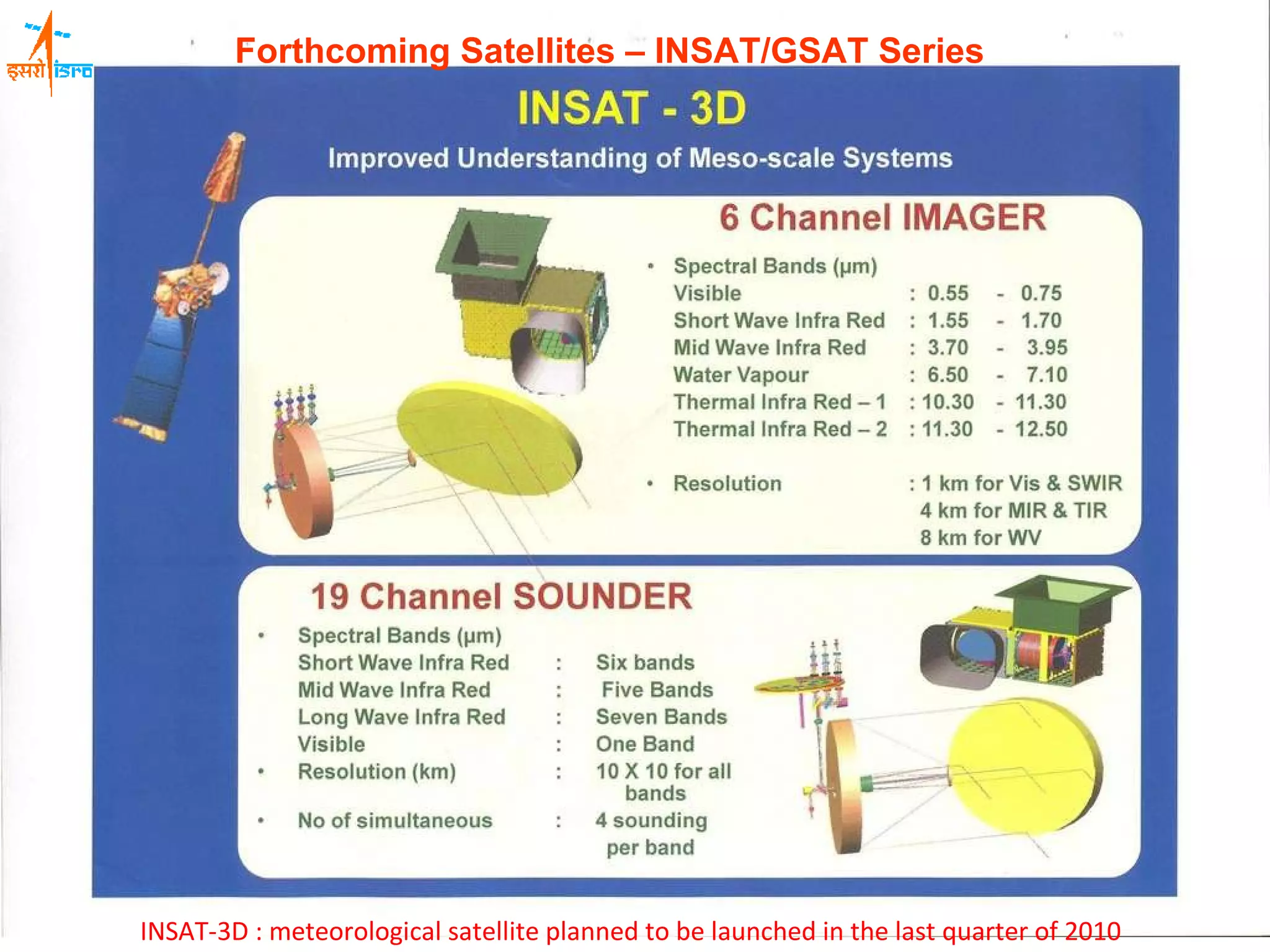
INSAT-3D : meteorological satellite planned to be launched in the last quarter of 2010 Forthcoming Satellites – INSAT/GSAT Series
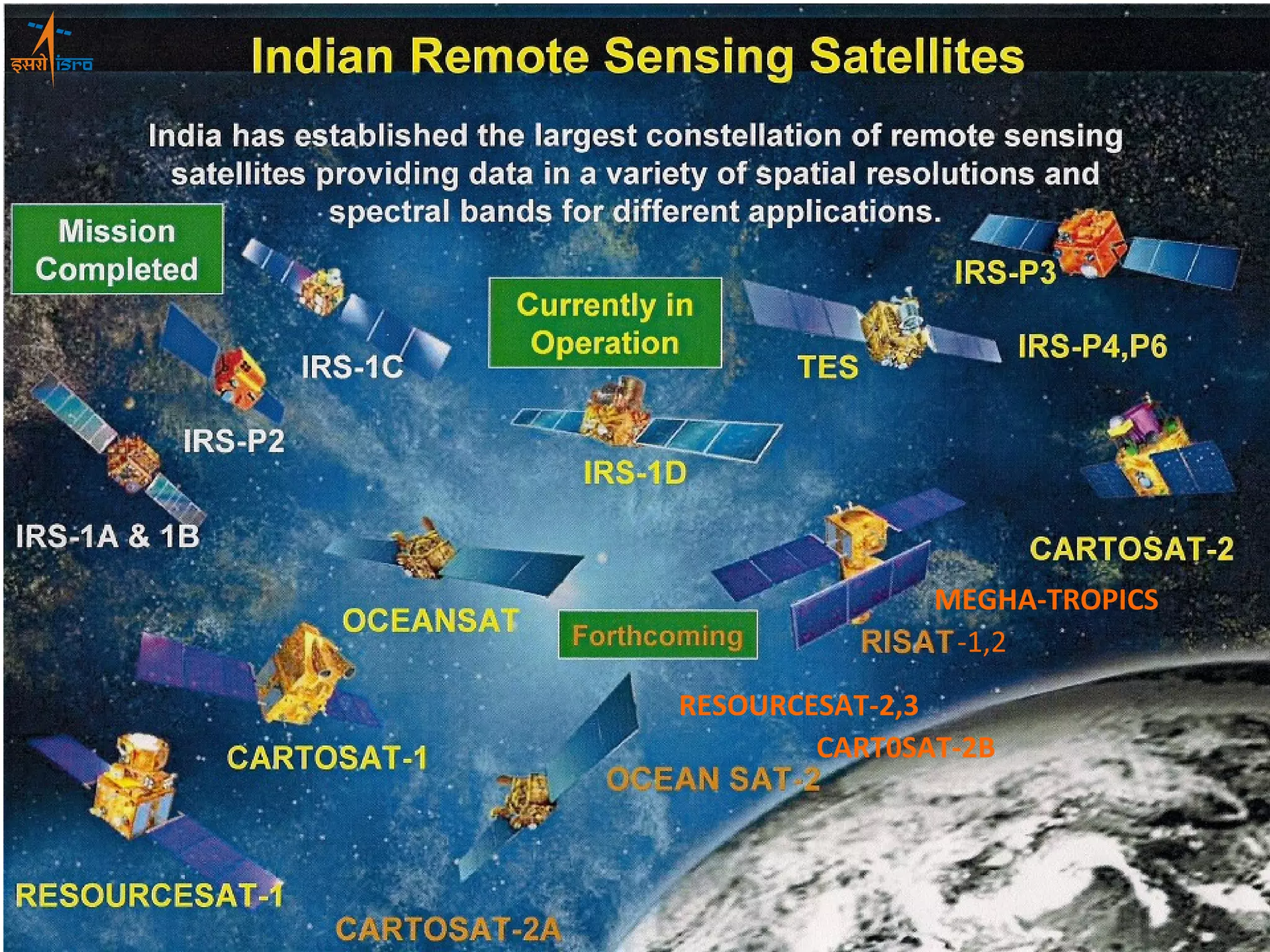
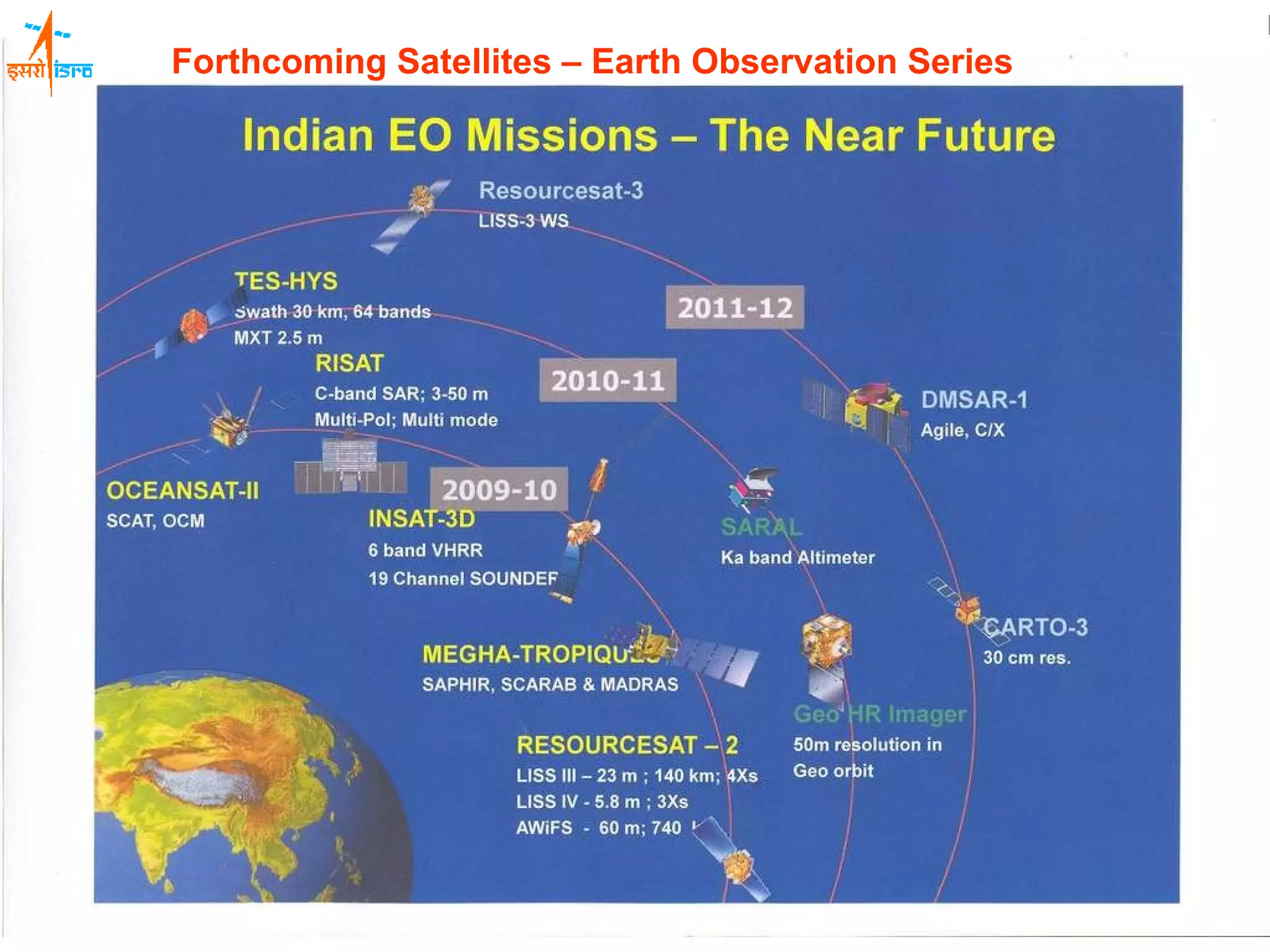
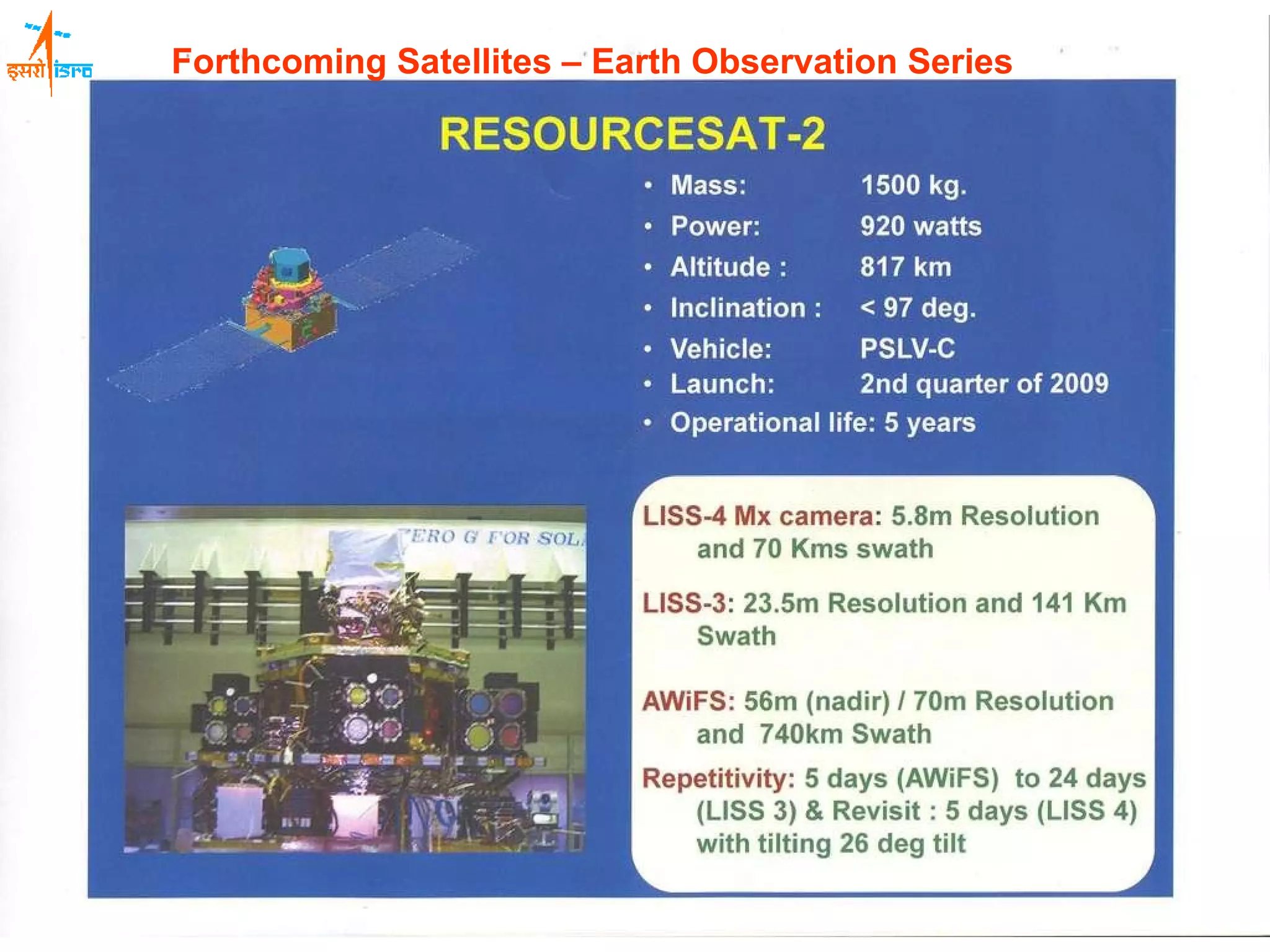
RESOURCESAT-2,3 CART0SAT-2B MEGHA-TROPICS -1,2
 
 
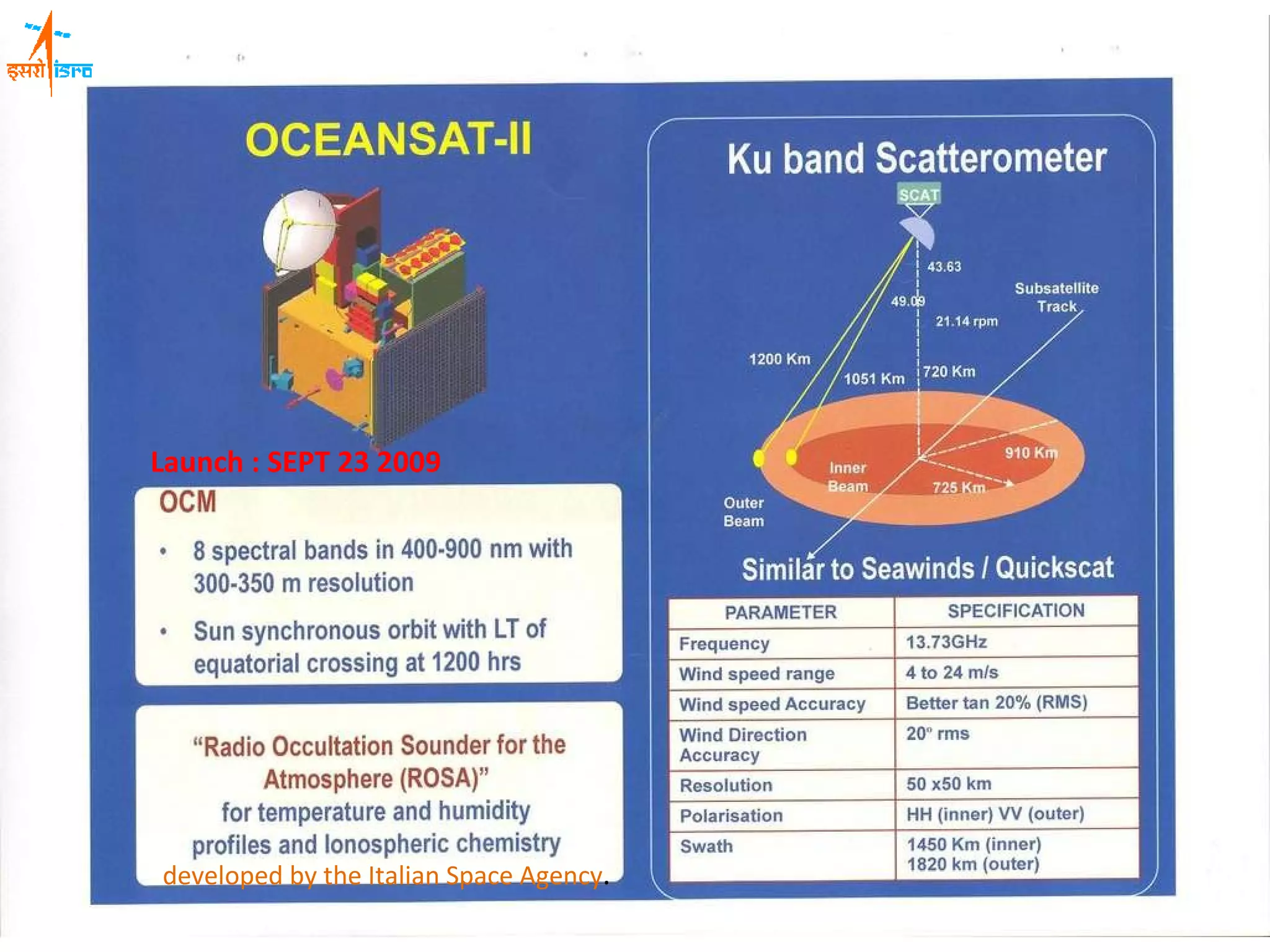
Launch : SEPT 23 2009 developed by the Italian Space Agency .
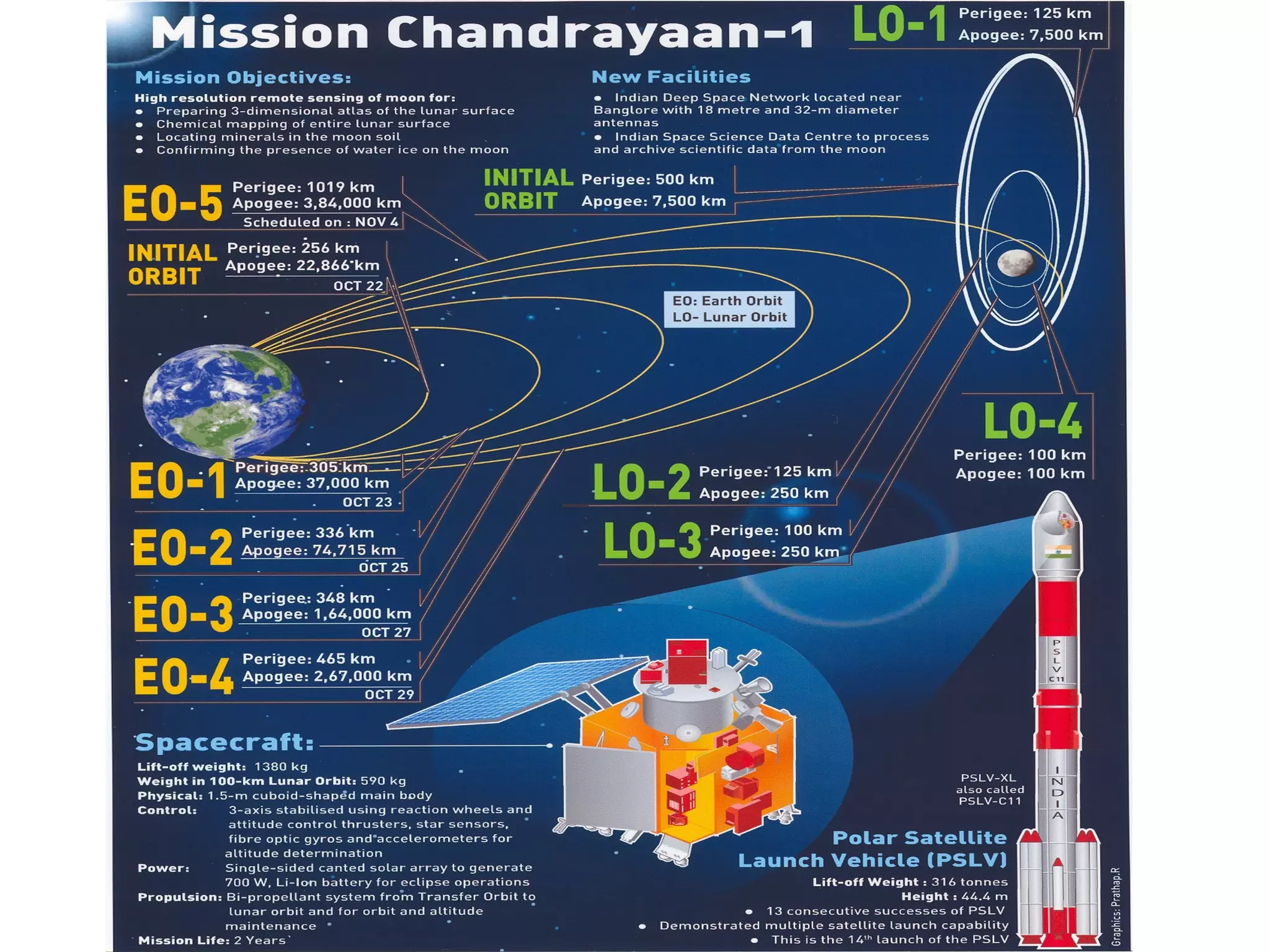
SPACE SCIENCE Chandrayaan-1 India’s First Lunar Mission
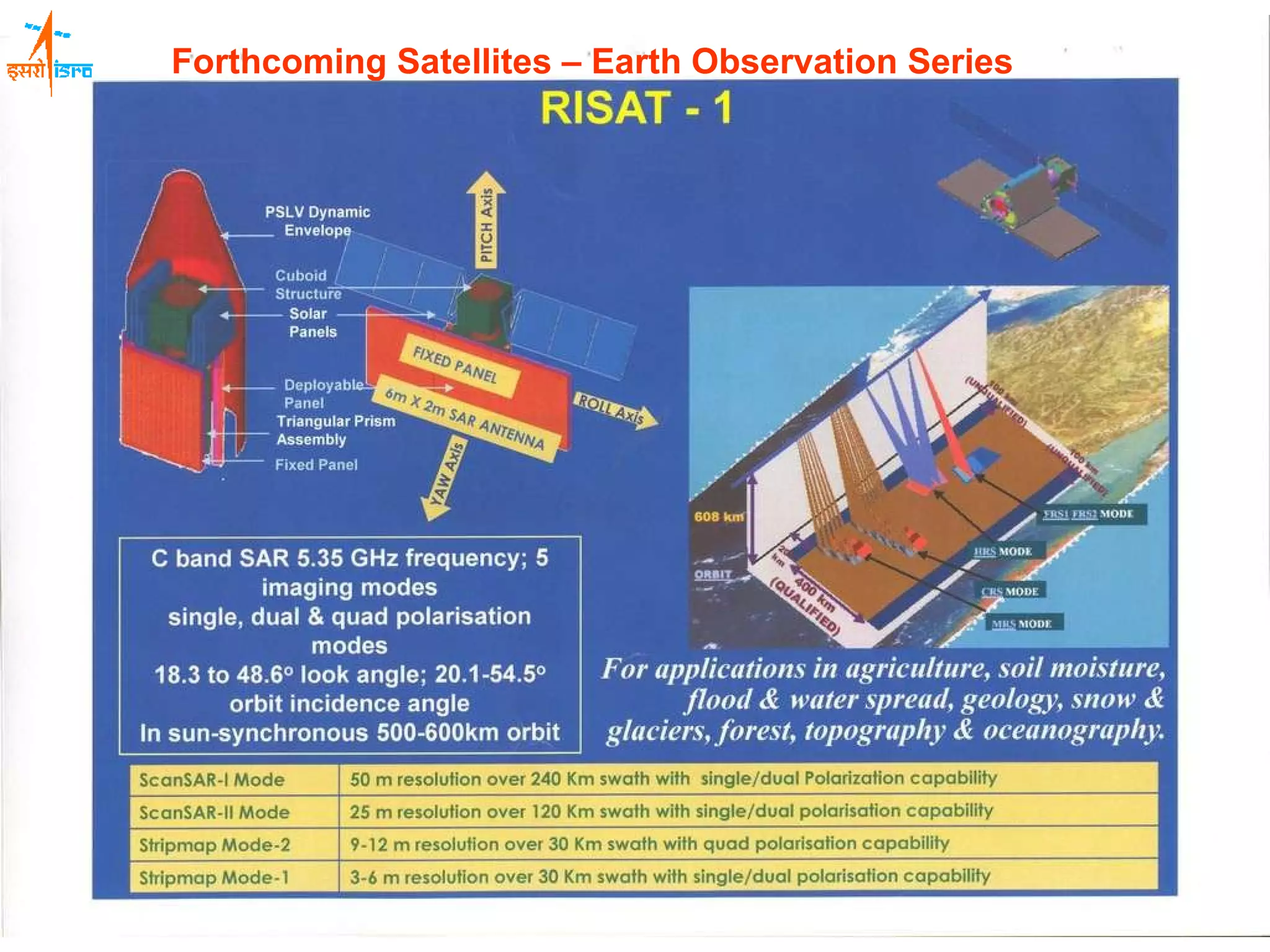
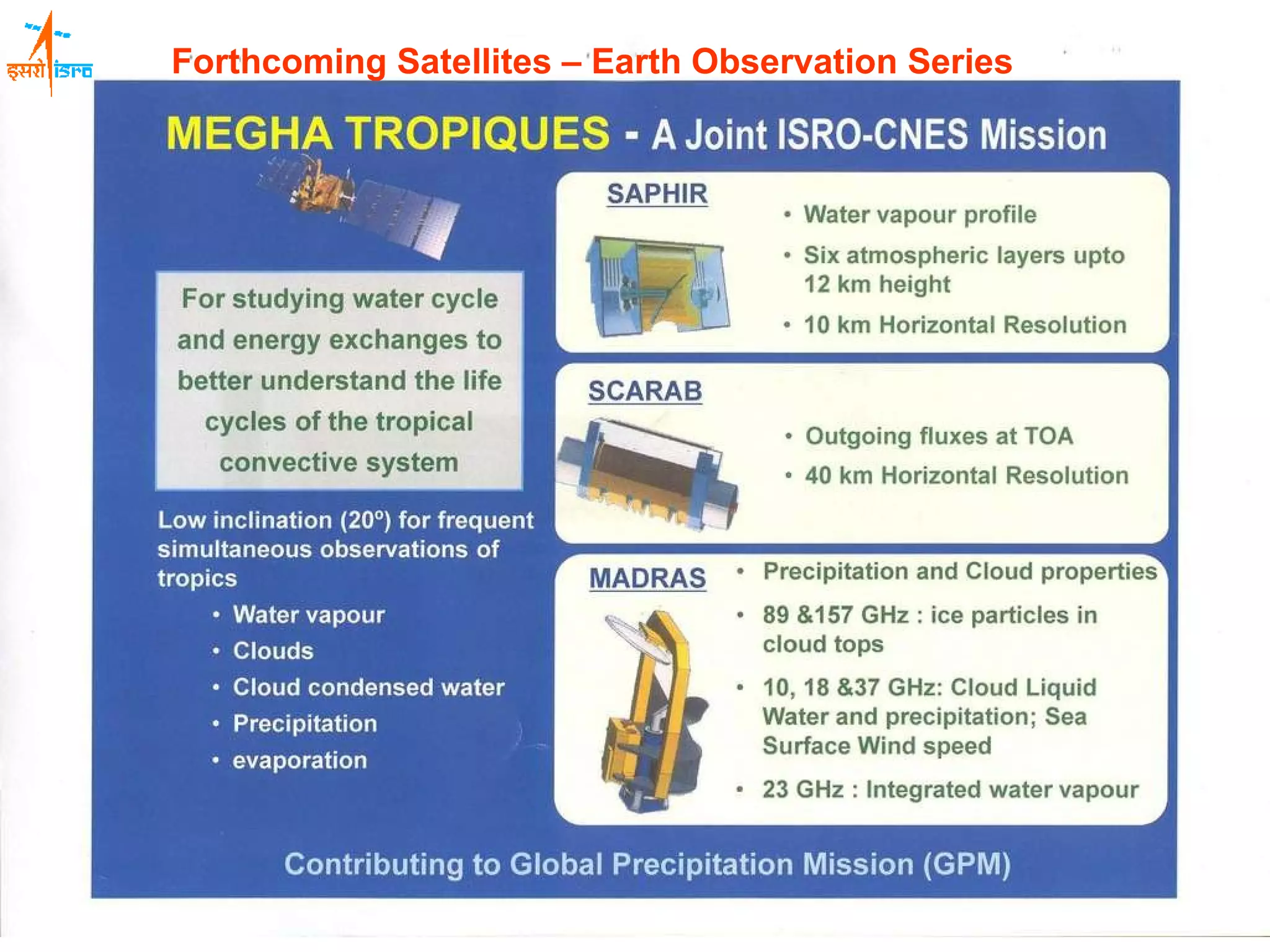
Forthcoming Satellites – Earth Observation Series
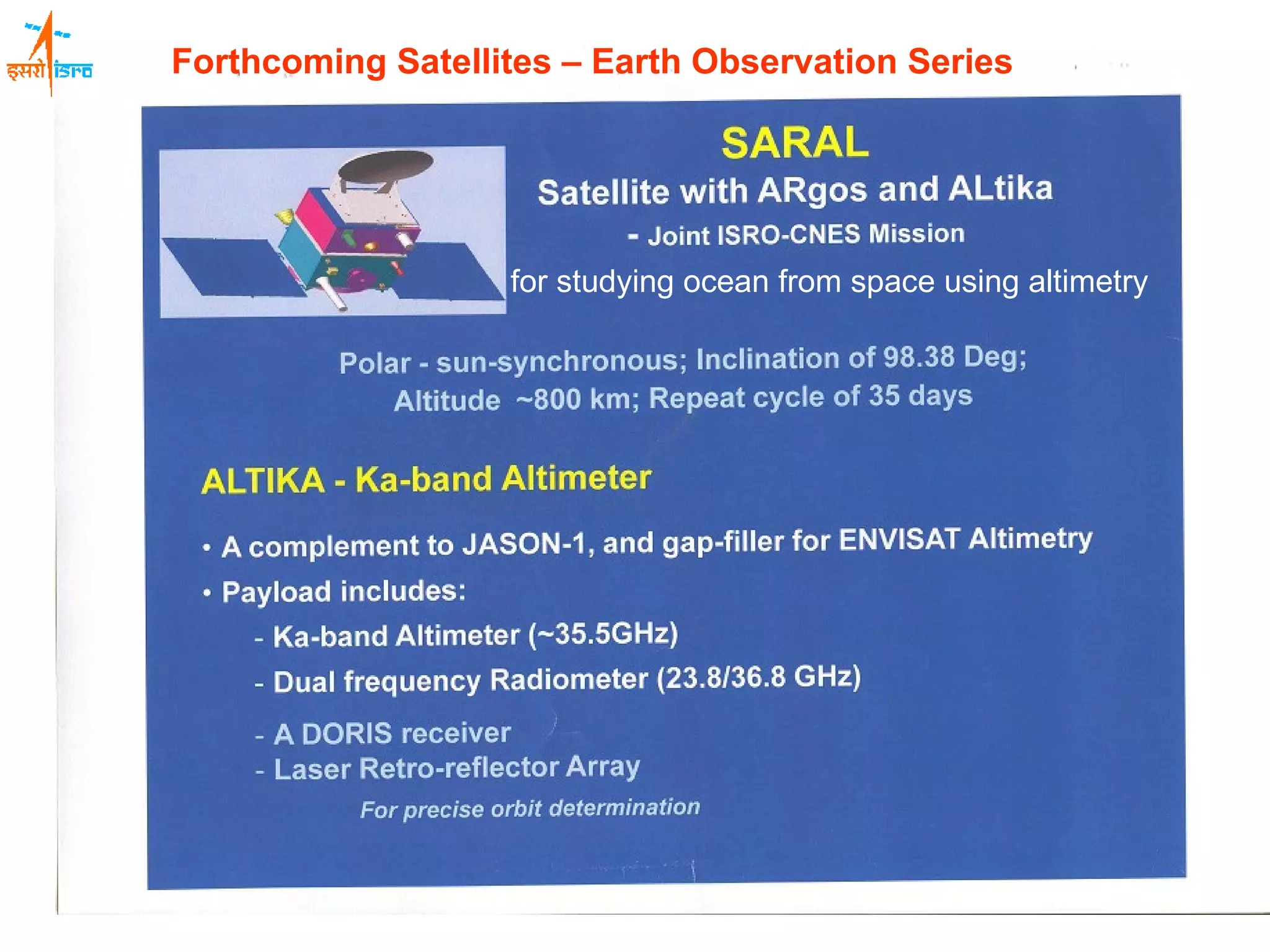
Forthcoming Satellites – Earth Observation Series   for studying ocean from space using altimetry
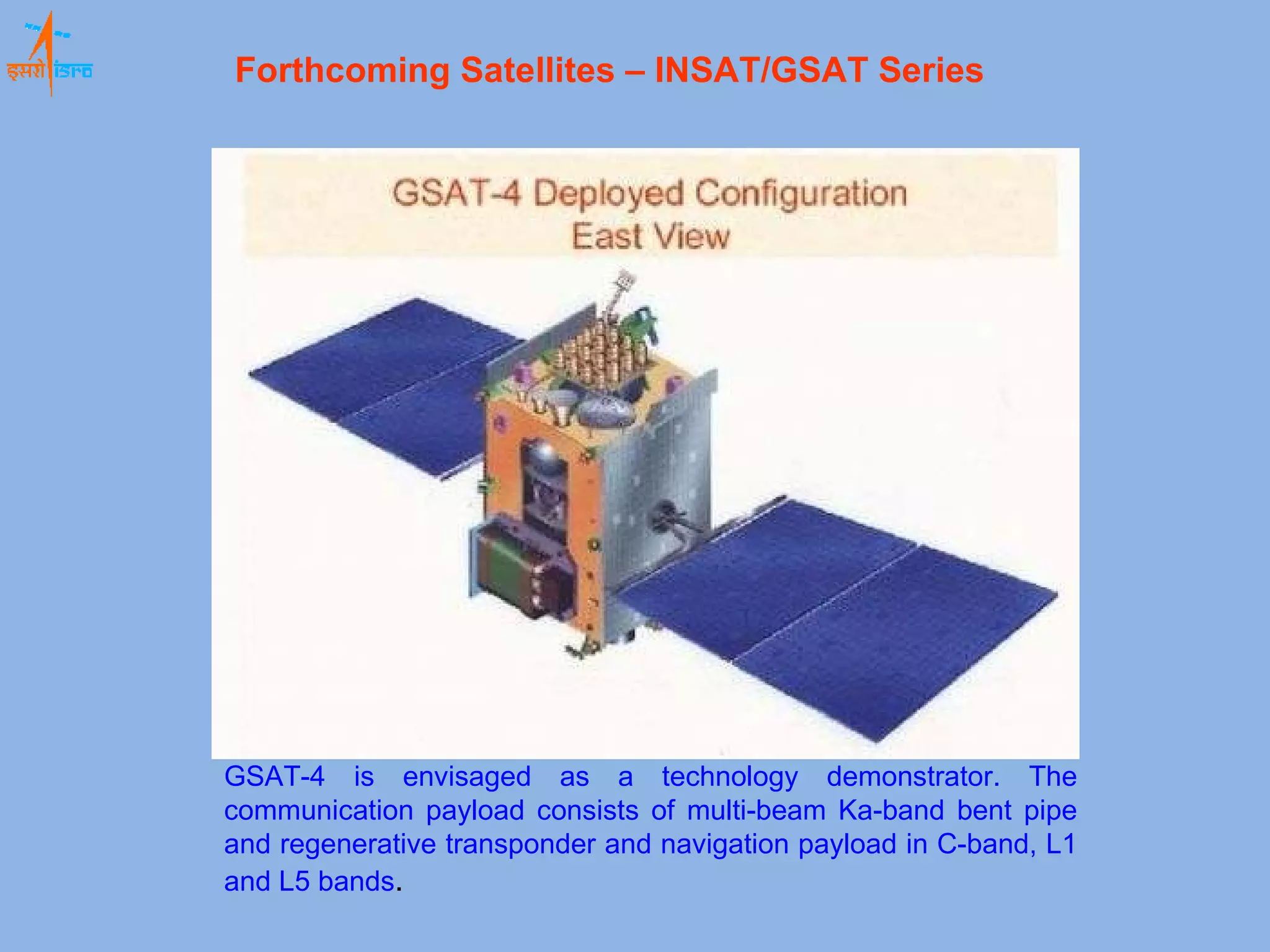
GSAT-4 is envisaged as a technology demonstrator. The communication payload consists of multi-beam Ka-band bent pipe and regenerative transponder and navigation payload in C-band, L1 and L5 bands .  Forthcoming Satellites – INSAT/GSAT Series
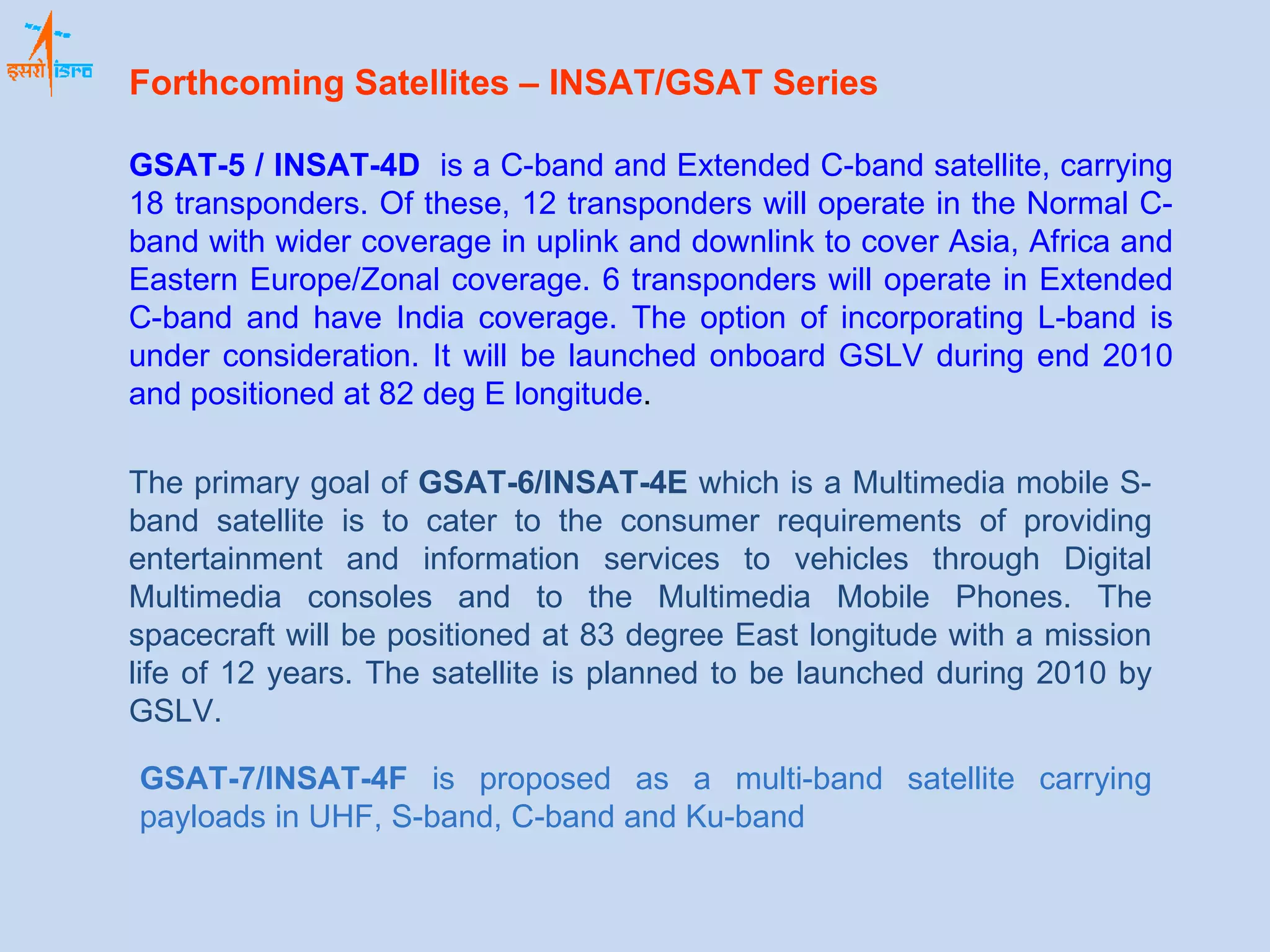
GSAT-5 / INSAT-4D   is a C-band and Extended C-band satellite, carrying 18 transponders. Of these, 12 transponders will operate in the Normal C-band with wider coverage in uplink and downlink to cover Asia, Africa and Eastern Europe/Zonal coverage. 6 transponders will operate in Extended C-band and have India coverage. The option of incorporating L-band is under consideration. It will be launched onboard GSLV during end 2010 and positioned at 82 deg E longitude . The primary goal of  GSAT-6/INSAT-4E  which is a Multimedia mobile S-band satellite is to cater to the consumer requirements of providing entertainment and information services to vehicles through Digital Multimedia consoles and to the Multimedia Mobile Phones. The spacecraft will be positioned at 83 degree East longitude with a mission life of 12 years. The satellite is planned to be launched during 2010 by GSLV. GSAT-7/INSAT-4F  is proposed as a multi-band satellite carrying payloads in UHF, S-band, C-band and Ku-band Forthcoming Satellites – INSAT/GSAT Series
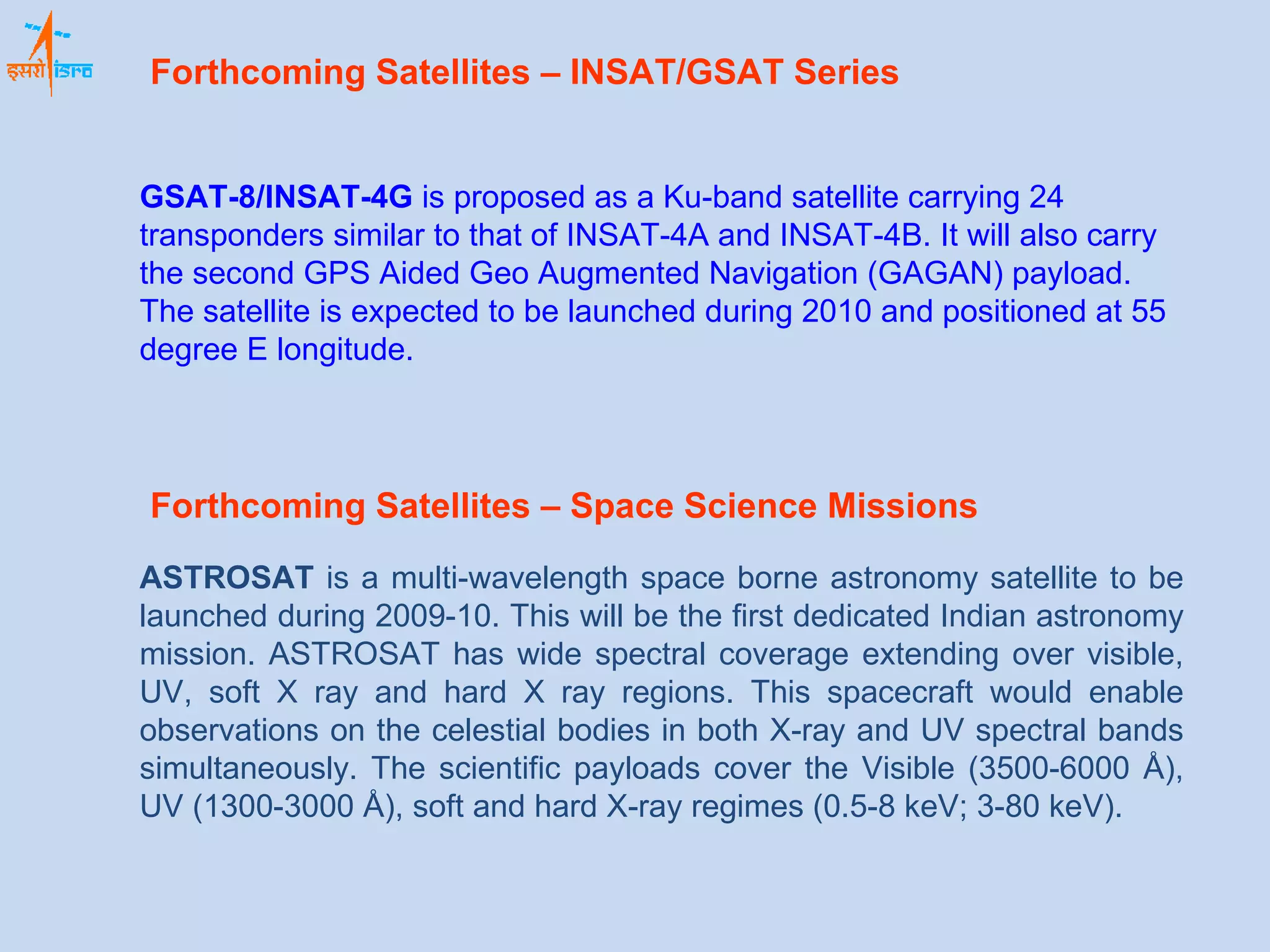
GSAT-8/INSAT-4G  is proposed as a Ku-band satellite carrying 24 transponders similar to that of INSAT-4A and INSAT-4B. It will also carry the second GPS Aided Geo Augmented Navigation (GAGAN) payload. The satellite is expected to be launched during 2010 and positioned at 55 degree E longitude.  Forthcoming Satellites – INSAT/GSAT Series   ASTROSAT  is a multi-wavelength space borne astronomy satellite to be launched during 2009-10. This will be the first dedicated Indian astronomy mission. ASTROSAT has wide spectral coverage extending over visible, UV, soft X ray and hard X ray regions. This spacecraft would enable observations on the celestial bodies in both X-ray and UV spectral bands simultaneously. The scientific payloads cover the Visible (3500-6000 Å), UV (1300-3000 Å), soft and hard X-ray regimes (0.5-8 keV; 3-80 keV). Forthcoming Satellites – Space Science Missions
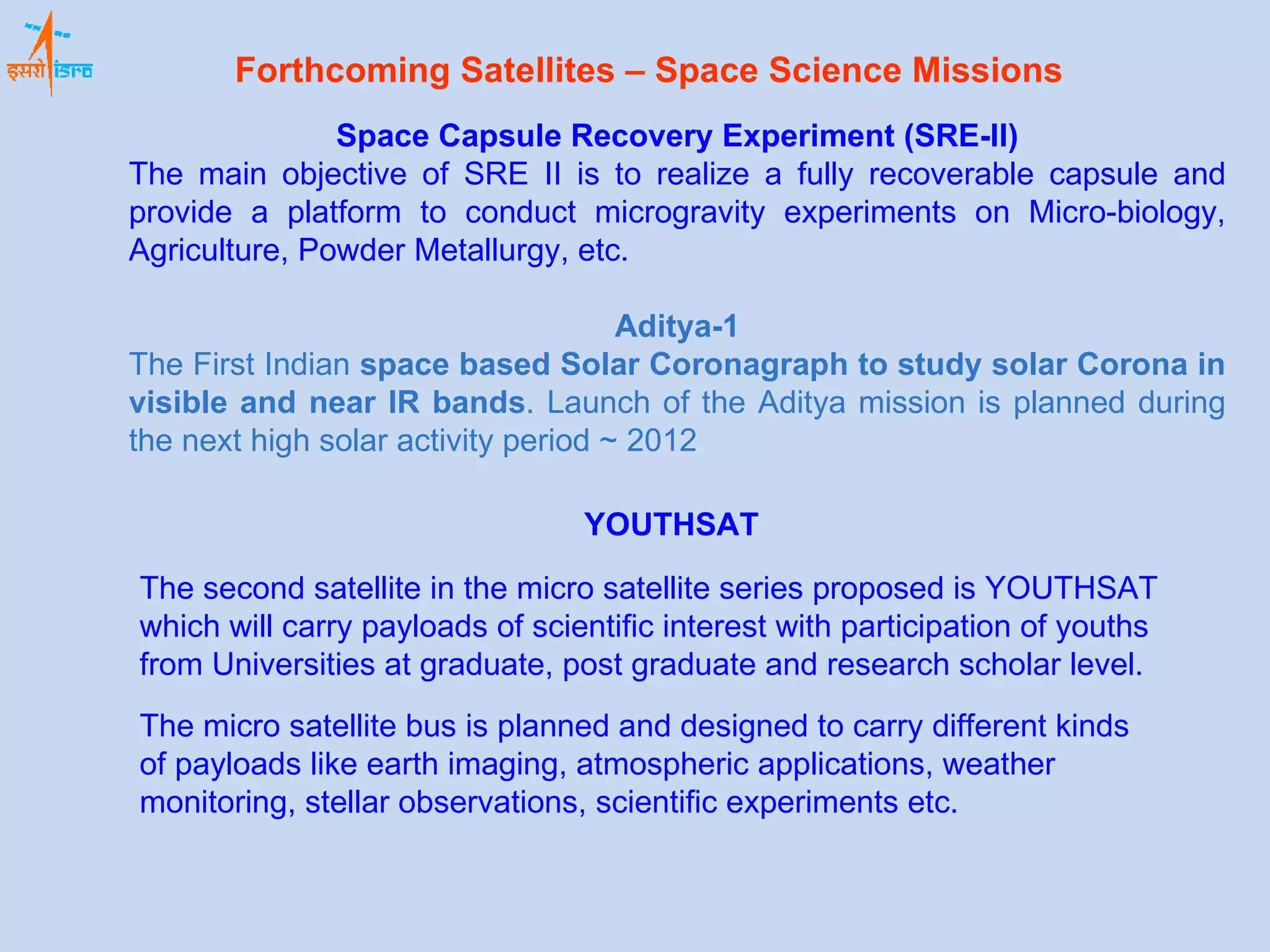
Space Capsule Recovery Experiment (SRE-II) The main objective of SRE II is to realize a fully recoverable capsule and provide a platform to conduct microgravity experiments on Micro-biology, Agriculture, Powder Metallurgy, etc.  Aditya-1 The First Indian  space based Solar Coronagraph to study solar Corona in visible and near IR bands . Launch of the Aditya mission is planned during the next high solar activity period ~ 2012 YOUTHSAT The second satellite in the micro satellite series proposed is YOUTHSAT which will carry payloads of scientific interest with participation of youths from Universities at graduate, post graduate and research scholar level.   The micro satellite bus is planned and designed to carry different kinds of payloads like earth imaging, atmospheric applications, weather monitoring, stellar observations, scientific experiments etc.   Forthcoming Satellites – Space Science Missions
Satellite Navigation GAGAN : Indigenous Satellite-Based Regional GPS Augmentation System also known as Space-Based Augmentation System (SBAS) as part of the Satellite-Based Communications, Navigation and Surveillance (CNS)/Air Traffic Management (ATM) plan for civil aviation.  GPS Aided GEO Augmented Navigation The first navigation payload is being fabricated and it is proposed to be flown on GSAT-4. Two more payloads will be subsequently flown, one each on two geostationary satellites GSAT-8 and GSAT-12.
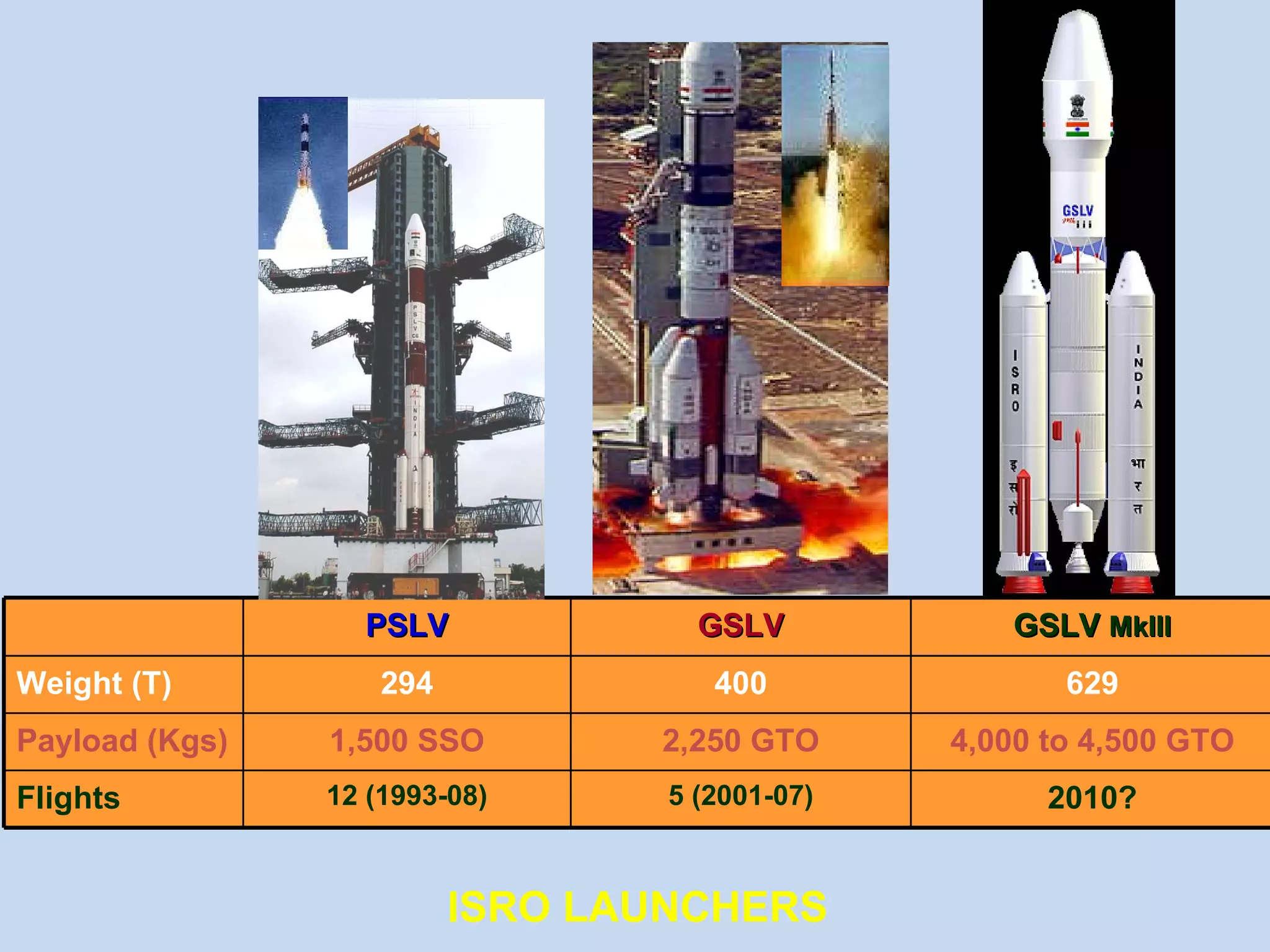
ISRO LAUNCHERS  PSLV GSLV GSLV  MkIII Weight (T) 294 400 629 Payload (Kgs) 1,500 SSO 2,250 GTO 4,000 to 4,500 GTO Flights 12 (1993-08) 5 (2001-07) 2010?
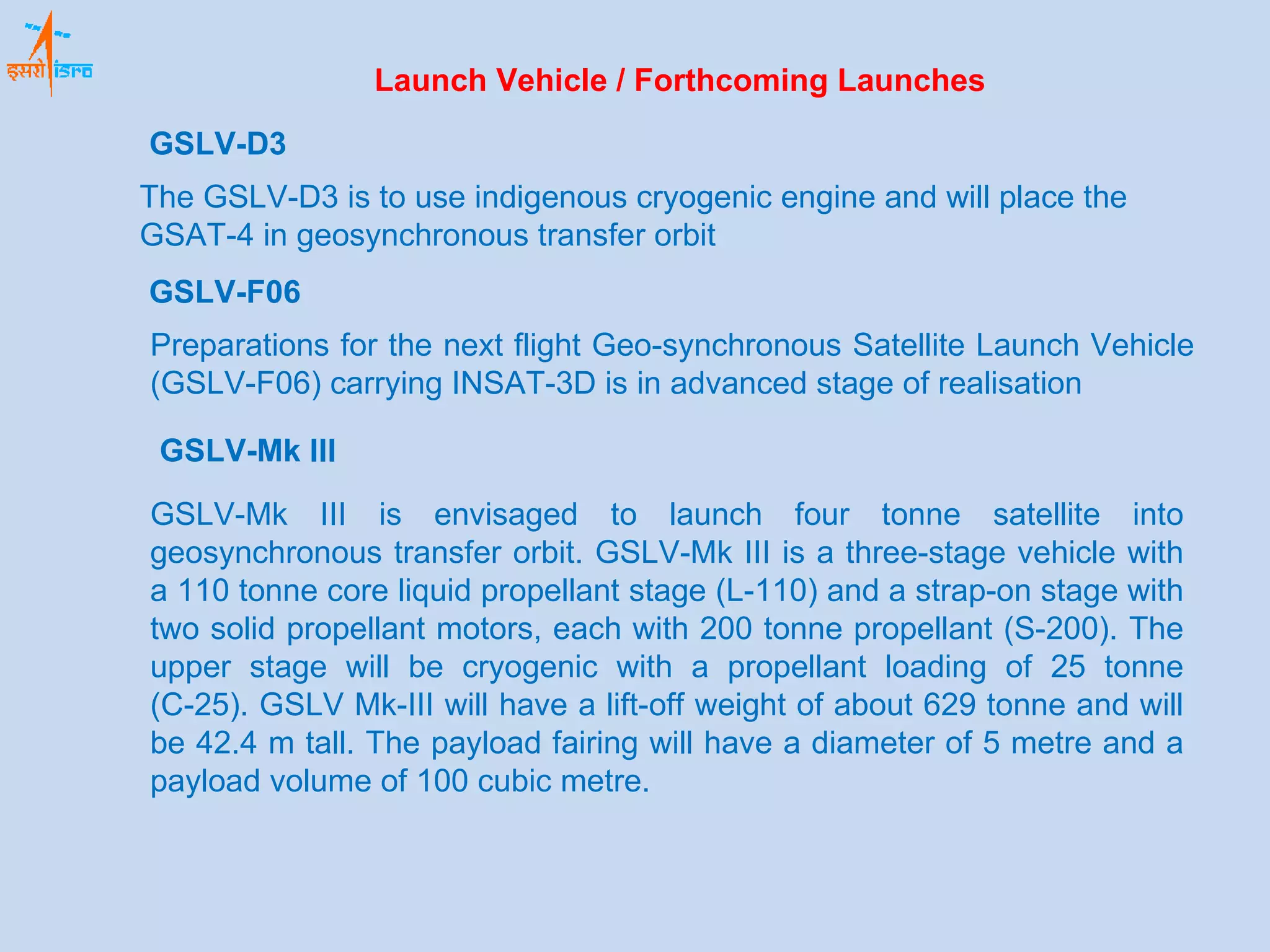
Launch Vehicle / Forthcoming Launches GSLV-Mk III GSLV-Mk III is envisaged to launch four tonne satellite into geosynchronous transfer orbit. GSLV-Mk III is a three-stage vehicle with a 110 tonne core liquid propellant stage (L-110) and a strap-on stage with two solid propellant motors, each with 200 tonne propellant (S-200). The upper stage will be cryogenic with a propellant loading of 25 tonne (C-25). GSLV Mk-III will have a lift-off weight of about 629 tonne and will be 42.4 m tall. The payload fairing will have a diameter of 5 metre and a payload volume of 100 cubic metre. GSLV-D3 The GSLV-D3 is to use indigenous cryogenic engine and will place the GSAT-4 in geosynchronous transfer orbit GSLV-F06 Preparations for the next flight Geo-synchronous Satellite Launch Vehicle (GSLV-F06) carrying INSAT-3D is in advanced stage of realisation
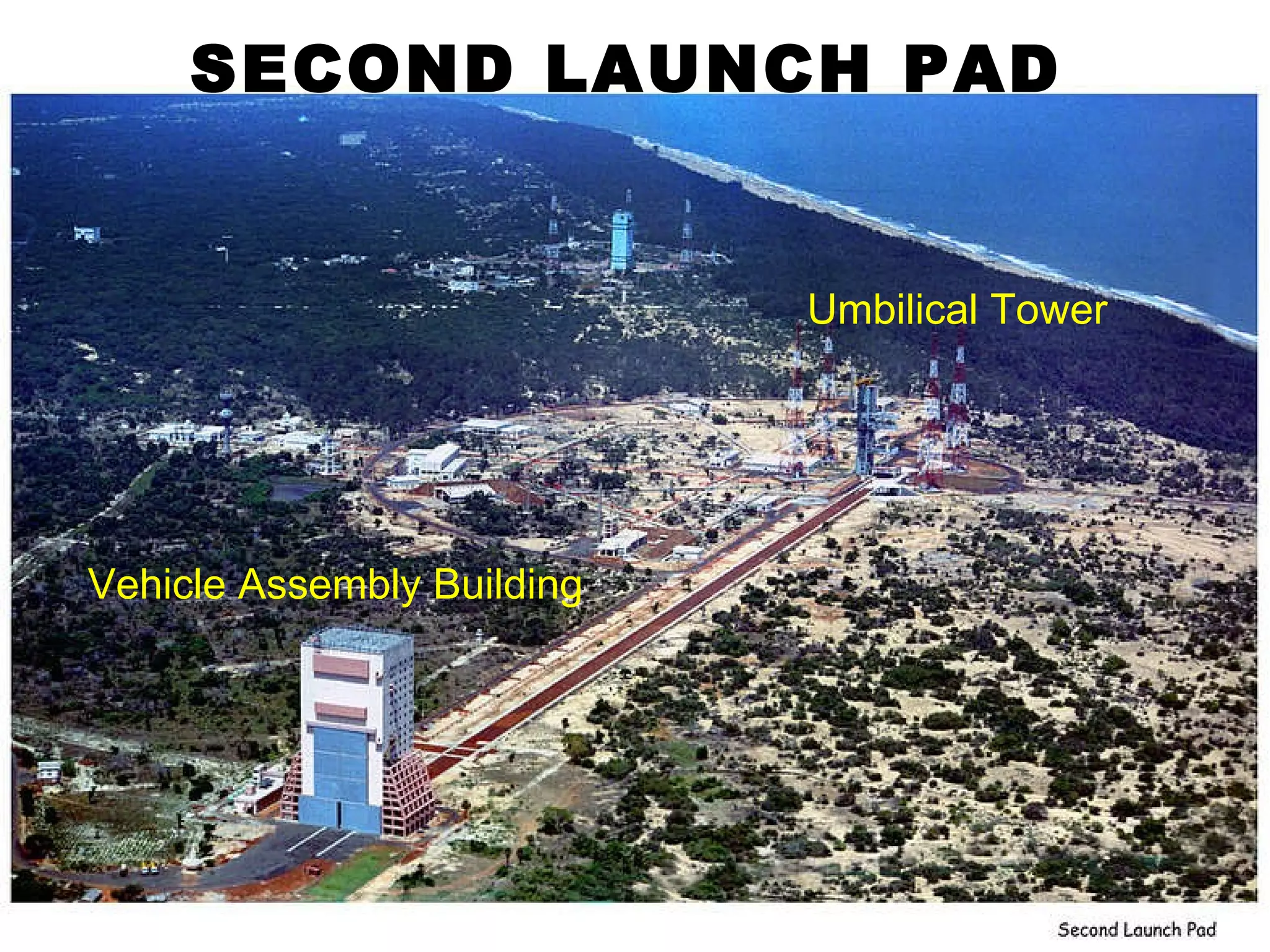
SECOND LAUNCH PAD Vehicle Assembly Building Umbilical Tower
Human Space Flight Mission Programme The department has carried out a detailed study on the feasibility of undertaking indigenous human space flight mission with an aim to build and demonstrate the capability for carrying humans to low earth orbit and their return to earth. The programme envisages development of a fully autonomous orbital vehicle carrying two or three crew members to 275 km low earth orbit and their safe return. It is planned to realize the programme in about seven years time frame.  Reusable Launch Vehicle-Technology Demonstrator (RLV-TD) As a first step towards realizing a Two Stage To Orbit (TSTO) fully re-usable launch vehicle The RLV-TD will act as a flying test bed to evaluate various technologies viz., hypersonic flight, autonomous landing, powered cruise flight and hypersonic flight using air breathing propulsion.
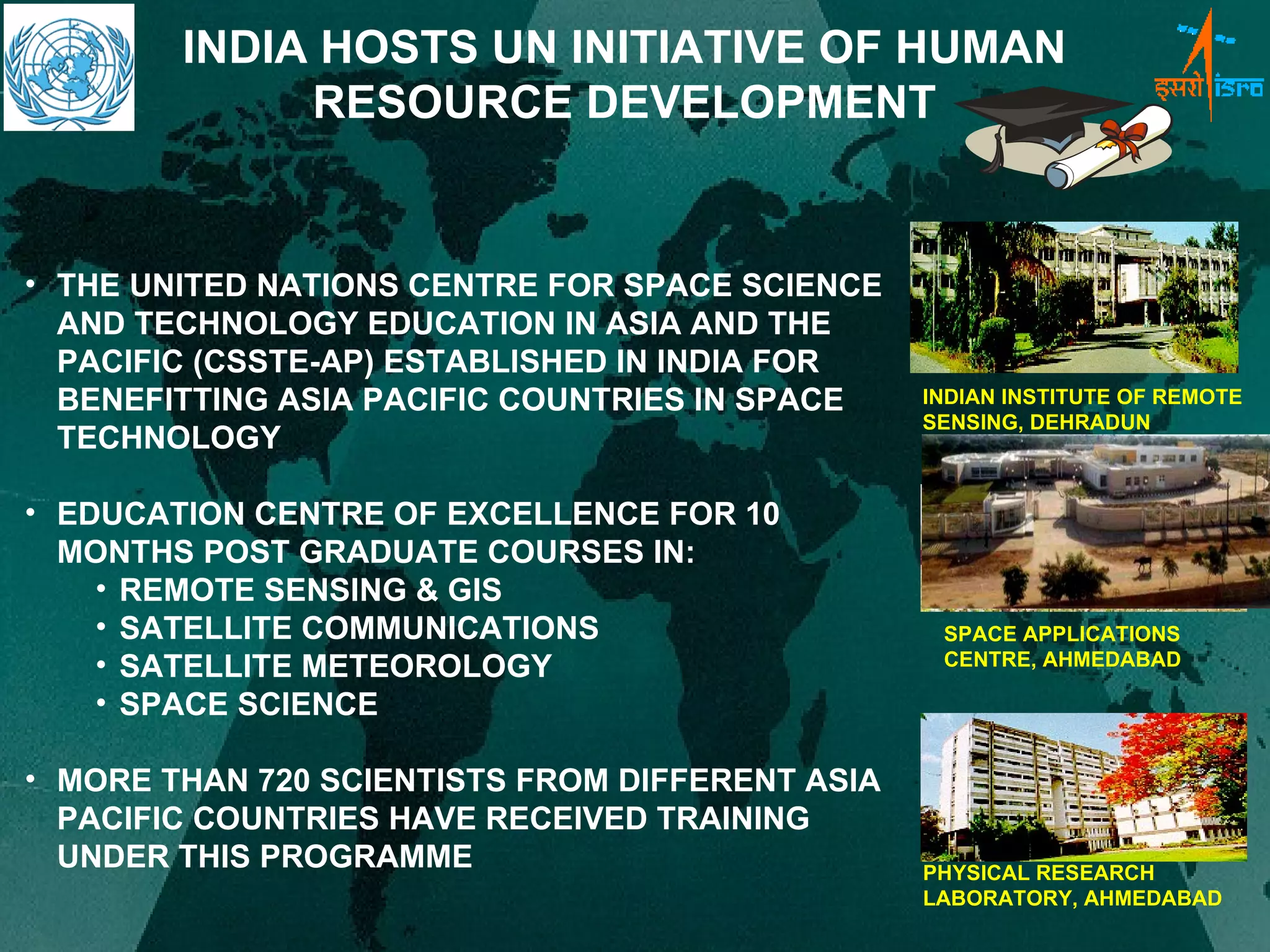
INDIA HOSTS UN INITIATIVE OF HUMAN RESOURCE DEVELOPMENT PHYSICAL RESEARCH LABORATORY, AHMEDABAD THE UNITED NATIONS CENTRE FOR SPACE SCIENCE AND TECHNOLOGY EDUCATION IN ASIA AND THE PACIFIC (CSSTE-AP) ESTABLISHED IN INDIA FOR BENEFITTING ASIA PACIFIC COUNTRIES IN SPACE TECHNOLOGY EDUCATION CENTRE OF EXCELLENCE FOR 10 MONTHS POST GRADUATE COURSES IN: REMOTE SENSING & GIS SATELLITE COMMUNICATIONS SATELLITE METEOROLOGY SPACE SCIENCE MORE THAN 720 SCIENTISTS FROM DIFFERENT ASIA PACIFIC COUNTRIES HAVE RECEIVED TRAINING UNDER THIS PROGRAMME INDIAN INSTITUTE OF REMOTE SENSING, DEHRADUN  SPACE APPLICATIONS CENTRE, AHMEDABAD
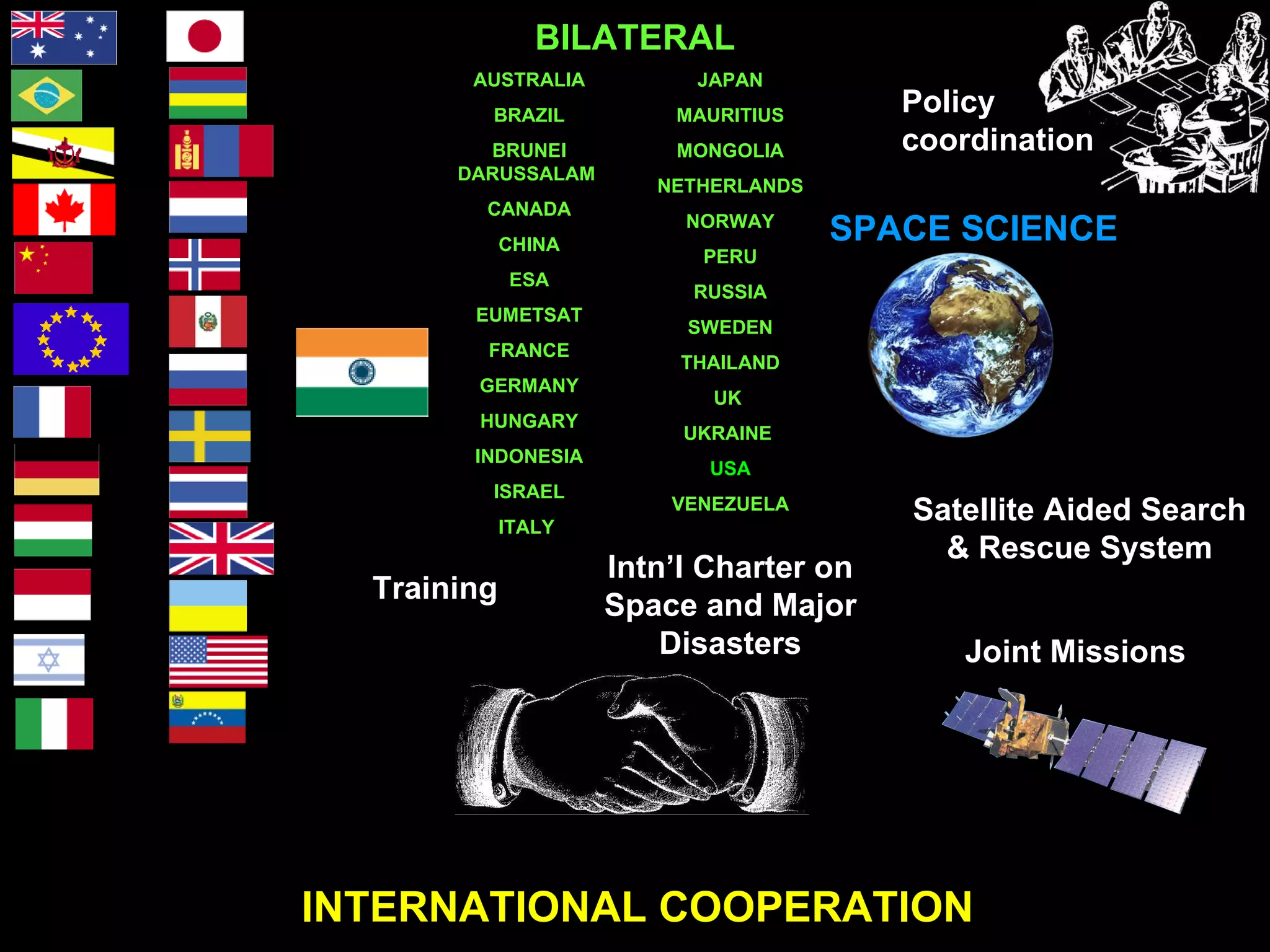
INTERNATIONAL COOPERATION  SPACE SCIENCE Satellite Aided Search & Rescue System Intn’l Charter on Space and Major Disasters Training Policy coordination Joint Missions AUSTRALIA BRAZIL BRUNEI DARUSSALAM  CANADA CHINA ESA EUMETSAT FRANCE GERMANY HUNGARY INDONESIA ISRAEL ITALY  JAPAN MAURITIUS MONGOLIA NETHERLANDS NORWAY PERU RUSSIA SWEDEN THAILAND UK  UKRAINE  USA VENEZUELA BILATERAL
Examples of International Cooperation Satellite Instructional Television Experiment with NASA Experiments with Franco-German Symphonie satellite Launch of satellites from USA & USSR Indian cosmonaut on Salyut space station  DLR instrument on IRS-P3 Chandrayaan-1 Instruments : (5 from India, 2 from USA, 3 from ESA, 1  BULGARIA ) Sentinel Asia disaster management support programme ISRO-CNES Joint Satellite Mission: Megha-Tropiques Megha-Tropiques – GPM Coopertion  with NASA ISRO-CNES Joint Satellite Mission: SARAL Italian instrument ROSA on Oceansat-2 Israeli instrument TAUVEX on GSAT-4 Canadian UV detector assembly for Astrosat Joint development and use of GLONASS system with Russia Chandrayaan-2 with Russia and international participation
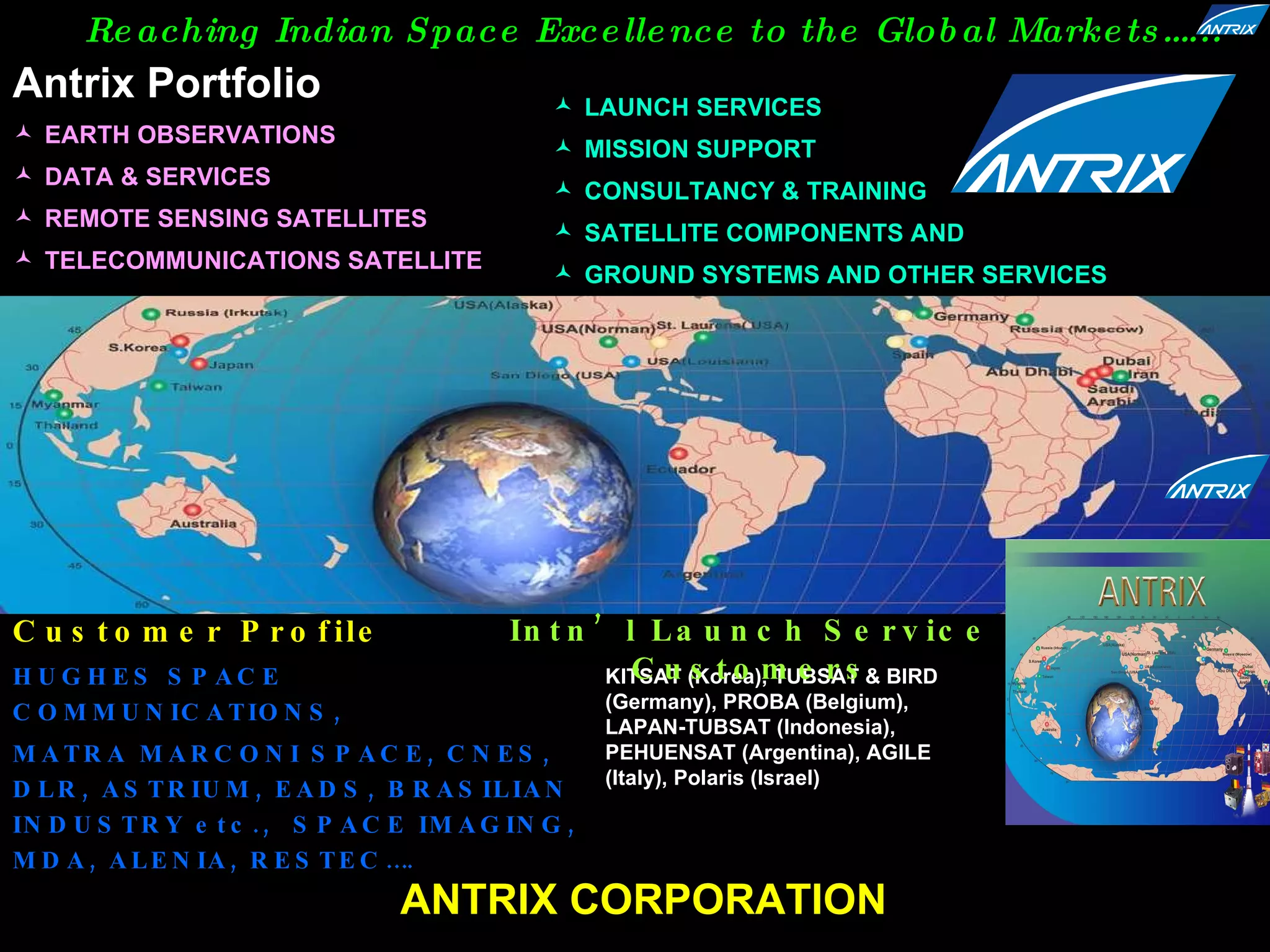
Customer Profile HUGHES SPACE  COMMUNICATIONS,  MATRA MARCONI SPACE, CNES, DLR, ASTRIUM, EADS, BRASILIAN INDUSTRY etc.,  SPACE IMAGING, MDA, ALENIA, RESTEC…. KITSAT (Korea), TUBSAT & BIRD (Germany), PROBA (Belgium), LAPAN-TUBSAT (Indonesia), PEHUENSAT (Argentina), AGILE (Italy), Polaris (Israel) Intn’l Launch Service Customers ANTRIX CORPORATION Reaching Indian Space Excellence to the   Global Markets…...  EARTH OBSERVATIONS DATA & SERVICES  REMOTE SENSING SATELLITES TELECOMMUNICATIONS SATELLITE  LAUNCH SERVICES  MISSION SUPPORT CONSULTANCY & TRAINING SATELLITE COMPONENTS AND  GROUND SYSTEMS AND OTHER SERVICES Antrix Portfolio
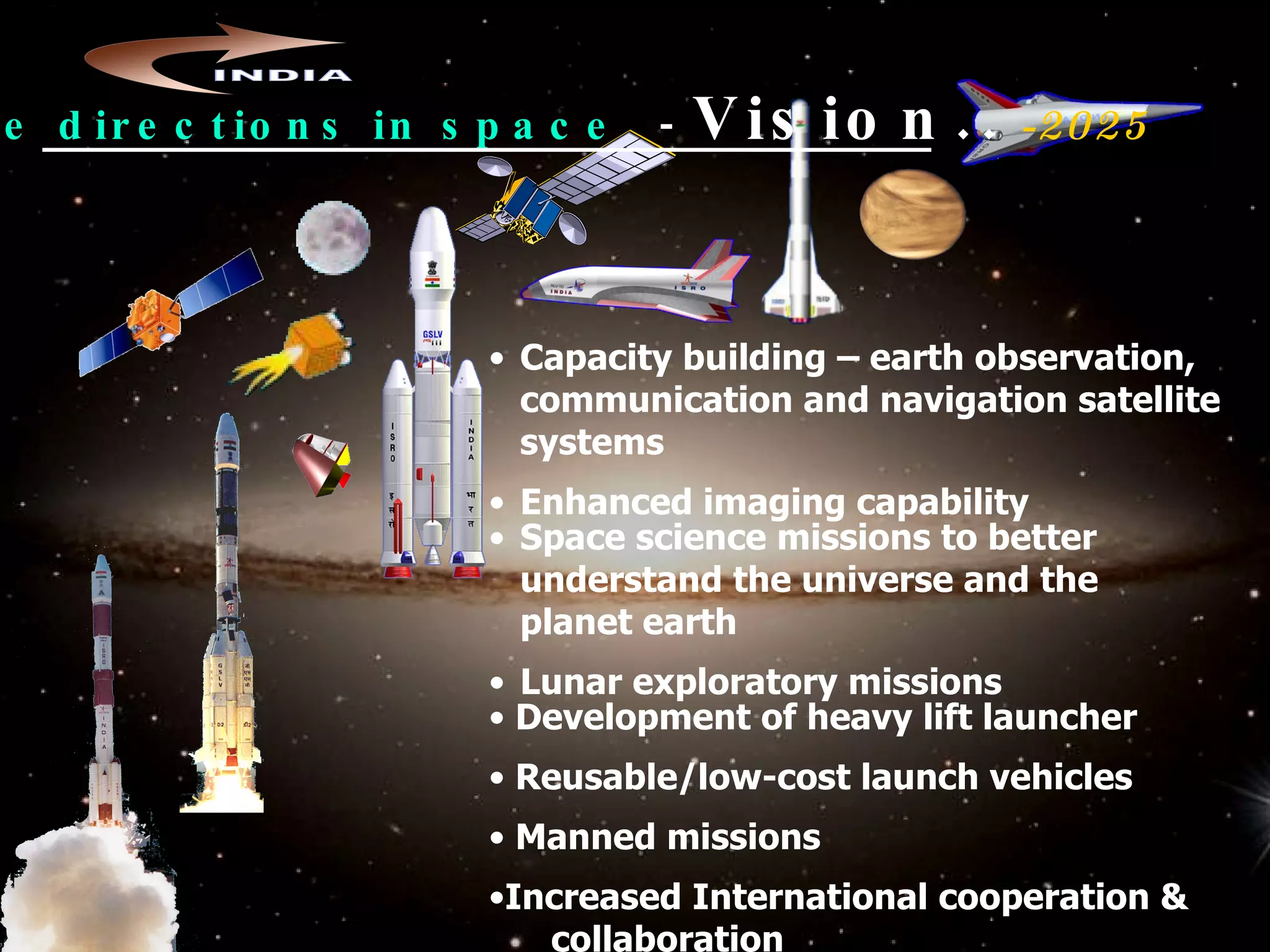
Capacity building – earth observation, communication and navigation satellite systems Enhanced imaging capability Space science missions to better understand the universe and the planet earth Lunar exploratory missions Future directions in space  -   Vision..  -2025 Development of heavy lift launcher Reusable/low-cost launch vehicles Manned missions Increased International cooperation &  collaboration
Thank You

International Goals in Space, Indian Space Program

  • 1.
    International Goals inSpace : Indian Space Program DEVIPRASAD KARNIK Counsellor (Space) Indian Space Research Organization (ISRO) Embassy of India March 11, 2010 48 th GODDARD MEMORIAL SYMPOSIUM
  • 2.
    " …..we must be second to none in the application of advanced technologies to the real problems of man and society, which we find in our country. … - Dr. Vikram A. Sarabhai (1960s) Indian Space Program is very different. Very deeply rooted to the society SPACE POLICY To assure its development, India views science and space technology as a crucial apparatus for its socioeconomic development - not a display of its might
  • 3.
  • 4.
  • 5.
  • 6.
  • 7.
  • 8.
    INSAT-3D : meteorologicalsatellite planned to be launched in the last quarter of 2010 Forthcoming Satellites – INSAT/GSAT Series
  • 9.
  • 10.
  • 11.
  • 12.
    Launch : SEPT23 2009 developed by the Italian Space Agency .
  • 13.
    SPACE SCIENCE Chandrayaan-1India’s First Lunar Mission
  • 14.
    Forthcoming Satellites –Earth Observation Series
  • 15.
    Forthcoming Satellites –Earth Observation Series
  • 16.
    Forthcoming Satellites –Earth Observation Series
  • 17.
    Forthcoming Satellites –Earth Observation Series
  • 18.
    Forthcoming Satellites –Earth Observation Series for studying ocean from space using altimetry
  • 19.
    GSAT-4 is envisagedas a technology demonstrator. The communication payload consists of multi-beam Ka-band bent pipe and regenerative transponder and navigation payload in C-band, L1 and L5 bands . Forthcoming Satellites – INSAT/GSAT Series
  • 20.
    GSAT-5 / INSAT-4D is a C-band and Extended C-band satellite, carrying 18 transponders. Of these, 12 transponders will operate in the Normal C-band with wider coverage in uplink and downlink to cover Asia, Africa and Eastern Europe/Zonal coverage. 6 transponders will operate in Extended C-band and have India coverage. The option of incorporating L-band is under consideration. It will be launched onboard GSLV during end 2010 and positioned at 82 deg E longitude . The primary goal of GSAT-6/INSAT-4E which is a Multimedia mobile S-band satellite is to cater to the consumer requirements of providing entertainment and information services to vehicles through Digital Multimedia consoles and to the Multimedia Mobile Phones. The spacecraft will be positioned at 83 degree East longitude with a mission life of 12 years. The satellite is planned to be launched during 2010 by GSLV. GSAT-7/INSAT-4F is proposed as a multi-band satellite carrying payloads in UHF, S-band, C-band and Ku-band Forthcoming Satellites – INSAT/GSAT Series
  • 21.
    GSAT-8/INSAT-4G isproposed as a Ku-band satellite carrying 24 transponders similar to that of INSAT-4A and INSAT-4B. It will also carry the second GPS Aided Geo Augmented Navigation (GAGAN) payload. The satellite is expected to be launched during 2010 and positioned at 55 degree E longitude. Forthcoming Satellites – INSAT/GSAT Series ASTROSAT is a multi-wavelength space borne astronomy satellite to be launched during 2009-10. This will be the first dedicated Indian astronomy mission. ASTROSAT has wide spectral coverage extending over visible, UV, soft X ray and hard X ray regions. This spacecraft would enable observations on the celestial bodies in both X-ray and UV spectral bands simultaneously. The scientific payloads cover the Visible (3500-6000 Å), UV (1300-3000 Å), soft and hard X-ray regimes (0.5-8 keV; 3-80 keV). Forthcoming Satellites – Space Science Missions
  • 22.
    Space Capsule RecoveryExperiment (SRE-II) The main objective of SRE II is to realize a fully recoverable capsule and provide a platform to conduct microgravity experiments on Micro-biology, Agriculture, Powder Metallurgy, etc. Aditya-1 The First Indian space based Solar Coronagraph to study solar Corona in visible and near IR bands . Launch of the Aditya mission is planned during the next high solar activity period ~ 2012 YOUTHSAT The second satellite in the micro satellite series proposed is YOUTHSAT which will carry payloads of scientific interest with participation of youths from Universities at graduate, post graduate and research scholar level. The micro satellite bus is planned and designed to carry different kinds of payloads like earth imaging, atmospheric applications, weather monitoring, stellar observations, scientific experiments etc. Forthcoming Satellites – Space Science Missions
  • 23.
    Satellite Navigation GAGAN: Indigenous Satellite-Based Regional GPS Augmentation System also known as Space-Based Augmentation System (SBAS) as part of the Satellite-Based Communications, Navigation and Surveillance (CNS)/Air Traffic Management (ATM) plan for civil aviation. GPS Aided GEO Augmented Navigation The first navigation payload is being fabricated and it is proposed to be flown on GSAT-4. Two more payloads will be subsequently flown, one each on two geostationary satellites GSAT-8 and GSAT-12.
  • 24.
    ISRO LAUNCHERS PSLV GSLV GSLV MkIII Weight (T) 294 400 629 Payload (Kgs) 1,500 SSO 2,250 GTO 4,000 to 4,500 GTO Flights 12 (1993-08) 5 (2001-07) 2010?
  • 25.
    Launch Vehicle /Forthcoming Launches GSLV-Mk III GSLV-Mk III is envisaged to launch four tonne satellite into geosynchronous transfer orbit. GSLV-Mk III is a three-stage vehicle with a 110 tonne core liquid propellant stage (L-110) and a strap-on stage with two solid propellant motors, each with 200 tonne propellant (S-200). The upper stage will be cryogenic with a propellant loading of 25 tonne (C-25). GSLV Mk-III will have a lift-off weight of about 629 tonne and will be 42.4 m tall. The payload fairing will have a diameter of 5 metre and a payload volume of 100 cubic metre. GSLV-D3 The GSLV-D3 is to use indigenous cryogenic engine and will place the GSAT-4 in geosynchronous transfer orbit GSLV-F06 Preparations for the next flight Geo-synchronous Satellite Launch Vehicle (GSLV-F06) carrying INSAT-3D is in advanced stage of realisation
  • 26.
    SECOND LAUNCH PADVehicle Assembly Building Umbilical Tower
  • 27.
    Human Space FlightMission Programme The department has carried out a detailed study on the feasibility of undertaking indigenous human space flight mission with an aim to build and demonstrate the capability for carrying humans to low earth orbit and their return to earth. The programme envisages development of a fully autonomous orbital vehicle carrying two or three crew members to 275 km low earth orbit and their safe return. It is planned to realize the programme in about seven years time frame. Reusable Launch Vehicle-Technology Demonstrator (RLV-TD) As a first step towards realizing a Two Stage To Orbit (TSTO) fully re-usable launch vehicle The RLV-TD will act as a flying test bed to evaluate various technologies viz., hypersonic flight, autonomous landing, powered cruise flight and hypersonic flight using air breathing propulsion.
  • 28.
    INDIA HOSTS UNINITIATIVE OF HUMAN RESOURCE DEVELOPMENT PHYSICAL RESEARCH LABORATORY, AHMEDABAD THE UNITED NATIONS CENTRE FOR SPACE SCIENCE AND TECHNOLOGY EDUCATION IN ASIA AND THE PACIFIC (CSSTE-AP) ESTABLISHED IN INDIA FOR BENEFITTING ASIA PACIFIC COUNTRIES IN SPACE TECHNOLOGY EDUCATION CENTRE OF EXCELLENCE FOR 10 MONTHS POST GRADUATE COURSES IN: REMOTE SENSING & GIS SATELLITE COMMUNICATIONS SATELLITE METEOROLOGY SPACE SCIENCE MORE THAN 720 SCIENTISTS FROM DIFFERENT ASIA PACIFIC COUNTRIES HAVE RECEIVED TRAINING UNDER THIS PROGRAMME INDIAN INSTITUTE OF REMOTE SENSING, DEHRADUN SPACE APPLICATIONS CENTRE, AHMEDABAD
  • 29.
    INTERNATIONAL COOPERATION SPACE SCIENCE Satellite Aided Search & Rescue System Intn’l Charter on Space and Major Disasters Training Policy coordination Joint Missions AUSTRALIA BRAZIL BRUNEI DARUSSALAM CANADA CHINA ESA EUMETSAT FRANCE GERMANY HUNGARY INDONESIA ISRAEL ITALY JAPAN MAURITIUS MONGOLIA NETHERLANDS NORWAY PERU RUSSIA SWEDEN THAILAND UK UKRAINE USA VENEZUELA BILATERAL
  • 30.
    Examples of InternationalCooperation Satellite Instructional Television Experiment with NASA Experiments with Franco-German Symphonie satellite Launch of satellites from USA & USSR Indian cosmonaut on Salyut space station DLR instrument on IRS-P3 Chandrayaan-1 Instruments : (5 from India, 2 from USA, 3 from ESA, 1 BULGARIA ) Sentinel Asia disaster management support programme ISRO-CNES Joint Satellite Mission: Megha-Tropiques Megha-Tropiques – GPM Coopertion with NASA ISRO-CNES Joint Satellite Mission: SARAL Italian instrument ROSA on Oceansat-2 Israeli instrument TAUVEX on GSAT-4 Canadian UV detector assembly for Astrosat Joint development and use of GLONASS system with Russia Chandrayaan-2 with Russia and international participation
  • 31.
    Customer Profile HUGHESSPACE COMMUNICATIONS, MATRA MARCONI SPACE, CNES, DLR, ASTRIUM, EADS, BRASILIAN INDUSTRY etc., SPACE IMAGING, MDA, ALENIA, RESTEC…. KITSAT (Korea), TUBSAT & BIRD (Germany), PROBA (Belgium), LAPAN-TUBSAT (Indonesia), PEHUENSAT (Argentina), AGILE (Italy), Polaris (Israel) Intn’l Launch Service Customers ANTRIX CORPORATION Reaching Indian Space Excellence to the Global Markets…... EARTH OBSERVATIONS DATA & SERVICES REMOTE SENSING SATELLITES TELECOMMUNICATIONS SATELLITE LAUNCH SERVICES MISSION SUPPORT CONSULTANCY & TRAINING SATELLITE COMPONENTS AND GROUND SYSTEMS AND OTHER SERVICES Antrix Portfolio
  • 32.
    Capacity building –earth observation, communication and navigation satellite systems Enhanced imaging capability Space science missions to better understand the universe and the planet earth Lunar exploratory missions Future directions in space - Vision.. -2025 Development of heavy lift launcher Reusable/low-cost launch vehicles Manned missions Increased International cooperation & collaboration
  • 33.

Editor's Notes

  • #34 Before I close, I would like to draw your attention to the image you see in the background. This image is taken by a telescope which is at highest altitude. Around 4 km above the mean sea level – about half the altitude of the highest mountain peak on the Earth – That is Himalayas. The conditions there are very tough and approach very difficult. It is built by Indian Scientists and is known as Hanley Telescope. ISRO has provided these scientists a connectivity using our own INSAT through which this instrument can be operated from the comforts of Bangalore and data received at the desktop. This image is that of a crab nebula taken from that telescope. Space makes impossible looking things possible. Let us make it work for the humanity. And not for a chosen few. Thank you for your kind attention.