SUBMITTED TO:- RAHUL ABHISHEK OJHA
The Indian Space Research Organisation (ISRO) is the
space agency of the government of INDIA.
 Its vision is to "harness space technology for
national development", while pursuing space science
research and planetary exploration.
 ISRO lanched many space satlites since it's
formation .
 Now ISRO is not only an official representative of
Indian space program , it becomes a leader of
global satlite market with much reliability .
 ESTABLISHED IN -
 HEADQUARTERS -
 PRIMARY SPACEPORT -
 MOTTO -
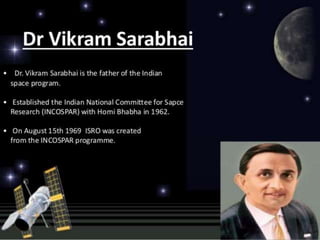
 Father of Indian space
program -
15 August 1969
Bangalore, Karnataka
INDIA
Satish Dhawan space
centre,sriharikota,(A.P.)
Manav jati ki seva mai
antariksa prodyogiki
Vikram Sarabhai
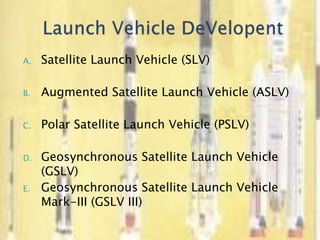
A. Satellite Launch Vehicle (SLV)
B. Augmented Satellite Launch Vehicle (ASLV)
C. Polar Satellite Launch Vehicle (PSLV)
D. Geosynchronous Satellite Launch Vehicle
(GSLV)
E. Geosynchronous Satellite Launch Vehicle
Mark-III (GSLV III)
 India's first satellite, the Aryabhata, was
launched by the Soviet Union on 19 April
1975 from Kapustin Yar using a Cosmos-3M
launch vehicle.
 INSAT (Indian National Satellite System) is a
series of multipurpose geostationary
satellites launched by ISRO to satisfy the
telecommunications, broadcasting,
meteorology and search-and-rescue needs of
India.
 Indian Remote Sensing satellites (IRS) are a
series of earth observation satellites provides
remote sensing services to the country. The
Indian Remote Sensing Satellite system is the
largest constellation of remote sensing
satellites for civilian use in operation today in
the world.
 GAGAN satellite navigation system is an
indigenous Satellite-Based Regional GPS
Augmentation System as part of the Satellite-
Based Communications, Navigation and
Surveillance (CNS)/Air Traffic Management
(ATM) plan for civil aviation.
 IRNSS satellite navigation system is an
independent regional navigation satellite
system is designed to provide accurate
position information service to users in India
as well as the region extending up to 1500
km from its boundary.
 The maximum number of satellites launched
by the PSLV in a single launch is 20, in the
PSLV-C34 launch on 22 June 2016.
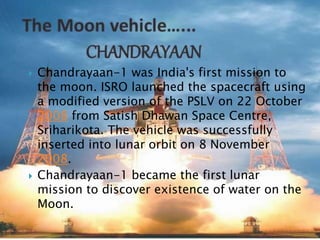
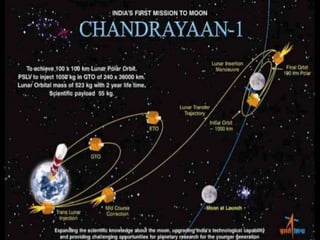
 Chandrayaan-1 was India's first mission to
the moon. ISRO launched the spacecraft using
a modified version of the PSLV on 22 October
2008 from Satish Dhawan Space Centre,
Sriharikota. The vehicle was successfully
inserted into lunar orbit on 8 November
2008.
 Chandrayaan-1 became the first lunar
mission to discover existence of water on the
Moon.
 The Mars Orbiter Mission or Mangalayaan,
was launched into Earth orbit on 5 November
2013 by ISRO and has entered Mars orbit on
24 September 2014.
 India is the first country to enter Mars orbit
in first attempt.
 It was completed at a record cost of $74
million.
 Reusable Launch Vehicle-Technology
Demonstrator (RLV-TD).
 The ULV or Unified Launch Vehicle is a launch
vehicle in development that will enable the
replacement of the PSLV, GSLV Mk I/II and
GSLV Mk III with a single family of launchers.
 Chandrayaan-2 will be India's mission to the
Moon which will include an orbiter and
lander-rover module. Chandrayaan-2 will be
launched (by GSLV-MkII) around 2016–2017 .
 Aditya-1 (400kg) is the First Indian space
based Solar Coronagraph to study solar
Corona in visible and near IR bands.
THANK
YOU

ISRO & It's Achivements

  • 1.
    SUBMITTED TO:- RAHULABHISHEK OJHA
  • 2.
    The Indian SpaceResearch Organisation (ISRO) is the space agency of the government of INDIA.  Its vision is to "harness space technology for national development", while pursuing space science research and planetary exploration.  ISRO lanched many space satlites since it's formation .  Now ISRO is not only an official representative of Indian space program , it becomes a leader of global satlite market with much reliability .
  • 3.
     ESTABLISHED IN-  HEADQUARTERS -  PRIMARY SPACEPORT -  MOTTO -  Father of Indian space program - 15 August 1969 Bangalore, Karnataka INDIA Satish Dhawan space centre,sriharikota,(A.P.) Manav jati ki seva mai antariksa prodyogiki Vikram Sarabhai
  • 5.
    A. Satellite LaunchVehicle (SLV) B. Augmented Satellite Launch Vehicle (ASLV) C. Polar Satellite Launch Vehicle (PSLV) D. Geosynchronous Satellite Launch Vehicle (GSLV) E. Geosynchronous Satellite Launch Vehicle Mark-III (GSLV III)
  • 6.
     India's firstsatellite, the Aryabhata, was launched by the Soviet Union on 19 April 1975 from Kapustin Yar using a Cosmos-3M launch vehicle.  INSAT (Indian National Satellite System) is a series of multipurpose geostationary satellites launched by ISRO to satisfy the telecommunications, broadcasting, meteorology and search-and-rescue needs of India.
  • 7.
     Indian RemoteSensing satellites (IRS) are a series of earth observation satellites provides remote sensing services to the country. The Indian Remote Sensing Satellite system is the largest constellation of remote sensing satellites for civilian use in operation today in the world.  GAGAN satellite navigation system is an indigenous Satellite-Based Regional GPS Augmentation System as part of the Satellite- Based Communications, Navigation and Surveillance (CNS)/Air Traffic Management (ATM) plan for civil aviation.
  • 8.
     IRNSS satellitenavigation system is an independent regional navigation satellite system is designed to provide accurate position information service to users in India as well as the region extending up to 1500 km from its boundary.  The maximum number of satellites launched by the PSLV in a single launch is 20, in the PSLV-C34 launch on 22 June 2016.
  • 9.
     Chandrayaan-1 wasIndia's first mission to the moon. ISRO launched the spacecraft using a modified version of the PSLV on 22 October 2008 from Satish Dhawan Space Centre, Sriharikota. The vehicle was successfully inserted into lunar orbit on 8 November 2008.  Chandrayaan-1 became the first lunar mission to discover existence of water on the Moon.
  • 11.
     The MarsOrbiter Mission or Mangalayaan, was launched into Earth orbit on 5 November 2013 by ISRO and has entered Mars orbit on 24 September 2014.  India is the first country to enter Mars orbit in first attempt.  It was completed at a record cost of $74 million.
  • 12.
     Reusable LaunchVehicle-Technology Demonstrator (RLV-TD).  The ULV or Unified Launch Vehicle is a launch vehicle in development that will enable the replacement of the PSLV, GSLV Mk I/II and GSLV Mk III with a single family of launchers.  Chandrayaan-2 will be India's mission to the Moon which will include an orbiter and lander-rover module. Chandrayaan-2 will be launched (by GSLV-MkII) around 2016–2017 .  Aditya-1 (400kg) is the First Indian space based Solar Coronagraph to study solar Corona in visible and near IR bands.
  • 14.