PRESENTED BY:-
UDIT KR DIXIT
KHARAGPUR
Indian Space Research Organisation
OBJECTIVES
upon completion of this lesson you will be
able to know :-
About ISRO(Indian Space Research
Organization)
Achievement
Vision
Mission
 India decided to go to space when Indian
National Committee for Space Research
(INCOSPAR) was set up by the Government of
India in 1962. With the visionary Dr Vikram
Sarabhai
 ISRO was formed in 1969 with a vision to
develop and harness space technology in
national development, while pursuing planetary
exploration and space science research.
 The Indian Space Research Organization
(ISRO) is the pioneer space exploration
agency of the Government of India,
headquartered at Bengaluru.
 The great personalities (APJ Abdul kalam, Dr
K Radhakrishnan) had given their great
contribution in new direction and Success of
ISRO
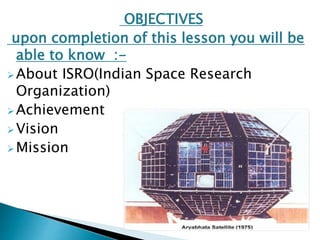
 Aryabhatta is India's first satellite. It was the
spacecraft to be entirely built in the country
making a breakthrough in space missions.
 leadership of APJ Abdul Kalam, the Satellite
Launch Vehicle (SLV) project was initiated. The
aim of this project was to develop the
necessary technology to launch satellites.
 In2008,Chandrayaan, country’s first unmanned
lunar probe was launched by ISRO.
 ISRO in 2016, also launched Indian Regional
Navigation Satellite System for marine
navigation,vehicle,tracking,disaster
management.
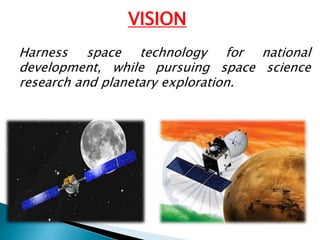
VISION
Harness space technology for national
development, while pursuing space science
research and planetary exploration.
MISSION
 Design and development of launch vehicles and
Srelated technologies for providing access to space.
 Design and development of satellites and related
technologies for earth observation, communication,
navigation, meteorology and space science.
 Indian National Satellite (INSAT) programme for
meeting telecommunication, television broadcasting
and developmental applications.
 Indian Remote Sensing Satellite (IRS) programme for
management of natural resources and monitoring of
environment using space based imagery.
 Space based Applications for Societal development.
 Research and Development in space science and
planetary exploration.
REVIEW
About ISRO
Achievement
Vision
Missions
India's first satellite ………………
a.Chandrayan
b.Mangalyan
c.Aryabhata
INDIAN SPACE RESEARCH ORGANIZATION (ISRO)

INDIAN SPACE RESEARCH ORGANIZATION (ISRO)

  • 1.
    PRESENTED BY:- UDIT KRDIXIT KHARAGPUR Indian Space Research Organisation
  • 2.
    OBJECTIVES upon completion ofthis lesson you will be able to know :- About ISRO(Indian Space Research Organization) Achievement Vision Mission
  • 3.
     India decidedto go to space when Indian National Committee for Space Research (INCOSPAR) was set up by the Government of India in 1962. With the visionary Dr Vikram Sarabhai  ISRO was formed in 1969 with a vision to develop and harness space technology in national development, while pursuing planetary exploration and space science research.
  • 4.
     The IndianSpace Research Organization (ISRO) is the pioneer space exploration agency of the Government of India, headquartered at Bengaluru.  The great personalities (APJ Abdul kalam, Dr K Radhakrishnan) had given their great contribution in new direction and Success of ISRO
  • 5.
     Aryabhatta isIndia's first satellite. It was the spacecraft to be entirely built in the country making a breakthrough in space missions.  leadership of APJ Abdul Kalam, the Satellite Launch Vehicle (SLV) project was initiated. The aim of this project was to develop the necessary technology to launch satellites.  In2008,Chandrayaan, country’s first unmanned lunar probe was launched by ISRO.  ISRO in 2016, also launched Indian Regional Navigation Satellite System for marine navigation,vehicle,tracking,disaster management.
  • 6.
    VISION Harness space technologyfor national development, while pursuing space science research and planetary exploration.
  • 7.
    MISSION  Design anddevelopment of launch vehicles and Srelated technologies for providing access to space.  Design and development of satellites and related technologies for earth observation, communication, navigation, meteorology and space science.  Indian National Satellite (INSAT) programme for meeting telecommunication, television broadcasting and developmental applications.  Indian Remote Sensing Satellite (IRS) programme for management of natural resources and monitoring of environment using space based imagery.  Space based Applications for Societal development.  Research and Development in space science and planetary exploration.
  • 8.
  • 9.
    India's first satellite……………… a.Chandrayan b.Mangalyan c.Aryabhata