GUIDELINES FOR THE
IMPLEMENTATION OF THE
ACADEMIC FOCUSED –
BRIDGING PROGRAM
(AFBP)
Kathrina T. Trañas
GROUP VI
PHILIPPINE NORMAL UNIVERSITY
The National Center for Teacher Education
South Luzon Campus
Lopez Quezon
The Academic Focused-
Bridging Program (AFBP)
•is pioneering nonformal
education Secondary Level test
passers who wish to continue
learning in the tertiary level or
enroll in four to five year
courses and/or post-secondary
vocational training.
Target Learners of the AFBP
•out-of-school youth and
adults aged 15 years old
and above who are NFE
A&E Secondary Level test
passers.
Skills/Competency areas:
•Science –related skills
•Mathematical-related skills
•English and Filipino language
skills
•History-related knowledge and
skills
•Higher Education Preparation
Separate funds for the
implementation of AFBP
•there would be no separate
funding for AFBP.
Criteria for the selection
of the Service Providers
interested to implement
the AFBP:
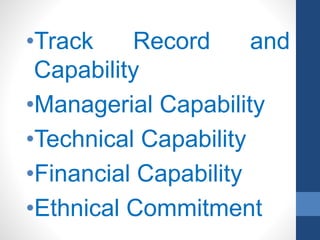
•Track Record and
Capability
•Managerial Capability
•Technical Capability
•Financial Capability
•Ethnical Commitment
Duties and Responsibilities of
the Service Providers
interested to implement the
AFBP:
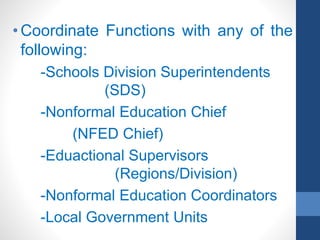
• Coordinate Functions with any of the
following:
-Schools Division Superintendents
(SDS)
-Nonformal Education Chief
(NFED Chief)
-Eduactional Supervisors
(Regions/Division)
-Nonformal Education Coordinators
-Local Government Units
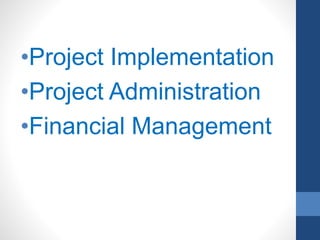
•Project Implementation
•Project Administration
•Financial Management
Duties and Responsibilities of
the Instructional Managers
hired by the Service Providers:
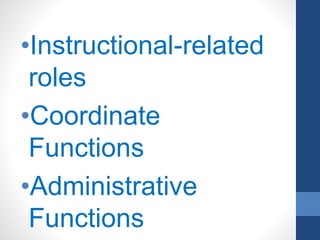
•Instructional-related
roles
•Coordinate
Functions
•Administrative
Functions
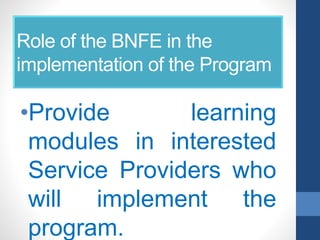
Role of the BNFE in the
implementation of the Program
•Provide learning
modules in interested
Service Providers who
will implement the
program.
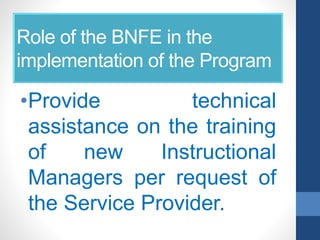
Role of the BNFE in the
implementation of the Program
•Provide technical
assistance on the training
of new Instructional
Managers per request of
the Service Provider.
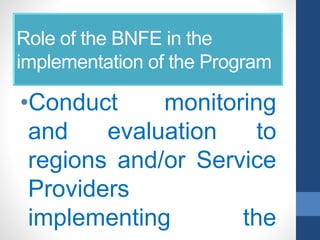
Role of the BNFE in the
implementation of the Program
•Conduct monitoring
and evaluation to
regions and/or Service
Providers
implementing the
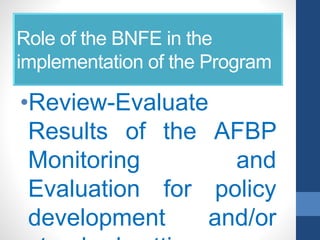
Role of the BNFE in the
implementation of the Program
•Review-Evaluate
Results of the AFBP
Monitoring and
Evaluation for policy
development and/or
NONFORMAL
EDUCATION
STANDARDIZED
TESTS
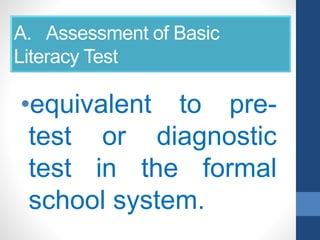
A. Assessment of Basic
Literacy Test
•equivalent to pre-
test or diagnostic
test in the formal
school system.
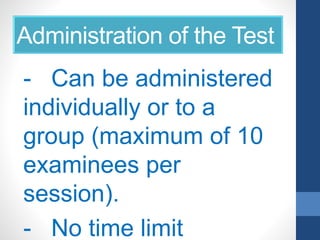
Administration of the Test
- Can be administered
individually or to a
group (maximum of 10
examinees per
session).
- No time limit
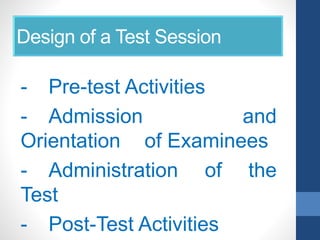
Design of a Test Session
- Pre-test Activities
- Admission and
Orientation of Examinees
- Administration of the
Test
- Post-Test Activities
Uses of Pre-Test
- Screening of applicants
for the Basic Literacy
Program.
- Identification of entry level
of learners.
- Helps in designing the
Uses of Post-Test
- Evaluates the learner`s
performance.
- Acts as an evaluator of
the IM`s (Instructional
Manager) performance.
- Measures gains in
knowledge of the learners.
Scoring
- The examiner will do
the scoring right after
the test.
B. Functional Literacy Test
•equivalent to post-test
in the formal school.
B. Functional Literacy Test
•Demographic
Information Sheet
(DIS)
•Functional Literacy
Test Proper
Demographic Information
Sheet (DIS)
1-10 basic Information sheet
11-13 write simple
sentences
14 ability to count/do simple
mathematical operations
Some Alternative
Perspectives on the Role of
Nonformal Education in
National Development
1. Demand Side
•Covers the community
profiling of families.
•Their needs will be the basis
of mobilizing them.
•Can be given technological
development to meet the
demands of new generation.
2. Supply Side
•Demands for programs to
be delivered with capacity
building, standard setting
for service providers and
policy protecting the
interest and welfare of
individuals.
3. Legislative Agenda
•sets in place of coordinating
mechanisms for alternative
learning system, reviewing
mandates and functions for
literacy assistance, and other
legislating development to
respond on national
sustainable development.
4. Monitoring and
Evaluation
•Aims for strategic
development using
technology-based
monitoring and
evaluation.
End of presentation…… 
#kyungsoo anirhtak

AFBP