GOOD
AFTERNOON

Lesson 6
Instructional Planning
and Development
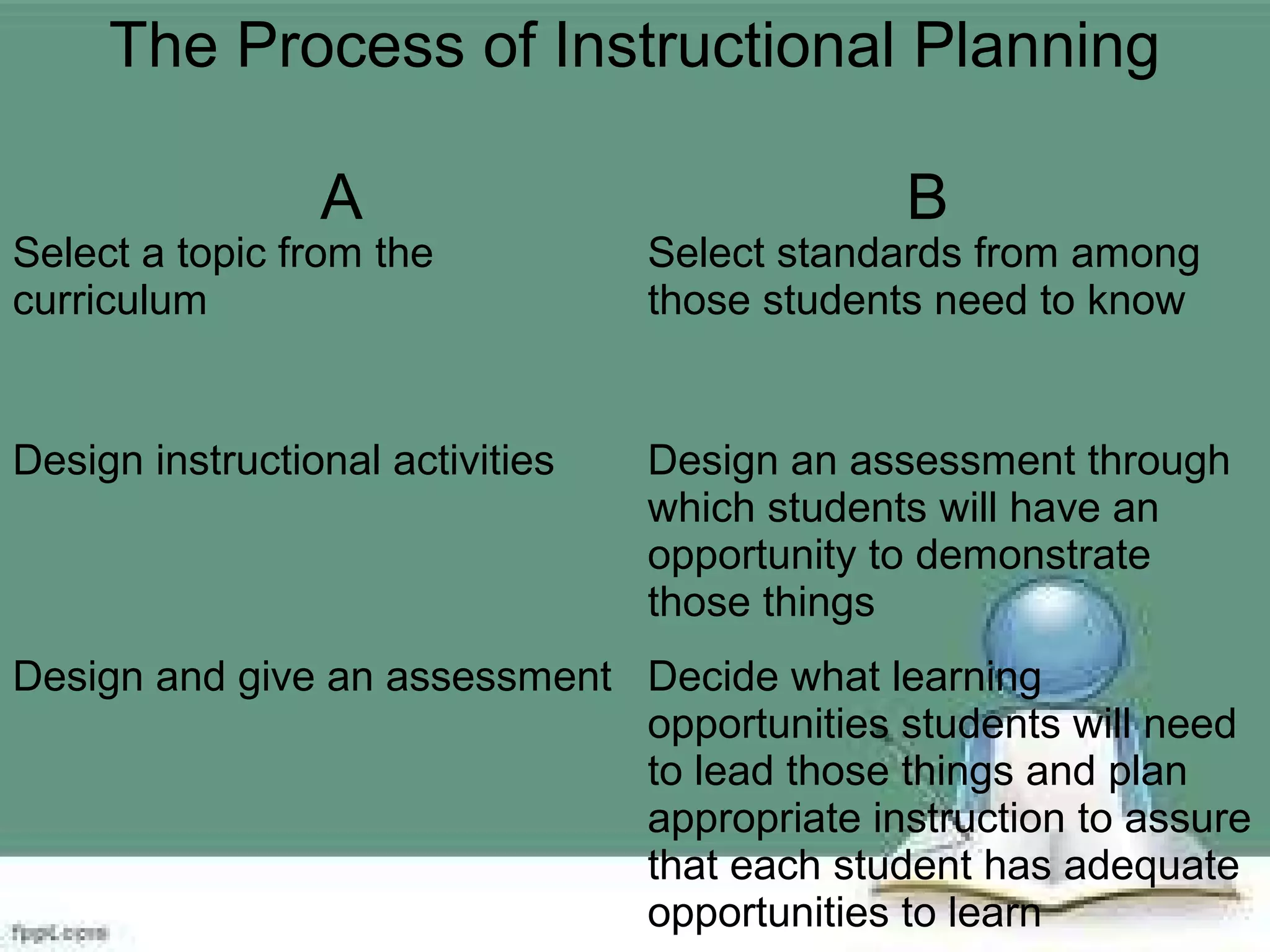
The Process of Instructional Planning
A B
Select a topic from the
curriculum
Select standards from among
those students need to know
Design instructional activities Design an assessment through
which students will have an
opportunity to demonstrate
those things
Design and give an assessment Decide what learning
opportunities students will need
to lead those things and plan
appropriate instruction to assure
that each student has adequate
opportunities to learn
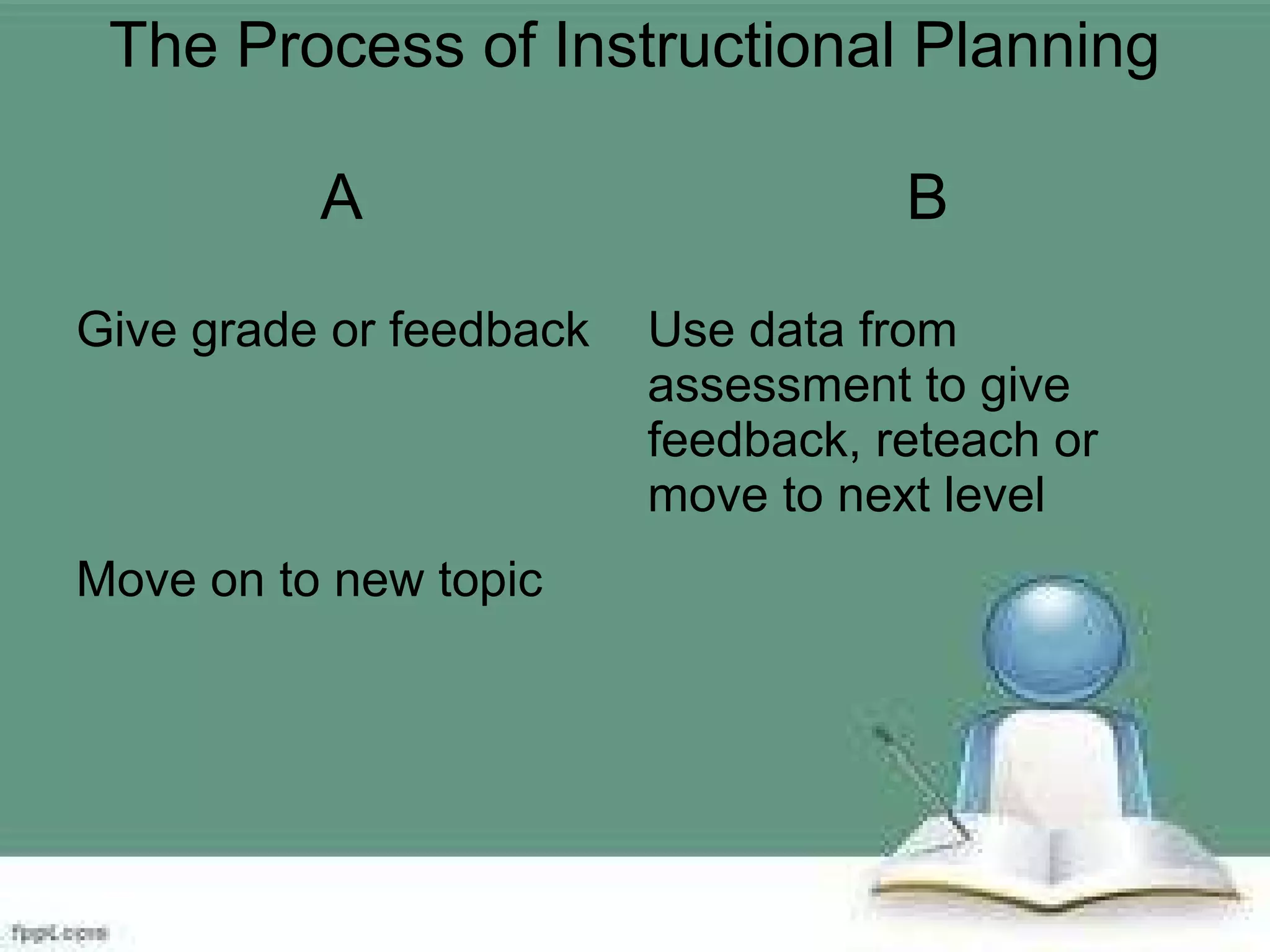
The Process of Instructional Planning
A B
Give grade or feedback Use data from
assessment to give
feedback, reteach or
move to next level
Move on to new topic
Outcomes – Base Education (OBE)
and Understanding by Design
(UbD)
*One of the features of OBE is “design down”.
*Understanding by design also known as UbD is a
backward design. Like OBE, the first step in UbD
is “identify result” followed by determining
assessment evidence. Planning instruction
comes only after determining assessment
evidence.
*Standards – Based framework goes with OBE
which is Outcomes – Base Teaching – Learning
(OBTL) when applied in the classroom
The Understanding by Design
(UbD) Framework
1. With what does UbD begin – learning content
or standards?
2. Are the broad content standards made more
specific by the statement of understanding/
goals, essential questions, student objectives/
outcomes?
3. Is teacher free to write down any essential
questions? Or should the essential questions
flow from the understanding/ goals?
4. Are the essential questions specific or general
in nature?
The Understanding by Design
(UbD) Framework
5. Does assessment evidence mean proof that the
content standards, goals, student outcomes
where attained or not attained?
6. Is the learning plan independent of desired
results and assessment evidence?
7. Does the learning plan have an objective or
outcome?
8. Excluding materials and timeline, what are the
parts of a learning plan?
9. Is the sequencing of the three last parts of the
learning plan also the same in a lesson plan?
Stage 1 Desired Result
*Content standards
>comes from professional standards in your
field
*Understanding Goals
>this is a goal not an objective
>list the big ideas or concepts
Stage 1 Desired Result
*Students Objectives
>this are observable, measurable, outcomes
that students should be able to
demonstrate and that you can assess
>design and directly linked to having
students to be able to achieve the
understandings
Stage 2 Assessment Evidence
*Performance Task
>authentic performance based task
>Bloom’s Taxonomy
>rubrics can be used to guide students in
their self assessment of their performance
Stage 2 Assessment Evidence
*Other Evidence
>includes pre – assessment, formative
assessment and summative assessment
evidence
>can be individual or group based
>can include informal methods
Stage 3 Learning Plan
1. Materials and Resources
2. Timeline
3. Introductory Activities
4. Developmental Activities
5. Closing Activities
Important Points to Remember in
Planning and Organizing Instruction
1. Daily Teaching Learning is supposed to
contribute to the realization of the vision
statement of the department.
2. If you belong to a private institution, bear in
mind the vision mission statement of your
school in addition to the DepEd vision and
mission statement.
3. Describes the knowledge and skills and values
of Philippine graduates at diff. levels in the
Phil. Educational system
4. These Grade 10 and Grade 12 qualifications
laid down in the PQF flow in to the standards.
5. Our instructional planning is suppose to begin
with study of the K-12 curriculum guide for the
subjects that we teach.
6. Which instructional plan are you going to
prepare depends on what your school requires.
7. Apply all the Principles of teaching and learning
that you have learned in PT 1.
A. Include appropriate strategies that promote
student learning, active engagement,
manipulation and testing of ideas.
B. Include cultural integration.
C. Clearly tie to a standard
D. Engage students in both individual and group
learning based on personal interest.
E. Lesson clearly ties to curriculum goals.
F. Include activating prior knowledge, anticipating
pre conceptions, exploration, and problem
solving and new skill building.
8. Always begin with the end in mind.
9. Do assessment to ensure learning.
10. Give your students opportunities to
assess themselves.
11. You teach two types of knowledge
declarative and procedural knowledge.
A. Test and quizzes with constructed
response.
B. Reflective assessment
C. Academic prompts that clearly specify
performance task elements
D. Culminating assessment projects that
allow for students choice and independent
application
13. Don’t forget that part of instructional
planning is utilization of assessment result
Elements of a Lesson
Plan/ Instructional
Plan/ Learning Plan
Several samples of Lesson
Plan/ Instructional Plan
1. Dr. Madeline Hunter’s
research indicates that
effective teachers usually
include the following
elements in their lesson.
A. Anticipatory Set
B. Purpose
C. Input
D. Modeling
E. Guide Practice
F. Checking for
Understanding
G. Independent Practice
H. Closure
2. For UbD, the parts of an
instructional plan follows
the acronym W.H.E.R.E.T.O.
W – Where and Why
H – Hook and Hold
E – Explore and Experience,
Enable and Equip
R – Reflect, Rethink and Revise
E – Evaluation
T – Tailor and Personalize the
Work
O – Organize for Optimal
Effectiveness
I. Objectives
II. Subject Matter and
References
III. Materials
IV. Procedure
A. Introduction/ Preliminary
Activities
B. Motivation
C. Lesson Proper
1. Activities
2. Application
3. Summary
D. Evaluation
E. Homework
Parts of Lesson Plan
common to all samples
1. The lesson/ instruction plans
begin with objective, standard,
outcome, purpose, where and
why;
2. Subject matter
3. Steps in lesson development
4. Evaluation
Lesson Development in
Direct (Deductive) and
Indirect (Inductive)
Instruction
*Direct (Deductive)
instruction
>>you teach begging with the
rule, generalization,
abstraction or principles and
end with examples and
details.
Detailed Illustration for
Direct (Deductive)
instruction
1. Input
2. Modeling
3. Checking for understanding
4. Questioning strategies
5. Guided practice
6. Closure
7. Independent practice
Indirect (inductive)
instruction
>>you begin your lesson
with concrete experiences,
details, examples and
assist students to discover
and give the rule,
generalization and
abstraction.
Four (4) As
1. Activity
2. Analysis
3. Abstraction
4. Application
Thank you
for listening

REPORTER:
Aica M. Tuazon.
BSED English II

Instructional planning and Devalopment

  • 1.
  • 2.
  • 3.
    The Process ofInstructional Planning A B Select a topic from the curriculum Select standards from among those students need to know Design instructional activities Design an assessment through which students will have an opportunity to demonstrate those things Design and give an assessment Decide what learning opportunities students will need to lead those things and plan appropriate instruction to assure that each student has adequate opportunities to learn
  • 4.
    The Process ofInstructional Planning A B Give grade or feedback Use data from assessment to give feedback, reteach or move to next level Move on to new topic
  • 5.
    Outcomes – BaseEducation (OBE) and Understanding by Design (UbD) *One of the features of OBE is “design down”. *Understanding by design also known as UbD is a backward design. Like OBE, the first step in UbD is “identify result” followed by determining assessment evidence. Planning instruction comes only after determining assessment evidence. *Standards – Based framework goes with OBE which is Outcomes – Base Teaching – Learning (OBTL) when applied in the classroom
  • 6.
    The Understanding byDesign (UbD) Framework 1. With what does UbD begin – learning content or standards? 2. Are the broad content standards made more specific by the statement of understanding/ goals, essential questions, student objectives/ outcomes? 3. Is teacher free to write down any essential questions? Or should the essential questions flow from the understanding/ goals? 4. Are the essential questions specific or general in nature?
  • 7.
    The Understanding byDesign (UbD) Framework 5. Does assessment evidence mean proof that the content standards, goals, student outcomes where attained or not attained? 6. Is the learning plan independent of desired results and assessment evidence? 7. Does the learning plan have an objective or outcome? 8. Excluding materials and timeline, what are the parts of a learning plan? 9. Is the sequencing of the three last parts of the learning plan also the same in a lesson plan?
  • 8.
    Stage 1 DesiredResult *Content standards >comes from professional standards in your field *Understanding Goals >this is a goal not an objective >list the big ideas or concepts
  • 9.
    Stage 1 DesiredResult *Students Objectives >this are observable, measurable, outcomes that students should be able to demonstrate and that you can assess >design and directly linked to having students to be able to achieve the understandings
  • 10.
    Stage 2 AssessmentEvidence *Performance Task >authentic performance based task >Bloom’s Taxonomy >rubrics can be used to guide students in their self assessment of their performance
  • 11.
    Stage 2 AssessmentEvidence *Other Evidence >includes pre – assessment, formative assessment and summative assessment evidence >can be individual or group based >can include informal methods
  • 12.
    Stage 3 LearningPlan 1. Materials and Resources 2. Timeline 3. Introductory Activities 4. Developmental Activities 5. Closing Activities
  • 13.
    Important Points toRemember in Planning and Organizing Instruction 1. Daily Teaching Learning is supposed to contribute to the realization of the vision statement of the department. 2. If you belong to a private institution, bear in mind the vision mission statement of your school in addition to the DepEd vision and mission statement. 3. Describes the knowledge and skills and values of Philippine graduates at diff. levels in the Phil. Educational system
  • 14.
    4. These Grade10 and Grade 12 qualifications laid down in the PQF flow in to the standards. 5. Our instructional planning is suppose to begin with study of the K-12 curriculum guide for the subjects that we teach. 6. Which instructional plan are you going to prepare depends on what your school requires. 7. Apply all the Principles of teaching and learning that you have learned in PT 1.
  • 15.
    A. Include appropriatestrategies that promote student learning, active engagement, manipulation and testing of ideas. B. Include cultural integration. C. Clearly tie to a standard D. Engage students in both individual and group learning based on personal interest. E. Lesson clearly ties to curriculum goals. F. Include activating prior knowledge, anticipating pre conceptions, exploration, and problem solving and new skill building.
  • 16.
    8. Always beginwith the end in mind. 9. Do assessment to ensure learning. 10. Give your students opportunities to assess themselves. 11. You teach two types of knowledge declarative and procedural knowledge. A. Test and quizzes with constructed response.
  • 17.
    B. Reflective assessment C.Academic prompts that clearly specify performance task elements D. Culminating assessment projects that allow for students choice and independent application 13. Don’t forget that part of instructional planning is utilization of assessment result
  • 18.
    Elements of aLesson Plan/ Instructional Plan/ Learning Plan
  • 19.
    Several samples ofLesson Plan/ Instructional Plan 1. Dr. Madeline Hunter’s research indicates that effective teachers usually include the following elements in their lesson.
  • 20.
    A. Anticipatory Set B.Purpose C. Input D. Modeling E. Guide Practice F. Checking for Understanding G. Independent Practice H. Closure
  • 21.
    2. For UbD,the parts of an instructional plan follows the acronym W.H.E.R.E.T.O.
  • 22.
    W – Whereand Why H – Hook and Hold E – Explore and Experience, Enable and Equip R – Reflect, Rethink and Revise E – Evaluation T – Tailor and Personalize the Work O – Organize for Optimal Effectiveness
  • 23.
    I. Objectives II. SubjectMatter and References III. Materials IV. Procedure A. Introduction/ Preliminary Activities B. Motivation C. Lesson Proper 1. Activities 2. Application 3. Summary D. Evaluation E. Homework
  • 24.
    Parts of LessonPlan common to all samples 1. The lesson/ instruction plans begin with objective, standard, outcome, purpose, where and why; 2. Subject matter 3. Steps in lesson development 4. Evaluation
  • 25.
    Lesson Development in Direct(Deductive) and Indirect (Inductive) Instruction *Direct (Deductive) instruction >>you teach begging with the rule, generalization, abstraction or principles and end with examples and details.
  • 26.
    Detailed Illustration for Direct(Deductive) instruction 1. Input 2. Modeling 3. Checking for understanding 4. Questioning strategies 5. Guided practice 6. Closure 7. Independent practice
  • 27.
    Indirect (inductive) instruction >>you beginyour lesson with concrete experiences, details, examples and assist students to discover and give the rule, generalization and abstraction.
  • 28.
    Four (4) As 1.Activity 2. Analysis 3. Abstraction 4. Application
  • 29.