PRESENTATION # 01
Teaching Strategies and Taxonomies
INSTRUCTOR: MAIM RABIA KAMRAN
SEMESTER: 2ND )MORNING(
SESSION: 2016 TO 2020
UNIVERSITY OF EDUCATION (MULTAN)
PROGRAME 2016 TO 2020
Group Members
M.Aamir Khan bsf1604208
Shahzaib bsf1602175
Khurram Shahzad bsf1602088
Numan saleem bsf1604217
M Tariq bsf1604180
Chapter Outline
 Teaching strategies and taxonomies
 BLOOM’S TAXONOMY
 SOLO TAXONOMY
PSYCHOLOGICAL FOUNDATIONS OF
SOLO TAXONOMY
SURFACE AND DEEP KNOWLEDGE
Teaching strategies and taxonomies
Teacher used many strategies in the classroom
but when he/she start to plane his /her lesson
planning, lesson delivery. summative and
formative assessment in the light of
taxonomies, his/her learning outcomes be
enhanced and his teaching/learning may be
enhanced and judged systematically, so
knowledge of taxonomy is very fruitful in the
classroom situation.
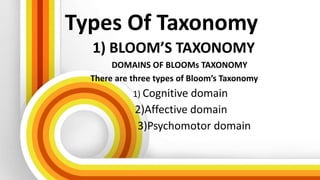
Types Of Taxonomy
1) BLOOM’S TAXONOMY
DOMAINS OF BLOOMs TAXONOMY
There are three types of Bloom’s Taxonomy
1) Cognitive domain
2)Affective domain
3)Psychomotor domain
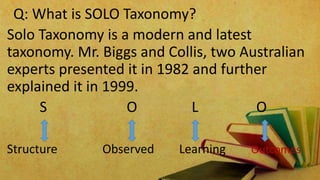
Q: What is SOLO Taxonomy?
Solo Taxonomy is a modern and latest
taxonomy. Mr. Biggs and Collis, two Australian
experts presented it in 1982 and further
explained it in 1999.
S O L O
Structure Observed Learning Outcomes
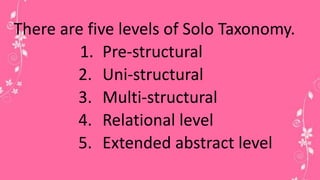
There are five levels of Solo Taxonomy.
1. Pre-structural
2. Uni-structural
3. Multi-structural
4. Relational level
5. Extended abstract level
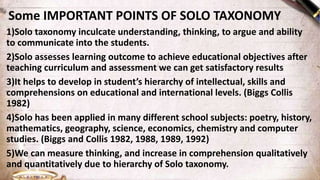
Some IMPORTANT POINTS OF SOLO TAXONOMY
1)Solo taxonomy inculcate understanding, thinking, to argue and ability
to communicate into the students.
2)Solo assesses learning outcome to achieve educational objectives after
teaching curriculum and assessment we can get satisfactory results
3)It helps to develop in student’s hierarchy of intellectual, skills and
comprehensions on educational and international levels. (Biggs Collis
1982)
4)Solo has been applied in many different school subjects: poetry, history,
mathematics, geography, science, economics, chemistry and computer
studies. (Biggs and Collis 1982, 1988, 1989, 1992)
5)We can measure thinking, and increase in comprehension qualitatively
and quantitatively due to hierarchy of Solo taxonomy.
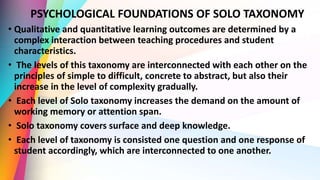
PSYCHOLOGICAL FOUNDATIONS OF SOLO TAXONOMY
• Qualitative and quantitative learning outcomes are determined by a
complex interaction between teaching procedures and student
characteristics.
• The levels of this taxonomy are interconnected with each other on the
principles of simple to difficult, concrete to abstract, but also their
increase in the level of complexity gradually.
• Each level of Solo taxonomy increases the demand on the amount of
working memory or attention span.
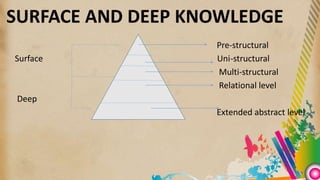
• Solo taxonomy covers surface and deep knowledge.
• Each level of taxonomy is consisted one question and one response of
student accordingly, which are interconnected to one another.
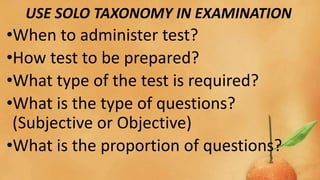
USE SOLO TAXONOMY IN EXAMINATION
•When to administer test?
•How test to be prepared?
•What type of the test is required?
•What is the type of questions?
(Subjective or Objective)
•What is the proportion of questions?
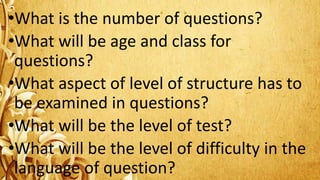
•What is the number of questions?
•What will be age and class for
questions?
•What aspect of level of structure has to
be examined in questions?
•What will be the level of test?
•What will be the level of difficulty in the
language of question?
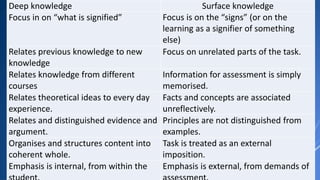
SURFACE AND DEEP KNOWLEDGE
Pre-structural
Surface Uni-structural
Multi-structural
Relational level
Deep
Extended abstract level
Deep knowledge Surface knowledge
Focus in on “what is signified” Focus is on the “signs” (or on the
learning as a signifier of something
else)
Relates previous knowledge to new
knowledge
Focus on unrelated parts of the task.
Relates knowledge from different
courses
Information for assessment is simply
memorised.
Relates theoretical ideas to every day
experience.
Facts and concepts are associated
unreflectively.
Relates and distinguished evidence and
argument.
Principles are not distinguished from
examples.
Organises and structures content into
coherent whole.
Task is treated as an external
imposition.
Emphasis is internal, from within the Emphasis is external, from demands of
GETTING THE CURRICULUM IN FOCUS
•What kind of knowledge and content to comprise?
•Curriculum is to be focused here. To select titles and topics
according to curriculum.
•To keep the teaching objectives of the topic in view, design
the questions accordingly, afterwards to keep in mind the
objectives of curriculum and subject.
•Up to what class and level, students have acquired
knowledge and how much curriculum they have covered.
•To select important and unimportant topics.
•Construct the test according to objectives of the
curriculum so that results can be compiled and reported
according to grades
• Designed By: M.Aamir Khan

Presentation

  • 1.
    PRESENTATION # 01 TeachingStrategies and Taxonomies INSTRUCTOR: MAIM RABIA KAMRAN SEMESTER: 2ND )MORNING( SESSION: 2016 TO 2020 UNIVERSITY OF EDUCATION (MULTAN) PROGRAME 2016 TO 2020
  • 2.
    Group Members M.Aamir Khanbsf1604208 Shahzaib bsf1602175 Khurram Shahzad bsf1602088 Numan saleem bsf1604217 M Tariq bsf1604180
  • 3.
    Chapter Outline  Teachingstrategies and taxonomies  BLOOM’S TAXONOMY  SOLO TAXONOMY PSYCHOLOGICAL FOUNDATIONS OF SOLO TAXONOMY SURFACE AND DEEP KNOWLEDGE
  • 4.
    Teaching strategies andtaxonomies Teacher used many strategies in the classroom but when he/she start to plane his /her lesson planning, lesson delivery. summative and formative assessment in the light of taxonomies, his/her learning outcomes be enhanced and his teaching/learning may be enhanced and judged systematically, so knowledge of taxonomy is very fruitful in the classroom situation.
  • 5.
    Types Of Taxonomy 1)BLOOM’S TAXONOMY DOMAINS OF BLOOMs TAXONOMY There are three types of Bloom’s Taxonomy 1) Cognitive domain 2)Affective domain 3)Psychomotor domain
  • 6.
    Q: What isSOLO Taxonomy? Solo Taxonomy is a modern and latest taxonomy. Mr. Biggs and Collis, two Australian experts presented it in 1982 and further explained it in 1999. S O L O Structure Observed Learning Outcomes
  • 7.
    There are fivelevels of Solo Taxonomy. 1. Pre-structural 2. Uni-structural 3. Multi-structural 4. Relational level 5. Extended abstract level
  • 8.
    Some IMPORTANT POINTSOF SOLO TAXONOMY 1)Solo taxonomy inculcate understanding, thinking, to argue and ability to communicate into the students. 2)Solo assesses learning outcome to achieve educational objectives after teaching curriculum and assessment we can get satisfactory results 3)It helps to develop in student’s hierarchy of intellectual, skills and comprehensions on educational and international levels. (Biggs Collis 1982) 4)Solo has been applied in many different school subjects: poetry, history, mathematics, geography, science, economics, chemistry and computer studies. (Biggs and Collis 1982, 1988, 1989, 1992) 5)We can measure thinking, and increase in comprehension qualitatively and quantitatively due to hierarchy of Solo taxonomy.
  • 9.
    PSYCHOLOGICAL FOUNDATIONS OFSOLO TAXONOMY • Qualitative and quantitative learning outcomes are determined by a complex interaction between teaching procedures and student characteristics. • The levels of this taxonomy are interconnected with each other on the principles of simple to difficult, concrete to abstract, but also their increase in the level of complexity gradually. • Each level of Solo taxonomy increases the demand on the amount of working memory or attention span. • Solo taxonomy covers surface and deep knowledge. • Each level of taxonomy is consisted one question and one response of student accordingly, which are interconnected to one another.
  • 10.
    USE SOLO TAXONOMYIN EXAMINATION •When to administer test? •How test to be prepared? •What type of the test is required? •What is the type of questions? (Subjective or Objective) •What is the proportion of questions?
  • 11.
    •What is thenumber of questions? •What will be age and class for questions? •What aspect of level of structure has to be examined in questions? •What will be the level of test? •What will be the level of difficulty in the language of question?
  • 12.
    SURFACE AND DEEPKNOWLEDGE Pre-structural Surface Uni-structural Multi-structural Relational level Deep Extended abstract level
  • 13.
    Deep knowledge Surfaceknowledge Focus in on “what is signified” Focus is on the “signs” (or on the learning as a signifier of something else) Relates previous knowledge to new knowledge Focus on unrelated parts of the task. Relates knowledge from different courses Information for assessment is simply memorised. Relates theoretical ideas to every day experience. Facts and concepts are associated unreflectively. Relates and distinguished evidence and argument. Principles are not distinguished from examples. Organises and structures content into coherent whole. Task is treated as an external imposition. Emphasis is internal, from within the Emphasis is external, from demands of
  • 14.
    GETTING THE CURRICULUMIN FOCUS •What kind of knowledge and content to comprise? •Curriculum is to be focused here. To select titles and topics according to curriculum. •To keep the teaching objectives of the topic in view, design the questions accordingly, afterwards to keep in mind the objectives of curriculum and subject. •Up to what class and level, students have acquired knowledge and how much curriculum they have covered. •To select important and unimportant topics. •Construct the test according to objectives of the curriculum so that results can be compiled and reported according to grades
  • 15.
    • Designed By:M.Aamir Khan