PHARMACOGNOSY
Lecture 1d
Drug evaluation
• Phytochemical investigation.
• Phytochemistry. Extraction methods.
Suggested bibliography:
Pharmacognosy, Kokate, Purohit & Gokhale, 2004, Chap. 6. pp. 99-105.
Pharmacognosy, Trease and Evans, 1996, Chap..
Textbook of Pharmacocognosy, Handa & Kapoor, 2003, Chp 24, 10, 15.
OBJETIVES.
The student must know how
obtain the components present in
medicinal plants through the
stablished extraction methods.
Phytochemistry. Extraction methods.
Phytochemistry implies the chemical examination of the
active fraction after its extraction.
The systematic investigations of plant material for
its phytochemical behavior involve different
stages. One of them is the extraction of chemical
constituents.
Factors influencing the different methods
of extraction
The methods and techniques for extraction and isolation of
active principles from crude drugs, depend on several
factors as the following:
a) Establish the right procedure and solvent selection
taking on account the chemical composition of the
raw material standardized.
b) Fragmentation (particle size).
Leaf, flower and herbaceous plants 5mm
Bark, stem and roots 3mm
Seed and fruits 0,5 mm
g) Viscosity of the médium, solvent characteristics.
h) Fluctuation in the concentration among the raw
material (higher) and the solvent of the
extraction (lower).
i) Ph of the extraction médium.
j) Influence of temperature on the solubility
and decomposition of the chemicals.
k) Product stability on experimental
conditions.
In the pharmaceutical market there are
usually found four types of extracts:
Are the must common and contain the whole
diversity of chemical components. The two
common different kinds of extracts are:
Fluid extract: concentration of the drug extract
until 1 ml contain the extractives of 1 g of plant.
Tincture: Concentration of the drug extract to
certain percentage. For example:
10% tincture  1 g drug / 10 mL
20%  1 g drug / 5 mL
Hydro alcoholic extracts
Dry extracts
Are obtained concentrating the liquid
extraction through vacuum evaporation or
spray dry system until a powder is obtained.
As termolabile substances could change its
chemical structure, spray dry is used
nowadays. This procedure preserves the
enzymatic, vitamin and hormonal content of
fresh plant preparations.
Soft extracts
Are thick liquids or semisolid masses
that are obtained evaporating the
extraction solvent without reaching to
dryness. In general, each gram of the
soft extract is equivalent to 4-6 g from
each 100g of the raw material.
Oily extracts
When the substance of interest is
hydrophobic and the evaporation of
the extract finally is oily in its
consistence
The main techniques for extraction are:
Maceration
Lixiviation or percolation
Digestion
Soxhlet or continous extraction
Distillation for volatile components
Infusion
Decoction
Cold extraction
Supercritical fluid extraction
Continuous extraction
Maceration: The word maceration means softening. It is a cold
extraction employed in the production of a number of
preparations such as tinctures, extracts and concentrated
infusions. The fragmented crude drug is left to soak in the solvent,
so the cellular substances dissolve in it.
The material is agitated periodically during 2-14 days in a
hermetically closed flask. Then, the solvent is filtrated pressing the
residue, and washing it with a small volume of the solvent.
Digestion: It is another kind of maceration where the
powdered material is slightly heated to increase the
extracting power. So as the solvent can be used
continuously by recycling, a condenser can be adjusted
to the flask where the digestion is being carried out.
Cold extraction or maceration modification (in a large flask
with agitation using a stirrer) in which the ground dried
material is extracted at room temperature sequentially
with solvents of increasing polarity: hexane (or petroleum
ether), then chloroform, ethyl acetate, acetone, methanol
and finally water. The major advantage of this protocol is
that it is a soft extraction method, the extract is not heated
and there is therefore, little potential degradation of
natural products according to their solubility (and polarity)
in the extraction solvents.
Lixiviation: The powder material is firstly
macerated for 30 min, and the placed in the
percolator, making the solvent to flow through
it until the air bubbles disappear.
Hot percolation, the biomass is added to a round-bottomed
flask containing solvent and the mixture is heated under
reflux. Typically, the plant material is stewed using solvents
such as ethanol or aqueous ethanol mixtures.
The technique is sometimes referred to as total extraction
and has the advantage that, with ethanol, the major
hydrophobic and hydrophilic compounds are extracted.
Infusion: The drug is extracted with hot water, but
not boiling, or with cold water. The water is purred
over the crude drug, keeping the container well
closed during about 15 min.
Decoction: The crude drug is boiled in water during
15-30 minutes and filtered out in boiling solvent.
For the most usual drugs the proportion is each 1 g of
drug per 30 ml of water.
For drugs that contain toxic substances the proportion
is each 1 g of drug per 400 ml of water.
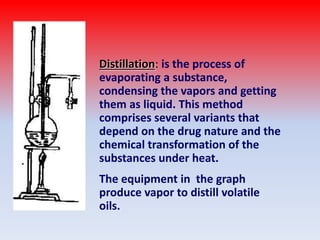
Distillation: is the process of
evaporating a substance,
condensing the vapors and getting
them as liquid. This method
comprises several variants that
depend on the drug nature and the
chemical transformation of the
substances under heat.
The equipment in the graph
produce vapor to distill volatile
oils.
Supercritical fluid extraction utilizes the fact that some
gases behave as liquids when under pressure they show
solvating properties. The most important example is
carbon dioxide which can be used to extract biomass and
has the advantage that, once the pressure has been
removed, the gas boils off leaving a clean extract. Carbon
dioxide is a non-polar solvent but the polarity of the
supercritical fluid extraction solvent may be increased by
addition of a modifying agent, which is usually another
solvent (e.g. methanol or dichloromethane).
Continuous extraction: The plant material
is treated with solvents of increasing
polarity that dissolve one or some of its
components. This methods require
specially designed equipments such as the
Soxhlet apparatus and the liquid-liquid
extractor.
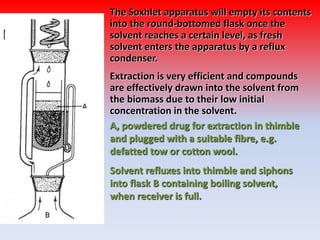
The biomass is placed on a Soxhlet
thimble constructed of filter paper,
through which solvent is continuously
refluxed.
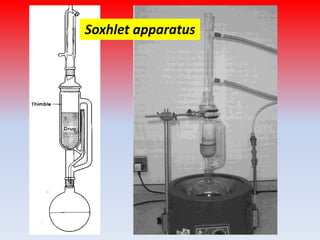
Soxhlet apparatus
The Soxhlet apparatus will empty its contents
into the round-bottomed flask once the
solvent reaches a certain level, as fresh
solvent enters the apparatus by a reflux
condenser.
Extraction is very efficient and compounds
are effectively drawn into the solvent from
the biomass due to their low initial
concentration in the solvent.
A, powdered drug for extraction in thimble
and plugged with a suitable fibre, e.g.
defatted tow or cotton wool.
Solvent refluxes into thimble and siphons
into flask B containing boiling solvent,
when receiver is full.
The method suffers ,from the same drawbacks ,as other hot extraction methods (possible
degradation of products), but it is the best extraction method for the recovery of big yields of
extract.
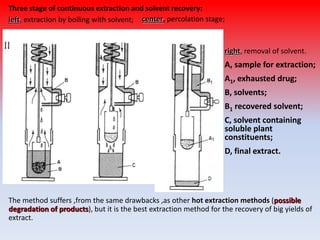
Three stage of continuous extraction and solvent recovery:
left, extraction by boiling with solvent; center, percolation stage;
right, removal of solvent.
A, sample for extraction;
A1, exhausted drug;
B, solvents;
B1 recovered solvent;
C, solvent containing
soluble plant
constituents;
D, final extract.
Concluding remarks
• Summarize the main stages for
phytochemical studies.
• Mention the main methods of
extraction.

pharmacognosy lecture 2e.ppt

  • 1.
  • 2.
    Drug evaluation • Phytochemicalinvestigation. • Phytochemistry. Extraction methods. Suggested bibliography: Pharmacognosy, Kokate, Purohit & Gokhale, 2004, Chap. 6. pp. 99-105. Pharmacognosy, Trease and Evans, 1996, Chap.. Textbook of Pharmacocognosy, Handa & Kapoor, 2003, Chp 24, 10, 15.
  • 3.
    OBJETIVES. The student mustknow how obtain the components present in medicinal plants through the stablished extraction methods.
  • 4.
    Phytochemistry. Extraction methods. Phytochemistryimplies the chemical examination of the active fraction after its extraction. The systematic investigations of plant material for its phytochemical behavior involve different stages. One of them is the extraction of chemical constituents.
  • 5.
    Factors influencing thedifferent methods of extraction The methods and techniques for extraction and isolation of active principles from crude drugs, depend on several factors as the following: a) Establish the right procedure and solvent selection taking on account the chemical composition of the raw material standardized. b) Fragmentation (particle size). Leaf, flower and herbaceous plants 5mm Bark, stem and roots 3mm Seed and fruits 0,5 mm
  • 6.
    g) Viscosity ofthe médium, solvent characteristics. h) Fluctuation in the concentration among the raw material (higher) and the solvent of the extraction (lower). i) Ph of the extraction médium. j) Influence of temperature on the solubility and decomposition of the chemicals. k) Product stability on experimental conditions.
  • 7.
    In the pharmaceuticalmarket there are usually found four types of extracts: Are the must common and contain the whole diversity of chemical components. The two common different kinds of extracts are: Fluid extract: concentration of the drug extract until 1 ml contain the extractives of 1 g of plant. Tincture: Concentration of the drug extract to certain percentage. For example: 10% tincture  1 g drug / 10 mL 20%  1 g drug / 5 mL Hydro alcoholic extracts
  • 8.
    Dry extracts Are obtainedconcentrating the liquid extraction through vacuum evaporation or spray dry system until a powder is obtained. As termolabile substances could change its chemical structure, spray dry is used nowadays. This procedure preserves the enzymatic, vitamin and hormonal content of fresh plant preparations.
  • 9.
    Soft extracts Are thickliquids or semisolid masses that are obtained evaporating the extraction solvent without reaching to dryness. In general, each gram of the soft extract is equivalent to 4-6 g from each 100g of the raw material.
  • 10.
    Oily extracts When thesubstance of interest is hydrophobic and the evaporation of the extract finally is oily in its consistence
  • 11.
    The main techniquesfor extraction are: Maceration Lixiviation or percolation Digestion Soxhlet or continous extraction Distillation for volatile components Infusion Decoction Cold extraction Supercritical fluid extraction Continuous extraction
  • 12.
    Maceration: The wordmaceration means softening. It is a cold extraction employed in the production of a number of preparations such as tinctures, extracts and concentrated infusions. The fragmented crude drug is left to soak in the solvent, so the cellular substances dissolve in it. The material is agitated periodically during 2-14 days in a hermetically closed flask. Then, the solvent is filtrated pressing the residue, and washing it with a small volume of the solvent. Digestion: It is another kind of maceration where the powdered material is slightly heated to increase the extracting power. So as the solvent can be used continuously by recycling, a condenser can be adjusted to the flask where the digestion is being carried out.
  • 13.
    Cold extraction ormaceration modification (in a large flask with agitation using a stirrer) in which the ground dried material is extracted at room temperature sequentially with solvents of increasing polarity: hexane (or petroleum ether), then chloroform, ethyl acetate, acetone, methanol and finally water. The major advantage of this protocol is that it is a soft extraction method, the extract is not heated and there is therefore, little potential degradation of natural products according to their solubility (and polarity) in the extraction solvents.
  • 14.
    Lixiviation: The powdermaterial is firstly macerated for 30 min, and the placed in the percolator, making the solvent to flow through it until the air bubbles disappear. Hot percolation, the biomass is added to a round-bottomed flask containing solvent and the mixture is heated under reflux. Typically, the plant material is stewed using solvents such as ethanol or aqueous ethanol mixtures. The technique is sometimes referred to as total extraction and has the advantage that, with ethanol, the major hydrophobic and hydrophilic compounds are extracted.
  • 15.
    Infusion: The drugis extracted with hot water, but not boiling, or with cold water. The water is purred over the crude drug, keeping the container well closed during about 15 min. Decoction: The crude drug is boiled in water during 15-30 minutes and filtered out in boiling solvent. For the most usual drugs the proportion is each 1 g of drug per 30 ml of water. For drugs that contain toxic substances the proportion is each 1 g of drug per 400 ml of water.
  • 16.
    Distillation: is theprocess of evaporating a substance, condensing the vapors and getting them as liquid. This method comprises several variants that depend on the drug nature and the chemical transformation of the substances under heat. The equipment in the graph produce vapor to distill volatile oils.
  • 17.
    Supercritical fluid extractionutilizes the fact that some gases behave as liquids when under pressure they show solvating properties. The most important example is carbon dioxide which can be used to extract biomass and has the advantage that, once the pressure has been removed, the gas boils off leaving a clean extract. Carbon dioxide is a non-polar solvent but the polarity of the supercritical fluid extraction solvent may be increased by addition of a modifying agent, which is usually another solvent (e.g. methanol or dichloromethane).
  • 18.
    Continuous extraction: Theplant material is treated with solvents of increasing polarity that dissolve one or some of its components. This methods require specially designed equipments such as the Soxhlet apparatus and the liquid-liquid extractor. The biomass is placed on a Soxhlet thimble constructed of filter paper, through which solvent is continuously refluxed.
  • 19.
  • 20.
    The Soxhlet apparatuswill empty its contents into the round-bottomed flask once the solvent reaches a certain level, as fresh solvent enters the apparatus by a reflux condenser. Extraction is very efficient and compounds are effectively drawn into the solvent from the biomass due to their low initial concentration in the solvent. A, powdered drug for extraction in thimble and plugged with a suitable fibre, e.g. defatted tow or cotton wool. Solvent refluxes into thimble and siphons into flask B containing boiling solvent, when receiver is full.
  • 21.
    The method suffers,from the same drawbacks ,as other hot extraction methods (possible degradation of products), but it is the best extraction method for the recovery of big yields of extract. Three stage of continuous extraction and solvent recovery: left, extraction by boiling with solvent; center, percolation stage; right, removal of solvent. A, sample for extraction; A1, exhausted drug; B, solvents; B1 recovered solvent; C, solvent containing soluble plant constituents; D, final extract.
  • 22.
    Concluding remarks • Summarizethe main stages for phytochemical studies. • Mention the main methods of extraction.