NAZMA LIAQUAT
13-PHC-S15
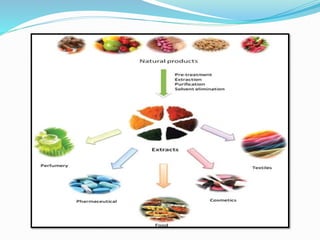
NATURAL PRODUCTS
Natural product is a chemical compound or
substance produced by a living organism, that is
found in nature.
Extraction
Extraction is a mass transfer process of one or more
components from one phase to another.
Goals;
• High yield
• high selectivity and purity
• high sensitivity
These properties may differ in terms of importance
depending on the process scale.
At the industrial scale yield and purity are the key
properties.
When dealing with natural products, in most cases the
sample to be extracted is a solid material, although in
some cases liquid samples are used. The extracting
solvent is usually a liquid, but it can also be a solid or a
supercritical fluid.
In order to understand how any extraction technique
works, both the target compounds and the extraction
solvent must be considered.
Therefore, knowledge of the properties of the solute,
mainly its chemical properties, is important in order to
understand the extraction process. Moreover, it is
important to know the properties of the solvent
medium in which the target material is to be dissolved
during the extraction process. The interactions
between solute and solvent are determined by the
vapor pressure of the solute, the solubility of the solute
in the solvent, the hydrophobicity , and the acid/base
properties of both solute and solvent.
Some of these properties only relate to the
compound of interest (solute), while others concern
the solvent used for the extraction process. The
compatibility between solvent and solute is based on
assessing the polarity of the molecular structure to
predict their solubility and miscibility. As a general
rule, it is assumed that non-polar solutes are
dissolved by non-polar solvents while polar solutes
are dissolved by polar solvents.
For example, water dissolves glucose due to the
attraction between the partially positively charged
atom of the glucose molecule to the partially
negatively charged atom of the water molecule while
at the same time the partially negatively charged atom
of the glucose molecule is attracted to the partially
positively charged atom of the water molecule. If the
target component from the raw material is freely
available and the polarity of the solvent and of the
solute is compatible, the solvent dissolves the solute
to form a homogenous solution.
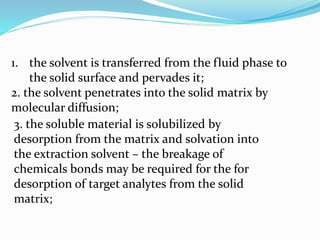
Extraction mechanism
1. the solvent is transferred from the fluid phase to
the solid surface and pervades it;
2. the solvent penetrates into the solid matrix by
molecular diffusion;
3. the soluble material is solubilized by
desorption from the matrix and solvation into
the extraction solvent – the breakage of
chemicals bonds may be required for the for
desorption of target analytes from the solid
matrix;
4. the solution containing the solutes returns to the
surface of the solid by
molecular diffusion;
5. the solution is transferred from the solid surface
to the bulk fluid by natural of forced convection.
The extraction of a chemical component X from a
phase A to a second phase B begins when the two
phases come into contact. The two phases should
therefore not be miscible if they are both liquids.
Furthermore, phase A can be in the solid or semi-
solid state. The distribution of X between the
immiscible phases occurs as soon as it can be
transferred from phase A to phase B and back from
phase B to phase A. The solubilization limit is the
equilibrium concentration between the phases.
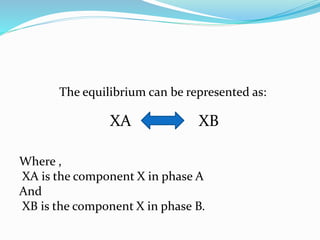
The equilibrium can be represented as:
XA XB
Where ,
XA is the component X in phase A
And
XB is the component X in phase B.
Conventional Extraction Techniques
The extraction method to be applied to a particular
solid matrix depends on the raw material to be
processed and on the product desired. There is no
single and standard extraction method for
obtaining bioactive compounds from natural
products, each one presenting advantages and
disadvantages.
The most commonly used
conventional techniques are ;
• Soaking extraction,
• Soxhlet extraction,
• Distillation.
Choosing one of them for extracting bioactive
compounds from
natural products depends on process conditions
such as temperature, mechanical action and solvent
type.
Soaking
In this process, the untreated or powdered plant
material is placed in a container along with the
solvent. The plant material stays in contact with
the solvent for several hours or even days, during
which the soluble material is transferred from the
solid sample to the solvent. Usually some kind of
agitation is provided to increase the mass transfer
rate by increasing the turbulence.
Agitation devices are used to process fine
particles. The dispersion of the particles in the
liquid solvent by the agitation facilitates the
contact of the solid with the solvent,
accelerating the process by favoring the
diffusion of the extracted components and
avoiding super saturation in the immediate
proximity of the surface of the solid to be
extracted. However, care should be taken with
excessive agitation, which may cause the
disintegration of particle solids.
The most common is to perform the process under
room temperature, but heat can be applied to
improve the extraction efficiency. However, when
extracting thermosensitive compounds high
temperatures should be avoided.
Drawbacks
Time consuming
High energy demand
 product quality loss
 mass transfer rate decreases with time because
solvent is continously enriched with solutes.
Soxhlet Extraction
Advantages
 Simplicity
 low cost
Apparatus
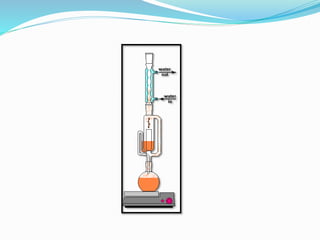
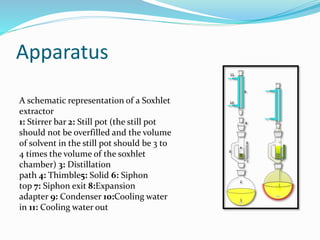
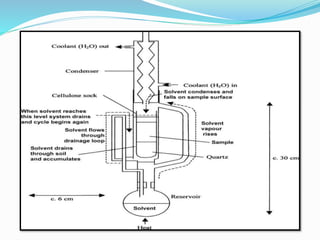
A schematic representation of a Soxhlet
extractor
1: Stirrer bar 2: Still pot (the still pot
should not be overfilled and the volume
of solvent in the still pot should be 3 to
4 times the volume of the soxhlet
chamber) 3: Distillation
path 4: Thimble5: Solid 6: Siphon
top 7: Siphon exit 8:Expansion
adapter 9: Condenser 10:Cooling water
in 11: Cooling water out
Operation;
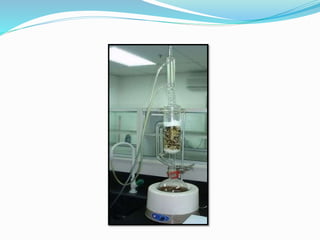
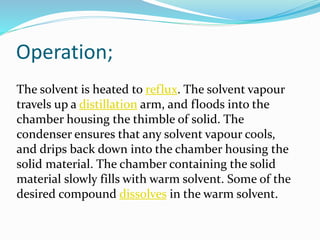
The solvent is heated to reflux. The solvent vapour
travels up a distillation arm, and floods into the
chamber housing the thimble of solid. The
condenser ensures that any solvent vapour cools,
and drips back down into the chamber housing the
solid material. The chamber containing the solid
material slowly fills with warm solvent. Some of the
desired compound dissolves in the warm solvent.
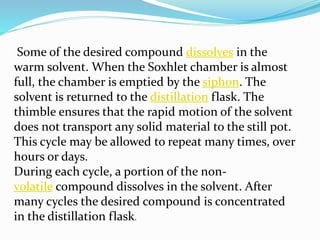
Some of the desired compound dissolves in the
warm solvent. When the Soxhlet chamber is almost
full, the chamber is emptied by the siphon. The
solvent is returned to the distillation flask. The
thimble ensures that the rapid motion of the solvent
does not transport any solid material to the still pot.
This cycle may be allowed to repeat many times, over
hours or days.
During each cycle, a portion of the non-
volatile compound dissolves in the solvent. After
many cycles the desired compound is concentrated
in the distillation flask.
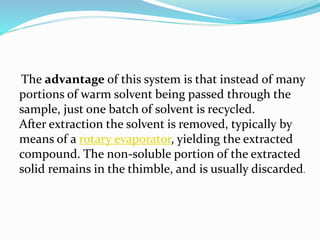
The advantage of this system is that instead of many
portions of warm solvent being passed through the
sample, just one batch of solvent is recycled.
After extraction the solvent is removed, typically by
means of a rotary evaporator, yielding the extracted
compound. The non-soluble portion of the extracted
solid remains in the thimble, and is usually discarded.
Several solvents have been used for the extraction of
active components from plants. Soxhlet has been
specifically applied to extract vegetable oil. In these
applications hexane has been the most commonly
used solvent. Different types of bioactive compounds
have been isolated using this method with hexane as
solvent. Hexane has a boiling point of approximately
65 1C, i.e. it should enable the application of Soxhlet
extraction to any compound with a boiling
point above 65 1C. Hexane is also an excellent solvent
for oil because of the high oil solubility in this solvent
and also because oil can be easily recovered
by distillation.
Drawback;
The main drawback for the use of hexane is its high
toxicity. As a result, other solvents have been used to
substitute hexane in oil recovery including some
polarity alcohols such as isopropanol and ethanol,
another option is to use water at pH 12
Focused Microwave assisted Soxhlet
Extraction (FMASE)
 Ultrasound assisted Soxhlet Extraction
(UASE)
FMASE;
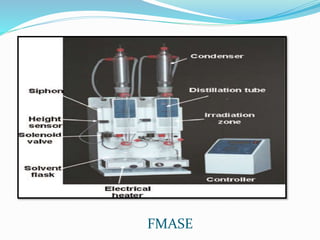
In FMASE systems the extractor design is the same
of a conventional Soxhlet apparatus and the solvent
is heated by conventional means (an electrical
jacket, for instance). The microwave irradiation is
focused only in the part of the extraction vessel
containing the sample and is directed to affect both
the solvent and the sample. Of course the effect of
microwaves on both will depend on their nature and
characteristics.
FMASE
UASE;
The application of ultrasound directed to the sample
and solvent causes the formation of bubbles that
collapse the cell structure and therefore facilitate the
extraction process.
The application of ultrasound combined to Soxhlet
reduces the number of cycles needed for exhaustive
extraction of fats from oleaginous seeds as
sunflower,rapeseed and soyabean
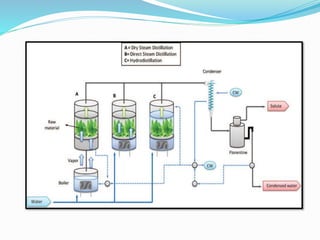
Distillation with water/steam;
Soxhlet is not applicable to highly volatile
components, but only to
components that have a boiling point below the
solvent boiling point. For highly volatile compounds
distillation is the preferred alternative. Water and
steam distillation are used for the extraction of
several volatile bioactive components from plants.
The product of this process is known as volatile oil
or essential oil. It is the most widely used method at
industrial scale for the processing of natural
products when the target compounds are volatile.
This technique simply involves vaporizing or
liberating the volatile compounds from the solid
matrix at high temperatures using water and/or
steam as extracting agent.The water/steam heats the
solid matrix, which releases the volatile compounds
present in it.
These are vaporized taking vaporization heat from
the steam, and then are transported to the steam
through diffusion. The resulting vapor phase is then
cooled and condensed prior to separating water and
the organic phase based on their mutual
immiscibility. The volatile oil constitutes the upper
phase in the decanter, while the bottom phase is
constituted of water containing some hydrolyzed
compounds, known as hydrosol. The compounds
present in hydrosol usually confer to it a pleasant
aroma; therefore, it can be used in the formulation of
lotions, soaps etc
Variants of distillation with
water/steam process;
 Direct steam distillation
 Hydrodistillation (water distillattion)
 Dry steam distillation
NEW TECHNIQUES OF
EXTRACTION
MICROWAVE ASSISTED EXTRACTION
ULTRASOUND ASSISTED EXTRACTION
 ACCELERATED LIQUID EXTRACTION
 SUPER CRITICAL FLUID EXTRACTION
Microwave
Assisted
Extraction
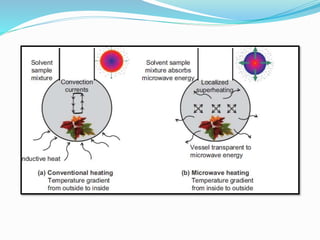
Microwaves heating principle;
Microwaves are electromagnetic waves made up of
two oscillating perpendicular fields:
electrical field and magnetic field.
They can be used as information carriers or as
energy vectors. The direct action of waves on a
material which is able to absorb a part of
electromagnetic energy, transform it into heat.
Ionic conduction is the mechanism by which
electromagnetic field is developed.
The resistance of the solution to this flow of
ions and the collisions between molecules because
the direction of ions changes
as many times as the field changes sign will result in
friction and, thus, heat the
solution
The treatment of plant material with microwave
irradiation during
extraction can result in enhanced recovery of
secondary metabolites and aroma compounds
Extraction of sensitive compounds
Nitrogen protected microwave assisted
extraction (NPMAE)
Vaccum microwave assisted
extraction (VMAE)
NPMAE
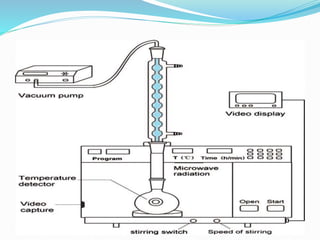
Oxidation of the active compounds during the
extraction process can be prevented by using a
pressurized inert gas, such as nitrogen, in a closed
system. In nitrogen-protected microwave assisted
extraction (NPMAE), the plant sample is introduced
into the vessel with a certain volume of solvent.
First, the air in the flask is pumped out by a vacuum
pump until a certain degree of vacuum is obtained.
Then the vessel is filled with nitrogen from the gas
cylinder. This technique has been employed in the
extraction of ascorbic acid from guava, yellow
pepper, green pepper.
VMAE
The boiling point of the extraction solvent under
vacuum is lower than at ambient pressure. Thus, the
solvent can be kept boiling at lower temperature
which is good for mixing the sample with the
solvent and extracting thermosensitive compounds
while preventing their degradation. Furthermore,
the air in the extraction system is mostly pumped
out, so oxidation of oxygen-sensitive compounds is
avoided or reduced.
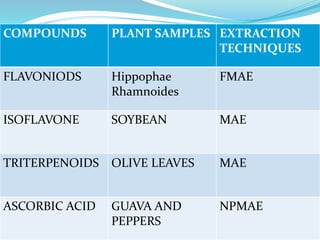
COMPOUNDS PLANT SAMPLES EXTRACTION
TECHNIQUES
FLAVONIODS Hippophae
Rhamnoides
FMAE
ISOFLAVONE SOYBEAN MAE
TRITERPENOIDS OLIVE LEAVES MAE
ASCORBIC ACID GUAVA AND
PEPPERS
NPMAE
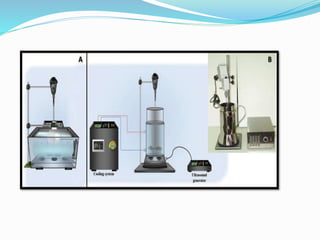
ULTRASOUND ASSISTED
EXTRACTION
Ultrasound wave passes through medium, it
induces a longitudinal displacement of those
molecules, acting as a piston on the surface,
resulting from a succession of compression.
The molecules that form the liquid are temporarily
dislodged from their original position and during
the compression cycle they can collide
with the surrounding molecules
As a result negative pressure will be exerted, pulling
the molecules apart. The extent of the negative
pressure depends on the nature and purity of the
liquid. At a sufficiently high power, the attraction
forces between them might be exceeded, generating
a voidin the liquid. The voids created into the
medium are the cavitation bubbles
The size of these bubbles reach a critical point they
collapse during a compression cycle and, since
heating is more rapid than thermal. The creating
hotspots are able to accelerate dramatically the
chemical reactivity of the medium. When these
bubbles collapse onto the surface of a solid
material, the high pressure and temperature
released generate shock waves towards the solid
surface.
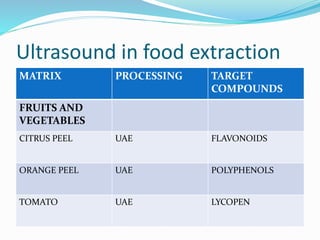
Ultrasound in food extraction
MATRIX PROCESSING TARGET
COMPOUNDS
FRUITS AND
VEGETABLES
CITRUS PEEL UAE FLAVONOIDS
ORANGE PEEL UAE POLYPHENOLS
TOMATO UAE LYCOPEN
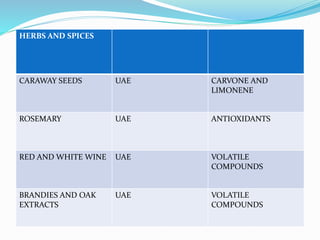
HERBS AND SPICES
CARAWAY SEEDS UAE CARVONE AND
LIMONENE
ROSEMARY UAE ANTIOXIDANTS
RED AND WHITE WINE UAE VOLATILE
COMPOUNDS
BRANDIES AND OAK
EXTRACTS
UAE VOLATILE
COMPOUNDS
Accelerated liquid extraction
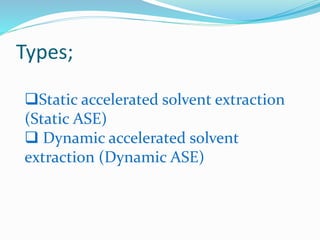
Types;
Static accelerated solvent extraction
(Static ASE)
 Dynamic accelerated solvent
extraction (Dynamic ASE)
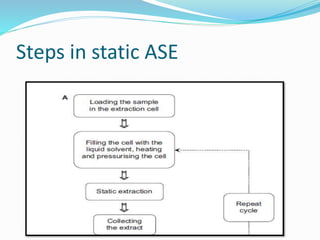
Steps in static ASE
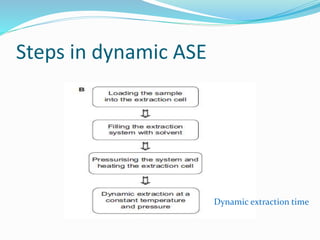
Steps in dynamic ASE
Dynamic extraction time
Super critical fluid extraction
(SFE)
A technique based on the use of solvents at
temperatures and pressures above their critical
points. SFE can be a fast, efficient, and clean
method for the extraction of natural products
from several matrices.
Supercritical fluid extraction is
commonly carried out considering two
basic steps:
(1) extraction of soluble substances from the
matrix by the supercritical
fluid and
(2) separation or fractionation of the extracted
compounds from the
supercritical solvent after the expansion
SFE has been used in different fields such as the
food, pharmaceutical, chemical, and fuel
industries. Due to the absence of toxic residue in
the final product, among other advantages,
supercritical fluids are especially useful for
extraction in two situations:
(a) extracting valuable bioactive compounds such
as flavors, colorants, and other biomolecules or
(b) removing undesirable compounds such as
organic pollutants, toxins, and pesticides
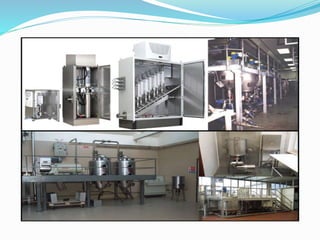
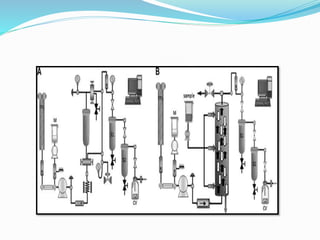
The extraction plant uses an extraction column in
which the extraction is performed in countercurrent
mode.
Countercurrent extraction (CC-SFE) is
performed introducing the sample in the system
from the top of the column and the pressurized
solvent from the bottom; in this process, the
components distribute between the solvent
and the liquid sample which flows countercurrent
through the separation column.
Bioactive components obtained
from SFE
Fatty acids , essential oils ,
antioxidants etc

Extraction Bahauddin Zakariya University multan

  • 1.
  • 2.
    NATURAL PRODUCTS Natural productis a chemical compound or substance produced by a living organism, that is found in nature.
  • 4.
    Extraction Extraction is amass transfer process of one or more components from one phase to another. Goals; • High yield • high selectivity and purity • high sensitivity These properties may differ in terms of importance depending on the process scale.
  • 5.
    At the industrialscale yield and purity are the key properties. When dealing with natural products, in most cases the sample to be extracted is a solid material, although in some cases liquid samples are used. The extracting solvent is usually a liquid, but it can also be a solid or a supercritical fluid. In order to understand how any extraction technique works, both the target compounds and the extraction solvent must be considered.
  • 6.
    Therefore, knowledge ofthe properties of the solute, mainly its chemical properties, is important in order to understand the extraction process. Moreover, it is important to know the properties of the solvent medium in which the target material is to be dissolved during the extraction process. The interactions between solute and solvent are determined by the vapor pressure of the solute, the solubility of the solute in the solvent, the hydrophobicity , and the acid/base properties of both solute and solvent.
  • 7.
    Some of theseproperties only relate to the compound of interest (solute), while others concern the solvent used for the extraction process. The compatibility between solvent and solute is based on assessing the polarity of the molecular structure to predict their solubility and miscibility. As a general rule, it is assumed that non-polar solutes are dissolved by non-polar solvents while polar solutes are dissolved by polar solvents.
  • 8.
    For example, waterdissolves glucose due to the attraction between the partially positively charged atom of the glucose molecule to the partially negatively charged atom of the water molecule while at the same time the partially negatively charged atom of the glucose molecule is attracted to the partially positively charged atom of the water molecule. If the target component from the raw material is freely available and the polarity of the solvent and of the solute is compatible, the solvent dissolves the solute to form a homogenous solution.
  • 9.
  • 10.
    1. the solventis transferred from the fluid phase to the solid surface and pervades it; 2. the solvent penetrates into the solid matrix by molecular diffusion; 3. the soluble material is solubilized by desorption from the matrix and solvation into the extraction solvent – the breakage of chemicals bonds may be required for the for desorption of target analytes from the solid matrix;
  • 11.
    4. the solutioncontaining the solutes returns to the surface of the solid by molecular diffusion; 5. the solution is transferred from the solid surface to the bulk fluid by natural of forced convection.
  • 12.
    The extraction ofa chemical component X from a phase A to a second phase B begins when the two phases come into contact. The two phases should therefore not be miscible if they are both liquids. Furthermore, phase A can be in the solid or semi- solid state. The distribution of X between the immiscible phases occurs as soon as it can be transferred from phase A to phase B and back from phase B to phase A. The solubilization limit is the equilibrium concentration between the phases.
  • 13.
    The equilibrium canbe represented as: XA XB Where , XA is the component X in phase A And XB is the component X in phase B.
  • 14.
    Conventional Extraction Techniques Theextraction method to be applied to a particular solid matrix depends on the raw material to be processed and on the product desired. There is no single and standard extraction method for obtaining bioactive compounds from natural products, each one presenting advantages and disadvantages.
  • 15.
    The most commonlyused conventional techniques are ; • Soaking extraction, • Soxhlet extraction, • Distillation. Choosing one of them for extracting bioactive compounds from natural products depends on process conditions such as temperature, mechanical action and solvent type.
  • 16.
    Soaking In this process,the untreated or powdered plant material is placed in a container along with the solvent. The plant material stays in contact with the solvent for several hours or even days, during which the soluble material is transferred from the solid sample to the solvent. Usually some kind of agitation is provided to increase the mass transfer rate by increasing the turbulence.
  • 17.
    Agitation devices areused to process fine particles. The dispersion of the particles in the liquid solvent by the agitation facilitates the contact of the solid with the solvent, accelerating the process by favoring the diffusion of the extracted components and avoiding super saturation in the immediate proximity of the surface of the solid to be extracted. However, care should be taken with excessive agitation, which may cause the disintegration of particle solids.
  • 18.
    The most commonis to perform the process under room temperature, but heat can be applied to improve the extraction efficiency. However, when extracting thermosensitive compounds high temperatures should be avoided.
  • 19.
    Drawbacks Time consuming High energydemand  product quality loss  mass transfer rate decreases with time because solvent is continously enriched with solutes.
  • 20.
  • 23.
    Apparatus A schematic representationof a Soxhlet extractor 1: Stirrer bar 2: Still pot (the still pot should not be overfilled and the volume of solvent in the still pot should be 3 to 4 times the volume of the soxhlet chamber) 3: Distillation path 4: Thimble5: Solid 6: Siphon top 7: Siphon exit 8:Expansion adapter 9: Condenser 10:Cooling water in 11: Cooling water out
  • 24.
    Operation; The solvent isheated to reflux. The solvent vapour travels up a distillation arm, and floods into the chamber housing the thimble of solid. The condenser ensures that any solvent vapour cools, and drips back down into the chamber housing the solid material. The chamber containing the solid material slowly fills with warm solvent. Some of the desired compound dissolves in the warm solvent.
  • 25.
    Some of thedesired compound dissolves in the warm solvent. When the Soxhlet chamber is almost full, the chamber is emptied by the siphon. The solvent is returned to the distillation flask. The thimble ensures that the rapid motion of the solvent does not transport any solid material to the still pot. This cycle may be allowed to repeat many times, over hours or days. During each cycle, a portion of the non- volatile compound dissolves in the solvent. After many cycles the desired compound is concentrated in the distillation flask.
  • 26.
    The advantage ofthis system is that instead of many portions of warm solvent being passed through the sample, just one batch of solvent is recycled. After extraction the solvent is removed, typically by means of a rotary evaporator, yielding the extracted compound. The non-soluble portion of the extracted solid remains in the thimble, and is usually discarded.
  • 28.
    Several solvents havebeen used for the extraction of active components from plants. Soxhlet has been specifically applied to extract vegetable oil. In these applications hexane has been the most commonly used solvent. Different types of bioactive compounds have been isolated using this method with hexane as solvent. Hexane has a boiling point of approximately 65 1C, i.e. it should enable the application of Soxhlet extraction to any compound with a boiling point above 65 1C. Hexane is also an excellent solvent for oil because of the high oil solubility in this solvent and also because oil can be easily recovered by distillation.
  • 29.
    Drawback; The main drawbackfor the use of hexane is its high toxicity. As a result, other solvents have been used to substitute hexane in oil recovery including some polarity alcohols such as isopropanol and ethanol, another option is to use water at pH 12
  • 30.
    Focused Microwave assistedSoxhlet Extraction (FMASE)  Ultrasound assisted Soxhlet Extraction (UASE)
  • 31.
    FMASE; In FMASE systemsthe extractor design is the same of a conventional Soxhlet apparatus and the solvent is heated by conventional means (an electrical jacket, for instance). The microwave irradiation is focused only in the part of the extraction vessel containing the sample and is directed to affect both the solvent and the sample. Of course the effect of microwaves on both will depend on their nature and characteristics.
  • 32.
  • 33.
    UASE; The application ofultrasound directed to the sample and solvent causes the formation of bubbles that collapse the cell structure and therefore facilitate the extraction process. The application of ultrasound combined to Soxhlet reduces the number of cycles needed for exhaustive extraction of fats from oleaginous seeds as sunflower,rapeseed and soyabean
  • 34.
    Distillation with water/steam; Soxhletis not applicable to highly volatile components, but only to components that have a boiling point below the solvent boiling point. For highly volatile compounds distillation is the preferred alternative. Water and steam distillation are used for the extraction of several volatile bioactive components from plants.
  • 35.
    The product ofthis process is known as volatile oil or essential oil. It is the most widely used method at industrial scale for the processing of natural products when the target compounds are volatile. This technique simply involves vaporizing or liberating the volatile compounds from the solid matrix at high temperatures using water and/or steam as extracting agent.The water/steam heats the solid matrix, which releases the volatile compounds present in it.
  • 36.
    These are vaporizedtaking vaporization heat from the steam, and then are transported to the steam through diffusion. The resulting vapor phase is then cooled and condensed prior to separating water and the organic phase based on their mutual immiscibility. The volatile oil constitutes the upper phase in the decanter, while the bottom phase is constituted of water containing some hydrolyzed compounds, known as hydrosol. The compounds present in hydrosol usually confer to it a pleasant aroma; therefore, it can be used in the formulation of lotions, soaps etc
  • 37.
    Variants of distillationwith water/steam process;  Direct steam distillation  Hydrodistillation (water distillattion)  Dry steam distillation
  • 39.
    NEW TECHNIQUES OF EXTRACTION MICROWAVEASSISTED EXTRACTION ULTRASOUND ASSISTED EXTRACTION  ACCELERATED LIQUID EXTRACTION  SUPER CRITICAL FLUID EXTRACTION
  • 40.
  • 41.
    Microwaves heating principle; Microwavesare electromagnetic waves made up of two oscillating perpendicular fields: electrical field and magnetic field. They can be used as information carriers or as energy vectors. The direct action of waves on a material which is able to absorb a part of electromagnetic energy, transform it into heat.
  • 42.
    Ionic conduction isthe mechanism by which electromagnetic field is developed. The resistance of the solution to this flow of ions and the collisions between molecules because the direction of ions changes as many times as the field changes sign will result in friction and, thus, heat the solution
  • 44.
    The treatment ofplant material with microwave irradiation during extraction can result in enhanced recovery of secondary metabolites and aroma compounds
  • 45.
    Extraction of sensitivecompounds Nitrogen protected microwave assisted extraction (NPMAE) Vaccum microwave assisted extraction (VMAE)
  • 46.
  • 47.
    Oxidation of theactive compounds during the extraction process can be prevented by using a pressurized inert gas, such as nitrogen, in a closed system. In nitrogen-protected microwave assisted extraction (NPMAE), the plant sample is introduced into the vessel with a certain volume of solvent. First, the air in the flask is pumped out by a vacuum pump until a certain degree of vacuum is obtained. Then the vessel is filled with nitrogen from the gas cylinder. This technique has been employed in the extraction of ascorbic acid from guava, yellow pepper, green pepper.
  • 48.
  • 50.
    The boiling pointof the extraction solvent under vacuum is lower than at ambient pressure. Thus, the solvent can be kept boiling at lower temperature which is good for mixing the sample with the solvent and extracting thermosensitive compounds while preventing their degradation. Furthermore, the air in the extraction system is mostly pumped out, so oxidation of oxygen-sensitive compounds is avoided or reduced.
  • 51.
    COMPOUNDS PLANT SAMPLESEXTRACTION TECHNIQUES FLAVONIODS Hippophae Rhamnoides FMAE ISOFLAVONE SOYBEAN MAE TRITERPENOIDS OLIVE LEAVES MAE ASCORBIC ACID GUAVA AND PEPPERS NPMAE
  • 52.
  • 53.
    Ultrasound wave passesthrough medium, it induces a longitudinal displacement of those molecules, acting as a piston on the surface, resulting from a succession of compression. The molecules that form the liquid are temporarily dislodged from their original position and during the compression cycle they can collide with the surrounding molecules
  • 54.
    As a resultnegative pressure will be exerted, pulling the molecules apart. The extent of the negative pressure depends on the nature and purity of the liquid. At a sufficiently high power, the attraction forces between them might be exceeded, generating a voidin the liquid. The voids created into the medium are the cavitation bubbles
  • 55.
    The size ofthese bubbles reach a critical point they collapse during a compression cycle and, since heating is more rapid than thermal. The creating hotspots are able to accelerate dramatically the chemical reactivity of the medium. When these bubbles collapse onto the surface of a solid material, the high pressure and temperature released generate shock waves towards the solid surface.
  • 58.
    Ultrasound in foodextraction MATRIX PROCESSING TARGET COMPOUNDS FRUITS AND VEGETABLES CITRUS PEEL UAE FLAVONOIDS ORANGE PEEL UAE POLYPHENOLS TOMATO UAE LYCOPEN
  • 59.
    HERBS AND SPICES CARAWAYSEEDS UAE CARVONE AND LIMONENE ROSEMARY UAE ANTIOXIDANTS RED AND WHITE WINE UAE VOLATILE COMPOUNDS BRANDIES AND OAK EXTRACTS UAE VOLATILE COMPOUNDS
  • 60.
  • 61.
    Types; Static accelerated solventextraction (Static ASE)  Dynamic accelerated solvent extraction (Dynamic ASE)
  • 62.
  • 63.
    Steps in dynamicASE Dynamic extraction time
  • 64.
    Super critical fluidextraction (SFE)
  • 65.
    A technique basedon the use of solvents at temperatures and pressures above their critical points. SFE can be a fast, efficient, and clean method for the extraction of natural products from several matrices.
  • 66.
    Supercritical fluid extractionis commonly carried out considering two basic steps: (1) extraction of soluble substances from the matrix by the supercritical fluid and (2) separation or fractionation of the extracted compounds from the supercritical solvent after the expansion
  • 67.
    SFE has beenused in different fields such as the food, pharmaceutical, chemical, and fuel industries. Due to the absence of toxic residue in the final product, among other advantages, supercritical fluids are especially useful for extraction in two situations: (a) extracting valuable bioactive compounds such as flavors, colorants, and other biomolecules or (b) removing undesirable compounds such as organic pollutants, toxins, and pesticides
  • 69.
    The extraction plantuses an extraction column in which the extraction is performed in countercurrent mode. Countercurrent extraction (CC-SFE) is performed introducing the sample in the system from the top of the column and the pressurized solvent from the bottom; in this process, the components distribute between the solvent and the liquid sample which flows countercurrent through the separation column.
  • 70.
    Bioactive components obtained fromSFE Fatty acids , essential oils , antioxidants etc

Editor's Notes

  • #3 .
  • #20  Time consuming High energy demand product quality loss mass transfer rate decreases with time because solvent is continously enriched with solutes