Downloaded 322 times
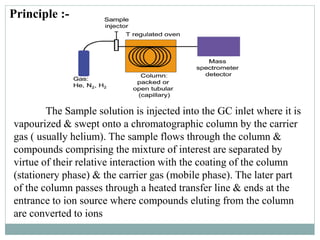
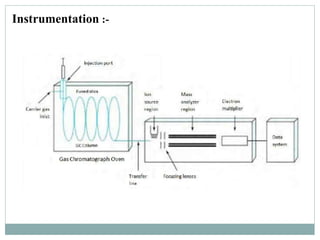
![1 ] Carrier Gas :-
• It is served as a mobile phase supplied in the steel tank under high
pressure.
• At a pressure of 40-80 psi passes into flow controllers. which allows
the operator to adjust the flow rate.
• Usually nitrogen & helium are used.
• And occasionally hydrogen & argon used.
• It should be inert with respect to sample component.
2] Sample Injection Port :-
• It is small chamber slightly above to the column
• In this the sample is made to vapourize rapidly before entering to
column.
• Sample is introduced int flowing gas through a sealing rubber using
a microlitre syringe](https://image.slidesharecdn.com/gcmslcms-180707112939/85/GCMS-LCMS-6-320.jpg)
![3] Column :- Two Types of column Capillary Column & Packed
Column
Capillary Column :-
• It consist of long capillary tubing 30-90M in length.
• It is made up from stainless steel & coil
• For fast analysis shorter column are applied.
• Large columns are required for high resolution seperation.
Packed Column :-
• These columns, less commonly used today, have diameter of 1.6 to
9.5mm and a length of between 1–3m.
• Manufactured from steel or glass, the internal wall of the tube is
treated to avoid catalytic effects with the sample.
• They can withstand a carrier gas flow rate within the range 10–40
mL/min.](https://image.slidesharecdn.com/gcmslcms-180707112939/85/GCMS-LCMS-7-320.jpg)
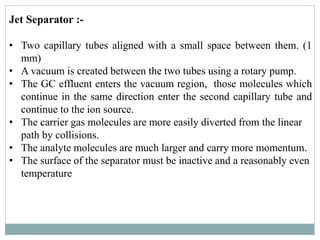
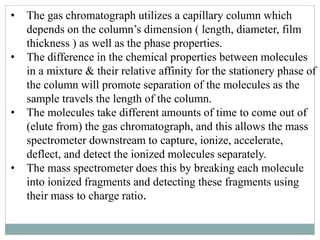
![Ionization :-
After the molecules travel the length of the column, pass
through the transfer line and enter into the mass
spectrometer they are ionized by various methods with
typically only one method being used at any given time. Once
the sample is fragmented it will then be detected, usually by
an electron multiplier diode, which essentially turns the
ionized mass fragment into an electrical signal that is then
detected.
1] Electron Ionization
2] Chemical Ionization](https://image.slidesharecdn.com/gcmslcms-180707112939/85/GCMS-LCMS-10-320.jpg)
![1] Electron Ionization :-
The molecules enter into the MS where they are
bombarded with free electrons emitted from a filament, not
unlike the filament one would find in a standard light bulb.
The electrons bombard the molecules, causing the molecule
to fragment in a characteristic and reproducible way.
2] Chemical Ionization :-
a reagent gas,typically methane or ammonia is
introduced into the mass spectrometer. Depending on the
technique (positive CI or negative CI) chosen, this reagent gas
will interact with the electrons and analyte and cause a 'soft'
ionization of the molecule of interest. A softer ionization
fragments the molecule to a lower degree..](https://image.slidesharecdn.com/gcmslcms-180707112939/85/GCMS-LCMS-11-320.jpg)
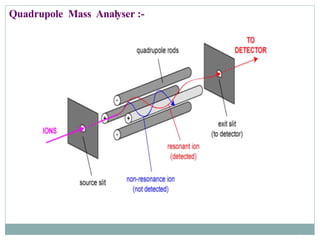
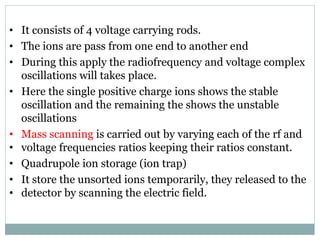
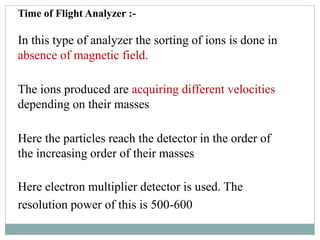
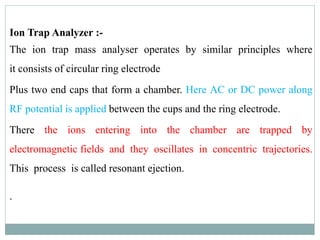


![Detectors :-
1] Photo graphic Plates
2] Faraday Cup
3] Electron multipliers
Photo graphic plates:
It is used as it is capable of higher resolution and speeder
than electronic devices. i.e. it can detect ions of all the masses
and provide a reverse geometry analyzer.](https://image.slidesharecdn.com/gcmslcms-180707112939/85/GCMS-LCMS-26-320.jpg)
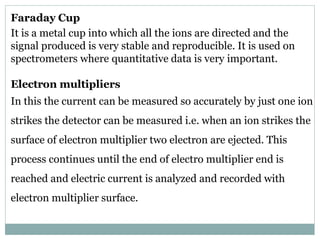


The document provides an overview of gas chromatography-mass spectrometry (GC-MS) and liquid chromatography-mass spectrometry (LC-MS). It discusses the principles, instrumentation, and applications of both techniques. For GC-MS, it describes how the carrier gas transports compounds through the column where they are separated and then ionized before being detected by the mass spectrometer. For LC-MS, it explains how compounds are separated by the liquid mobile phase and HPLC column before being ionized, typically by electrospray ionization, and detected based on their mass-to-charge ratio. Common applications of these techniques include analysis of metabolites, toxins, pesticides, and other compounds.


![LIQUID CHROMATOGRAPHY- MASS SPECTROSCOPY[LC-MS]](https://cdn.slidesharecdn.com/ss_thumbnails/63-191219160156-thumbnail.jpg?width=640&height=640&fit=bounds)


![GAS CHROMATOGRAPHY-MASS SPECTROSCOPY [GC-MS]](https://cdn.slidesharecdn.com/ss_thumbnails/42-191218144856-thumbnail.jpg?width=640&height=640&fit=bounds)


![Polymer [ बहुलक ] Chemistry Notes PDF - Irfanullah Mehar - JJ Sir Chemistry.pdf](https://cdn.slidesharecdn.com/ss_thumbnails/polymerchemistrynotespdf-irfanullahmehar-jjsirchemistry-260210172118-3f9b37f7-thumbnail.jpg?width=640&height=640&fit=bounds)


