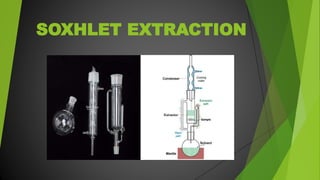
SOXHLET EXTRACTION
 A Soxhlet extractor is a piece of laboratory apparatus invented in 1879 by
Franz von Soxhlet.
 These devices allow for continuous treatment of a sample with a solvent over
a period of hours or days to extract compounds of interest.
 It was originally designed for the extraction of a lipid from a solid material.
However, a Soxhlet extractor is not limited to the extraction of lipids.
 Typically, a Soxhlet extraction is only required where the desired compound
has a limited solubility in a solvent, and the impurity is insoluble in that
solvent.
 If the desired compound has a high solubility in a solvent then a simple
filtration can be used to separate the compound from the insoluble
substance.
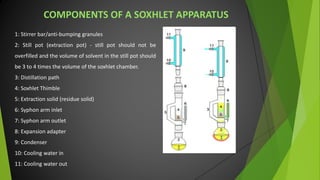
1: Stirrer bar/anti-bumping granules
2: Still pot (extraction pot) - still pot should not be
overfilled and the volume of solvent in the still pot should
be 3 to 4 times the volume of the soxhlet chamber.
3: Distillation path
4: Soxhlet Thimble
5: Extraction solid (residue solid)
6: Syphon arm inlet
7: Syphon arm outlet
8: Expansion adapter
9: Condenser
10: Cooling water in
11: Cooling water out
COMPONENTS OF A SOXHLET APPARATUS
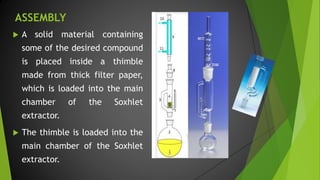
ASSEMBLY
 A solid material containing
some of the desired compound
is placed inside a thimble
made from thick filter paper,
which is loaded into the main
chamber of the Soxhlet
extractor.
 The thimble is loaded into the
main chamber of the Soxhlet
extractor.
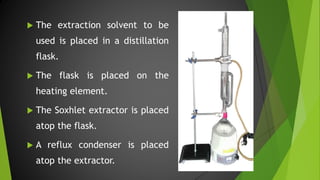
 The extraction solvent to be
used is placed in a distillation
flask.
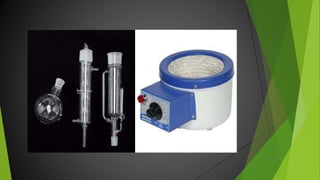
 The flask is placed on the
heating element.
 The Soxhlet extractor is placed
atop the flask.
 A reflux condenser is placed
atop the extractor.
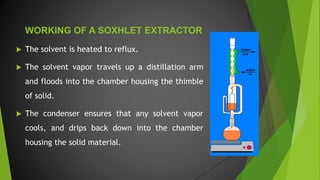
WORKING OF A SOXHLET EXTRACTOR
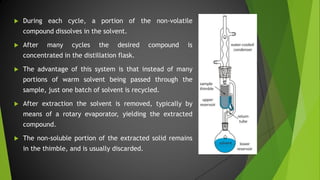
 The solvent is heated to reflux.
 The solvent vapor travels up a distillation arm
and floods into the chamber housing the thimble
of solid.
 The condenser ensures that any solvent vapor
cools, and drips back down into the chamber
housing the solid material.
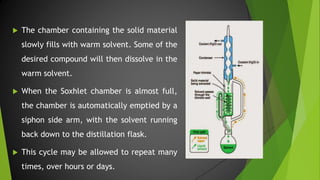
 The chamber containing the solid material
slowly fills with warm solvent. Some of the
desired compound will then dissolve in the
warm solvent.
 When the Soxhlet chamber is almost full,
the chamber is automatically emptied by a
siphon side arm, with the solvent running
back down to the distillation flask.
 This cycle may be allowed to repeat many
times, over hours or days.
 During each cycle, a portion of the non-volatile
compound dissolves in the solvent.
 After many cycles the desired compound is
concentrated in the distillation flask.
 The advantage of this system is that instead of many
portions of warm solvent being passed through the
sample, just one batch of solvent is recycled.
 After extraction the solvent is removed, typically by
means of a rotary evaporator, yielding the extracted
compound.
 The non-soluble portion of the extracted solid remains
in the thimble, and is usually discarded.
APPLICATIONS
Useful apparatus for solid-liquid extaction in various fields such as
 Pharmaceutics
 Environment
 Foodstuffs
Nowadays, Soxhlet apparatus is still common and widely used as
a reference and standard method in many laboratories for
extraction of oil from various materials.
ADVANTAGES
 Efficient extraction.
 Can perform elemental sulfur removal.
DISADVANTAGES
 Lengthy process.
 Require azeotropic mixtures to ensure efficient
extraction.
THANK YOU…

Soxhlet extraction

  • 1.
  • 2.
     A Soxhletextractor is a piece of laboratory apparatus invented in 1879 by Franz von Soxhlet.  These devices allow for continuous treatment of a sample with a solvent over a period of hours or days to extract compounds of interest.  It was originally designed for the extraction of a lipid from a solid material. However, a Soxhlet extractor is not limited to the extraction of lipids.  Typically, a Soxhlet extraction is only required where the desired compound has a limited solubility in a solvent, and the impurity is insoluble in that solvent.  If the desired compound has a high solubility in a solvent then a simple filtration can be used to separate the compound from the insoluble substance.
  • 3.
    1: Stirrer bar/anti-bumpinggranules 2: Still pot (extraction pot) - still pot should not be overfilled and the volume of solvent in the still pot should be 3 to 4 times the volume of the soxhlet chamber. 3: Distillation path 4: Soxhlet Thimble 5: Extraction solid (residue solid) 6: Syphon arm inlet 7: Syphon arm outlet 8: Expansion adapter 9: Condenser 10: Cooling water in 11: Cooling water out COMPONENTS OF A SOXHLET APPARATUS
  • 5.
    ASSEMBLY  A solidmaterial containing some of the desired compound is placed inside a thimble made from thick filter paper, which is loaded into the main chamber of the Soxhlet extractor.  The thimble is loaded into the main chamber of the Soxhlet extractor.
  • 6.
     The extractionsolvent to be used is placed in a distillation flask.  The flask is placed on the heating element.  The Soxhlet extractor is placed atop the flask.  A reflux condenser is placed atop the extractor.
  • 7.
    WORKING OF ASOXHLET EXTRACTOR  The solvent is heated to reflux.  The solvent vapor travels up a distillation arm and floods into the chamber housing the thimble of solid.  The condenser ensures that any solvent vapor cools, and drips back down into the chamber housing the solid material.
  • 8.
     The chambercontaining the solid material slowly fills with warm solvent. Some of the desired compound will then dissolve in the warm solvent.  When the Soxhlet chamber is almost full, the chamber is automatically emptied by a siphon side arm, with the solvent running back down to the distillation flask.  This cycle may be allowed to repeat many times, over hours or days.
  • 9.
     During eachcycle, a portion of the non-volatile compound dissolves in the solvent.  After many cycles the desired compound is concentrated in the distillation flask.  The advantage of this system is that instead of many portions of warm solvent being passed through the sample, just one batch of solvent is recycled.  After extraction the solvent is removed, typically by means of a rotary evaporator, yielding the extracted compound.  The non-soluble portion of the extracted solid remains in the thimble, and is usually discarded.
  • 10.
    APPLICATIONS Useful apparatus forsolid-liquid extaction in various fields such as  Pharmaceutics  Environment  Foodstuffs Nowadays, Soxhlet apparatus is still common and widely used as a reference and standard method in many laboratories for extraction of oil from various materials.
  • 11.
    ADVANTAGES  Efficient extraction. Can perform elemental sulfur removal. DISADVANTAGES  Lengthy process.  Require azeotropic mixtures to ensure efficient extraction.
  • 12.