Pronunciation
By
Labeeda Farid 526
M.A Education Regular
Pronunciation
• The act of producing the sounds of speech is called pronunciation.
• In lots of languages, each letter represent only one sound so its easy to
pronounce words just by looking at how the word is spelled. But English is
not like that.
• When you see letters in an English word, they won’t always be pronounced
the same way.
• Take the letter “c” for example. In the word cup it is pronounced as “k” but
it is different to the word “place”. When a “c” is next to “h” it’s often “ch”
like in “chocolate” but in the word “ache” it is pronounced as “k” again.
• There are many strategies for making the pronunciation better but the
International Phonetic Alphabet is such a great tool for English students to
practice their pronunciation with. As we follow British English language.
International Phonetic Alphabet
• In the IPA every sound has a unique symbol, so when you read it you
know exactly how to pronounce the English word.
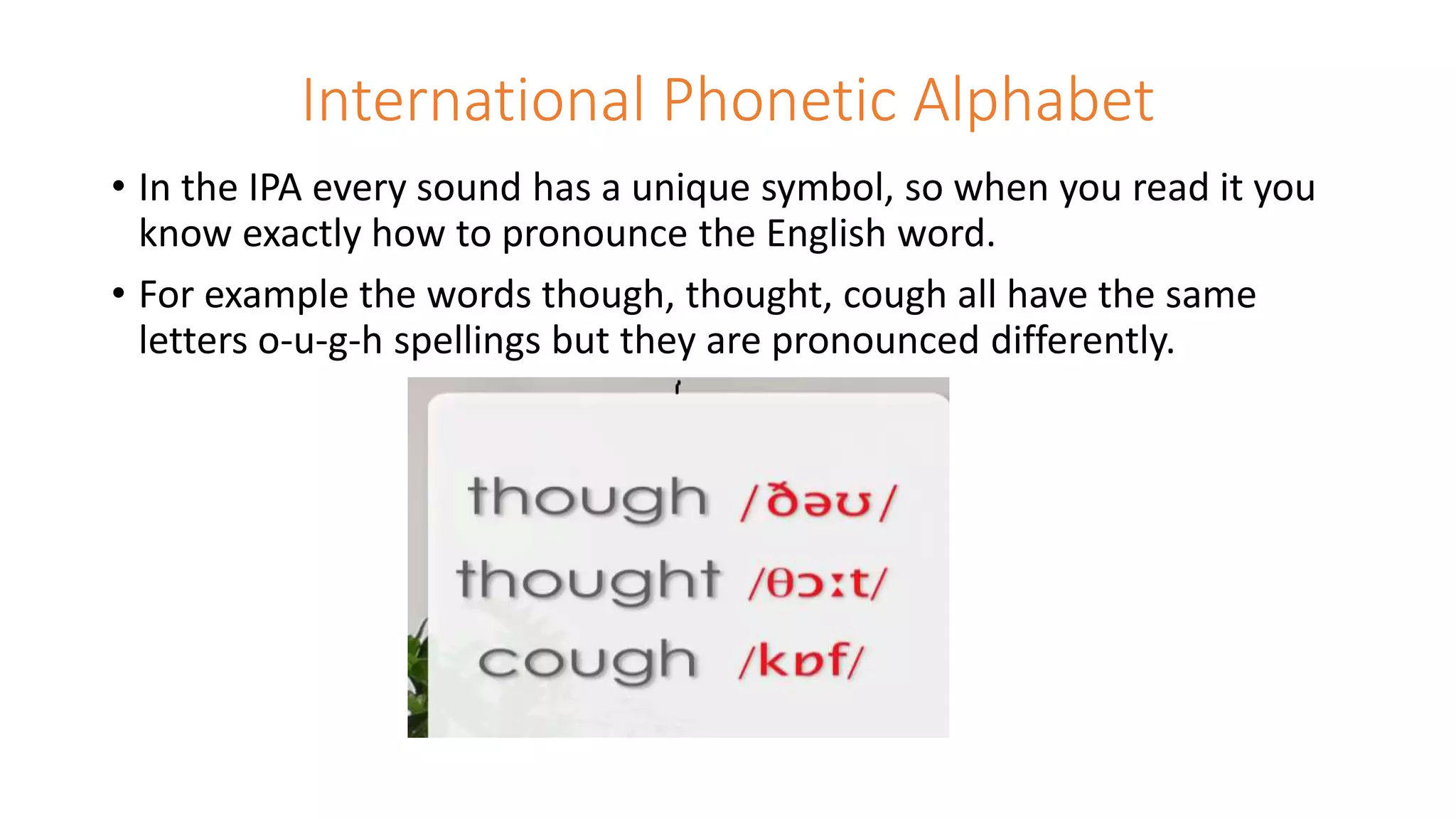
• For example the words though, thought, cough all have the same
letters o-u-g-h spellings but they are pronounced differently.
• These symbols seems scary at first but these are so helpful when
learning English pronunciation because it tells exactly how to say a
word.
• There are 26 alphabets in English alphabets. But there are 44 sounds.
• Three sounds are added so now there are 47 sounds.
Phonetic Chart
Vowels
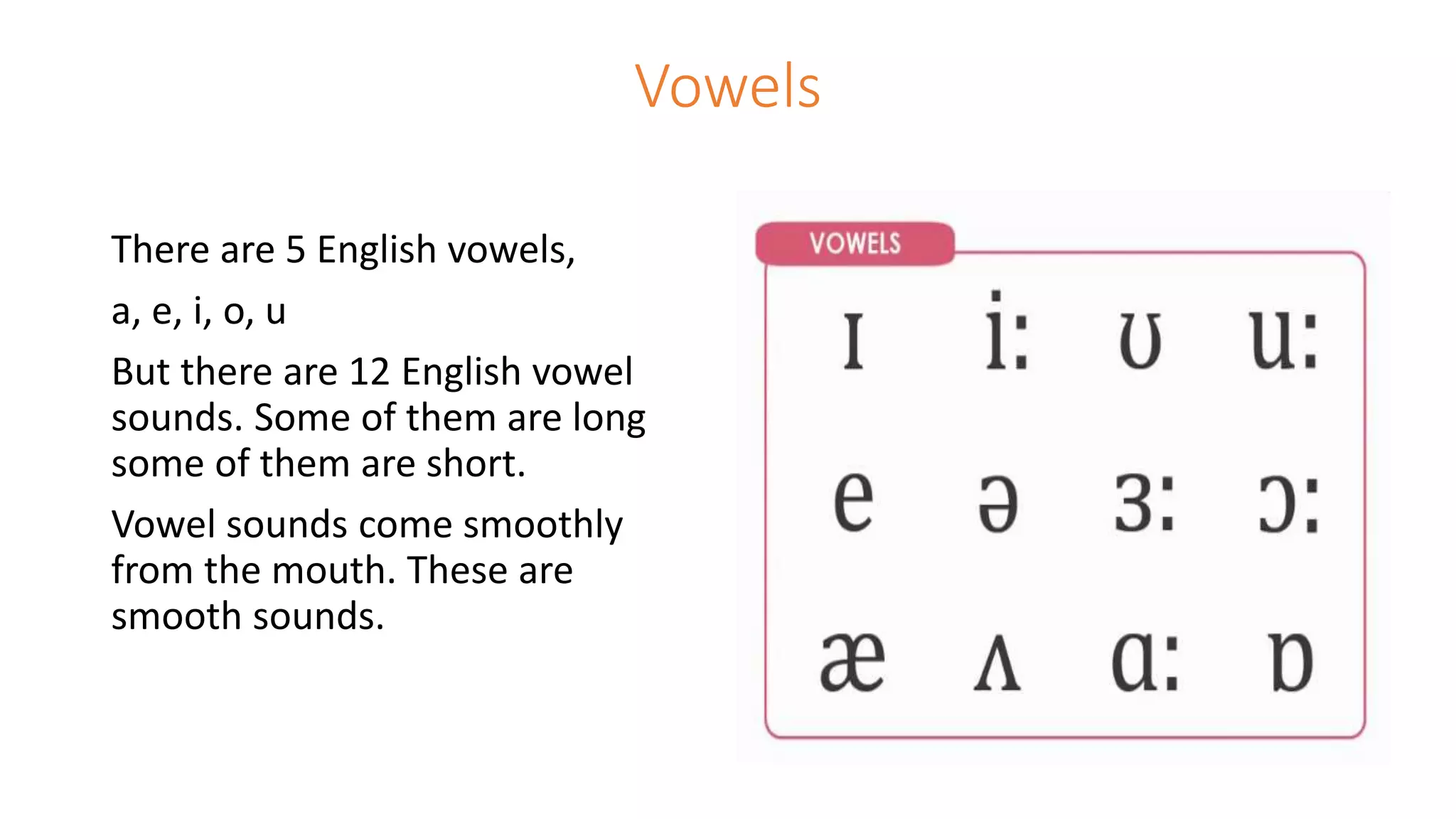
There are 5 English vowels,
a, e, i, o, u
But there are 12 English vowel
sounds. Some of them are long
some of them are short.
Vowel sounds come smoothly
from the mouth. These are
smooth sounds.
•/ɪ/ pin, English
•/ʊ/ look, put, could
•/e/ bed, head
•/ɜː/ word, heard
•/æ/ cat, bag
•/ɑː/ car, art
•/ɪː/ sea, bee
•/uː/ blue, fool
•/ə/ the, a, woman
•/ɔː/ or, board, door
•/ʌ/ cut, come
•/ɒ/ clock, what
Diphthongs
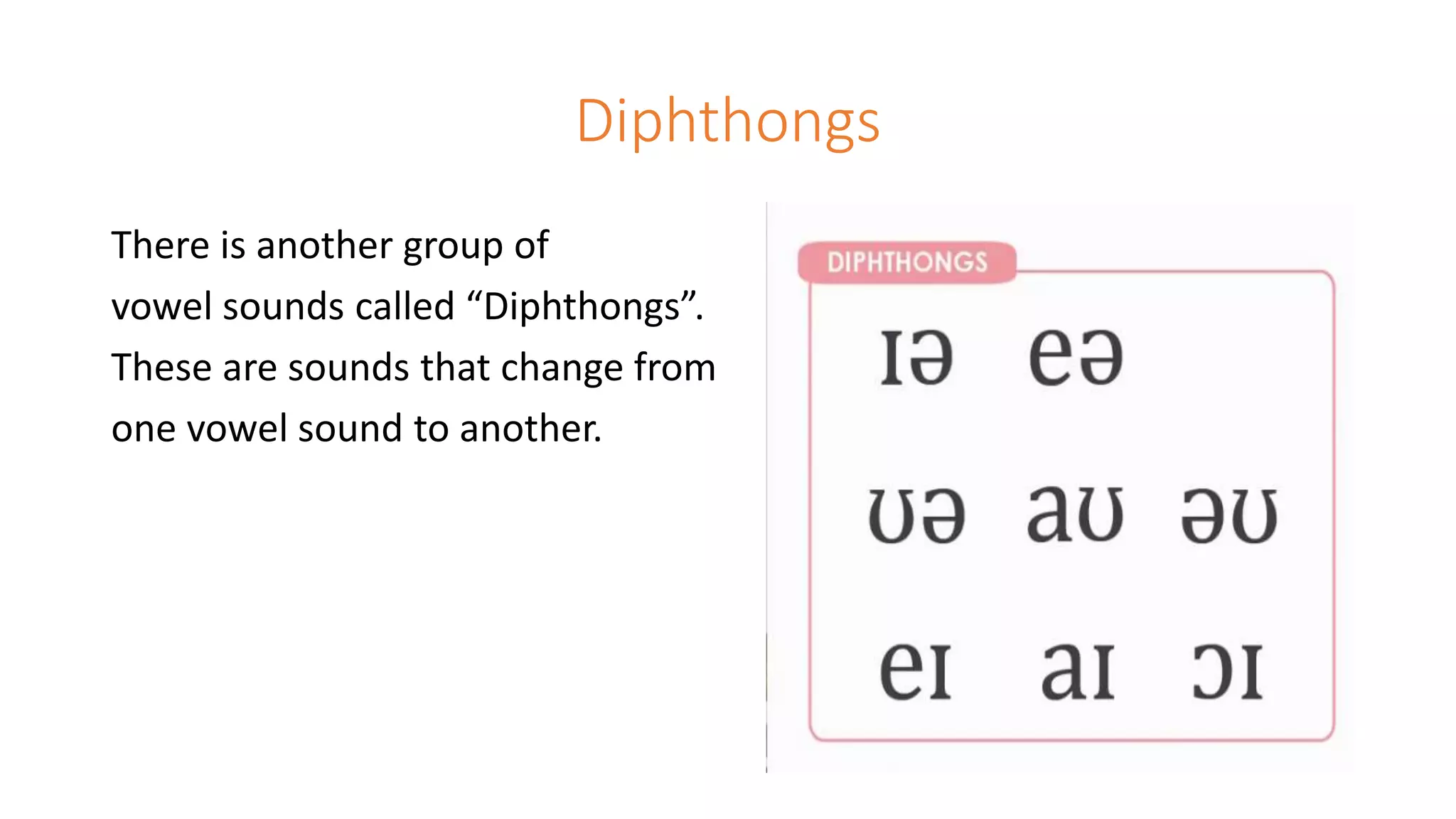
There is another group of
vowel sounds called “Diphthongs”.
These are sounds that change from
one vowel sound to another.
•/ɪə/ here, deer
•/ʊə/ poor, insure
•/əʊ/ no, road
•/ɑɪ/ five, height
•/eə/ care, air
•/ɑʊ/ round, doubt
•/eɪ/ take, wait
•/ɔɪ/ noise, boy
Consonants
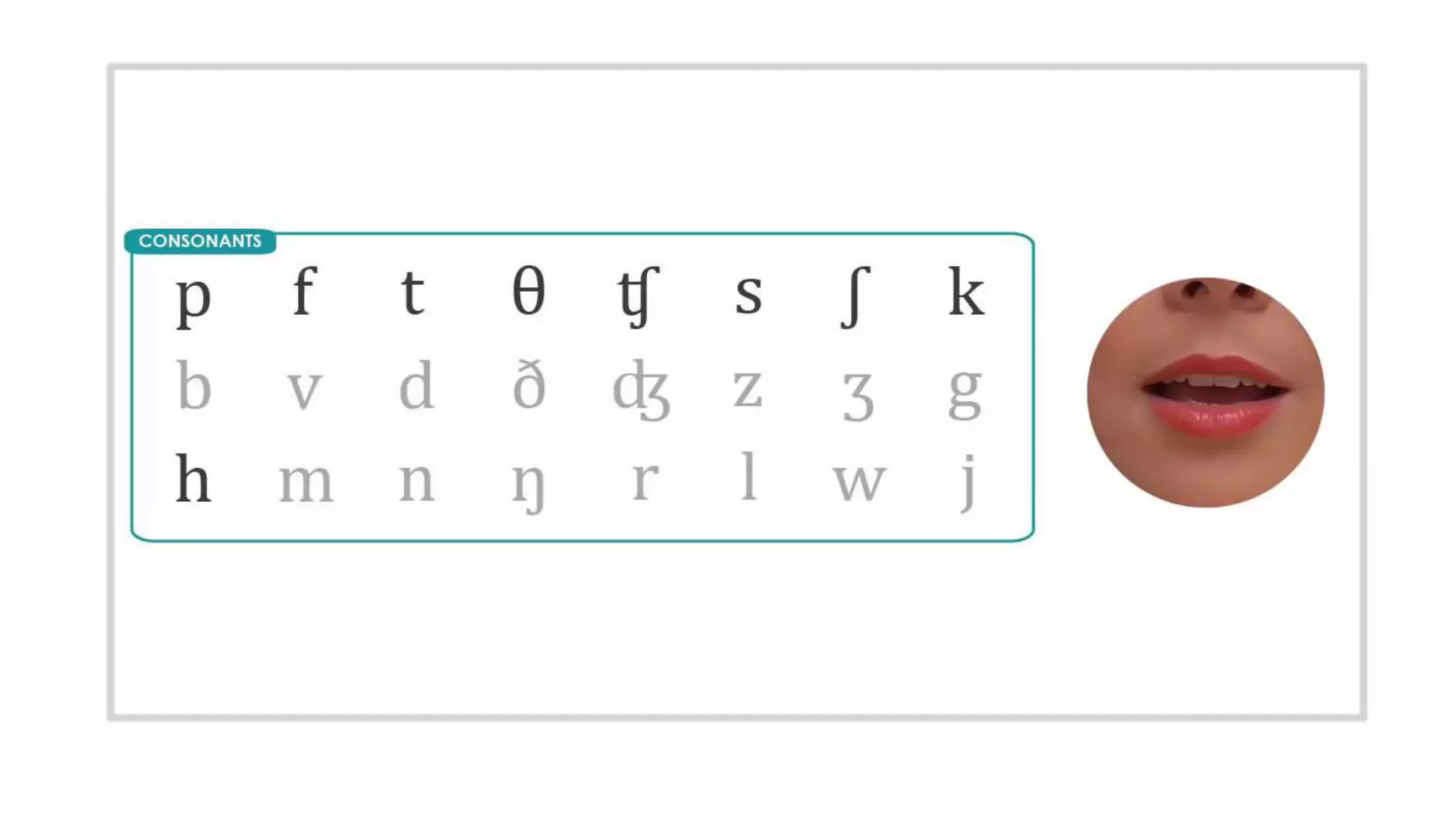
The top row are unvoiced consonants which means that sound is made
by air moving from the back of your mouth, through and out your lips.
There is one extra letter that is unvoiced, down the bottom.
Unvoiced sounds use just air. You can’t feel anything in your vocal
cords.
All the rest of the consonant sounds are voiced, which means that the
sound is made with vocal cords.
When you have to produce consonant sounds, first there is blockage of
air in the mouth and then release of air.
• /p/ play, stop
• /f/ food, laugh
• /t/ ten, little
• /θ/ method, both
• /tʃ/ chair, match
• /s/ small, scene
• /ʃ/ shell, machine
• /k/ character, quick
• /h/ hot, hair, whole
• /b/ bad, baby
• /d/ day, bed
• /g/ got, exam
• /v/ vain, over
• /ð/ they, father, with
• /z/ zoo, goes
• /ʒ/ measure, vision
• /m/ moon, lamp
• /n/ can, pneumonia
• /ŋ/ string, tongue
• /dʒ/ just, age, soldier
• /l/ look, small
• /r/ real, wrong
• /j/ yes, Europe
• /w/ window, twin
Activity
Circle the word that is pronounced differently from the other three
words.
1. accident access accommodate accept
2. suit fruit cruise biscuit
3. author caught laughter daughter
Phonetic Transcription
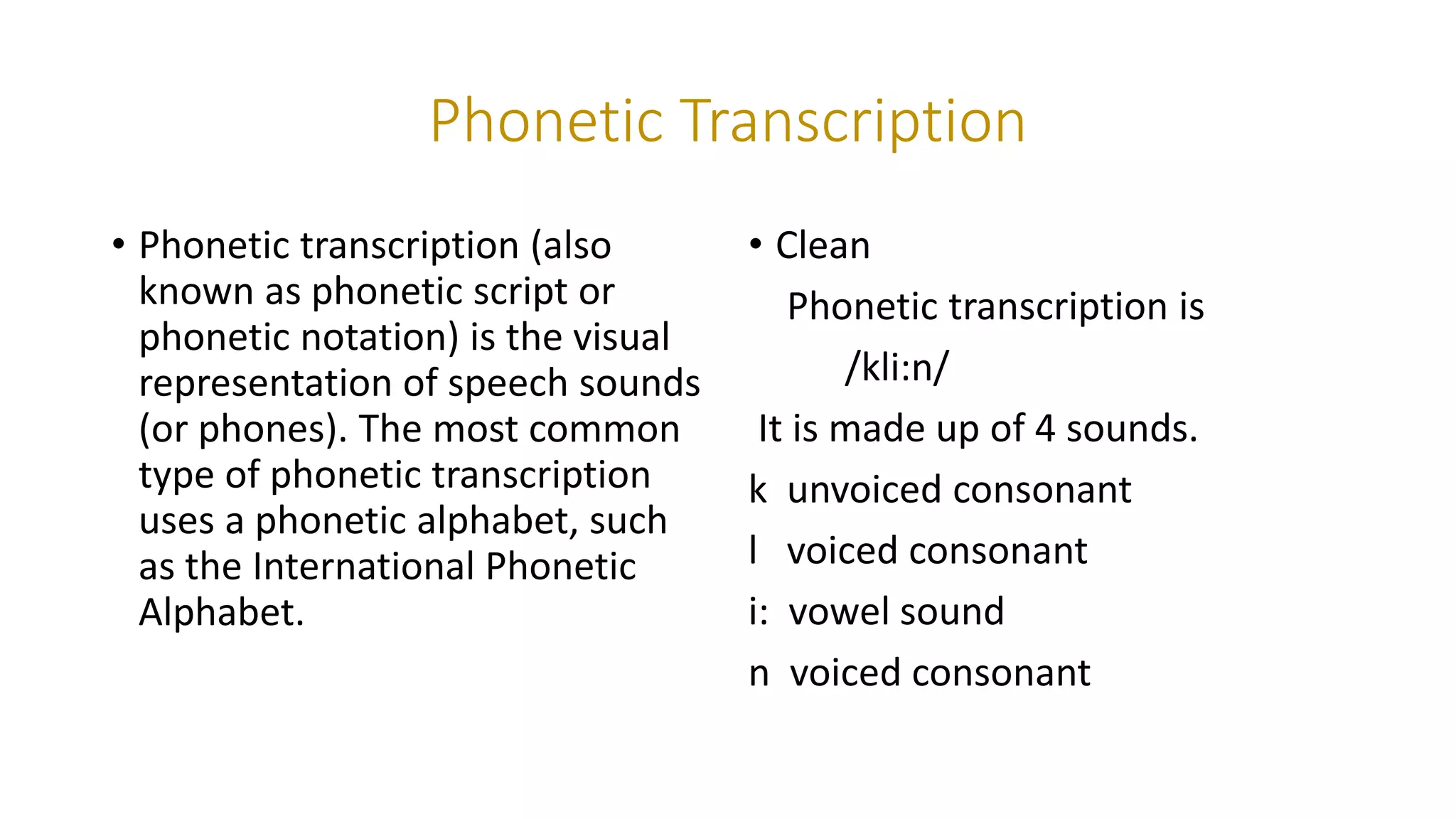
• Phonetic transcription (also
known as phonetic script or
phonetic notation) is the visual
representation of speech sounds
(or phones). The most common
type of phonetic transcription
uses a phonetic alphabet, such
as the International Phonetic
Alphabet.
• Clean
Phonetic transcription is
/kli:n/
It is made up of 4 sounds.
k unvoiced consonant
l voiced consonant
i: vowel sound
n voiced consonant
Tips
• Standard dictionaries use the IPA to show how words are pronounced.
• When you are first learning basic phonetic writing, you can practice first
with English spelling, instead of phonetic spelling. The symbols of IPA are
based on more complex symbols that may be difficult for a beginner to
understand.
• Look at the words in a dictionary to get a sense of how to use phonetic
spelling. Copy out the phonetic spelling of your favorite words and note the
phonetic spelling of each word. Practice saying the terms out loud, based
on the phonetic spelling.
• Focus on the sound of the words, rather than the spelling of the words.
You can also use an online translator to translate
words into phonetics.
You can download an app on your Android and
I-phone.
Tongue Twisters
• Short phrases or short stories that repeat problem sounds or same
groups of sounds to make it difficult to pronounce when you say it
very quickly.
• Improves your pronunciation.
• Improve your ability to speak more fluently.
Home Assignment
TRY TO WRITE YOUR NAME USING THE PHONETIC ALPHABET!

Pronunciation

  • 1.
  • 2.
    Pronunciation • The actof producing the sounds of speech is called pronunciation. • In lots of languages, each letter represent only one sound so its easy to pronounce words just by looking at how the word is spelled. But English is not like that. • When you see letters in an English word, they won’t always be pronounced the same way. • Take the letter “c” for example. In the word cup it is pronounced as “k” but it is different to the word “place”. When a “c” is next to “h” it’s often “ch” like in “chocolate” but in the word “ache” it is pronounced as “k” again. • There are many strategies for making the pronunciation better but the International Phonetic Alphabet is such a great tool for English students to practice their pronunciation with. As we follow British English language.
  • 3.
    International Phonetic Alphabet •In the IPA every sound has a unique symbol, so when you read it you know exactly how to pronounce the English word. • For example the words though, thought, cough all have the same letters o-u-g-h spellings but they are pronounced differently.
  • 4.
    • These symbolsseems scary at first but these are so helpful when learning English pronunciation because it tells exactly how to say a word. • There are 26 alphabets in English alphabets. But there are 44 sounds. • Three sounds are added so now there are 47 sounds.
  • 5.
  • 6.
    Vowels There are 5English vowels, a, e, i, o, u But there are 12 English vowel sounds. Some of them are long some of them are short. Vowel sounds come smoothly from the mouth. These are smooth sounds.
  • 8.
    •/ɪ/ pin, English •/ʊ/look, put, could •/e/ bed, head •/ɜː/ word, heard •/æ/ cat, bag •/ɑː/ car, art •/ɪː/ sea, bee •/uː/ blue, fool •/ə/ the, a, woman •/ɔː/ or, board, door •/ʌ/ cut, come •/ɒ/ clock, what
  • 9.
    Diphthongs There is anothergroup of vowel sounds called “Diphthongs”. These are sounds that change from one vowel sound to another.
  • 11.
    •/ɪə/ here, deer •/ʊə/poor, insure •/əʊ/ no, road •/ɑɪ/ five, height •/eə/ care, air •/ɑʊ/ round, doubt •/eɪ/ take, wait •/ɔɪ/ noise, boy
  • 12.
    Consonants The top roware unvoiced consonants which means that sound is made by air moving from the back of your mouth, through and out your lips. There is one extra letter that is unvoiced, down the bottom. Unvoiced sounds use just air. You can’t feel anything in your vocal cords.
  • 13.
    All the restof the consonant sounds are voiced, which means that the sound is made with vocal cords. When you have to produce consonant sounds, first there is blockage of air in the mouth and then release of air.
  • 15.
    • /p/ play,stop • /f/ food, laugh • /t/ ten, little • /θ/ method, both • /tʃ/ chair, match • /s/ small, scene • /ʃ/ shell, machine • /k/ character, quick • /h/ hot, hair, whole • /b/ bad, baby • /d/ day, bed • /g/ got, exam • /v/ vain, over • /ð/ they, father, with • /z/ zoo, goes • /ʒ/ measure, vision • /m/ moon, lamp • /n/ can, pneumonia • /ŋ/ string, tongue • /dʒ/ just, age, soldier • /l/ look, small • /r/ real, wrong • /j/ yes, Europe • /w/ window, twin
  • 16.
    Activity Circle the wordthat is pronounced differently from the other three words. 1. accident access accommodate accept 2. suit fruit cruise biscuit 3. author caught laughter daughter
  • 17.
    Phonetic Transcription • Phonetictranscription (also known as phonetic script or phonetic notation) is the visual representation of speech sounds (or phones). The most common type of phonetic transcription uses a phonetic alphabet, such as the International Phonetic Alphabet. • Clean Phonetic transcription is /kli:n/ It is made up of 4 sounds. k unvoiced consonant l voiced consonant i: vowel sound n voiced consonant
  • 18.
    Tips • Standard dictionariesuse the IPA to show how words are pronounced. • When you are first learning basic phonetic writing, you can practice first with English spelling, instead of phonetic spelling. The symbols of IPA are based on more complex symbols that may be difficult for a beginner to understand. • Look at the words in a dictionary to get a sense of how to use phonetic spelling. Copy out the phonetic spelling of your favorite words and note the phonetic spelling of each word. Practice saying the terms out loud, based on the phonetic spelling. • Focus on the sound of the words, rather than the spelling of the words.
  • 19.
    You can alsouse an online translator to translate words into phonetics.
  • 20.
    You can downloadan app on your Android and I-phone.
  • 21.
    Tongue Twisters • Shortphrases or short stories that repeat problem sounds or same groups of sounds to make it difficult to pronounce when you say it very quickly. • Improves your pronunciation. • Improve your ability to speak more fluently.
  • 24.
    Home Assignment TRY TOWRITE YOUR NAME USING THE PHONETIC ALPHABET!