Mathematics and Music


                        1
Quotes


   “Without music life would be a mistake.” –
    Friedrich Nietzsche
   “Music is a secret arithmetical exercise and
    the person who indulges in it does not realize
    that he is manipulating numbers.” – Gottfried
    Liebniz                                          2
Math and Music
   Mathematics and music have been link since the days
    of Pythagoras.
   Since the Middle Ages, music theorists had been
    studying proportions, a subject that Pythagoras had
    written about when discussing music.
   The theorists explained how to make different pitches
    (sounds) on stringed instruments by lengthening or
    shortening the strings by different proportions.

                                                        3
Math and Music
   For example, if a musician were to divide a
    string in half (the proportion of 2:1), he would
    create a new tone that is an octave above the
    original tone.
   Renaissance musicians carried on this idea in
    their own music.


                                                   4
The Sound of Music
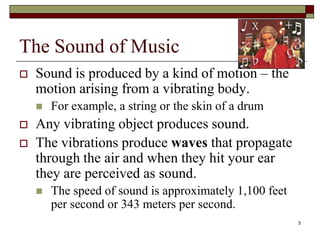
   Sound is produced by a kind of motion – the
    motion arising from a vibrating body.
       For example, a string or the skin of a drum
   Any vibrating object produces sound.
   The vibrations produce waves that propagate
    through the air and when they hit your ear
    they are perceived as sound.
       The speed of sound is approximately 1,100 feet
        per second or 343 meters per second.
                                                         5
The Sound of Music
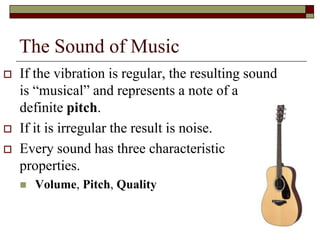
   If the vibration is regular, the resulting sound
    is “musical” and represents a note of a
    definite pitch.
   If it is irregular the result is noise.
   Every sound has three characteristic
    properties.
       Volume, Pitch, Quality

                                                       6
Volume
 The volume of a note depends on the
  amplitude of the vibration.
 More intense vibration produces louder
  sounds.
 Less intense produces

softer sounds.


                                           7
Pitch
   Perception of pitch means the ability to
    distinguish between the highness and the
    lowness of a musical sound.
   It depends on the frequency (number of
    vibrations per second) of the vibrating body.
   The higher the frequency of a sound the
    higher is its pitch, the lower the frequency, the
    lower its pitch.
                                                    8
Galileo and Mersenne
   Both Galileo Galilei [1564-1642] and Marin
    Mersenne [1588-1648] studied sound.
   Galileo elevated the study of vibrations and
    the correlation between pitch and frequency
    of the sound source to scientific standards.
   His interest in sound was inspired by his
    father, who was a
    mathematician, musician, and composer.
                                                   9
Galileo and Mersenne
   Following Galileo’s foundation work, progress in
    acoustics came relatively quickly.
   The French mathematician Marin Mersenne studied
    the vibration of stretched strings.
   The results of these studies were summarized in the
    three Mersenne’s laws.
   Mersenne’s Harmonicorum Libri (1636) provided the
    basis for modern musical acoustics.
   Marin Mersenne is known as the “father of
    acoustics.”
                                                      10
Frequency
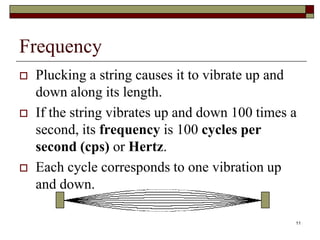
   Plucking a string causes it to vibrate up and
    down along its length.
   If the string vibrates up and down 100 times a
    second, its frequency is 100 cycles per
    second (cps) or Hertz.
   Each cycle corresponds to one vibration up
    and down.

                                                 11
Frequency and Pitch
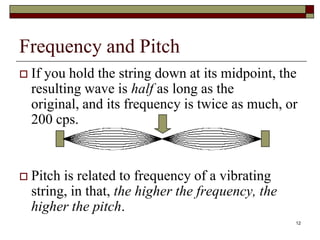
   If you hold the string down at its midpoint, the
    resulting wave is half as long as the
    original, and its frequency is twice as much, or
    200 cps.


   Pitch is related to frequency of a vibrating
    string, in that, the higher the frequency, the
    higher the pitch.
                                                     12
Ultrasonic and Infrasonic
   Humans hear from about 20 Hz to about 20,000 Hz.
       Frequencies above and below the audible range may be
        sensed by humans, but they are not necessarily heard.
   Bats can hear frequencies around 100,000 Hz (1
    MHz), and dogs as high as 50,000 Hz.
   Frequencies above 20,000 Hz are referred to as
    ultrasonic, and frequencies below 20 Hz are
    referred to as infrasonic.


                                                                13
Supersonic and Subsonic
  Supersonic is sometimes substituted for
   “ultrasonic,” but that is technically incorrect
   when referring to sound waves above the
   range of human hearing.
 Supersonic refers to a speed
greate
than the speed of sound.
 Subsonic refers to speeds slower
than the speed of sound, although                    14

that is also inaccurate.
Quality
   Quality (timbre) defines the difference in tone
    color between a note played on different
    instruments or sung by different voices.
       Timbre, pronounced either “tambr” or timber, is
        the quality of a particular tone, or tone color.
 Quality enables you to distinguish between
  various instruments playing the same tune.
 Why does a trumpet sound different from a
  violin?
                                                           15
The Fundamental and Overtones
   The acoustic phenomena – the overtones.
   The characteristic frequency of a note is only the
    fundamental of a series of other notes which are
    simultaneously present over the basic one.
   These notes are called overtones (or partials, or
    harmonics).
   The reason why the overtones are not distinctly
    audible is that their intensity is less than that of the
    fundamental.
                                                               16
Fundamental Frequency
   The initial vibration of a sound is called the
    fundamental, or fundamental frequency.
   In a purely Physics-based sense, the fundamental is
    the lowest pitch of a sound, and in most real-world
    cases this model holds true.
   A note played on a string has a fundamental
    frequency which is its lowest natural frequency.
   Additionally, the fundamental frequency is the
    strongest pitch we hear.
                                                          17
The Overtones
   The note also has overtones at consecutive integer
    multiples of its fundamental frequency.
   Plucking a string excites a number of tones not just
    the fundamental.
   They determine the quality of a note and they give
    brilliance to the tone.
   What makes us able to distinguish between an oboe
    and a horn is the varying intensity of the overtones
    over the actual notes which they play.
                                                           18
The Overtones (Harmonics)
   Music would be boring if all sounds were comprised
    of just their fundamental frequency – you would not
    be able to tell the difference between a violin playing
    an “A” at 440 Hz and a flute playing the same note?
   Luckily, most sounds are a combination of a
    fundamental pitch and various multiples of the
    fundamental, known as overtones, or harmonics.
   When overtones are added to the fundamental
    frequency, the character or quality of the sound is
    changed; the character of the sound is called timbre.

                                                          19
Harmonics and Overtones
  The term harmonic has a precise meaning – that of
   an integer (whole number) multiple of the
   fundamental frequency of a vibrating object.
 The term overtone is used to refer to any resonant
   frequency above the fundamental frequency.
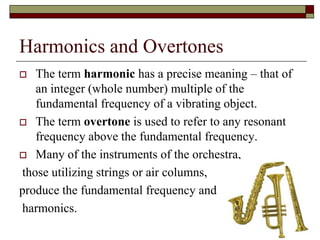
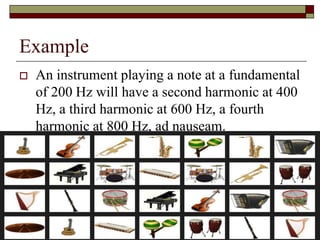
 Many of the instruments of the orchestra,

those utilizing strings or air columns,
produce the fundamental frequency and
harmonics.
                                                       20
Example
   An instrument playing a note at a fundamental
    of 200 Hz will have a second harmonic at 400
    Hz, a third harmonic at 600 Hz, a fourth
    harmonic at 800 Hz, ad nauseam.


                                                21
Harmonic Series
   Harmonic Series – a series of tones consisting
    of a fundamental tone and the overtones
    produced by it.
   It is the amplitude and placement of
    harmonics and partials which give different
    instruments different timbre (despite not
    usually being detected separately by the
    untrained human ear).
                                                 22
Harmonic Series
   Given a fundamental of C’, the first 6
    harmonics are:
       1st C’ – the fundamental
     2nd C – the first octave
    (8th) above
     3rd G – the twelve
     (12th) above
     4th c – the second
    octave (15th) above
     5th e – the 17th above
                                             23

     6th g – the 19th above
Psychoacoustics
   The study of psychoacoustics teaches us that
    even-numbered harmonics tend to make
    sounds “soft” and “warm,” while odd-
    numbered harmonics make sounds “bright”
    and “metallic.”
   Lower-order harmonics control the basic
    timbre of the sound, and higher-order
    harmonics control the harshness of the sound.
                                                24
The Octave
   Again, a one-octave separation occurs when the
    higher frequency is twice the lower frequency – the
    octave ratio is thus 2:1.
   A note’s first overtone is one octave higher than its
    fundamental frequency.
   An octave denotes the difference between any two
    frequencies where the ratio between them is 2:1.
       Therefore, an octave separates the fundamental from the
        second harmonic as above: 400 Hz:200 Hz.

                                                                  25
The Octave
   Note that even though, as frequency
    increases, the linear distance between
    frequencies becomes greater, the ratio of 2:1
    is still the same: an octave still separates 4000
    Hz from 2000 Hz.
   In the musical world, two notes separated by
    an octave are said to be “in tune.”
   An “A” on a violin at 440 Hz is an octave
    below the “A” at 880 Hz.
                                                    26
Other Ratios
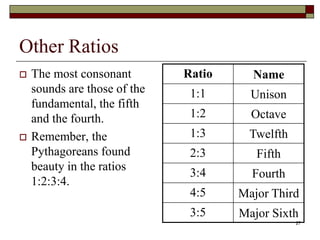
   The most consonant        Ratio     Name
    sounds are those of the    1:1      Unison
    fundamental, the fifth
    and the fourth.            1:2      Octave
   Remember, the              1:3      Twelfth
    Pythagoreans found         2:3       Fifth
    beauty in the ratios
                               3:4      Fourth
    1:2:3:4.
                               4:5    Major Third
                               3:5    Major Sixth
                                                  27
Standard Pitch
   Musicians tune their instruments to a note
    which has 440 cycles per second.
   This is the accepted number of vibration for
    the note a above middle c.
   In 1939 at an international conference most of
    the Western nations accepted this note as the
    standard pitch.
       A – 440Hz
                                                 28
Intonation
 Good intonation means being in tune (pitching
  the note accurately).
 If two notes have the same frequency, we
  know that they have the same pitch, and so
  they are in unison.
 But if one of these is played slightly out of
  tune, the result is that one produces shorter
  wave and these waves collide with each
  other, producing a pulsating effect.
                                              29
Resonance
   Certain pitches can cause some nearby object
    to resound sympathetically.
       Opera singer shattering a glass.
   When two vibrating sources are at the same
    pitch, and one is set into vibration, the
    untouched one will take the vibration
    sympathetically from the other.

                                                   30
Resonance
   When we sing it is not our vocals cords alone
    which produce sound, but the sympathetic
    vibrations set up in the cavities of our heads.
   It is the belly of a guitar which actually
    produces the tone, by vibrating
    sympathetically with the string.


                                                      31
Resonant Frequencies and Bridges
   Bridges have a “natural frequency.”
   When the wind blows or people cross the
    bridge at a rhythm that matches this
    frequency, the force can cause the bridge to
    vibrate.
   This phenomenon is called resonance, and
    the frequency is called resonant frequency.

                                                   32
Resonant Frequencies and Bridges
   Soldiers are taught to march across a bridge
    out-of-step, so they won’t create vibrations
    that tap into the bridge’s resonant frequency.
   In extreme cases, the vibrations can cause a
    bridge to collapse, as happened when the
    driving force of the wind caused the collapse
    of the Tacoma Narrows Bridge in Washington
    State in 1940.
                                                 33
Lewinter & Widulski   The Saga of Mathematics   ‹#›
35

Math and music

  • 1.
  • 2.
    Quotes  “Without music life would be a mistake.” – Friedrich Nietzsche  “Music is a secret arithmetical exercise and the person who indulges in it does not realize that he is manipulating numbers.” – Gottfried Liebniz 2
  • 3.
    Math and Music  Mathematics and music have been link since the days of Pythagoras.  Since the Middle Ages, music theorists had been studying proportions, a subject that Pythagoras had written about when discussing music.  The theorists explained how to make different pitches (sounds) on stringed instruments by lengthening or shortening the strings by different proportions. 3
  • 4.
    Math and Music  For example, if a musician were to divide a string in half (the proportion of 2:1), he would create a new tone that is an octave above the original tone.  Renaissance musicians carried on this idea in their own music. 4
  • 5.
    The Sound ofMusic  Sound is produced by a kind of motion – the motion arising from a vibrating body.  For example, a string or the skin of a drum  Any vibrating object produces sound.  The vibrations produce waves that propagate through the air and when they hit your ear they are perceived as sound.  The speed of sound is approximately 1,100 feet per second or 343 meters per second. 5
  • 6.
    The Sound ofMusic  If the vibration is regular, the resulting sound is “musical” and represents a note of a definite pitch.  If it is irregular the result is noise.  Every sound has three characteristic properties.  Volume, Pitch, Quality 6
  • 7.
    Volume  The volumeof a note depends on the amplitude of the vibration.  More intense vibration produces louder sounds.  Less intense produces softer sounds. 7
  • 8.
    Pitch  Perception of pitch means the ability to distinguish between the highness and the lowness of a musical sound.  It depends on the frequency (number of vibrations per second) of the vibrating body.  The higher the frequency of a sound the higher is its pitch, the lower the frequency, the lower its pitch. 8
  • 9.
    Galileo and Mersenne  Both Galileo Galilei [1564-1642] and Marin Mersenne [1588-1648] studied sound.  Galileo elevated the study of vibrations and the correlation between pitch and frequency of the sound source to scientific standards.  His interest in sound was inspired by his father, who was a mathematician, musician, and composer. 9
  • 10.
    Galileo and Mersenne  Following Galileo’s foundation work, progress in acoustics came relatively quickly.  The French mathematician Marin Mersenne studied the vibration of stretched strings.  The results of these studies were summarized in the three Mersenne’s laws.  Mersenne’s Harmonicorum Libri (1636) provided the basis for modern musical acoustics.  Marin Mersenne is known as the “father of acoustics.” 10
  • 11.
    Frequency  Plucking a string causes it to vibrate up and down along its length.  If the string vibrates up and down 100 times a second, its frequency is 100 cycles per second (cps) or Hertz.  Each cycle corresponds to one vibration up and down. 11
  • 12.
    Frequency and Pitch  If you hold the string down at its midpoint, the resulting wave is half as long as the original, and its frequency is twice as much, or 200 cps.  Pitch is related to frequency of a vibrating string, in that, the higher the frequency, the higher the pitch. 12
  • 13.
    Ultrasonic and Infrasonic  Humans hear from about 20 Hz to about 20,000 Hz.  Frequencies above and below the audible range may be sensed by humans, but they are not necessarily heard.  Bats can hear frequencies around 100,000 Hz (1 MHz), and dogs as high as 50,000 Hz.  Frequencies above 20,000 Hz are referred to as ultrasonic, and frequencies below 20 Hz are referred to as infrasonic. 13
  • 14.
    Supersonic and Subsonic  Supersonic is sometimes substituted for “ultrasonic,” but that is technically incorrect when referring to sound waves above the range of human hearing.  Supersonic refers to a speed greate than the speed of sound.  Subsonic refers to speeds slower than the speed of sound, although 14 that is also inaccurate.
  • 15.
    Quality  Quality (timbre) defines the difference in tone color between a note played on different instruments or sung by different voices.  Timbre, pronounced either “tambr” or timber, is the quality of a particular tone, or tone color.  Quality enables you to distinguish between various instruments playing the same tune.  Why does a trumpet sound different from a violin? 15
  • 16.
    The Fundamental andOvertones  The acoustic phenomena – the overtones.  The characteristic frequency of a note is only the fundamental of a series of other notes which are simultaneously present over the basic one.  These notes are called overtones (or partials, or harmonics).  The reason why the overtones are not distinctly audible is that their intensity is less than that of the fundamental. 16
  • 17.
    Fundamental Frequency  The initial vibration of a sound is called the fundamental, or fundamental frequency.  In a purely Physics-based sense, the fundamental is the lowest pitch of a sound, and in most real-world cases this model holds true.  A note played on a string has a fundamental frequency which is its lowest natural frequency.  Additionally, the fundamental frequency is the strongest pitch we hear. 17
  • 18.
    The Overtones  The note also has overtones at consecutive integer multiples of its fundamental frequency.  Plucking a string excites a number of tones not just the fundamental.  They determine the quality of a note and they give brilliance to the tone.  What makes us able to distinguish between an oboe and a horn is the varying intensity of the overtones over the actual notes which they play. 18
  • 19.
    The Overtones (Harmonics)  Music would be boring if all sounds were comprised of just their fundamental frequency – you would not be able to tell the difference between a violin playing an “A” at 440 Hz and a flute playing the same note?  Luckily, most sounds are a combination of a fundamental pitch and various multiples of the fundamental, known as overtones, or harmonics.  When overtones are added to the fundamental frequency, the character or quality of the sound is changed; the character of the sound is called timbre. 19
  • 20.
    Harmonics and Overtones  The term harmonic has a precise meaning – that of an integer (whole number) multiple of the fundamental frequency of a vibrating object.  The term overtone is used to refer to any resonant frequency above the fundamental frequency.  Many of the instruments of the orchestra, those utilizing strings or air columns, produce the fundamental frequency and harmonics. 20
  • 21.
    Example  An instrument playing a note at a fundamental of 200 Hz will have a second harmonic at 400 Hz, a third harmonic at 600 Hz, a fourth harmonic at 800 Hz, ad nauseam. 21
  • 22.
    Harmonic Series  Harmonic Series – a series of tones consisting of a fundamental tone and the overtones produced by it.  It is the amplitude and placement of harmonics and partials which give different instruments different timbre (despite not usually being detected separately by the untrained human ear). 22
  • 23.
    Harmonic Series  Given a fundamental of C’, the first 6 harmonics are:  1st C’ – the fundamental  2nd C – the first octave (8th) above  3rd G – the twelve (12th) above  4th c – the second octave (15th) above  5th e – the 17th above 23  6th g – the 19th above
  • 24.
    Psychoacoustics  The study of psychoacoustics teaches us that even-numbered harmonics tend to make sounds “soft” and “warm,” while odd- numbered harmonics make sounds “bright” and “metallic.”  Lower-order harmonics control the basic timbre of the sound, and higher-order harmonics control the harshness of the sound. 24
  • 25.
    The Octave  Again, a one-octave separation occurs when the higher frequency is twice the lower frequency – the octave ratio is thus 2:1.  A note’s first overtone is one octave higher than its fundamental frequency.  An octave denotes the difference between any two frequencies where the ratio between them is 2:1.  Therefore, an octave separates the fundamental from the second harmonic as above: 400 Hz:200 Hz. 25
  • 26.
    The Octave  Note that even though, as frequency increases, the linear distance between frequencies becomes greater, the ratio of 2:1 is still the same: an octave still separates 4000 Hz from 2000 Hz.  In the musical world, two notes separated by an octave are said to be “in tune.”  An “A” on a violin at 440 Hz is an octave below the “A” at 880 Hz. 26
  • 27.
    Other Ratios  The most consonant Ratio Name sounds are those of the 1:1 Unison fundamental, the fifth and the fourth. 1:2 Octave  Remember, the 1:3 Twelfth Pythagoreans found 2:3 Fifth beauty in the ratios 3:4 Fourth 1:2:3:4. 4:5 Major Third 3:5 Major Sixth 27
  • 28.
    Standard Pitch  Musicians tune their instruments to a note which has 440 cycles per second.  This is the accepted number of vibration for the note a above middle c.  In 1939 at an international conference most of the Western nations accepted this note as the standard pitch.  A – 440Hz 28
  • 29.
    Intonation  Good intonationmeans being in tune (pitching the note accurately).  If two notes have the same frequency, we know that they have the same pitch, and so they are in unison.  But if one of these is played slightly out of tune, the result is that one produces shorter wave and these waves collide with each other, producing a pulsating effect. 29
  • 30.
    Resonance  Certain pitches can cause some nearby object to resound sympathetically.  Opera singer shattering a glass.  When two vibrating sources are at the same pitch, and one is set into vibration, the untouched one will take the vibration sympathetically from the other. 30
  • 31.
    Resonance  When we sing it is not our vocals cords alone which produce sound, but the sympathetic vibrations set up in the cavities of our heads.  It is the belly of a guitar which actually produces the tone, by vibrating sympathetically with the string. 31
  • 32.
    Resonant Frequencies andBridges  Bridges have a “natural frequency.”  When the wind blows or people cross the bridge at a rhythm that matches this frequency, the force can cause the bridge to vibrate.  This phenomenon is called resonance, and the frequency is called resonant frequency. 32
  • 33.
    Resonant Frequencies andBridges  Soldiers are taught to march across a bridge out-of-step, so they won’t create vibrations that tap into the bridge’s resonant frequency.  In extreme cases, the vibrations can cause a bridge to collapse, as happened when the driving force of the wind caused the collapse of the Tacoma Narrows Bridge in Washington State in 1940. 33
  • 34.
    Lewinter & Widulski The Saga of Mathematics ‹#›
  • 35.