The SOUND
SoundSound
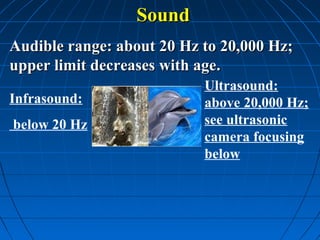
Audible range: about 20 Hz to 20,000 Hz;Audible range: about 20 Hz to 20,000 Hz;
upper limit decreases with ageupper limit decreases with age..
Ultrasound:
above 20,000 Hz;
see ultrasonic
camera focusing
below
Infrasound:
below 20 Hz
Approximate frequency rangesApproximate frequency ranges
corresponding to ultrasound, withcorresponding to ultrasound, with
rough guide of some applicationsrough guide of some applications
 Ultrasonic Testing (UT) is a
group of
nondestructive examination
(NDE) techniques that use short,
high-frequency ultrasonic waves
to identify flaws in a material.
The Ear and Its Response; LoudnessThe Ear and Its Response; Loudness
Outer earOuter ear: sound waves travel: sound waves travel
down the ear canal to the eardrum,down the ear canal to the eardrum,
which vibrates in responsewhich vibrates in response
Middle earMiddle ear: hammer, anvil, and: hammer, anvil, and
stirrup transfer vibrations to innerstirrup transfer vibrations to inner
earear
Inner earInner ear: cochlea transforms: cochlea transforms
vibrational energy to electricalvibrational energy to electrical
energy and sends signals to theenergy and sends signals to the
brainbrain
The strings on a guitar canThe strings on a guitar can
be effectively shortened bybe effectively shortened by
fingering, raising thefingering, raising the
fundamental pitch.fundamental pitch.
The pitch of a string of aThe pitch of a string of a
given length can also begiven length can also be
altered by using a string ofaltered by using a string of
different density.different density.
Sources of Sound: VibratingSources of Sound: Vibrating
Strings and Air ColumnsStrings and Air Columns
A piano uses both methodsA piano uses both methods
to cover its more than seven-to cover its more than seven-
octave range—the loweroctave range—the lower
strings (at left) are bothstrings (at left) are both
much longer and muchmuch longer and much
thicker than the higher ones.thicker than the higher ones.
Sources of Sound: VibratingSources of Sound: Vibrating
Strings and Air ColumnsStrings and Air Columns
A tube open at both ends (most wind instruments)A tube open at both ends (most wind instruments)
has pressure nodes, and therefore displacementhas pressure nodes, and therefore displacement
antinodes,antinodes, at the ends.at the ends.
Sources of Sound: VibratingSources of Sound: Vibrating
Strings and Air ColumnsStrings and Air Columns
Doppler EffectDoppler Effect
The Doppler effect occurs when a source ofThe Doppler effect occurs when a source of
sound is moving with respect to an observer.sound is moving with respect to an observer.
As can be seen in the previous image, a sourceAs can be seen in the previous image, a source
moving toward an observer has a higher frequencymoving toward an observer has a higher frequency
and shorter wavelength; the opposite is true whenand shorter wavelength; the opposite is true when
a source is moving away from an observer.a source is moving away from an observer.
The Doppler effectThe Doppler effect
 The The Doppler effectDoppler effect (or the  (or the DopplerDoppler
shiftshift) is the change in frequency or ) is the change in frequency or 
wavelenngth of a waver for an wavelenngth of a waver for an 
observer, who is moving relative to observer, who is moving relative to 
the wave sourcethe wave source
 It is named after the Austrian It is named after the Austrian 
physicist physicist Christian DopplerChristian Doppler, who , who 
described the phenomenon in 1842.described the phenomenon in 1842.
Free to share, print, make copies and changes. Get yours at www.boundless.com
Wikipedia. "Dopplereffectsourcemovingrightatmach0.7." CC BY-SA http://en.wikipedia.org/wiki/File:Dopplereffectsourcemovingrightatmach0.7.gif View on
Boundless.com
Sound
And the change in the frequency:And the change in the frequency:
If the source is moving away from the observer:If the source is moving away from the observer:
Doppler EffectDoppler Effect
Color flow ultrasonographyColor flow ultrasonography
(Doppler) of a carotid artery(Doppler) of a carotid artery
Renal ultrasonography with usingRenal ultrasonography with using
duplex technique of a normal adultduplex technique of a normal adult
kidneykidney
Doppler echocardiographyDoppler echocardiography
THE CHARACTERISTICS
OF
A SOUND
 Fundamental frequency determinesFundamental frequency determines
thus have hearing the pitch, and athus have hearing the pitch, and a
set of harmonic components - theset of harmonic components - the
timbre of soundtimbre of sound. In the spectrum of. In the spectrum of
speech sounds are formants -speech sounds are formants -
stable groups of frequencystable groups of frequency
components corresponding tocomponents corresponding to
certain phonetic elements.certain phonetic elements.
 Energy characteristic of theEnergy characteristic of the
sound waves is thesound waves is the soundsound
intensityintensity - the energy carried by- the energy carried by
a sound wave through a unita sound wave through a unit
area perpendicular to thearea perpendicular to the
direction of wave propagation indirection of wave propagation in
a unit time. The intensity of thea unit time. The intensity of the
sound depends on the amplitudesound depends on the amplitude
of the sound pressure, as well asof the sound pressure, as well as
the properties of the mediumthe properties of the medium
itself and the shape of the wave.itself and the shape of the wave.
 Subjective soundSubjective sound
characteristics related tocharacteristics related to
its intensity, is theits intensity, is the
volumevolume, depending on the, depending on the
frequency.frequency.
 Ultrasound with a frequency over 25Ultrasound with a frequency over 25
kHz causes pain in birds.kHz causes pain in birds.
 This is useful for scaring gulls fromThis is useful for scaring gulls from
reservoirs of drinking water and fishreservoirs of drinking water and fish
from the trawlers.from the trawlers.
 1. volcanic eruptions1. volcanic eruptions
 2.Wind flowing around the2.Wind flowing around the
crests of the wavescrests of the waves
Sources of infrasound

Sound

  • 1.
  • 2.
    SoundSound Audible range: about20 Hz to 20,000 Hz;Audible range: about 20 Hz to 20,000 Hz; upper limit decreases with ageupper limit decreases with age.. Ultrasound: above 20,000 Hz; see ultrasonic camera focusing below Infrasound: below 20 Hz
  • 3.
    Approximate frequency rangesApproximatefrequency ranges corresponding to ultrasound, withcorresponding to ultrasound, with rough guide of some applicationsrough guide of some applications
  • 4.
     Ultrasonic Testing(UT) is a group of nondestructive examination (NDE) techniques that use short, high-frequency ultrasonic waves to identify flaws in a material.
  • 5.
    The Ear andIts Response; LoudnessThe Ear and Its Response; Loudness Outer earOuter ear: sound waves travel: sound waves travel down the ear canal to the eardrum,down the ear canal to the eardrum, which vibrates in responsewhich vibrates in response Middle earMiddle ear: hammer, anvil, and: hammer, anvil, and stirrup transfer vibrations to innerstirrup transfer vibrations to inner earear Inner earInner ear: cochlea transforms: cochlea transforms vibrational energy to electricalvibrational energy to electrical energy and sends signals to theenergy and sends signals to the brainbrain
  • 7.
    The strings ona guitar canThe strings on a guitar can be effectively shortened bybe effectively shortened by fingering, raising thefingering, raising the fundamental pitch.fundamental pitch. The pitch of a string of aThe pitch of a string of a given length can also begiven length can also be altered by using a string ofaltered by using a string of different density.different density. Sources of Sound: VibratingSources of Sound: Vibrating Strings and Air ColumnsStrings and Air Columns
  • 8.
    A piano usesboth methodsA piano uses both methods to cover its more than seven-to cover its more than seven- octave range—the loweroctave range—the lower strings (at left) are bothstrings (at left) are both much longer and muchmuch longer and much thicker than the higher ones.thicker than the higher ones. Sources of Sound: VibratingSources of Sound: Vibrating Strings and Air ColumnsStrings and Air Columns
  • 9.
    A tube openat both ends (most wind instruments)A tube open at both ends (most wind instruments) has pressure nodes, and therefore displacementhas pressure nodes, and therefore displacement antinodes,antinodes, at the ends.at the ends. Sources of Sound: VibratingSources of Sound: Vibrating Strings and Air ColumnsStrings and Air Columns
  • 10.
    Doppler EffectDoppler Effect TheDoppler effect occurs when a source ofThe Doppler effect occurs when a source of sound is moving with respect to an observer.sound is moving with respect to an observer. As can be seen in the previous image, a sourceAs can be seen in the previous image, a source moving toward an observer has a higher frequencymoving toward an observer has a higher frequency and shorter wavelength; the opposite is true whenand shorter wavelength; the opposite is true when a source is moving away from an observer.a source is moving away from an observer.
  • 11.
    The Doppler effectTheDoppler effect  The The Doppler effectDoppler effect (or the  (or the DopplerDoppler shiftshift) is the change in frequency or ) is the change in frequency or  wavelenngth of a waver for an wavelenngth of a waver for an  observer, who is moving relative to observer, who is moving relative to  the wave sourcethe wave source  It is named after the Austrian It is named after the Austrian  physicist physicist Christian DopplerChristian Doppler, who , who  described the phenomenon in 1842.described the phenomenon in 1842.
  • 12.
    Free to share,print, make copies and changes. Get yours at www.boundless.com Wikipedia. "Dopplereffectsourcemovingrightatmach0.7." CC BY-SA http://en.wikipedia.org/wiki/File:Dopplereffectsourcemovingrightatmach0.7.gif View on Boundless.com Sound
  • 13.
    And the changein the frequency:And the change in the frequency: If the source is moving away from the observer:If the source is moving away from the observer: Doppler EffectDoppler Effect
  • 14.
    Color flow ultrasonographyColorflow ultrasonography (Doppler) of a carotid artery(Doppler) of a carotid artery
  • 15.
    Renal ultrasonography withusingRenal ultrasonography with using duplex technique of a normal adultduplex technique of a normal adult kidneykidney
  • 16.
  • 18.
  • 19.
     Fundamental frequencydeterminesFundamental frequency determines thus have hearing the pitch, and athus have hearing the pitch, and a set of harmonic components - theset of harmonic components - the timbre of soundtimbre of sound. In the spectrum of. In the spectrum of speech sounds are formants -speech sounds are formants - stable groups of frequencystable groups of frequency components corresponding tocomponents corresponding to certain phonetic elements.certain phonetic elements.
  • 20.
     Energy characteristicof theEnergy characteristic of the sound waves is thesound waves is the soundsound intensityintensity - the energy carried by- the energy carried by a sound wave through a unita sound wave through a unit area perpendicular to thearea perpendicular to the direction of wave propagation indirection of wave propagation in a unit time. The intensity of thea unit time. The intensity of the sound depends on the amplitudesound depends on the amplitude of the sound pressure, as well asof the sound pressure, as well as the properties of the mediumthe properties of the medium itself and the shape of the wave.itself and the shape of the wave.
  • 21.
     Subjective soundSubjectivesound characteristics related tocharacteristics related to its intensity, is theits intensity, is the volumevolume, depending on the, depending on the frequency.frequency.
  • 22.
     Ultrasound witha frequency over 25Ultrasound with a frequency over 25 kHz causes pain in birds.kHz causes pain in birds.  This is useful for scaring gulls fromThis is useful for scaring gulls from reservoirs of drinking water and fishreservoirs of drinking water and fish from the trawlers.from the trawlers.
  • 23.
     1. volcaniceruptions1. volcanic eruptions  2.Wind flowing around the2.Wind flowing around the crests of the wavescrests of the waves Sources of infrasound