


SOUND
NATURE AND PRODUCTION OF
SOUND
Sound is…..
• A form of energy
• By sound, we commonly mean the
vibrations that travel through air and
can be heard by humans.
• Produced by vibrating sources placed
in a medium. (solid, liquid or gas)
PRODUCTION OF SOUND…
THE MEDIUM OF TRANSMISSION
• Any medium that has
particles that can vibrate
will transmit sound.
• Solids can transmit sound
fastest followed by liquid
then air.
Application:
In olden days, people would hear the
ground for movement.
SOUND CAN BE PRODUCED BY:-
• Vibrating strings
• Vibrating air columns
• Vibrating membranes
• Vibrating plates
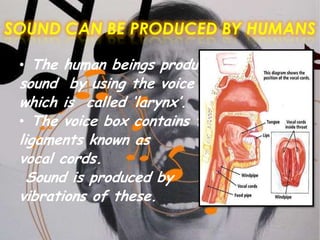
SOUND CAN BE PRODUCED BY HUMANS
• The human beings produce
sound by using the voice box
which is called ‘larynx’.
• The voice box contains two
ligaments known as
vocal cords.
Sound is produced by
vibrations of these.
WORKING OF VOCAL CORDS
• THE LUNGS PASS A CURRENT OF AIR
BETWEEN TWO VOLCAL CORDS.THIS MAKES
THE VOCAL CORDS VIBRATE.AND THE
VIBRATING VOCAL CORDS PRODUCE
SOUND.WHEN THE MUSCLES ATTACHED TO
THEM CONTRACT AND STRETCH ,THE VOCAL
CORDS BECOME TIGHT AND THIN AND
SOUND IS PRODUCED.
PROPAGATION OF SOUND…
• By saying that sound needs a
medium for propagation , we mean
that sound needs a solid ,liquid ,gas
for transmission sound cannot
travel through vacuum because
vacuum has no molecules which can
vibrate and carry sound waves.
Solids can transmit sound fastest
followed by liquid then air.
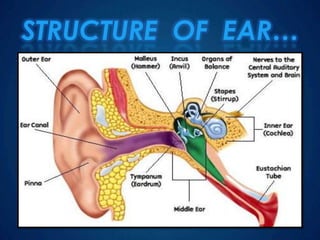
STRUCTURE OF EAR…
PARTS OF EAR…
• Outer ear : The outer part of ear is
funnel shaped to receive the sound waves
.It is called pinna and it is attached to
about 2-3 cm.long passage called ear
canal.
• Middle ear : There are 3 small bones
called hammer,anvil and stirrup in the
middle part of ear.
• Inner ear : The inner part of ear has a
coiled tube called cochlea.one end of
cochlea is connected to middle part of ear
through the elastic membrane over the
CHARACTERISTICS OF SOUND…
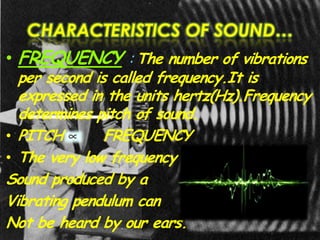
• FREQUENCY : The number of vibrations
per second is called frequency.It is
expressed in the units hertz(Hz).Frequency
determines pitch of sound.
• PITCH FREQUENCY
• The very low frequency
Sound produced by a
Vibrating pendulum can
Not be heard by our ears.
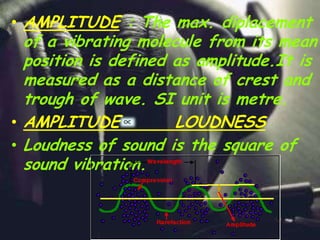
• AMPLITUDE : The max. diplacement
of a vibrating molecule from its mean
position is defined as amplitude.It is
measured as a distance of crest and
trough of wave. SI unit is metre.
• AMPLITUDE LOUDNESS
• Loudness of sound is the square of
sound vibration.
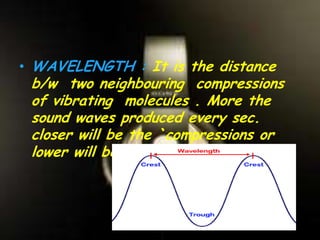
• WAVELENGTH : It is the distance
b/w two neighbouring compressions
of vibrating molecules . More the
sound waves produced every sec.
closer will be the `compressions or
lower will be the wavelength.
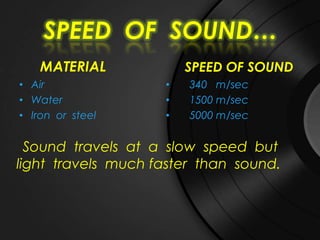
SPEED OF SOUND…
MATERIAL
• Air
• Water
• Iron or steel
SPEED OF SOUND
• 340 m/sec
• 1500 m/sec
• 5000 m/sec
Sound travels at a slow speed but
light travels much faster than sound.
AUDIBLE AND NON -AUDIBLE
SOUNDS
For human ears, the audible range of
sound waves lies between 20-20,000Hz.
Sound waves less than 20 Hz are called
infrasonic waves and more than 20 Hz
are caleed ultrasoinic waves.thes are not
audible to us.
Many animals make sounda that we cannot
hear as the frequencies they produce or
hear infrasonic sounds of 12 Hz
frequency ,whereas some animals like
dogs,cats,mice etc.can hear and produce
ultrasonic sounds
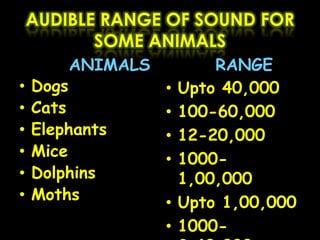
AUDIBLE RANGE OF SOUND FOR
SOME ANIMALS
ANIMALS
• Dogs
• Cats
• Elephants
• Mice
• Dolphins
• Moths
RANGE
• Upto 40,000
• 100-60,000
• 12-20,000
• 1000-
1,00,000
• Upto 1,00,000
• 1000-
MUSICAL INSTUMENTS
• We are familier with many
musical instruments.All the
instruments produce sound by
vibration.on the basis of
vibrating parts ,musical
instruments are classified into
following groups:::
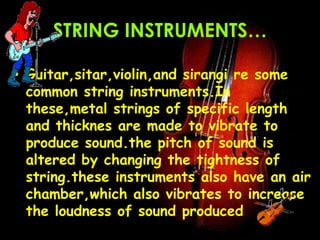
STRING INSTRUMENTS…
• Guitar,sitar,violin,and sirangi re some
common string instruments.In
these,metal strings of specific length
and thicknes are made to vibrate to
produce sound.the pitch of sound is
altered by changing the tightness of
string.these instruments also have an air
chamber,which also vibrates to increase
the loudness of sound produced
WIND INSTRUMENTS…
• Trumpet,shehnai,flute,bassons,h
armonica,etc.are some wind
instuments.in these
instrumentssound is produced by
vibrating air column inside the
instrument.the pitch of sound is
changed by changing the length
of vibrating column.
PERCUSSION INSTRUMENTS…
• Tabla,drum,dholak,bongo,congo,etc.ar
e some of the percussion
instruments.in all these
instruments,specific hollow shaped
body is closed by stretched skin of
animals.the stretched skin is beaten
by hands or sticks to vibrate
it.vibrating skin vibrates the column
of air inside the body of the
instrument and sound is
produced.pitch of sound is altered to
a certain extent by decreasing or
KEYBOARD INSTRUMENTS…
• Piano and harmonium are keyboard
instruments.under each key there
is a hole of specific shape and
size,covered with a thin mettalic
stripe .ehen key is pressed
,metallic stripe vibrates and
produce sound of a particular
note.air pressure is changed In
harmonium to produce variety of
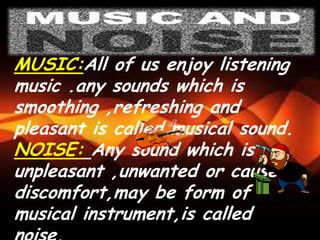
MUSIC:All of us enjoy listening
music .any sounds which is
smoothing ,refreshing and
pleasant is called musical sound.
NOISE: Any sound which is
unpleasant ,unwanted or causes
discomfort,may be form of
musical instrument,is called
Sustained pressure of
excessive unwanted and harmful
noise in the env.is called noise
pollution.major sources of noise
pollution are sounds from vehicles
including trains and
aircrafts,machines in factories,horns
loudspeakers,sources of noise pollution
are t.v and musicc player playing at
HARMFUL EFFECTS…
• It cause annoyaance,irritation,loss of
concentration,insomania,etc.
• It causes sleep
disturbances,stress,hypertension,etc.l
eading to cardiovascular diseases.
• Continuous exprosure to noise over a
period of time or sudden expossure to
loud noise may damage eardrums and
cause permanent loss of hearing.
CONTROL MEASURES…
• Use of loudspeakers should be
avoided in any case.
• Volume of music systems, t.vs
etc.should be kept low,sow that
others should not get disturbed
• Noise producing industries.should be
set-up away from residental areas.
• Use of horns should be minimized
• Donot buy cracker which produce
loud noise.
HEARING IMPAIRMENT…
• Total hearing impairment which is
rare,is ussually from birth
itself.parential diability is ussually
due to a disease,injury or aging.a
deaf child is ussually dumb or have
defective speech as speech develops
as a result of hearing.children with
impaired hearing need special
care.There are many private and govt
institutes to help such persons and to
THANK
YOU…

Sound

  • 1.
  • 2.
    NATURE AND PRODUCTIONOF SOUND Sound is….. • A form of energy • By sound, we commonly mean the vibrations that travel through air and can be heard by humans. • Produced by vibrating sources placed in a medium. (solid, liquid or gas)
  • 3.
  • 4.
    THE MEDIUM OFTRANSMISSION • Any medium that has particles that can vibrate will transmit sound. • Solids can transmit sound fastest followed by liquid then air. Application: In olden days, people would hear the ground for movement.
  • 5.
    SOUND CAN BEPRODUCED BY:- • Vibrating strings • Vibrating air columns • Vibrating membranes • Vibrating plates
  • 6.
    SOUND CAN BEPRODUCED BY HUMANS • The human beings produce sound by using the voice box which is called ‘larynx’. • The voice box contains two ligaments known as vocal cords. Sound is produced by vibrations of these.
  • 7.
    WORKING OF VOCALCORDS • THE LUNGS PASS A CURRENT OF AIR BETWEEN TWO VOLCAL CORDS.THIS MAKES THE VOCAL CORDS VIBRATE.AND THE VIBRATING VOCAL CORDS PRODUCE SOUND.WHEN THE MUSCLES ATTACHED TO THEM CONTRACT AND STRETCH ,THE VOCAL CORDS BECOME TIGHT AND THIN AND SOUND IS PRODUCED.
  • 8.
    PROPAGATION OF SOUND… •By saying that sound needs a medium for propagation , we mean that sound needs a solid ,liquid ,gas for transmission sound cannot travel through vacuum because vacuum has no molecules which can vibrate and carry sound waves. Solids can transmit sound fastest followed by liquid then air.
  • 9.
  • 10.
    PARTS OF EAR… •Outer ear : The outer part of ear is funnel shaped to receive the sound waves .It is called pinna and it is attached to about 2-3 cm.long passage called ear canal. • Middle ear : There are 3 small bones called hammer,anvil and stirrup in the middle part of ear. • Inner ear : The inner part of ear has a coiled tube called cochlea.one end of cochlea is connected to middle part of ear through the elastic membrane over the
  • 11.
    CHARACTERISTICS OF SOUND… •FREQUENCY : The number of vibrations per second is called frequency.It is expressed in the units hertz(Hz).Frequency determines pitch of sound. • PITCH FREQUENCY • The very low frequency Sound produced by a Vibrating pendulum can Not be heard by our ears.
  • 12.
    • AMPLITUDE :The max. diplacement of a vibrating molecule from its mean position is defined as amplitude.It is measured as a distance of crest and trough of wave. SI unit is metre. • AMPLITUDE LOUDNESS • Loudness of sound is the square of sound vibration.
  • 13.
    • WAVELENGTH :It is the distance b/w two neighbouring compressions of vibrating molecules . More the sound waves produced every sec. closer will be the `compressions or lower will be the wavelength.
  • 14.
    SPEED OF SOUND… MATERIAL •Air • Water • Iron or steel SPEED OF SOUND • 340 m/sec • 1500 m/sec • 5000 m/sec Sound travels at a slow speed but light travels much faster than sound.
  • 15.
    AUDIBLE AND NON-AUDIBLE SOUNDS For human ears, the audible range of sound waves lies between 20-20,000Hz. Sound waves less than 20 Hz are called infrasonic waves and more than 20 Hz are caleed ultrasoinic waves.thes are not audible to us. Many animals make sounda that we cannot hear as the frequencies they produce or hear infrasonic sounds of 12 Hz frequency ,whereas some animals like dogs,cats,mice etc.can hear and produce ultrasonic sounds
  • 16.
    AUDIBLE RANGE OFSOUND FOR SOME ANIMALS ANIMALS • Dogs • Cats • Elephants • Mice • Dolphins • Moths RANGE • Upto 40,000 • 100-60,000 • 12-20,000 • 1000- 1,00,000 • Upto 1,00,000 • 1000-
  • 17.
    MUSICAL INSTUMENTS • Weare familier with many musical instruments.All the instruments produce sound by vibration.on the basis of vibrating parts ,musical instruments are classified into following groups:::
  • 18.
    STRING INSTRUMENTS… • Guitar,sitar,violin,andsirangi re some common string instruments.In these,metal strings of specific length and thicknes are made to vibrate to produce sound.the pitch of sound is altered by changing the tightness of string.these instruments also have an air chamber,which also vibrates to increase the loudness of sound produced
  • 19.
    WIND INSTRUMENTS… • Trumpet,shehnai,flute,bassons,h armonica,etc.aresome wind instuments.in these instrumentssound is produced by vibrating air column inside the instrument.the pitch of sound is changed by changing the length of vibrating column.
  • 20.
    PERCUSSION INSTRUMENTS… • Tabla,drum,dholak,bongo,congo,etc.ar esome of the percussion instruments.in all these instruments,specific hollow shaped body is closed by stretched skin of animals.the stretched skin is beaten by hands or sticks to vibrate it.vibrating skin vibrates the column of air inside the body of the instrument and sound is produced.pitch of sound is altered to a certain extent by decreasing or
  • 21.
    KEYBOARD INSTRUMENTS… • Pianoand harmonium are keyboard instruments.under each key there is a hole of specific shape and size,covered with a thin mettalic stripe .ehen key is pressed ,metallic stripe vibrates and produce sound of a particular note.air pressure is changed In harmonium to produce variety of
  • 22.
    MUSIC:All of usenjoy listening music .any sounds which is smoothing ,refreshing and pleasant is called musical sound. NOISE: Any sound which is unpleasant ,unwanted or causes discomfort,may be form of musical instrument,is called
  • 23.
    Sustained pressure of excessiveunwanted and harmful noise in the env.is called noise pollution.major sources of noise pollution are sounds from vehicles including trains and aircrafts,machines in factories,horns loudspeakers,sources of noise pollution are t.v and musicc player playing at
  • 24.
    HARMFUL EFFECTS… • Itcause annoyaance,irritation,loss of concentration,insomania,etc. • It causes sleep disturbances,stress,hypertension,etc.l eading to cardiovascular diseases. • Continuous exprosure to noise over a period of time or sudden expossure to loud noise may damage eardrums and cause permanent loss of hearing.
  • 25.
    CONTROL MEASURES… • Useof loudspeakers should be avoided in any case. • Volume of music systems, t.vs etc.should be kept low,sow that others should not get disturbed • Noise producing industries.should be set-up away from residental areas. • Use of horns should be minimized • Donot buy cracker which produce loud noise.
  • 26.
    HEARING IMPAIRMENT… • Totalhearing impairment which is rare,is ussually from birth itself.parential diability is ussually due to a disease,injury or aging.a deaf child is ussually dumb or have defective speech as speech develops as a result of hearing.children with impaired hearing need special care.There are many private and govt institutes to help such persons and to
  • 27.