OOAD USING THE UNIFIED MODELING LANGUAGE (UML)                         CHAPTER 1: OBJECT-ORIENTED ANALYSIS AND DESIGN


                            Chapter 1:
                Object-Oriented Analysis and Design

              Evaluation
 1) What is OOAD? ....................................................................................................... 1-3

 2) Approaches to System Analysis .............................................................................. 1-4


                Copy
 3) Object-Oriented Methodologies ............................................................................. 1-5

 4) History of UML ........................................................................................................ 1-7

 5) What is UML? .......................................................................................................... 1-9

 6) Models and Architectural Views .......................................................................... 1-10

 7) Common Features of UML Diagrams.................................................................. 1-11

 8) Characteristics of a UML Process ........................................................................ 1-13


              Evaluation
                Copy
               ©2007 /training/etc Inc.       REPRODUCTION OF THESE MATERIALS IS PROHIBITED.
                                                            1-1
OOAD USING THE UNIFIED MODELING LANGUAGE (UML)          CHAPTER 1: OBJECT-ORIENTED ANALYSIS AND DESIGN


                                           Exercise
 1. Class Discussion:

           Evaluation
        What is analysis?
        What is design?


             Copy
        What is decomposition?
        What kinds of techniques and drawings have you used in the
        past for analysis and design?


           Evaluation
             Copy
            ©2007 /training/etc Inc.   REPRODUCTION OF THESE MATERIALS IS PROHIBITED.
                                                 1-2
OOAD USING THE UNIFIED MODELING LANGUAGE (UML)           CHAPTER 1: OBJECT-ORIENTED ANALYSIS AND DESIGN


                                       What is OOAD?

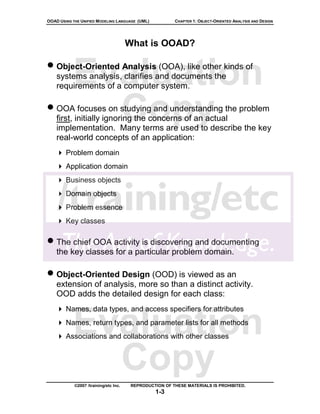
• Object-Oriented Analysis (OOA), like other kinds of
           Evaluation
    systems analysis, clarifies and documents the
    requirements of a computer system.


             Copy
• OOA focuses on studying and understanding the problem
    first, initially ignoring the concerns of an actual
    implementation. Many terms are used to describe the key
    real-world concepts of an application:
        Problem domain
        Application domain
        Business objects
        Domain objects
        Problem essence
        Key classes

• The chief OOA activity is discovering and documenting
    the key classes for a particular problem domain.

• Object-Oriented Design (OOD) is viewed as an
    extension of analysis, more so than a distinct activity.
    OOD adds the detailed design for each class:
        Names, data types, and access specifiers for attributes


           Evaluation
        Names, return types, and parameter lists for all methods
        Associations and collaborations with other classes


             Copy
            ©2007 /training/etc Inc.    REPRODUCTION OF THESE MATERIALS IS PROHIBITED.
                                                 1-3
OOAD USING THE UNIFIED MODELING LANGUAGE (UML)          CHAPTER 1: OBJECT-ORIENTED ANALYSIS AND DESIGN


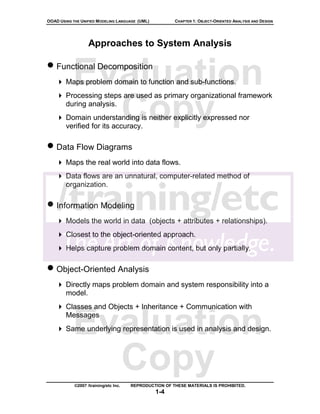
                   Approaches to System Analysis

• Functional Decomposition
           Evaluation
        Maps problem domain to function and sub-functions.
        Processing steps are used as primary organizational framework


             Copy
        during analysis.
        Domain understanding is neither explicitly expressed nor
        verified for its accuracy.

• Data Flow Diagrams
        Maps the real world into data flows.
        Data flows are an unnatural, computer-related method of
        organization.

• Information Modeling
        Models the world in data (objects + attributes + relationships).
        Closest to the object-oriented approach.
        Helps capture problem domain content, but only partially.

• Object-Oriented Analysis
        Directly maps problem domain and system responsibility into a
        model.
        Classes and Objects + Inheritance + Communication with


           Evaluation
        Messages
        Same underlying representation is used in analysis and design.


             Copy
            ©2007 /training/etc Inc.   REPRODUCTION OF THESE MATERIALS IS PROHIBITED.
                                                 1-4
OOAD USING THE UNIFIED MODELING LANGUAGE (UML)          CHAPTER 1: OBJECT-ORIENTED ANALYSIS AND DESIGN


                    Object-Oriented Methodologies

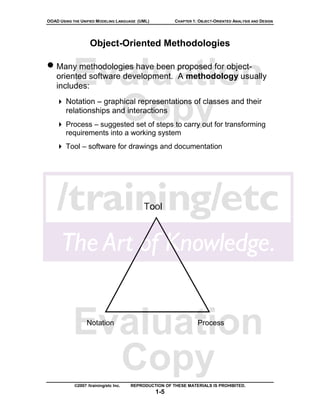
• Many methodologies have been proposed for object-
           Evaluation
    oriented software development. A methodology usually
    includes:


             Copy
        Notation – graphical representations of classes and their
        relationships and interactions
        Process – suggested set of steps to carry out for transforming
        requirements into a working system
        Tool – software for drawings and documentation


                                            Tool


           Evaluation
                  Notation                                        Process


             Copy
            ©2007 /training/etc Inc.   REPRODUCTION OF THESE MATERIALS IS PROHIBITED.
                                                 1-5
OOAD USING THE UNIFIED MODELING LANGUAGE (UML)          CHAPTER 1: OBJECT-ORIENTED ANALYSIS AND DESIGN


                    Object-Oriented Methodologies

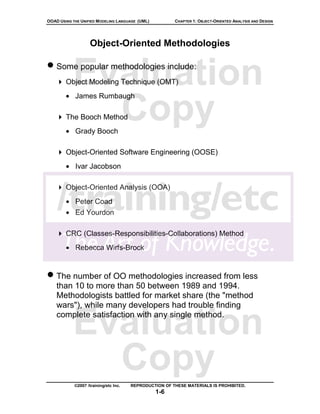
• Some popular methodologies include:
           Evaluation
        Object Modeling Technique (OMT)
        • James Rumbaugh

             Copy
        The Booch Method
        • Grady Booch

        Object-Oriented Software Engineering (OOSE)
        • Ivar Jacobson

        Object-Oriented Analysis (OOA)
        • Peter Coad
        • Ed Yourdon

        CRC (Classes-Responsibilities-Collaborations) Method
        • Rebecca Wirfs-Brock


• The number of OO methodologies increased from less
    than 10 to more than 50 between 1989 and 1994.
    Methodologists battled for market share (the "method
    wars"), while many developers had trouble finding


           Evaluation
    complete satisfaction with any single method.


             Copy
            ©2007 /training/etc Inc.   REPRODUCTION OF THESE MATERIALS IS PROHIBITED.
                                                 1-6
OOAD USING THE UNIFIED MODELING LANGUAGE (UML)          CHAPTER 1: OBJECT-ORIENTED ANALYSIS AND DESIGN


                                       History of UML

• In October 1994, Rumbaugh joined Booch's company
           Evaluation
    (Rational Software Corporation) to unify the Booch and
    OMT methods. A draft was released in October 1995,
    then called the Unified Method.

             Copy
• In 1995 Jacobson also joined the unification effort,
    merging in the OOSE method. Preliminary documents for
    the Unified Modeling Language (UML) were released
    during 1996.

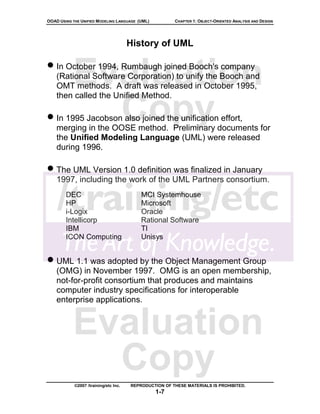
• The UML Version 1.0 definition was finalized in January
    1997, including the work of the UML Partners consortium.
        DEC                                MCI Systemhouse
        HP                                 Microsoft
        i-Logix                            Oracle
        Intellicorp                        Rational Software
        IBM                                TI
        ICON Computing                     Unisys


• UML 1.1 was adopted by the Object Management Group
    (OMG) in November 1997. OMG is an open membership,
    not-for-profit consortium that produces and maintains
    computer industry specifications for interoperable
    enterprise applications.


           Evaluation
             Copy
            ©2007 /training/etc Inc.   REPRODUCTION OF THESE MATERIALS IS PROHIBITED.
                                                 1-7
OOAD USING THE UNIFIED MODELING LANGUAGE (UML)          CHAPTER 1: OBJECT-ORIENTED ANALYSIS AND DESIGN


                                       History of UML

• IBM acquired Rational Software Company in 2002.
           Evaluation
• Revisions to the UML specification through Version 1.5
             Copy
    were released in March 2003.

• OMG is currently upgrading UML to Version 2.0. Adopted
    in late 2003 and posted on OMG's website labeled "UML
    2.0 Final Adopted Specification,” the upgraded version
    won't replace UML 1.5 as the official "Available UML
    Specification" until it completes its initial maintenance
    revision sometime around the end of 2004.
    http://www.omg.org


           Evaluation
             Copy
            ©2007 /training/etc Inc.   REPRODUCTION OF THESE MATERIALS IS PROHIBITED.
                                                 1-8
OOAD USING THE UNIFIED MODELING LANGUAGE (UML)          CHAPTER 1: OBJECT-ORIENTED ANALYSIS AND DESIGN


                                       What is UML?

• UML focuses on a standard modeling language, not a
           Evaluation
    standard process.

• UML fuses the concepts of Booch, Rumbaugh, and
    Jacobson.
             Copy
• UML is nonproprietary.
        UML Version 1.0 was submitted to the Object Management
        Group (OMG) Analysis and Design Task Force for
        consideration as the industry standard.
        In November 1997, UML was adopted into the Object
        Management Architecture (OMA).

• This course introduces UML as a standard graphical
    notation for object-oriented software design, and as a
    vehicle for presenting important analysis and design
    concepts. The following UML features will be studied:
        Use Case Diagrams
        Class Diagrams
        Sequence Diagrams
        Collaboration Diagrams
        State Diagrams


           Evaluation
        Activity Diagrams
        Component Diagrams


             Copy
        Deployment Diagrams


            ©2007 /training/etc Inc.   REPRODUCTION OF THESE MATERIALS IS PROHIBITED.
                                                 1-9
OOAD USING THE UNIFIED MODELING LANGUAGE (UML)              CHAPTER 1: OBJECT-ORIENTED ANALYSIS AND DESIGN


                   Models and Architectural Views

• Models are blueprints of systems used for system
           Evaluation
    construction and renovation.

• Models are used to understand and manage complexity
             Copy
    within systems.

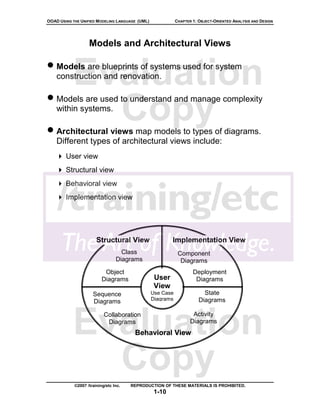
• Architectural views map models to types of diagrams.
    Different types of architectural views include:
        User view
        Structural view
        Behavioral view
        Implementation view


                       Structural View                   Implementation View
                                   Class                     Component
                                 Diagrams                     Diagrams
                           Object                                   Deployment
                          Diagrams                User               Diagrams
                                                  View
                     Sequence                    Use Case                State
                                                 Diagrams              Diagrams
                     Diagrams


           Evaluation      Collaboration
                            Diagrams
                                        Behavioral View
                                                                    Activity
                                                                   Diagrams


             Copy
            ©2007 /training/etc Inc.   REPRODUCTION OF THESE MATERIALS IS PROHIBITED.
                                                  1-10
OOAD USING THE UNIFIED MODELING LANGUAGE (UML)          CHAPTER 1: OBJECT-ORIENTED ANALYSIS AND DESIGN


              Common Features of UML Diagrams

• UML diagrams are two-dimensional drawings.
           Evaluation                           Most UML
    diagrams are graphs containing nodes connected by
    paths.


             Copy
• There are four basic diagram elements:
        Shapes - two-dimensional symbols of variable width and height
        that can expand to hold other symbols or strings
        Paths - sequences of line segments with optional terminators
        Icons - graphical figures (that do not hold contents)
        Strings

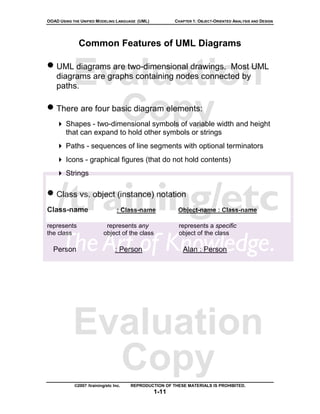
• Class vs. object (instance) notation
Class-name                        : Class-name            Object-name : Class-name

represents                  represents any                represents a specific
the class                  object of the class            object of the class

  Person                         : Person                  Alan : Person


           Evaluation
             Copy
            ©2007 /training/etc Inc.   REPRODUCTION OF THESE MATERIALS IS PROHIBITED.
                                                 1-11
OOAD USING THE UNIFIED MODELING LANGUAGE (UML)           CHAPTER 1: OBJECT-ORIENTED ANALYSIS AND DESIGN


              Common Features of UML Diagrams

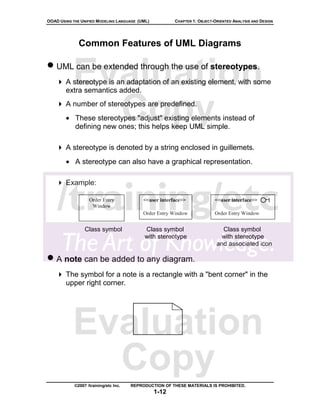
• UML can be extended through the use of stereotypes.
           Evaluation
        A stereotype is an adaptation of an existing element, with some
        extra semantics added.


             Copy
        A number of stereotypes are predefined.
        • These stereotypes "adjust" existing elements instead of
          defining new ones; this helps keep UML simple.

        A stereotype is denoted by a string enclosed in guillemets.
        • A stereotype can also have a graphical representation.

        Example:

                   Order Entry              <<user interface>>             <<user interface>>
                    Window
                                            Order Entry Window             Order Entry Window


                 Class symbol               Class symbol                      Class symbol
                                            with stereotype                   with stereotype
                                                                            and associated icon

• A note can be added to any diagram.
        The symbol for a note is a rectangle with a "bent corner" in the
        upper right corner.


           Evaluation
             Copy
            ©2007 /training/etc Inc.   REPRODUCTION OF THESE MATERIALS IS PROHIBITED.
                                                 1-12
OOAD USING THE UNIFIED MODELING LANGUAGE (UML)          CHAPTER 1: OBJECT-ORIENTED ANALYSIS AND DESIGN


                 Characteristics of a UML Process

• UML provides a consistent language for specifying,
           Evaluation
    visualizing, and documenting object-oriented software. It
    does not prescribe a process or method for working with
    the language.

             Copy
        Rational Software offers the Rational Unified Process as their
        methodology.

• Basic characteristics of any UML process should include:
        Iterative
        • Instead of trying to define all the details of a model at once,
          several "passes" are made.
        • Each iteration adds more detail.

        Incremental
        • The system evolves through a set of increments.
        • Each increment adds more functionality.

        User-centric
        • Analysts specify functionality with use cases.
        • Customers confirm use cases.
        • Designers and implementers realize use cases.
        • Testers verify the system with use cases.


           Evaluation
        Well-defined architecture
        • The system is partitioned into subsystems.


             Copy
        • Logical and physical views of the system are separated.


            ©2007 /training/etc Inc.   REPRODUCTION OF THESE MATERIALS IS PROHIBITED.
                                                 1-13
OOAD USING THE UNIFIED MODELING LANGUAGE (UML)          CHAPTER 1: OBJECT-ORIENTED ANALYSIS AND DESIGN


                      Ductwork Estimating System


           Evaluation
The Ductwork Estimating System (DES) allows the user to enter
dimensions of sheet metal air ducts and then computes the amount
and cost of the required materials and accessories. There are three
major steps involved in using DES:


             Copy
(1) The user inputs all of the dimensions for the pieces of ductwork
required for a particular project.

(2) The computer calculates the total surface area of metal required
and total number of accessories needed.

(3) The computer applies unit cost factors and determines total cost
of materials.

There are three types of ductwork handled by DES: square,
rectangular, and round. For each air duct, the user will first select
which type and then enter dimensions. One dimension is required for
square or round, and two dimensions are required for rectangular. All
of the following information is entered regardless of the duct type:

        - Length
        - Type of metal (galvanized or stainless steel)
        - Thickness of metal (8, 10, or 12-gauge)
        - Insulation type (interior, exterior, or none)

Surface area is calculated using standard formulas. Accessories are
calculated based on the total length of all ductwork, regardless of
type or size. For each 10' of ductwork, the computer will allow for
one duct hanger and four duct hanger screws.


           Evaluation
In the final processing step, DES will determine total cost of all sheet
metal and accessories. The unit cost factors will be available in a
data file that can be updated by the user.


             Copy
            ©2007 /training/etc Inc.   REPRODUCTION OF THESE MATERIALS IS PROHIBITED.
                                                 1-14
OOAD USING THE UNIFIED MODELING LANGUAGE (UML)          CHAPTER 1: OBJECT-ORIENTED ANALYSIS AND DESIGN


                                           Exercise


           Evaluation
 1. Working in small groups, construct a very top-level (i.e.,
    don't worry about details) design for the Ductwork
    Estimating System. In particular, decompose the problem


             Copy
    in some way so that the work can be divided among a
    number of programming teams. Your "solution" may take
    any form that you feel is best: an outline, a paragraph, a
    drawing or chart.


           Evaluation
             Copy
            ©2007 /training/etc Inc.   REPRODUCTION OF THESE MATERIALS IS PROHIBITED.
                                                 1-15
OOAD USING THE UNIFIED MODELING LANGUAGE (UML)          CHAPTER 1: OBJECT-ORIENTED ANALYSIS AND DESIGN


                 This Page Intentionally Left Blank


           Evaluation
             Copy


           Evaluation
             Copy
            ©2007 /training/etc Inc.   REPRODUCTION OF THESE MATERIALS IS PROHIBITED.
                                                 1-16

Ooad

  • 1.
    OOAD USING THEUNIFIED MODELING LANGUAGE (UML) CHAPTER 1: OBJECT-ORIENTED ANALYSIS AND DESIGN Chapter 1: Object-Oriented Analysis and Design Evaluation 1) What is OOAD? ....................................................................................................... 1-3 2) Approaches to System Analysis .............................................................................. 1-4 Copy 3) Object-Oriented Methodologies ............................................................................. 1-5 4) History of UML ........................................................................................................ 1-7 5) What is UML? .......................................................................................................... 1-9 6) Models and Architectural Views .......................................................................... 1-10 7) Common Features of UML Diagrams.................................................................. 1-11 8) Characteristics of a UML Process ........................................................................ 1-13 Evaluation Copy ©2007 /training/etc Inc. REPRODUCTION OF THESE MATERIALS IS PROHIBITED. 1-1
  • 2.
    OOAD USING THEUNIFIED MODELING LANGUAGE (UML) CHAPTER 1: OBJECT-ORIENTED ANALYSIS AND DESIGN Exercise 1. Class Discussion: Evaluation What is analysis? What is design? Copy What is decomposition? What kinds of techniques and drawings have you used in the past for analysis and design? Evaluation Copy ©2007 /training/etc Inc. REPRODUCTION OF THESE MATERIALS IS PROHIBITED. 1-2
  • 3.
    OOAD USING THEUNIFIED MODELING LANGUAGE (UML) CHAPTER 1: OBJECT-ORIENTED ANALYSIS AND DESIGN What is OOAD? • Object-Oriented Analysis (OOA), like other kinds of Evaluation systems analysis, clarifies and documents the requirements of a computer system. Copy • OOA focuses on studying and understanding the problem first, initially ignoring the concerns of an actual implementation. Many terms are used to describe the key real-world concepts of an application: Problem domain Application domain Business objects Domain objects Problem essence Key classes • The chief OOA activity is discovering and documenting the key classes for a particular problem domain. • Object-Oriented Design (OOD) is viewed as an extension of analysis, more so than a distinct activity. OOD adds the detailed design for each class: Names, data types, and access specifiers for attributes Evaluation Names, return types, and parameter lists for all methods Associations and collaborations with other classes Copy ©2007 /training/etc Inc. REPRODUCTION OF THESE MATERIALS IS PROHIBITED. 1-3
  • 4.
    OOAD USING THEUNIFIED MODELING LANGUAGE (UML) CHAPTER 1: OBJECT-ORIENTED ANALYSIS AND DESIGN Approaches to System Analysis • Functional Decomposition Evaluation Maps problem domain to function and sub-functions. Processing steps are used as primary organizational framework Copy during analysis. Domain understanding is neither explicitly expressed nor verified for its accuracy. • Data Flow Diagrams Maps the real world into data flows. Data flows are an unnatural, computer-related method of organization. • Information Modeling Models the world in data (objects + attributes + relationships). Closest to the object-oriented approach. Helps capture problem domain content, but only partially. • Object-Oriented Analysis Directly maps problem domain and system responsibility into a model. Classes and Objects + Inheritance + Communication with Evaluation Messages Same underlying representation is used in analysis and design. Copy ©2007 /training/etc Inc. REPRODUCTION OF THESE MATERIALS IS PROHIBITED. 1-4
  • 5.
    OOAD USING THEUNIFIED MODELING LANGUAGE (UML) CHAPTER 1: OBJECT-ORIENTED ANALYSIS AND DESIGN Object-Oriented Methodologies • Many methodologies have been proposed for object- Evaluation oriented software development. A methodology usually includes: Copy Notation – graphical representations of classes and their relationships and interactions Process – suggested set of steps to carry out for transforming requirements into a working system Tool – software for drawings and documentation Tool Evaluation Notation Process Copy ©2007 /training/etc Inc. REPRODUCTION OF THESE MATERIALS IS PROHIBITED. 1-5
  • 6.
    OOAD USING THEUNIFIED MODELING LANGUAGE (UML) CHAPTER 1: OBJECT-ORIENTED ANALYSIS AND DESIGN Object-Oriented Methodologies • Some popular methodologies include: Evaluation Object Modeling Technique (OMT) • James Rumbaugh Copy The Booch Method • Grady Booch Object-Oriented Software Engineering (OOSE) • Ivar Jacobson Object-Oriented Analysis (OOA) • Peter Coad • Ed Yourdon CRC (Classes-Responsibilities-Collaborations) Method • Rebecca Wirfs-Brock • The number of OO methodologies increased from less than 10 to more than 50 between 1989 and 1994. Methodologists battled for market share (the "method wars"), while many developers had trouble finding Evaluation complete satisfaction with any single method. Copy ©2007 /training/etc Inc. REPRODUCTION OF THESE MATERIALS IS PROHIBITED. 1-6
  • 7.
    OOAD USING THEUNIFIED MODELING LANGUAGE (UML) CHAPTER 1: OBJECT-ORIENTED ANALYSIS AND DESIGN History of UML • In October 1994, Rumbaugh joined Booch's company Evaluation (Rational Software Corporation) to unify the Booch and OMT methods. A draft was released in October 1995, then called the Unified Method. Copy • In 1995 Jacobson also joined the unification effort, merging in the OOSE method. Preliminary documents for the Unified Modeling Language (UML) were released during 1996. • The UML Version 1.0 definition was finalized in January 1997, including the work of the UML Partners consortium. DEC MCI Systemhouse HP Microsoft i-Logix Oracle Intellicorp Rational Software IBM TI ICON Computing Unisys • UML 1.1 was adopted by the Object Management Group (OMG) in November 1997. OMG is an open membership, not-for-profit consortium that produces and maintains computer industry specifications for interoperable enterprise applications. Evaluation Copy ©2007 /training/etc Inc. REPRODUCTION OF THESE MATERIALS IS PROHIBITED. 1-7
  • 8.
    OOAD USING THEUNIFIED MODELING LANGUAGE (UML) CHAPTER 1: OBJECT-ORIENTED ANALYSIS AND DESIGN History of UML • IBM acquired Rational Software Company in 2002. Evaluation • Revisions to the UML specification through Version 1.5 Copy were released in March 2003. • OMG is currently upgrading UML to Version 2.0. Adopted in late 2003 and posted on OMG's website labeled "UML 2.0 Final Adopted Specification,” the upgraded version won't replace UML 1.5 as the official "Available UML Specification" until it completes its initial maintenance revision sometime around the end of 2004. http://www.omg.org Evaluation Copy ©2007 /training/etc Inc. REPRODUCTION OF THESE MATERIALS IS PROHIBITED. 1-8
  • 9.
    OOAD USING THEUNIFIED MODELING LANGUAGE (UML) CHAPTER 1: OBJECT-ORIENTED ANALYSIS AND DESIGN What is UML? • UML focuses on a standard modeling language, not a Evaluation standard process. • UML fuses the concepts of Booch, Rumbaugh, and Jacobson. Copy • UML is nonproprietary. UML Version 1.0 was submitted to the Object Management Group (OMG) Analysis and Design Task Force for consideration as the industry standard. In November 1997, UML was adopted into the Object Management Architecture (OMA). • This course introduces UML as a standard graphical notation for object-oriented software design, and as a vehicle for presenting important analysis and design concepts. The following UML features will be studied: Use Case Diagrams Class Diagrams Sequence Diagrams Collaboration Diagrams State Diagrams Evaluation Activity Diagrams Component Diagrams Copy Deployment Diagrams ©2007 /training/etc Inc. REPRODUCTION OF THESE MATERIALS IS PROHIBITED. 1-9
  • 10.
    OOAD USING THEUNIFIED MODELING LANGUAGE (UML) CHAPTER 1: OBJECT-ORIENTED ANALYSIS AND DESIGN Models and Architectural Views • Models are blueprints of systems used for system Evaluation construction and renovation. • Models are used to understand and manage complexity Copy within systems. • Architectural views map models to types of diagrams. Different types of architectural views include: User view Structural view Behavioral view Implementation view Structural View Implementation View Class Component Diagrams Diagrams Object Deployment Diagrams User Diagrams View Sequence Use Case State Diagrams Diagrams Diagrams Evaluation Collaboration Diagrams Behavioral View Activity Diagrams Copy ©2007 /training/etc Inc. REPRODUCTION OF THESE MATERIALS IS PROHIBITED. 1-10
  • 11.
    OOAD USING THEUNIFIED MODELING LANGUAGE (UML) CHAPTER 1: OBJECT-ORIENTED ANALYSIS AND DESIGN Common Features of UML Diagrams • UML diagrams are two-dimensional drawings. Evaluation Most UML diagrams are graphs containing nodes connected by paths. Copy • There are four basic diagram elements: Shapes - two-dimensional symbols of variable width and height that can expand to hold other symbols or strings Paths - sequences of line segments with optional terminators Icons - graphical figures (that do not hold contents) Strings • Class vs. object (instance) notation Class-name : Class-name Object-name : Class-name represents represents any represents a specific the class object of the class object of the class Person : Person Alan : Person Evaluation Copy ©2007 /training/etc Inc. REPRODUCTION OF THESE MATERIALS IS PROHIBITED. 1-11
  • 12.
    OOAD USING THEUNIFIED MODELING LANGUAGE (UML) CHAPTER 1: OBJECT-ORIENTED ANALYSIS AND DESIGN Common Features of UML Diagrams • UML can be extended through the use of stereotypes. Evaluation A stereotype is an adaptation of an existing element, with some extra semantics added. Copy A number of stereotypes are predefined. • These stereotypes "adjust" existing elements instead of defining new ones; this helps keep UML simple. A stereotype is denoted by a string enclosed in guillemets. • A stereotype can also have a graphical representation. Example: Order Entry <<user interface>> <<user interface>> Window Order Entry Window Order Entry Window Class symbol Class symbol Class symbol with stereotype with stereotype and associated icon • A note can be added to any diagram. The symbol for a note is a rectangle with a "bent corner" in the upper right corner. Evaluation Copy ©2007 /training/etc Inc. REPRODUCTION OF THESE MATERIALS IS PROHIBITED. 1-12
  • 13.
    OOAD USING THEUNIFIED MODELING LANGUAGE (UML) CHAPTER 1: OBJECT-ORIENTED ANALYSIS AND DESIGN Characteristics of a UML Process • UML provides a consistent language for specifying, Evaluation visualizing, and documenting object-oriented software. It does not prescribe a process or method for working with the language. Copy Rational Software offers the Rational Unified Process as their methodology. • Basic characteristics of any UML process should include: Iterative • Instead of trying to define all the details of a model at once, several "passes" are made. • Each iteration adds more detail. Incremental • The system evolves through a set of increments. • Each increment adds more functionality. User-centric • Analysts specify functionality with use cases. • Customers confirm use cases. • Designers and implementers realize use cases. • Testers verify the system with use cases. Evaluation Well-defined architecture • The system is partitioned into subsystems. Copy • Logical and physical views of the system are separated. ©2007 /training/etc Inc. REPRODUCTION OF THESE MATERIALS IS PROHIBITED. 1-13
  • 14.
    OOAD USING THEUNIFIED MODELING LANGUAGE (UML) CHAPTER 1: OBJECT-ORIENTED ANALYSIS AND DESIGN Ductwork Estimating System Evaluation The Ductwork Estimating System (DES) allows the user to enter dimensions of sheet metal air ducts and then computes the amount and cost of the required materials and accessories. There are three major steps involved in using DES: Copy (1) The user inputs all of the dimensions for the pieces of ductwork required for a particular project. (2) The computer calculates the total surface area of metal required and total number of accessories needed. (3) The computer applies unit cost factors and determines total cost of materials. There are three types of ductwork handled by DES: square, rectangular, and round. For each air duct, the user will first select which type and then enter dimensions. One dimension is required for square or round, and two dimensions are required for rectangular. All of the following information is entered regardless of the duct type: - Length - Type of metal (galvanized or stainless steel) - Thickness of metal (8, 10, or 12-gauge) - Insulation type (interior, exterior, or none) Surface area is calculated using standard formulas. Accessories are calculated based on the total length of all ductwork, regardless of type or size. For each 10' of ductwork, the computer will allow for one duct hanger and four duct hanger screws. Evaluation In the final processing step, DES will determine total cost of all sheet metal and accessories. The unit cost factors will be available in a data file that can be updated by the user. Copy ©2007 /training/etc Inc. REPRODUCTION OF THESE MATERIALS IS PROHIBITED. 1-14
  • 15.
    OOAD USING THEUNIFIED MODELING LANGUAGE (UML) CHAPTER 1: OBJECT-ORIENTED ANALYSIS AND DESIGN Exercise Evaluation 1. Working in small groups, construct a very top-level (i.e., don't worry about details) design for the Ductwork Estimating System. In particular, decompose the problem Copy in some way so that the work can be divided among a number of programming teams. Your "solution" may take any form that you feel is best: an outline, a paragraph, a drawing or chart. Evaluation Copy ©2007 /training/etc Inc. REPRODUCTION OF THESE MATERIALS IS PROHIBITED. 1-15
  • 16.
    OOAD USING THEUNIFIED MODELING LANGUAGE (UML) CHAPTER 1: OBJECT-ORIENTED ANALYSIS AND DESIGN This Page Intentionally Left Blank Evaluation Copy Evaluation Copy ©2007 /training/etc Inc. REPRODUCTION OF THESE MATERIALS IS PROHIBITED. 1-16