Solubility and chemical equationsChapter  Two
IsotopesIsotopes are atoms of the same element with the same number of protons but different number of neutrons.Isotopes have the same chemical properties as the electrons in isotopes are similar.Isotopes have slightly different physical properties due to differing relative masses.Example : Chlorine-35 and Chlorine-37
Cations and AnionsMetals from cations (positively charged ions) by losing electrons.Formation of cations : (Sodium) Na [Na] +Non-metals form anions (negatively charged ions) by gaining electrons.Formation of anions : (Oxygen) O [O] 2-
Molecules of elementsHere are a few common examplesHydrogen – H2Oxygen – O2Nitrogen – N2Chlorine – Cl2Bromine – Br2Phosphorus – P 4Sulphur – S 8
Polyatomic IonsPolyatomic ions are ions of grouped atomsHere are a few common examplesNitrate – NO3-Hydroxide – OH -Carbonate – CO32-Sulphate – SO42-Phosphate – PO43-Ammonia – NH3+Ammonium – NH4+
Ionic bondingIonic bonding between metals and non-metals is formed by electrovalent bonds.Examples :Na ++    Cl-[Na]++    [Cl]-Na ClMg 2++    Cl -[Mg] 2++    2[Cl]-   Mg Cl2Notice that the ions of both elements are swapped to become the chemical formula of the compound.This also applies to covalent compounds.
Covalent bondingNon-metals share electrons to create covalent bonding between one other.Examples :H-+    O2-[H]1+1=2  [O]6+2=8          H2OC4-+    H-[C]4+4=8 [H]1+1=2          CH4Although the formation of the chemical formula is the same as ionic compounds, the method of bonding is different.Both atoms gain electrons through sharing.
Chemical EquationsLithium burns in bromine to form lithium bromide.Li  +  Br         Li BrNickel (II) carbonate decomposes on heating to form nickel (II) oxide and carbon dioxide.Ni CO3Ni O  +  CO Sometimes, chemical equations have to balanced to be complete.
Balancing EquationsNitrogen reacts with oxygen to form nitrogen monoxide.N2+  O2           2 NOSilver nitrate decomposes on heating to form silver, nitrogen dioxide and oxygen.2  AgNO32 Ag  +  2 NO2+  O2Iron (III) sulphate reacts with sodium hydroxide to form rubidium nitrite and oxygen.Fe (SO4)3+  6 Na OH          2 Fe (OH) 3+  3 Na2 SO4
Soluble elementsDefinite solubilityAmmonium saltsSodium saltsPotassium saltsNitrates
Soluble elementsSolubility with exceptionsChlorides except Lead (II) and SilverSulphates except Barium, Calcium and Lead (II)
Insoluble saltsCarbonatesexcept  other soluble saltsHydroxideexcept  other soluble salts and CalciumOxidesexcept  other soluble salts and Calcium

Solubility And Equations

  • 1.
    Solubility and chemicalequationsChapter Two
  • 2.
    IsotopesIsotopes are atomsof the same element with the same number of protons but different number of neutrons.Isotopes have the same chemical properties as the electrons in isotopes are similar.Isotopes have slightly different physical properties due to differing relative masses.Example : Chlorine-35 and Chlorine-37
  • 3.
    Cations and AnionsMetalsfrom cations (positively charged ions) by losing electrons.Formation of cations : (Sodium) Na [Na] +Non-metals form anions (negatively charged ions) by gaining electrons.Formation of anions : (Oxygen) O [O] 2-
  • 4.
    Molecules of elementsHereare a few common examplesHydrogen – H2Oxygen – O2Nitrogen – N2Chlorine – Cl2Bromine – Br2Phosphorus – P 4Sulphur – S 8
  • 5.
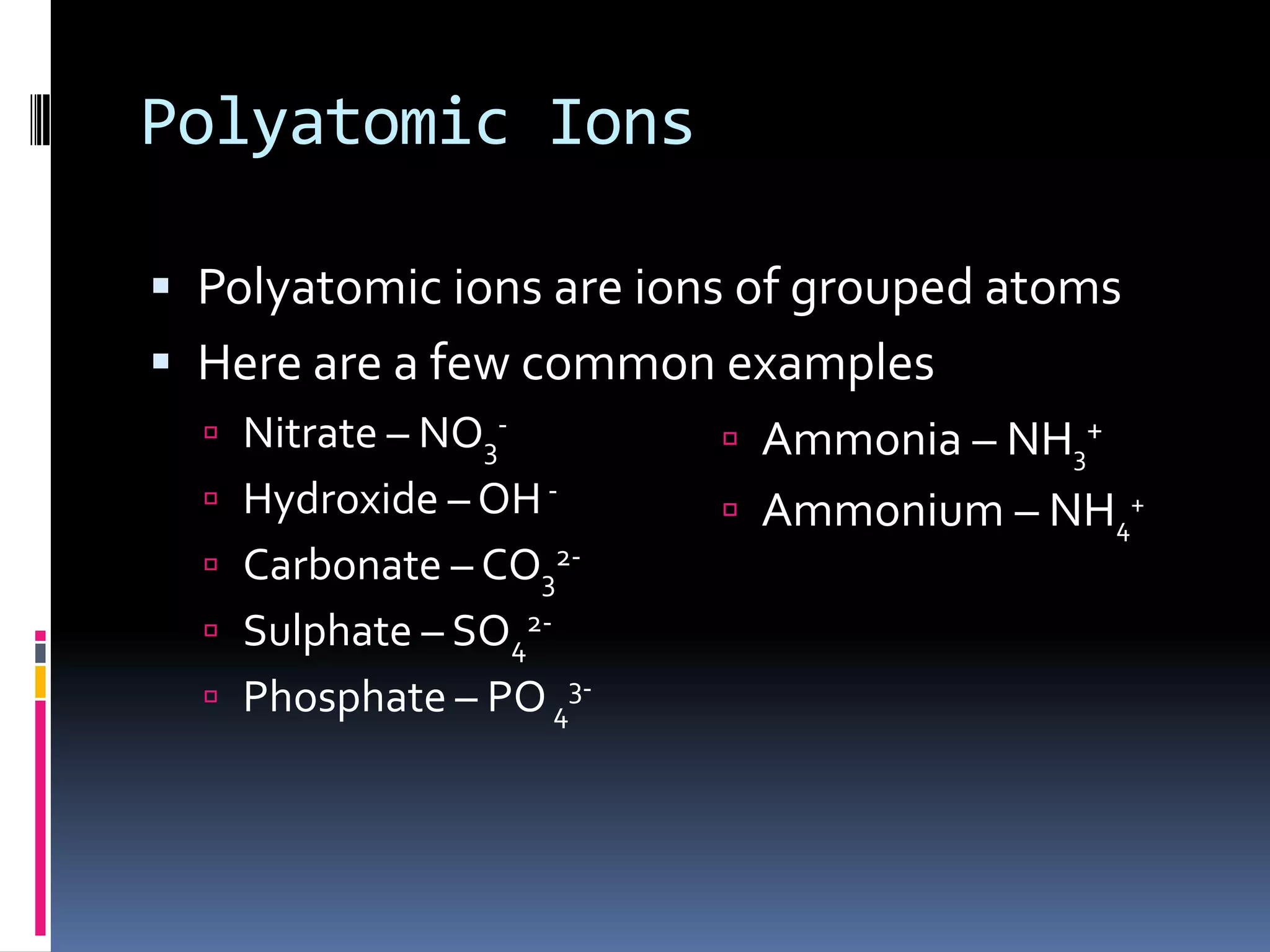
    Polyatomic IonsPolyatomic ionsare ions of grouped atomsHere are a few common examplesNitrate – NO3-Hydroxide – OH -Carbonate – CO32-Sulphate – SO42-Phosphate – PO43-Ammonia – NH3+Ammonium – NH4+
  • 6.
    Ionic bondingIonic bondingbetween metals and non-metals is formed by electrovalent bonds.Examples :Na ++ Cl-[Na]++ [Cl]-Na ClMg 2++ Cl -[Mg] 2++ 2[Cl]- Mg Cl2Notice that the ions of both elements are swapped to become the chemical formula of the compound.This also applies to covalent compounds.
  • 7.
    Covalent bondingNon-metals shareelectrons to create covalent bonding between one other.Examples :H-+ O2-[H]1+1=2 [O]6+2=8 H2OC4-+ H-[C]4+4=8 [H]1+1=2 CH4Although the formation of the chemical formula is the same as ionic compounds, the method of bonding is different.Both atoms gain electrons through sharing.
  • 8.
    Chemical EquationsLithium burnsin bromine to form lithium bromide.Li + Br Li BrNickel (II) carbonate decomposes on heating to form nickel (II) oxide and carbon dioxide.Ni CO3Ni O + CO Sometimes, chemical equations have to balanced to be complete.
  • 9.
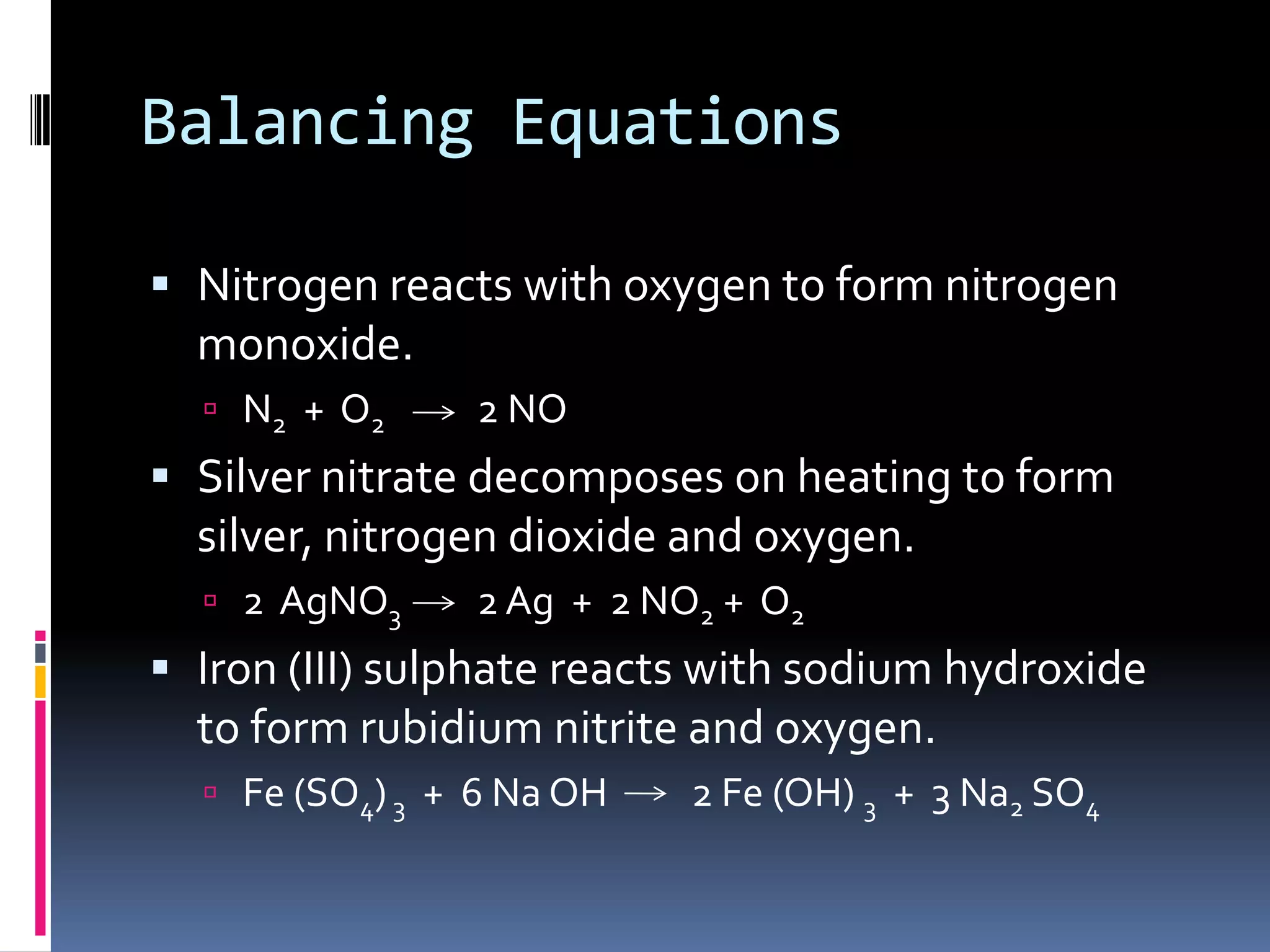
    Balancing EquationsNitrogen reactswith oxygen to form nitrogen monoxide.N2+ O2 2 NOSilver nitrate decomposes on heating to form silver, nitrogen dioxide and oxygen.2 AgNO32 Ag + 2 NO2+ O2Iron (III) sulphate reacts with sodium hydroxide to form rubidium nitrite and oxygen.Fe (SO4)3+ 6 Na OH 2 Fe (OH) 3+ 3 Na2 SO4
  • 10.
    Soluble elementsDefinite solubilityAmmoniumsaltsSodium saltsPotassium saltsNitrates
  • 11.
    Soluble elementsSolubility withexceptionsChlorides except Lead (II) and SilverSulphates except Barium, Calcium and Lead (II)
  • 12.
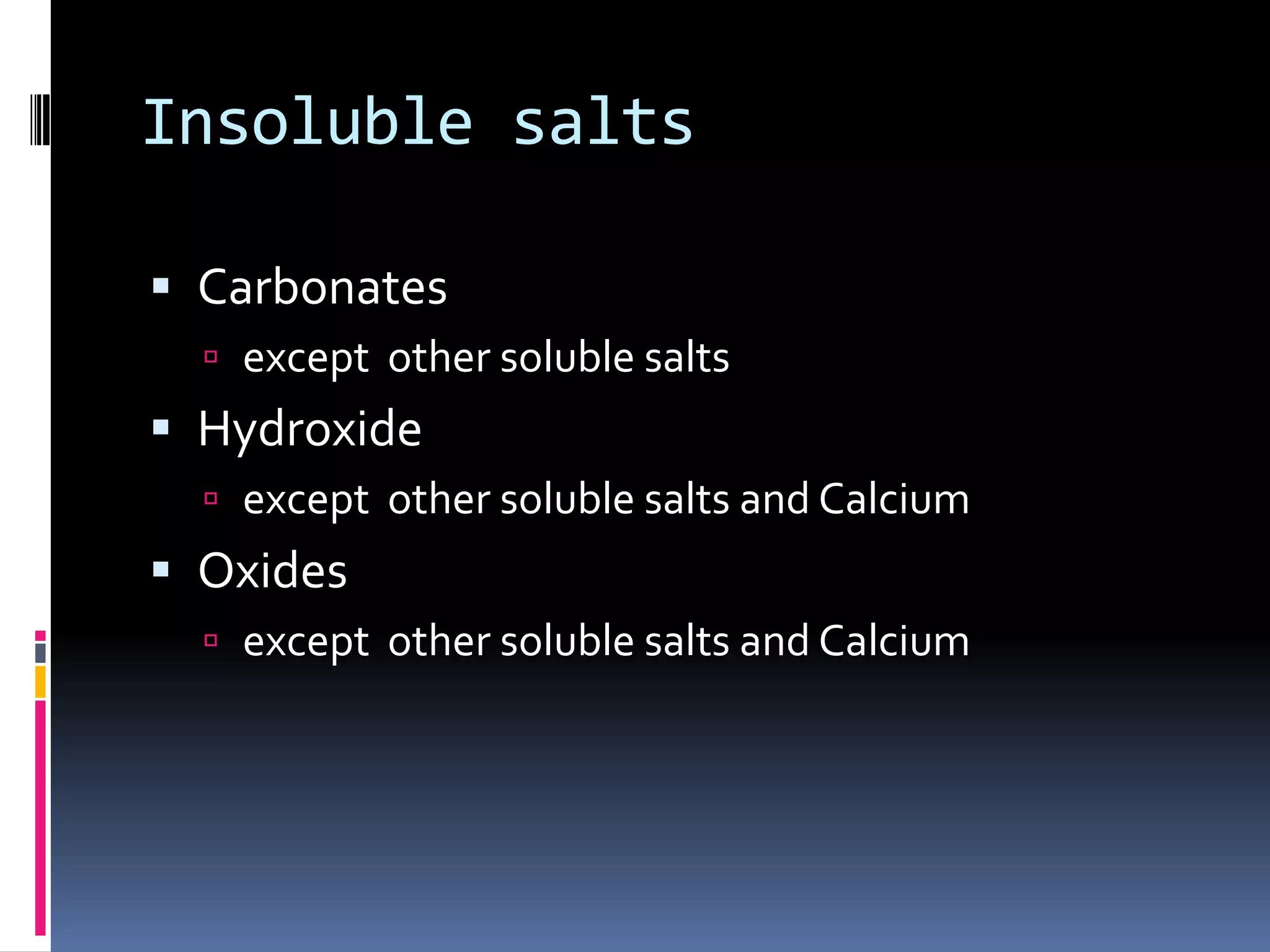
    Insoluble saltsCarbonatesexcept other soluble saltsHydroxideexcept other soluble salts and CalciumOxidesexcept other soluble salts and Calcium